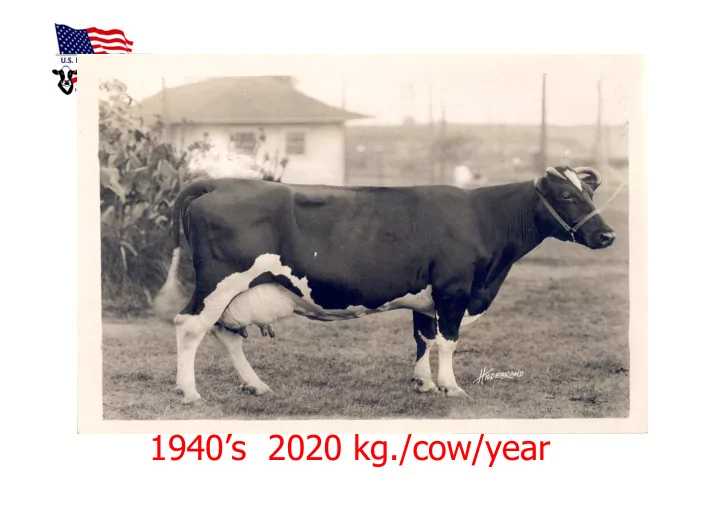
1940s 2020 kg./cow/year 1953 21,691,000 milk cows in the United - - PowerPoint PPT Presentation

1940 s 2020 kg cow year 1953
SMART_READER_LITE
LIVE PREVIEW

1940s 2020 kg./cow/year 1953 21,691,000 milk cows in the United - - PowerPoint PPT Presentation

1940s 2020 kg./cow/year 1953 21,691,000 milk cows in the United States Average annual production was 5,542 pounds of milk Total annual production was 120 billion pounds of milk Farm milk price = $4.25 per hundred pounds


slide-1
SLIDE 1

1940’s 2020 kg./cow/year

slide-2
SLIDE 2

1953

 21,691,000 milk cows in the United

States

 Average annual production was 5,542

pounds of milk

 Total annual production was 120 billion

pounds of milk

 Farm milk price = $4.25 per hundred

pounds

slide-3
SLIDE 3

1950’s 2500 kg./cow/year

slide-4
SLIDE 4

1983

 Just over 11 million cows  Average annual production was 12,587

pounds of milk

 Total annual production was 140 billion

pounds of milk

 Farm milk price = $13.67 per hundred

pounds

slide-5
SLIDE 5

From 1953 to 1983:

 Milk production per cow more than

doubled 2,600 kg to 5,700 kg

 Slightly more than half as many cows

21 million to 11 million

 Total production increased by 20 billion

pounds

 Farm milk price more than tripled

slide-6
SLIDE 6

The Holstein Cow

 Produces 93% of

all the milk consumed in U.S.

 Of the 9.12 million

dairy cows in U.S., nearly 8.48 million are Holsteins.

 A mature Holstein stands 58 inches (1.47m) tall at

the shoulder and can weigh 1,500 Lbs (680Kg).

slide-7
SLIDE 7

Reasons for Change

 Management

feeding & environment

 Genetics

Frozen semen progeny testing programs genomics

 Technology

accurate milk testing genetic evaluation programs

slide-8
SLIDE 8

Reasons for Change

 Management

feeding & environment

 Genetics

Frozen semen progeny testing programs genomics

 Technology

accurate milk testing genetic evaluation programs

slide-9
SLIDE 9

21st Century 12000 kg./cow/year

slide-10
SLIDE 10

U.S. Dairy Industry

 Total production: 193 Bill Lb milk (87.7 Bill Kg)  62,500 dairy operations  9.12 million dairy cows  4.34 million cows on milk recording  2010 Averages of Holsteins in milk control:

 10,539 Kg M; 385 Kg F; 327 Kg P

 Averages of Registered Holsteins

 11,606 Kg M; 425 Kg F; 349 Kg P

slide-11
SLIDE 11

Top Ten States - 2010 Total Cows

# 1 - CA 1,813,000 # 2 - WI 1,247,000 # 3 – NY 627,000 # 4 – PA 550,000 # 6 – MN 460,000 # 7 – TX 349,000 # 5 – ID 513,000 # 9 – MI 335,000 # 10 – OH 276,000 # 8 – NM 342,000

Source: DairyBusiness Magazine

slide-12
SLIDE 12

Top Ten States - 2010 Total Milk Production

(Million Kg)

# 1 - CA 18,356 # 2 - WI 11,834 # 4 – NY 5,779 # 5 – PA 4,879 # 6 – MN 4,137 # 7 – TX 4,012 # 3 – ID 5,809 # 8 – MI 3,785 # 9 – NM 3,582 # 10 – WA 2,682

Source: USDA

slide-13
SLIDE 13

USA BREEDS on TEST

AYRSHIRE BROWN SWISS GUERNSEY HOLSTEIN JERSEY

MILKING SHORTHORN

# COWS

  • n TEST

4,878 12,775 5,422 3,776,761 225,111 1,758

MILK

15,474 18,635 15,377 23,187 16,611 13,757

FAT

607 756 696 841 781 480

PROTEIN

492 629 515 711 601 425

IN-BREEDING

6.38 6.69 7.17 5.74 7.05 5.91

CHANGE SCS SINCE 2005

  • 0.01
  • 0.05

0.00

  • 0.10

+0.02 0.00

CHANGE PL SINCE 2005

+0.08 +0.25 +0.25 +0.79 +0.36 +0.54

CHANGE DPR SINCE 2005

+0.01 +0.05

  • 0.48

+0.69

  • 0.06
  • 0.34
slide-14
SLIDE 14

Holstein Association USA

 World’s largest dairy cattle breed

  • rganization headquartered in Brattleboro,

Vermont

 Membership organization (30,000)  More than 22 million

Holstein records contained in Association’s system

 Files include animal

ancestry, identity,

  • wnership, and

performance info

slide-15
SLIDE 15

Association’s Mission

 PROVIDE LEADERSHIP, INFORMATION

AND SERVICES TO HELP MEMBERS AND DAIRY PRODUCERS WORLDWIDE BE SUCCESSFUL.

slide-16
SLIDE 16

Day-to-day Business

 Staff of 110 employees  80 in Brattleboro  30 Field staff throughout the country

 Provide uniform assistance and services

to dairy producers

slide-17
SLIDE 17

Holstein Association Members

 Over 20,000 Adult

members.

 Over 8,000

Junior members.

slide-18
SLIDE 18

Structure and Organization

 Members have provided direction and set

policies for more than 120 years

 Members select delegates among themselves

by a voting process

 Delegates vote on bylaws and policies  Delegates select President,

Vice President and Board

  • f Directors

 Board of Directors determines

policies and appoints committees and the Executive Secretary

slide-19
SLIDE 19

Association’s Four Core Products and Services

 Registry/Identification  Type Evaluation  Performance Products  Dairy Genetics Marketing

slide-20
SLIDE 20

Registrations

 On an average day, 1,500 registrations are

received and processed at the Holstein Association by the 16-person registry staff.

 Register for two additional USA Breed

  • rginazations
slide-21
SLIDE 21

Genotyping and Blood Typing

 Holstein works with labs

to complete all of our members’ genotyping.

 The preferred method

for genotyping is a hair sample.

 Recessive testing  Genomic testing

slide-22
SLIDE 22

Association’s Four Core Products and Services

 20 Classifiers plus six support staff in Brattleboro

Type Evaluation

slide-23
SLIDE 23

Association’s Four Core Products and Services

Performance Products

slide-24
SLIDE 24

Association’s Four Core Products and Services

 16 Field Reps  Active Export markets

(U.S. Holstein genetics

  • females go to more than 50 countries)

Dairy Genetics Marketing

slide-25
SLIDE 25

One of Holstein USA’s Roles

 Calculate official evaluations for TYPE

 Calculate Total Performance Index – TPI

 Combine Productive Life, Production Traits

(Milk, Fat, Protein), Health Traits

 Distribute genetic evaluations

3 times per year

slide-26
SLIDE 26

26

slide-27
SLIDE 27

Have Selection Index Relate Directly to Farmer Profitability

TPI – Total Performance Index

45% emphasis on Production Fat and Protein & part of PTAT 21% emphasis on Udder Health SCS, UDC & part of PTAT 21% emphasis on Early Breeding DPR, PL & DF 8% emphasis on Mobility FLC & part of PTAT 3% emphasis on Calving Ability Daughter Calving Ease & Stillbirth 2% emphasis on Body Size Part of PTAT

slide-28
SLIDE 28

U.S. Cattle are Evaluated Under a Variety

  • f Different Management Situations
slide-29
SLIDE 29

29

Top TPI 100 Bulls per Country April 2010

USA 95 CAN 1 NLD 1

slide-30
SLIDE 30

Where does the U.S. find the top genetics?

slide-31
SLIDE 31

Holstein Country and Production Averages

AUSTRALIA GERMANY ITALY

NETHERLANDS

CANADA USA USA Reg Holsteins

# of Holstein Cows (million)

1.07 2.24 1.45 1.12 0.92 8.48 1.60 KG MILK 7,087 8,923 9,125 8,832 9,615 10,539 11,606 KG Fat 278 359 338 375 361 385 425

KG PROTEIN

232 299 307 305 298 327 349

slide-32
SLIDE 32

Breeding Philosophies

 USA: Production then Type, Health and Longevity

Comments: Focus on profitability Proven around the world

 Canada: Type then Production

Comments: not enough emphasis on production

 NLD: Production and Components %F, % P

Comments: Not enough emphasis on type

slide-33
SLIDE 33

Timeline for Genomic Testing

 1992 Dairy DNA repository began  2004 cattle genome sequenced  2007 May 58,000 SNP selected  2008 Preliminary genomic predictions  2009 January official genomic

predictions

 2010 3k & High Density (750,000) chips

slide-34
SLIDE 34

Reliability Gain by Breed

TRAIT HOLSTEIN JERSEY BROWN SWISS NET MERIT

23 9 3

MILK

23 11

FAT

33 15 5

PROTEIN

22 4 1

% FAT

43 41 10

% PROTEIN

34 29 5

PARENT AVERAGE

35 35 35

slide-35
SLIDE 35

Genomic tested by breed

 Holstein 112,042  Jersey 13,138  Brown Swiss 2,408

slide-36
SLIDE 36

Summary

 Internationally recognized as the world’s most

profitable breed for its balance between production and type

 Largest genetic base and progeny test program

in the world produces more top bulls

 1,400 bulls/year are progeny tested

 Holstein Association USA is recognized as “the

source” of reliable and unbiased information

 No conflict of interest  Responsible for the success or failure of the breed

slide-37
SLIDE 37

Summary

 Product Advantage

 Higher Total Product Value

 Milk, Fat, Protein

 World’s Largest Dairy Cattle Population

 Genetic Evaluations in Different Environment/Climates  Top Genetics  Predicted Profitability Potential  Reliable Milk Control System

 Consumer Promise

 Higher Production with a more functional and durable

animal

slide-38
SLIDE 38

THANK YOU

Visit us at www.holsteinusa.com