
SLIDE 1
Criticisms of consequentialism and Kant Ethics 1
Ethical Theory (continued) Quiz 1
(Out of 4 points; 5 points possible) In one clear sentence, state one of the criticisms of consequentialism discussed in the course pack. (up to 2 bonus points): In one clear sentence, state what you regard as Williams’ criticism of utilitarianism. (not an example; examples are not themselves arguments but support arguments.
Here I am asking for the argument itself.)
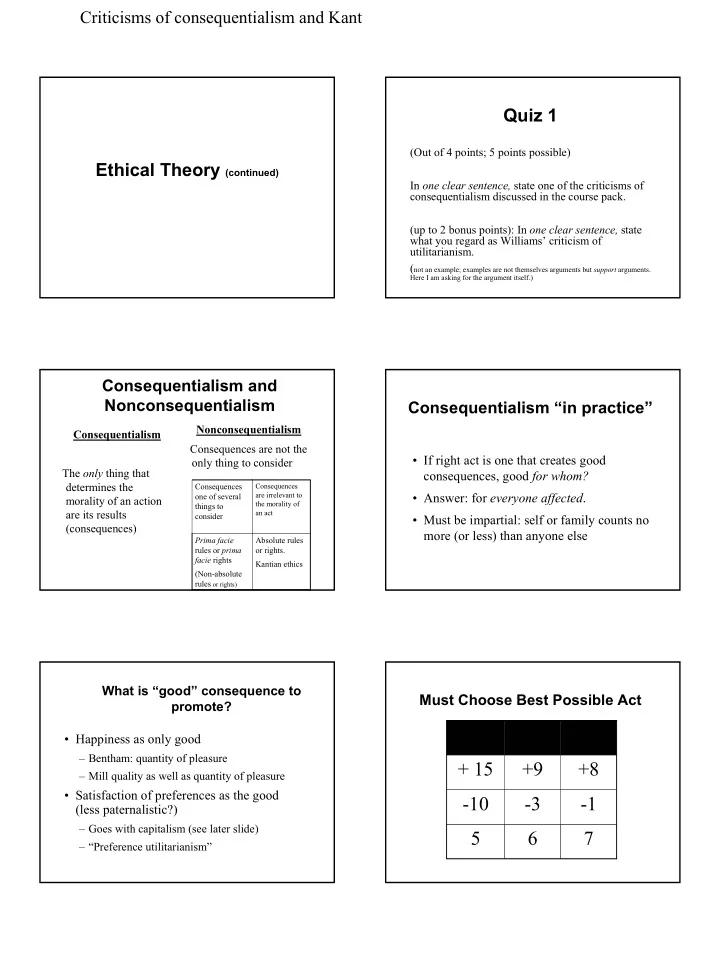
Consequentialism and Nonconsequentialism
Consequentialism The only thing that determines the morality of an action are its results (consequences) Nonconsequentialism Consequences are not the
- nly thing to consider
Absolute rules
- r rights.
Kantian ethics Prima facie rules or prima facie rights (Non-absolute rules or rights)
Consequences are irrelevant to the morality of an act
Consequences
- ne of several
things to consider
Consequentialism “in practice”
- If right act is one that creates good
consequences, good for whom?
- Answer: for everyone affected.
- Must be impartial: self or family counts no
more (or less) than anyone else What is “good” consequence to promote?
- Happiness as only good
– Bentham: quantity of pleasure – Mill quality as well as quantity of pleasure
- Satisfaction of preferences as the good
(less paternalistic?)
– Goes with capitalism (see later slide) – “Preference utilitarianism”
Must Choose Best Possible Act Act C Act B Act A
7 6 5
- 1
- 3
- 10