1332 State Innovation Task Force Meeting Agenda September 26, 2016 - - PowerPoint PPT Presentation

1332 state innovation task force meeting agenda
SMART_READER_LITE
LIVE PREVIEW

1332 State Innovation Task Force Meeting Agenda September 26, 2016 - - PowerPoint PPT Presentation

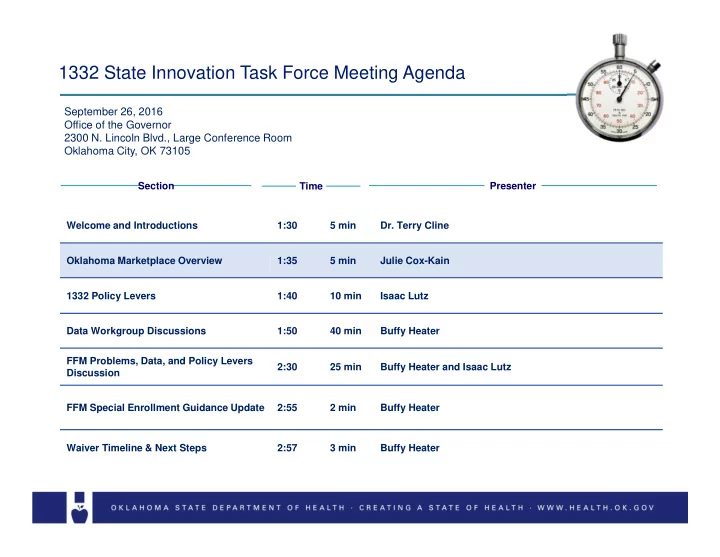
1332 State Innovation Task Force Meeting Agenda September 26, 2016 Office of the Governor 2300 N. Lincoln Blvd., Large Conference Room Oklahoma City, OK 73105 Section Presenter Time Welcome and Introductions 1:30 5 min Dr. Terry Cline


slide-1
SLIDE 1

1332 State Innovation Task Force Meeting Agenda

Presenter Section Welcome and Introductions 1:30 5 min

  • Dr. Terry Cline

Oklahoma Marketplace Overview 1:35 5 min Julie Cox-Kain 1332 Policy Levers 1:40 10 min Isaac Lutz Data Workgroup Discussions 1:50 40 min Buffy Heater FFM Problems, Data, and Policy Levers Discussion 2:30 25 min Buffy Heater and Isaac Lutz FFM Special Enrollment Guidance Update 2:55 2 min Buffy Heater Waiver Timeline & Next Steps 2:57 3 min Buffy Heater

September 26, 2016 Office of the Governor 2300 N. Lincoln Blvd., Large Conference Room Oklahoma City, OK 73105

Time

slide-2
SLIDE 2

Oklahoma Estimated Enrollment by Insurance Source

2013 2014 2015 Net Gain/Loss Uninsured 657,200 607,100 543,800

  • 113,400

Individual 122,100 171,800 223,500 101,400 Small Group 189,000 182,800 177,300

  • 11,700

Large Group 488,800 491,300 493,200 4,400 Self-Funded 840,400 849,400 854,500 14,100 EGID 169,800 175,200 184,500 14,700 Medicaid/CHIP (with Duals) 792,500 805,800 826,700 34,200 Medicare (without Duals) 499,300 501,900 504,200 4,900 Other Public Programs 91,400 91,900 92,500 1,100 Total Population 3,850,500 3,877,200 3,900,200 49,700

Source: Milliman, Oklahoma Insurance Market Analysis: https://www.ok.gov/health2/documents/Market%20Effects%20on%20Health%20Care%20Transformation.pdf

slide-3
SLIDE 3

Oklahoma Estimated Enrollment by Insurance Source

100,000 200,000 300,000 400,000 500,000 600,000 700,000 800,000 900,000 Enrollment

2013 2014 2015

Considerations:

  • The uninsured population has

decreased by 6.12% since 2013

  • While still a relatively small market

sector, the individual market (on and off exchange) has grown by 22% since 2013 and has seen the largest growth across market sectors

  • The majority of the decrease in

uninsured individuals may be attributable to enrollment in the FFM

  • Much of the other market

sectors/plans have had limited growth/contraction since 2013

Source: Milliman, Oklahoma Insurance Market Analysis: https://www.ok.gov/health2/documents/Market%20Effects%20on%20Health%20Care%20Transformation.pdf

slide-4
SLIDE 4

Estimated Enrollment in Overall Individual Market

Considerations:

  • Blue Cross Blue Shield had the

largest share of the individual market

  • In 2017, Blue Cross Blue Shield

will be the only carrier offering plans on the FFM

  • Although competition is limited in

the individual market, new state policy options provide potential

  • pportunities to encourage plans

to enter the market:

  • HB1566
  • CHIP Maintenance Of Effort

Source: Milliman, Oklahoma Insurance Market Analysis: https://www.ok.gov/health2/documents/Market%20Effects%20on%20Health%20Care%20Transformation.pdf

136,300 14,800 8,200 6,200 2,100 20,000 40,000 60,000 80,000 100,000 120,000 140,000 160,000 BCBS of OK United Healthcare Aetna Assurant Global health

Estimated Enrollment in Overall Individual Market: Top 5 Carriers (2014):

slide-5
SLIDE 5

Changes in the Individual Health Insurance Market

122,100 84,900 63,800 55,400 106,400 31,500 53,200

50,000 100,000 150,000 200,000 250,000

2013 2014 2015

Off-Marketplace ACA Compliant ACA Compliant Marketplace Non-ACA Compliant

Considerations:

  • Transitional/grandfathered plans,

including coverage that is non- ACA compliant, is declining

  • In 2015, FFM enrollment

accounted for nearly 2/3 of total enrollment in the overall Individual Marketplace

  • Off-Marketplace coverage also

grew between 2014 and 2015

Source: Milliman, Oklahoma Insurance Market Analysis: https://www.ok.gov/health2/documents/Market%20Effects%20on%20Health%20Care%20Transformation.pdf

slide-6
SLIDE 6

Oklahoma Percentage of Non-Elderly Adult (ages 18 to 64) Population Uninsured

Population

2013 2014 2015

Oklahoma 25.4% 23.7% 21.4% States Not Expanding Medicaid 21.4% 20.0% 14.4% National Composite 17.1% 15.1% 10.1%

Considerations:

  • Relative to other states that have

not expanded Medicaid, Oklahoma’s decrease in the uninsured rate for non-elderly adults was smaller than other states

  • In open enrollment 2015, only

27% of Oklahoma’s FFM eligible population enrolled compared to an average of 39% in other states that have not expanded Medicaid

  • Potential barriers include lack of

health insurance literacy and inadequate consumer supports at the time of enrollment (e.g. individual financial counseling)

Source: Milliman, Oklahoma Insurance Market Analysis: https://www.ok.gov/health2/documents/Market%20Effects%20on%20Health%20Care%20Transformation.pdf

slide-7
SLIDE 7

1332 State Innovation Task Force Meeting Agenda

Presenter Section Welcome and Introductions 1:30 5 min

  • Dr. Terry Cline

Oklahoma Marketplace Overview 1:35 5 min Julie Cox-Kain 1332 Policy Levers 1:40 10 min Isaac Lutz Data Workgroup Discussions 1:50 40 min Buffy Heater FFM Problems, Data, and Policy Levers Discussion 2:30 25 min Buffy Heater and Isaac Lutz FFM Special Enrollment Guidance Update 2:55 2 min Buffy Heater Waiver Timeline & Next Steps 2:57 3 min Buffy Heater

September 26, 2016 Office of the Governor 2300 N. Lincoln Blvd., Large Conference Room Oklahoma City, OK 73105

Time

slide-8
SLIDE 8

1332 Waivers: Policy Levers

1332 Policy Levers

Individual Mandate: States can modify or eliminate the tax penalties that the ACA imposes on individuals who fail to maintain health coverage. Employer Mandate: States can modify or eliminate the penalties that the ACA imposes on large employers who fail to offer affordable coverage to their full-time employees. Benefits and Subsidies: States can modify the rules governing what benefits and subsidies must be provided within the constraints of section 1332’s coverage requirements. Exchanges and QHPS: States can modify or eliminate QHP certification and the Exchanges as the vehicle for determining eligibility for subsidies and enrolling consumers in coverage.

slide-9
SLIDE 9

1332 Waivers: Individual Mandate

Includes:

  • Individual Mandate for individuals and their

dependents to maintain minimum essential coverage (MEC)

  • Plan qualifications that meet MEC standards
  • Individual Mandate Exemptions
  • Penalties for failing to maintain MEC
  • Reporting of MEC to the IRS

Individual Mandate

  • Part I of Subtitle F of

Title I

  • Section 5000A of

IRS Code

slide-10
SLIDE 10

1332 Waivers: Employer Mandate

Includes:

  • Shared employer responsibility to provide

employees health coverage for employers with 50

  • r more full time employees to at least 95% and

their children up to 26

  • Calculation of penalties for employers who do not
  • ffer coverage
  • Automatic enrollment for employers with more than

200 employees Employer Mandate

  • Section 1513 Part II
  • f Subtitle F of Title I
  • Section 4980H of

IRS Code

slide-11
SLIDE 11

1332 Waivers: QHPs, EHBs, & the Exchanges

Includes:

  • Certification of Qualified Health Plans (QHPs)
  • Essential Health Benefits (EHBs) to include 10

essential health services

  • Limits on cost sharing for QHPs
  • Metal coverage based on actuarial value
  • Coverage provided through exchanges, including

SHOP

  • Pooling of risk of all enrollees in all plans in each

market QHPs, EHBs, & the Exchanges

  • Part II of Subtitle D
  • f Title I
  • Part II of Subtitle D
  • f Title I
slide-12
SLIDE 12

1332 Waivers: Premium Tax Credits and Cost-sharing Reductions

Includes:

  • Amount of premium tax credits available to eligible

families to purchase health coverage based on a sliding scale

  • Essential Health Benefits (EHBs) to include 10

essential health services

  • Premium Tax Credit Repayment limits (for

advanced premium assistance overpayments)

  • Cost-sharing reductions (CSRs) for silver plans for

income levels between 100%-250% of the FPL

  • Out-of-pocket limits based on income

Premium Tax Credits and Cost- sharing Reductions

  • Sections 36B of the

IRS Code

  • Section 1402 of the

ACA

slide-13
SLIDE 13

1332 State Innovation Task Force Meeting Agenda

Presenter Section Welcome and Introductions 1:30 5 min

  • Dr. Terry Cline

Oklahoma Marketplace Overview 1:35 5 min Julie Cox-Kain 1332 Policy Levers 1:40 10 min Isaac Lutz Data Workgroup Discussions 1:50 40 min Buffy Heater FFM Problems, Data, and Policy Levers Discussion 2:30 25 min Buffy Heater and Isaac Lutz FFM Special Enrollment Guidance Update 2:55 2 min Buffy Heater Waiver Timeline & Next Steps 2:57 3 min Buffy Heater

September 26, 2016 Office of the Governor 2300 N. Lincoln Blvd., Large Conference Room Oklahoma City, OK 73105

Time

slide-14
SLIDE 14

Data Workgroup Discussions 1332 Data Workgroups:

Purpose: To identify, gather, analyze, review and report on relevant data sources informing the State’s 1332 waiver task force discussions. Workgroups will help shape a picture of the successes, challenges, and solutions from each group’s perspective. Workgroup Responsibilities: Identify data questions; identify data sources/resources; perform analysis; review and discuss findings; report findings to task force. Engage consultants for technical assistance. Deliverables: List of data questions; supporting data tables/worksheets; findings and relevant conclusions to be drawn from the data; report to the task force in table/worksheet/powerpoint style; case study(ies) of business and consumer experiences. De-identified, summary data are made available through reporting at task force meetings.

slide-15
SLIDE 15

Data Workgroup Discussions

Data Workgroup Participating Organizations Potential Data Points of Interest

Health Plans

  • BCBS
  • UHC
  • CommunityCare
  • OID
  • OAHP
  • Insure Oklahoma
  • Global Health
  • Eligibility and enrollment

information

  • Premium payment persistency
  • Population management
  • Claims experience
  • Special Enrollment

Provider

  • OHA
  • OSMA
  • OOA
  • Cherokee
  • Integris
  • St. John
  • Discharge Information
  • Bad debt information
  • Case mix and panel size
  • Acuity differences across market

sectors

Business

  • Devon
  • State Chamber
  • OAHU
  • HealthSmart
  • Business Survey
  • Case Studies on impact of

healthcare coverage

  • ACA Penalty Assessments

Consumer

  • HAU
  • CAA
  • CSC
  • State Agencies
  • Case Studies on consumer

experience accessing coverage

  • Barriers to affordable coverage
  • Exemptions for MEC
slide-16
SLIDE 16

Data Workgroup Discussions To help facilitate discussion around data, we have proposed the following questions to help you think about the various data and data sources you will be presenting and discussing: 1. What data have your organizations collected to date and from what sources? 2. What do these data tell us about Oklahoma’s marketplace? 3. What data are unable to be collected, and are there other groups who could provide alternatives?

slide-17
SLIDE 17

Data Workgroup Discussions Please see the handouts that were attached in the email:

  • GlobalHealth 1332 Data Responses
  • Blue Cross Blue Shield 1332 Data Responses
  • BCBS: The Health of America Report
slide-18
SLIDE 18

Tribal Premium Sponsorship Programs – Data Summary

An informal email survey was sent to Oklahoma tribes in September of 2016. The following are their responses about programs currently operated in Oklahoma. 1) Are you assisting individuals with premium payment assistance for FFM plans? ANSWER: There are 6 tribal nations in Oklahoma currently operating tribal premium sponsorship programs under the FFM. 2) What FFM plans are included in your premium assistance payment program? ANSWER: BCBS Blue Preferred, Blue Choice, and Blue Advantage plans (mostly bronze level plans, a few silver and gold); BCBS of TX HMO 3) How many individuals have benefitted from the tribal premium sponsorship program this year? ANSWER: 2014 – 62; 2015 – 221; 2016 – 414

slide-19
SLIDE 19

Tribal Premium Sponsorship Programs – Data Summary

4) On average, how long (or for how many months) did you make premium assistance payments for them? ANSWER: Don’t dis-enroll unless they become eligible for another program, i.e., Medicare, Medicaid Guaranteeing premium payments through 12-31-2016 Full benefit year/12 months 6-7 months average 11 months 5) Of those who benefitted: What was their income level (FPL)? ANSWER: 0-400% FPL 100-300% FPL 100%-400% FPL Average is 250% FPL 0-1883% FPL

slide-20
SLIDE 20

Tribal Premium Sponsorship Programs – Data Summary

5) Of those who benefitted: How many were female? ANSWER: 215 How many were male? ANSWER: 216 6) What is the average amount of premium assistance per individual? ANSWER (per month average): $330.00 $462.33 $394.00 $113.00 $122.82 $344.67 7) What was their income level (FPL)? ANSWER: 0-400% FPL 100-300% FPL 100%-400% FPL Average is 250% FPL 0-1883% FPL

slide-21
SLIDE 21

Tribal Premium Sponsorship Programs – Data Summary

8) What portion of the premium do you cover? ANSWER: 100% 9) Are you assisting individuals with FFM exemption requests? ANSWER: Yes 10) On average, how many exemption requests have you completed this year? ANSWER: Didn’t keep the data, but did hand out a lot of IRS Form 8965 to patients Offer the exemption form at all registration areas, if the individual has no insurance they visit with a benefit coordinator to see about plans and prices for their individual situation. Education on IRS Form 8965 135 11) On average, how many exemption requests did you complete last year? ANSWER: 374 Didn’t keep data

slide-22
SLIDE 22

Tribal Premium Sponsorship Programs – Data Summary

12) What reason(s) are the exemptions requested? ANSWER: They have Indian Health Uninsured non-native pregnant with a Native American baby Children and adults without insurance and cannot afford ACA plans due to income, etc. To receive permanent exemption number To avoid requirement to purchase health insurance To be exempt from paying the Individual Shared Responsibility Payment They can’t afford the premiums 13) Are you assisting individuals with FFM enrollment? ANSWER: Yes

slide-23
SLIDE 23

Tribal Premium Sponsorship Programs – Data Summary

14) How do you identify individuals to refer to the FFM? ANSWER:

If they are seeking a resource for health care and they do not qualify for SoonerCare For those looking for outside services and are needing coverage for some help If they are a tax filer we highly encourage them to see what is offered to them by doing an application on the Marketplace The benefit coordinators educate the patients that are uninsured and go over all insurance

  • ptions from Medicaid, Insure Oklahoma to ACA. If they don't qualify for other insurance plans,

and want aca they enroll the patient if they can afford the plan and if not they are referred to the tribal assistance program to be considered. Our PRC program also refers uninsured individuals to see if they can be covered through aca and/or the tribal assistance program. We try and catch those without insurance and offer them insurance options. FFM referrals are identified by Medicaid/Insure Oklahoma Denials and individuals over 100% FPL From PRC referrals High utilization rates

slide-24
SLIDE 24

Total Effectuated Enrollment, Oklahoma

https://www.cms.gov/Newsroom/MediaReleaseDatabase/Fact-sheets/2016-Fact-sheets- items/2016-06-30.html

Considerations:

  • In order to effectuate their

enrollment, they must pay their first month’s premium.

  • This snapshot measures

individuals who effectuated their enrollment and have an active policy on the date

  • f the snapshot; it does not

measure the rate at which consumers pay their first month’s premium.

  • Active policies include

those who have paid for the current month and individuals who may be in a grace period for non- payment.

Total Effectuated Enrollment Oklahoma Total Enrollment APTC Enrollment Percentage of Enrollment with APTC CSR Enrollment Percentage of Enrollment with CSR 31-Dec-14 55,407 46,460 83.90% 34,906 63.00% 31-Mar-15 106,392 87,136 81.90% 64,543 60.70% 30-Jun-15 108,614 86,904 80.00% 64,830 59.70% 30-Sep-15 101,333 81,823 80.70% 61,718 60.90% 31-Dec-15 95,902 77,942 81.30% 58,286 60.80% 31-Mar-16 130,178 113,209 87.00% 81,053 62.30% This is not specific to BCBSOK. This is total effectuated enrollment for Oklahoma on the FFM

Oklahoma FFM Effectuated Enrollment by Metal Tier

Oklahoma Total Enrollment Catastrophic Bronze Silver Gold Platinum 31-Dec-14 55,407 158 11,857 38,343 4,607 442 31-Mar-15 106,392 426 27,457 71,054 7,396 59 30-Jun-15 108,614 384 27,712 73,049 7,415 54 30-Sep-15 101,333 334 25,743 68,204 7,009 43 31-Dec-15 95,902 275 24,622 64,269 6,701 35 31-Mar-16 130,178 144 37,657 86,434 5,943 This represents individuals who have effectuated on the FFM. This is not specific to BCBSOK.
slide-25
SLIDE 25

FFM Special Enrollment Period Reasons

https://www.cms.gov/Newsroom/MediaReleaseDatabase/Fact-sheets/2016-Fact-sheets-items/2016-06-30.html

Considerations:

  • For states on the HealthCare.gov

platform during 2015, 1.6 million individuals who did not select a plan during open enrollment made a plan selection through a special enrollment period (SEP).

  • The majority of these consumers (60

percent) received a special enrollment period for loss of minimum essential coverage.

slide-26
SLIDE 26

Cost Sharing Reductions Question: Who receives the CSR and where is it distributed to? Providers? Consumers?

  • a. What happens at the point of sale? Who makes reimbursements?

How are they verified?

  • b. How long does the CSR process take? 30, 60, 90 days?

Answer: The cost sharing reduction subsides are received by the providers to cover out of pocket expenses on behalf of the member. HCSC includes the subsidy payment with the corporate liability

  • payment. The reimbursements come from CMS who provides monthly

advanced payment based on a factor of the premium amount calculated by CMS. The verification is done by an annual reconciliation between the advanced payments and actual subsides.

slide-27
SLIDE 27

1332 State Innovation Task Force Meeting Agenda

Presenter Section Welcome and Introductions 1:30 5 min

  • Dr. Terry Cline

Oklahoma Marketplace Overview 1:35 5 min Julie Cox-Kain 1332 Policy Levers 1:40 10 min Isaac Lutz Data Workgroup Discussions 1:50 40 min Buffy Heater FFM Problems, Data, and Policy Levers Discussion 2:30 25 min Buffy Heater and Isaac Lutz FFM Special Enrollment Guidance Update 2:55 2 min Buffy Heater Waiver Timeline & Next Steps 2:57 3 min Buffy Heater

September 26, 2016 Office of the Governor 2300 N. Lincoln Blvd., Large Conference Room Oklahoma City, OK 73105

Time

slide-28
SLIDE 28

FFM Pain Points and Problems At the last 1332 meeting, we discussed numerous problems and areas for concern related to coverage provided on the FFM and Oklahoma’s overall insurance market. Some of those “pain points” included:

  • Exemptions (too many consumer work-arounds for coverage)
  • Too many Special Enrollment exceptions
  • High uninsured rates
  • Unhealthy population
  • No competition in the marketplace (i.e. limited choices)
  • Churn
  • Limited plan design (e.g. too narrow a window across actuarial

values)

  • Few consumer support systems to access and purchase

coverage (navigational assistance, checking accounts, etc.)

slide-29
SLIDE 29

Scope of Pain Points and Problems

To ensure the 1332 Task Force has good understanding of the current FFM environment and its current issues, data workgroups have been convened to elaborate and quantify the scope of pain points in the FFM and Oklahoma’s

  • verall insurance market.

Data collection will be ongoing to help identify areas not previously addressed by the Task Force, creating a feedback loop to align data discussions with FFM and Oklahoma market problem areas.

Pain Points Supporting Data

Define Problem Scope

slide-30
SLIDE 30

Data-driven Policy Levers

As problems are identified and their scopes are defined and quantified, the 1332 Task Force will make linkages between those problem areas and available policy levers. Data will also be used to justify, prioritize, and benchmark policy options to ensure the waiver is developed using data-driven solutions.

Pain Points Supporting Data

Define Problem Scope

Policy Levers

Innovate with Data- Driven Solutions

Available Policy Levers

slide-31
SLIDE 31

Identify Pain Points, Data, and Available Levers

Pain Points Supporting Data

Policy Levers

Exemptions

  • IRS Data
  • Tribal Data
  • Navigators
  • IRS Data
  • Tribal Data
  • Navigators
  • 1332 Waiver- Modify

Individual Mandate

  • Non-Waiver- Navigation

supports to demonstrate value of healthcare coverage

Limited plan design

  • Plan Data and

Actuarial Analysis on impacts of limited plan design

  • Plan Data and

Actuarial Analysis on impacts of limited plan design

  • 1332 Waiver- Modify QHPs

and Exchanges*

  • Non-Waiver- Request HHS

to allow plan design flexibility across the FFM

Special Enrollment Exceptions

  • Plan Data
  • Navigators
  • Brokers
  • Plan Data
  • Navigators
  • Brokers
  • 1332 Waiver- Modify

Exchanges*

  • Non-Waiver- Submit public

comments to HHS to request tighter special enrollment exceptions and verification

Available Policy Levers

Define Problem Scope Innovate w/ Data-Driven Solutions

* Note: Current HHS/CMS guidance indicates limited flexibility for FFM states to modify exchanges with 1332 waivers unless states consider adopting a state-based exchange and additional administrative responsibilities and oversight

slide-32
SLIDE 32

Identify Pain Points, Data, and Available Levers

Pain Points Supporting Data

Policy Levers

Few Consumer Supports

  • No checking

accounts/ financial methods to pay premiums

  • Navigators
  • Brokers
  • ?
  • Navigators
  • Brokers
  • ?
  • 1332 Waiver- N/A
  • Non-Waiver- Assistance to

help families access financial tools to pay premiums

  • FFM website

consumer usability

  • Navigators
  • Brokers
  • Navigators
  • Brokers
  • ?
  • 1332 Waiver- Waive

exchange and use carriers to directly enroll members*

  • Non-Waiver- Work with

HHS to increase FFM accessibility

  • Consumer

understanding of coverage

  • Navigators
  • Brokers
  • Navigators
  • Brokers
  • ?
  • 1332 Waiver- N/A
  • Non-Waiver- Assistance to

help families understand coverage

Available Policy Levers

Define Problem Scope Innovate w/ Data-Driven Solutions

* Note: Current HHS/CMS guidance indicates limited flexibility for FFM states to modify exchanges with 1332 waivers unless states consider adopting a state-based exchange and additional administrative responsibilities and oversight

slide-33
SLIDE 33

1332 State Innovation Task Force Meeting Agenda

Presenter Section Welcome and Introductions 1:30 5 min

  • Dr. Terry Cline

Oklahoma Marketplace Overview 1:35 5 min Julie Cox-Kain 1332 Policy Levers 1:40 10 min Isaac Lutz Data Workgroup Discussions 1:50 40 min Buffy Heater FFM Problems, Data, and Policy Levers Discussion 2:30 25 min Buffy Heater and Isaac Lutz FFM Special Enrollment Guidance Update 2:55 2 min Buffy Heater Waiver Timeline & Next Steps 2:57 3 min Buffy Heater

September 26, 2016 Office of the Governor 2300 N. Lincoln Blvd., Large Conference Room Oklahoma City, OK 73105

Time

slide-34
SLIDE 34

Comments to CMS Regarding Verification of Special Enrollment Periods

Centers for Medicare and Medicaid Services (CMS) issued a request for comments regarding policy changes and potential additional actions regarding special enrollment period outreach and policy. Responses were due by September 20, 2016. Task Force members were asked to share their responses (if any) as an informational item. The responses received are as follows: AI/AN individuals can enroll anytime throughout the year and will not be affected by this rule, so we will not be submitting comments. The current ACA risk pool is out of balance. Immediate regulatory changes are needed in 3 key areas to stabilize the risk pool by promoting continuous coverage and affordability. Specifically, CMS must: Require upfront verification of special enrollment eligibility prior to coverage Recommendation: CMS should immediately issue guidance allowing health plans to check eligibility, prior to enrollment, based on criteria developed by CMS. At the same time, CMS should begin to build an automated system (which could take up to 18 months) to do upfront verification prior to enrollment.

slide-35
SLIDE 35

Comments to CMS Regarding Verification of Special Enrollment Periods

Require payment of outstanding premiums before reenrolling on the exchange:

Recommendation: CMS should immediately issue guidance to require people who fall into a grace period to pay all outstanding premiums and become whole with an issuer before reenrolling with that same issuer. At the same time, Congress and the Administration should work on legislation to allow states to determine the length of the grace period.

Issue an interim final rule to stop the inappropriate steering of Medicare and Medicaid eligible individuals to private coverage

Recommendation: CMS should use responses to their recent RFI to immediately issue an Interim Final Rule to prevent third party payment by, or on behalf of, entities with a pecuniary interest in the payment of health insurance claims and take steps to prevent the selective shifting of Medicare and Medicaid beneficiaries into private coverage. CMS should also codify existing guidance encouraging plans to reject such third party payments for all ACA enrollees, not just those eligible for Medicare and Medicaid.

slide-36
SLIDE 36

1332 State Innovation Task Force Meeting Agenda

Presenter Section Welcome and Introductions 1:30 5 min

  • Dr. Terry Cline

Oklahoma Marketplace Overview 1:35 5 min Julie Cox-Kain 1332 Policy Levers 1:40 10 min Isaac Lutz Data Workgroup Discussions 1:50 40 min Buffy Heater FFM Problems, Data, and Policy Levers Discussion 2:30 25 min Buffy Heater and Isaac Lutz FFM Special Enrollment Guidance Update 2:55 2 min Buffy Heater Waiver Timeline & Next Steps 2:57 3 min Buffy Heater

September 26, 2016 Office of the Governor 2300 N. Lincoln Blvd., Large Conference Room Oklahoma City, OK 73105

Time

slide-37
SLIDE 37

1332 Task Force Timeline

Date Milestone Task 5/2016 Legislative and Gubernatorial Approval to Research 1332 State Innovation Waiver and Form 1332 Task Force 8/1/2016 Form 1332 Task Force and Schedule Monthly Meetings; Regulatory Research Begins 8/30/2016 First 1332 Task Force Meeting, Identify Problems and Supporting Data Sources, Data Requests 9/2016 Second 1332 Task Force Meeting, Data Presented, Recommendation Development Begins 10/2016 Third 1332 Task Force Meeting, Recommendation Finalized 11/2016 Fourth 1332 Task Force Meeting, Assess Recommendation Impacts 11/2016 Public Review Period Begins, Draft of 1332 Policy Recommendations Concept Paper Available for Public Review 12/2016 Fifth 1332 Task Force Meeting, Public Comments Incorporated 1/2017 Sixth 1332 Task Force Meeting, Federal and State Review of Concept Paper 2/2017 Seventh 1332 Task Force Meeting, Concept Paper Finalized, Next Steps Determined

Milestone April ‘16 July ‘16 October ‘16 January ‘17

slide-38
SLIDE 38

Next Steps

  • Questions to research
  • Data follow up
  • One on one discussion opportunity
  • Task Force member attendance at next meeting
  • Date/time/location of next meeting
  • Meeting materials posted online

https://ok.gov/health/Organization/Center_for_Health_Innovation_a nd_Effectiveness/1332_State_Innovation_Waiver_/index.html