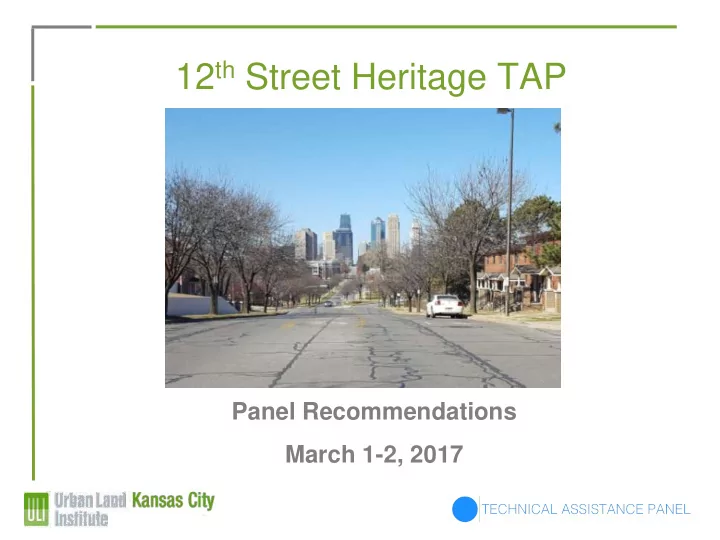
12 th Street Heritage TAP Photo here Panel Recommendations March - - PowerPoint PPT Presentation

12 th street heritage tap
SMART_READER_LITE
LIVE PREVIEW

12 th Street Heritage TAP Photo here Panel Recommendations March - - PowerPoint PPT Presentation

12 th Street Heritage TAP Photo here Panel Recommendations March 1-2, 2017 Thank you John McGurk, Polsinelli PC & ULI Kansas City TAP Chair Ashley Sadowski, DLR Group & ULI Kansas City TAP Co-Chair Diane Burnette,


slide-1
SLIDE 1

12th Street Heritage TAP

Panel Recommendations March 1-2, 2017

Photo here
slide-2
SLIDE 2

Thank you

  • John McGurk, Polsinelli PC & ULI Kansas City

TAP Chair

  • Ashley Sadowski, DLR Group & ULI Kansas

City TAP Co-Chair

  • Diane Burnette, MainCor & ULI Kansas City

Chair of Mission Advancement

  • Joy Crimmins, ULI Kansas City
  • Samuel Rodgers Health Center for providing

meeting facilities

slide-3
SLIDE 3

The mission of the ULI is to provide leadership in the responsible use of land and in creating and sustaining thriving communities worldwide.

ULI Mission Statement

slide-4
SLIDE 4

Technical Assistance Panel

  • Objective, multidisciplinary advice on land

use and real estate issues developed over the course of two days

  • ULI Kansas City members from across the

region volunteer their time to participate as panelists

slide-5
SLIDE 5

TAP Sponsors 12th Street Heritage Development Corporation Kansas City Economic Development Corporation

slide-6
SLIDE 6

Panel’s Charge

Question 1: What is the market for new market-rate single-family housing in this neighborhood in terms of cost/price parameters, housing formats, absorption rates, etc.?

slide-7
SLIDE 7

Panel’s Charge

Question 2:

What is the best way (and where to start) to phase-in new housing and mixed-use development to help restore a mixed-housing neighborhood pattern while recognizing that a fair amount of public housing will remain? Respond to BRT service and improve walkability and connectedness with surrounding area.

slide-8
SLIDE 8

Panel’s Charge

Question 3: What are some unconventional sources of financing and proposed deal-structures that can help offset possible financial feasibility gaps?

slide-9
SLIDE 9

TAP Panel Members

Panel Co-Chairs Quinton Lucas, City of Kansas City, Missouri Ashley Sadowski, DLR Group

Panel Members Erika Brice, Blue Hills Community Services Jason Swords, Sunflower Development Ruben Alonso, AltCap Rohn Grotenhuis, BNIM Dominique Davison, DRAW Architecture Audrey Navarro, Clemons Real Estate Jim Scott, Scott Associates Katherine Carttar, City of Kansas City, Missouri

slide-10
SLIDE 10
  • Briefing documents
  • Stakeholder interviews and tour
  • Full day of team discussions

Process

slide-11
SLIDE 11

Stakeholder Meetings

  • 12th Street Heritage

Development Corporation

  • Economic

Development Corporation

  • Kansas City Housing

Authority

  • Kansas City Parks

Department

  • United Intercity

Services

  • St. Marks Church
  • Downtown Council
  • Kansas City Area

Transportation Authority

  • Central Bank
  • Ollie Gates
  • The Call newspaper
  • Brinshore

Development

slide-12
SLIDE 12

Study Area

slide-13
SLIDE 13
slide-14
SLIDE 14
slide-15
SLIDE 15
slide-16
SLIDE 16
slide-17
SLIDE 17

Environmental Scan

  • Land is assembled, ready for

development

  • Willing and welcoming neighbors and

partners (Gates Properties, City of Kansas City, Housing Authority, neighborhood churches)

  • Social services in area – health,

education, youth

  • Retail services desired – hardware,

grocery, retail

  • Street grid needs reconnection
  • Rich cultural heritage
slide-18
SLIDE 18

Themes

  • Housing – affordable, market-rate,
  • pportunities for home ownership
  • Opportunities for additional commercial

(retail, office)

  • Establish 12th Street as a mixed use

corridor and true ‘boulevard’

  • Access to downtown, transit and area

workforce

  • North/South connection between

Independence Avenue and 18th Street

slide-19
SLIDE 19

Goals

  • Focus on people first – providing an
  • pportunity for people at a variety of

income levels and demographics to participate in the neighborhood

slide-20
SLIDE 20

Assumptions

  • Land assembly will not be a hurdle

(willing and able land owners support development)

  • Housing Authority is flexible in the

replacement housing at former Wayne Minor development

  • Desire to promote a mixed-income

community in future development efforts

slide-21
SLIDE 21

Market Trends/Potential

  • Urban living trends may create a viable

market for additional housing proximate to downtown

  • Home ownership is more accessible in

today’s market via creative financing

  • pportunities that encourage equity

building

  • Entrepreneurship and small business
  • wnership may create demand for small
  • ffice and/or ‘maker’ space
slide-22
SLIDE 22

Circulation

slide-23
SLIDE 23

Land Use Zones

slide-24
SLIDE 24

Options Considered

  • Market rate housing – single family, multi-

family (duplex, triplex), townhome

  • Additional services – grocery, hardware

store

  • Signature park improvements
  • Anchor campus option
slide-25
SLIDE 25
  • Urban Village
  • Potential Anchor Campus Development

Evaluation of Options

slide-26
SLIDE 26
slide-27
SLIDE 27
  • 12th Street Boulevard Enhancements - improved

streetscape from Paseo to Prospect with subsequent improvements to Oak Street – ultimately to promote a green connection to downtown

  • 12th & Brooklyn Node – provide a civic space

to reinforce the existing 12th and Brooklyn

  • development. The civic space should include

significant pedestrian amenities and provide for the use of street settings for special events with closure bollard option

District Development Framework Infrastructure

slide-28
SLIDE 28
  • Parks Master Plan – Prospect Park and Goin’ to

KC Park should have new master plan with community programming options coordinated with the new Community Improvement District.

  • Reimagining Paseo with gateway feature at 12th

St – Paseo is a powerful edge to the District with the option for a gateway entry feature at 12th and Paseo to be explored

District Development Framework Infrastructure

slide-29
SLIDE 29

Examples

12th Street Mixed Use 12th & Brooklyn Civic Space

slide-30
SLIDE 30

Scenario 1, Urban Village

  • Reinforce neighborhood cultural

and social patterns

  • Can be developed with incremental

projects and limited risk pattern

  • Scale of new development is compatible

with expectations of the community and marketplace

  • Development incentives are diversified and

possibly easier to secure

  • Incremental project execution allows for

market responsiveness in a changing environment

slide-31
SLIDE 31
slide-32
SLIDE 32
slide-33
SLIDE 33
slide-34
SLIDE 34

Examples

slide-35
SLIDE 35

Scenario 2, Anchor Campus

  • Promotes a new regional economic

development opportunity on pre-assembled site

  • Attracts a job anchor with strong city and civic

commitment

  • Establishes an economic catalyst for further

development to serve new population

  • Adds a substantial development benefit to the

city tax base

  • Opportunity to reinforce existing initiatives by

providing a regional valuable real estate location, adjacent to downtown

slide-36
SLIDE 36
slide-37
SLIDE 37

Examples

slide-38
SLIDE 38
  • Development Template
  • Residential focused with potential for

institutional anchor or unique corporate campus;

  • Housing types:
  • For sale single-family and townhome
  • Multifamily
  • Owner occupied duplex

Financing Discussion

slide-39
SLIDE 39
  • Single-family:

71; 1,500 sf.

  • Townhomes:

85; 1250-1400 sf.

  • Multifamily:

64 units; 48 1br./16 2br. (Rents $650/$895)

  • Retail (Mixed-use):

24,000 sf. (Rent $10/sf.)

Development Template – Urban Village

slide-40
SLIDE 40
  • Single-family:

15; 1,500 sf.

  • Townhomes:

77; 1250-1400 sf.

  • Multifamily:

32 units; 24 1br./8 2br. (Rents $650/$895)

  • Retail (Mixed-use):

12,000 sf. (Rent $10/sf.)

  • Office:

400,000 sf.

(Rent $10/sf.)

Development Template – Anchor Campus

slide-41
SLIDE 41
  • Private

– Debt – Equity

  • Private developer contributes the ground
  • Public Financing

– City of Kansas City, MO

  • CDBG
  • PIAC

– New Markets Tax Credits – Housing Authority – CDFI (LISC, AltCap, etc.)

Financing Discussion – Capital Stack

slide-42
SLIDE 42
  • Overview

– Residential

  • Single family:

$14,600,000 ($205,000/home)

  • Townhomes:

$12,100,000 ($189,000/home)

  • Multifamily:

$11,200,000 ($175,000/unit)

– Retail: $12,000,000 ($100/sf.) – Office: $80,000,000 ($200/sf.)

Development Costs – Urban Village

slide-43
SLIDE 43
  • Overview

– Residential

  • Single family:

$3,100,000 ($205,000/home)

  • Townhomes:

$14,600,000 ($189,000/home)

  • Multifamily:

$5,600,000 ($175,000/unit)

– Retail: $2,400,000 ($100/sf.) – Infrastructure: $4,000,000

Development Costs – Anchor Campus

slide-44
SLIDE 44

High Level Sources/Uses

OPTION A OPTION B Sources Uses Sources Uses Private Residential $ 14,600,000 Private Residential $ 3,100,000 Debt $ 15,720,000 $ 12,100,000 Debt $ 41,880,000 $ 14,600,000 Equity $ 5,000,000 $ 11,200,000 Equity $ 5,000,000 $ 5,600,000 Public $ 23,580,000 Retail $ 2,400,000 Public $ 62,820,000 Retail $ 2,400,000 Office $ 80,000,000 Infrastructure $ 4,000,000 Infrastructure $ 4,000,000 Total $ 44,300,000 $ 44,300,000 Total $ 109,700,000 $ 109,700,000

slide-45
SLIDE 45
  • 60%/40% public private funding split
  • Urban Village/residential focus will require

significant public subsidies

  • Anchor Campus contingent on landing

significant anchor tenant

Financing Conclusions

slide-46
SLIDE 46

Recommendations

  • 12th Street Boulevard

Enhancements

  • 12th & Brooklyn Node
  • Parks Master Plan
  • Reimagining Paseo with gateway

feature at 12th

  • Financing options that feature public

and/or nonprofit partnership

  • Explore both scenarios

simultaneously

slide-47
SLIDE 47

12th Street Heritage Technical Assistance Panel

Presentation Panel Recommendations March 1-2, 2017