11/11/2014 Chapter 21 COMPARING TWO PROPORTIONS 1 THE STANDARD - - PDF document

11 11 2014
SMART_READER_LITE
LIVE PREVIEW

11/11/2014 Chapter 21 COMPARING TWO PROPORTIONS 1 THE STANDARD - - PDF document

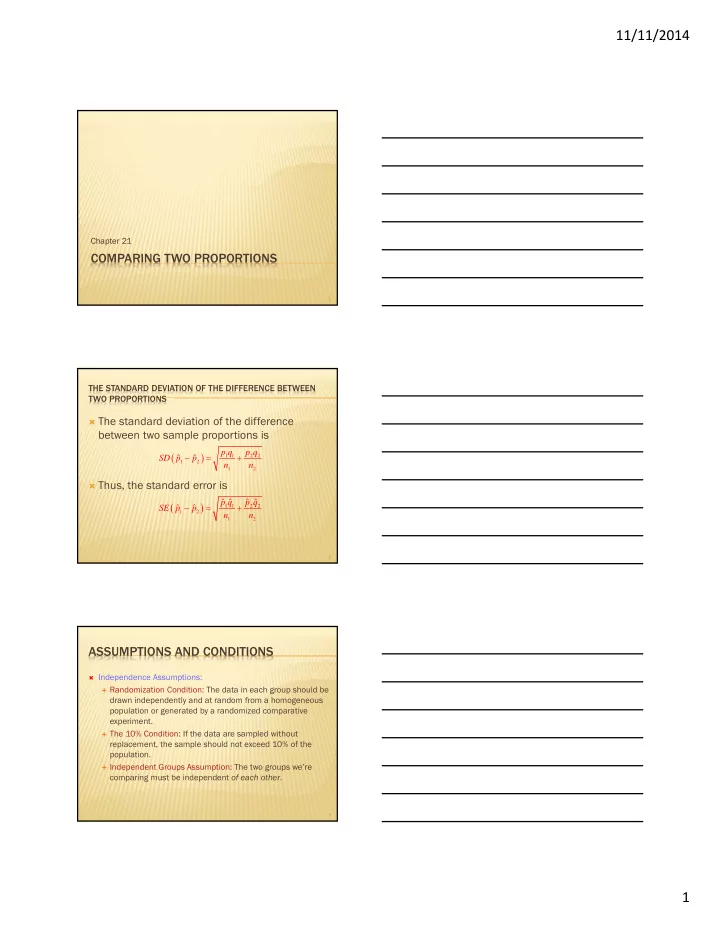
11/11/2014 Chapter 21 COMPARING TWO PROPORTIONS 1 THE STANDARD DEVIATION OF THE DIFFERENCE BETWEEN TWO PROPORTIONS The standard deviation of the difference between two sample proportions is p q p q 1 1 2 2 SD


slide-1
SLIDE 1

11/11/2014 1

COMPARING TWO PROPORTIONS

Chapter 21

1

THE STANDARD DEVIATION OF THE DIFFERENCE BETWEEN TWO PROPORTIONS

 The standard deviation of the difference

between two sample proportions is

 Thus, the standard error is

 

1 1 2 2 1 2 1 2

ˆ ˆ p q p q SD p p n n   

 

1 1 2 2 1 2 1 2

ˆ ˆ ˆ ˆ ˆ ˆ p q p q SE p p n n   

2

ASSUMPTIONS AND CONDITIONS

 Independence Assumptions:  Randomization Condition: The data in each group should be

drawn independently and at random from a homogeneous population or generated by a randomized comparative experiment.

 The 10% Condition: If the data are sampled without

replacement, the sample should not exceed 10% of the population.

 Independent Groups Assumption: The two groups we’re

comparing must be independent of each other.

3

slide-2
SLIDE 2

11/11/2014 2

ASSUMPTIONS AND CONDITIONS (CONT.)

 Sample Size Condition:

 Each of the groups must be big enough…  Success/Failure Condition: Both groups are big

enough that at least 10 successes and at least 10 failures have been observed in each.

4

THE SAMPLING DISTRIBUTION

 Provided that the sampled values are

independent, the samples are independent, and the samples sizes are large enough, the sampling distribution of is modeled by a Normal model with

 Mean:  Standard deviation: 1 2

p p   

1 2

ˆ ˆ p p 

 

1 1 2 2 1 2 1 2

ˆ ˆ p q p q SD p p n n   

5

TWO-PROPORTION Z-INTERVAL

 When the conditions are met, we are ready to find the

confidence interval for the difference of two proportions:

 The confidence interval is

where

 The critical value z* depends on the particular confidence

level, C, that you specify.

 

1 1 2 2 1 2 1 2

ˆ ˆ ˆ ˆ ˆ ˆ p q p q SE p p n n   

   

1 2 1 2

ˆ ˆ ˆ ˆ p p z SE p p

   

6

slide-3
SLIDE 3

11/11/2014 3

TWO-PROPORTION Z-TEST

 The conditions for the two-proportion z-test are

the same as for the two-proportion z-interval.

 We are testing the hypothesis H0: p1 = p2.  Because we hypothesize that the proportions

are equal, we pool them to find

1 2 1 2

ˆ pooled Success Success p n n   

7

TWO-PROPORTION Z-TEST

 We use the pooled value to estimate the standard error:  Now we find the test statistic:  When the conditions are met and the null hypothesis is true,

this statistic follows the standard Normal model, so we can use that model to obtain a P-value.

 

1 2 1 2

ˆ ˆ ˆ ˆ ˆ ˆ

pooled pooled pooled pooled pooled

p q p q SE p p n n   

 

1 2 1 2

ˆ ˆ ˆ ˆ

pooled

p p z SE p p   

8