
SLIDE 1
OCTOBER 9, 2018
107TH AAPA ANNUAL CONVENTION
Lars Ostergaard Nielsen Valparaiso, Chile
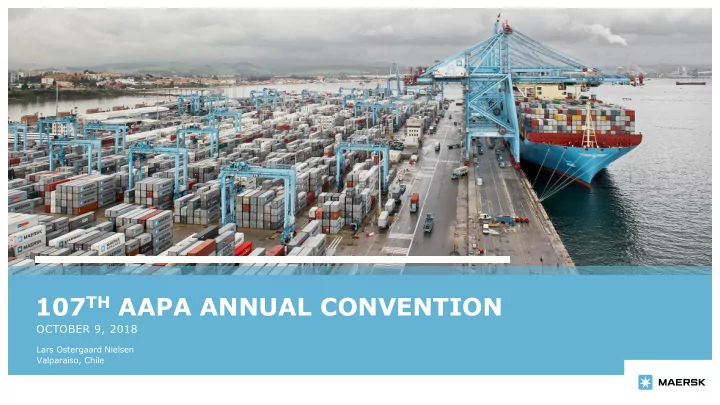
107 TH AAPA ANNUAL CONVENTION OCTOBER 9, 2018 Lars Ostergaard - - PowerPoint PPT Presentation
107 TH AAPA ANNUAL CONVENTION OCTOBER 9, 2018 Lars Ostergaard Nielsen Valparaiso, Chile | 2 | 2 A Snapshot of Shipping Today Financial pressures Global trade More consolidation Increased focus Increasing costs levels on freight rates
OCTOBER 9, 2018
Lars Ostergaard Nielsen Valparaiso, Chile
|2
|2
|3
|4
|5
|6
|7
Note: (1) Rest is bunker consumption driven. Maersk Line freight rates excludes Hamburg Süd. Bunker price is 380cst Rotterdam Source: Maersk, Clarkson
100 200 300 400 500 600 700 800 2,500 3,000 3,500 2,000 1,500 1,000 500 Market bunker price (USD/ton) 17Q4 15Q2 14Q4 14Q2 14Q1 13Q4 12Q4 16Q1 12Q3 16Q3 17Q2 13Q2 13Q1 16Q4 Maersk Line freight rate (USD/FFE) 15Q3 14Q3 17Q3 13Q3 15Q4 16Q2 15Q1 12Q1 12Q2 17Q1 Market bunker price (RHS) Maersk Line freight rate (LHS) Full year averages (LHS)
Maersk Line bunker cost 2016: 202 USD/FFE 2017: 308 USD/FFE 106 USD/FFE increase of which 93 USD is bunker price driven1
+210 USD/FEE
CAGR Freight rate Bunker price 12Q1-16Q4
16Q4-17Q4 7% 24%
|8
More than USD 4 trillion value of goods are shipped each year Over 80% of international world trade is transported by sea By reducing barriers within the international supply chain, global trade could increase by nearly 15%, boosting economies and creating jobs Estimated costs to all parties in the supply chain arising from limited visibility and lack of standardisation averages one-fifth of the
cost of goods
Source: “Enabling Trade – Valuing Growth Opportunities”, industry report by World Economic Forum. “Trade Cost”, research paper by Anderson & Wincoop
|9
2 3
Shipping InformationPipeline
From Kenya to Europe, the travel of these documents looks like this:
1 2 3 4 5
With the Shipping Information Pipeline it would look like this:
Farm fills out Phytosanitary Certificate regarding cargo Freight forwarder fills out Certificate
Courier brings them for approval to the Mombassa Port authorities Courier brings them back to Nairobi for copying and archival Original documents airfreighted to European Freight Forwarder
6
Courier transports them to a consulting company to prepare and package with
paperwork
7
Courier that transports them to Antwerp port terminal gate
8
If documents are in
picks up the container
9
Transports it to a Dutch customs controlled area for phytosanitary inspect
10
Documents in
released to customer Kenyan Farm fills out the 1 Phytosanitary Certificate and gives it to a FreightForwarder Freight Forwarder fills
Freight Forwarder uploadsboth documents into thecloud.
Consumer Forwarder Authorities Shipping company Trader Grower
|10
|11
As of 1st January 2020, new global regulation require all vessels to emit less sulphur particles from the fuel they burn. Whereas today the limit is 3.5% sulphur, the new sulphur cap will be 0.5% AT PRESENT
3.5% 2020 0.5%
|12 IMO 2020 REGULATIONS
|13
Use fuel with 0.5% Sulphur Install scrubbers (exhaust gas cleaning systems) onboard Use alternative fuel
|14
Around 90% of the global fleet will comply by using low-sulphur fuel by 2020. This is also the case for Maersk Line’s fleet
2020
0.5%
Maersk Line expects its extra fuel costs could exceed USD 2 billion. Container shipping industry costs could rise up to USD 30 billion
|15
Maersk is looking into all possible and available options to comply with the 2020 sulphur cap, that is compliant fuels, LNG, and scrubbers Various initiatives are being taken to secure compliant fuels through others own blending and storage
vessels in our fleet of around 750 ships To enable customers to plan for 2020, Maersk has introduced a fair, predictable surcharge (BAF) to recover the extra costs To ensure a level playing field, Maersk is advocating strong enforcement of the new rules
|16
Maersk Line has set a bold 2020 target of reducing CO2 emissions per container moved by 60% (baseline 2007) Innovation: A modern fleet, radical vessel upgrades, leading network efficiency and cutting-edge fleet performance management are key Since 2007, Maersk Line has reduced the CO2 emissions per container transported by 43% (as of 2017)
Thank you!