10/31/2018 About Me About Bellwether Education Partners Bonnie - - PowerPoint PPT Presentation

10 31 2018
SMART_READER_LITE
LIVE PREVIEW

10/31/2018 About Me About Bellwether Education Partners Bonnie - - PowerPoint PPT Presentation

10/31/2018 About Me About Bellwether Education Partners Bonnie OKeefe , Associate Partner, Bellwether Education Partners Bellwether is a national nonprofit focused on dramatically Author, Primetime for Coaching: Improving Instructional


slide-1
SLIDE 1

10/31/2018 1

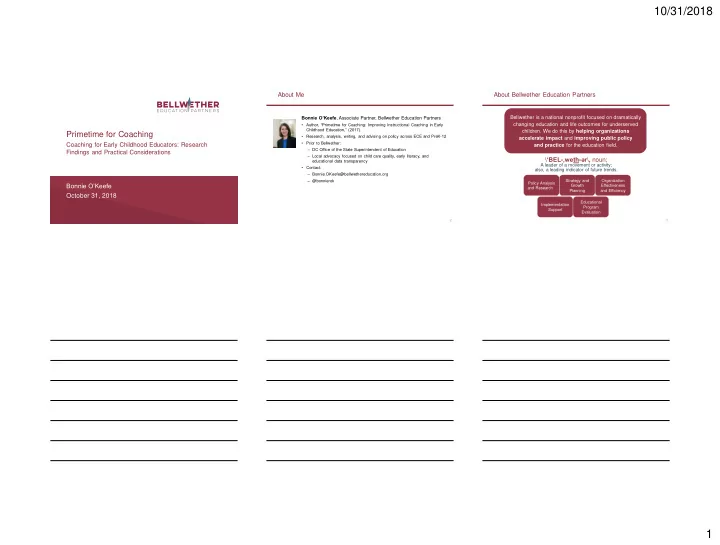
Bonnie O’Keefe October 31, 2018

Primetime for Coaching

Coaching for Early Childhood Educators: Research Findings and Practical Considerations

2

About Me

Bonnie O’Keefe, Associate Partner, Bellwether Education Partners

  • Author, “Primetime for Coaching: Improving Instructional Coaching in Early

Childhood Education,” (2017).

  • Research, analysis, writing, and advising on policy across ECE and PreK-12
  • Prior to Bellwether:

– DC Office of the State Superintendent of Education – Local advocacy focused on child care quality, early literacy, and educational data transparency

  • Contact:

– Bonnie.OKeefe@bellwethereducation.org – @bonnierok

3

About Bellwether Education Partners \‘BEL-‚weth-ər\, noun;

A leader of a movement or activity; also, a leading indicator of future trends. Bellwether is a national nonprofit focused on dramatically changing education and life outcomes for underserved

  • children. We do this by helping organizations

accelerate impact and improving public policy and practice for the education field.

Policy Analysis and Research Strategy and Growth Planning Organization Effectiveness and Efficiency Implementation Support Educational Program Evaluation

slide-2
SLIDE 2

10/31/2018 2

4

  • Primetime for Coaching: Improving Instructional Coaching in Early Childhood Education
  • Bonnie O’Keefe, 2017
  • Pre-K Teachers and Bachelor’s Degrees: Envisioning Equitable Access to High-Quality Preparation

Programs

  • Emily Workman, Lisa Guernsey, and Sara Mead, 2018 (with New America)
  • It Takes a Community: Leveraging Community Colleges to Transform the Early Childhood Workforce
  • Marnie Kaplan, 2018
  • The Best Teachers for Our Littlest Learners? Lessons from Head Start’s Last Decade
  • Marnie Kaplan and Sara Mead, 2017
  • Moneyball for Head Start: Using Data, Evidence, and Evaluation to Improve Outcomes for Children

and Families

  • Sara Mead and Ashley Libetti, 2016

Recent Bellwether publications on early childhood education

5

Goals for Today’s Webinar

  • Define coaching and its place in the world of ECE workforce development

efforts

  • Understand the research and policy landscape around coaching
  • Learn more about various examples of coaching at a large scale
  • Think though decision points for program leaders implementing a new

coaching approach

6

Coaching for educators has been around for a long time, but definitions are not always clear

“Coaching is a relationship-based process led by an expert with specialized early learning and adult learning knowledge and skills, who often serves in a different professional role than the recipient(s). Coaching is designed to build capacity for specific professional dispositions, skills, and behaviors and is focused on goal-setting and achievement for an individual or group.”

  • NAEYC & Child Care Aware, 2011

“Perhaps the most striking difference in training athletes and teachers is their initial

  • assumption. Athletes do not believe mastery will be achieved quickly or easily. They

understand enormous effort results in small increments of change. We, on the other hand, have often behaved as though teaching skills were so easily acquired that a simple presentation, one-day workshop, or single videotaped demonstration were sufficient to ensure successful classroom performance.”

  • The Coaching of Teaching, Bruce Joyce and Beverly Showers, 1982

1: Definitions

slide-3
SLIDE 3

10/31/2018 3

7

What differentiates coaching from other forms of professional development or technical assistance?

Coaching is

  • Individualized and goal-based
  • Led by a coach in an expert role, usually one with

knowledge of both ECE instruction and training adults

  • Designed to build capacity in specific areas of instructional

practice Coaching can be

  • Long-term or time-limited
  • Targeted, tiered, or available to all
  • Combined with other forms of professional learning

Coaching is not

  • Punitive, evaluative, or compliance-based
  • The same as mentorship by a peer, supervision by a

manager, or technical assistance (but in some cases a coach may wear multiple hats)

1: Definitions

8

Establishing these definitions can matter a lot, but there are some grey areas

Recommended Reading: “Personal Best: Top Athletes and Singers Have

  • Coaches. Should You?” by Atul Gawande, The New Yorker, 2011
  • Many conversations I had about coaching for this research began with,

“Well, what do you mean by coaching?”

  • Many examples of “coaching” programs in policy and in practice that

don’t meet the definition above. There are also programs called by another name that are functionally coaching.

  • Most coaching activities happen one-on-one, so there isn’t always

transparency between program leaders, coaches, and teachers.

  • If we want a coaching program to achieve its intended results for children

and teachers, we need clear, shared expectations and definitions.

1: Definitions

9

Coaching takes on new relevance as part of discussions about ECE workforce quality improvement

  • As access to publicly funded ECE has grown, so has the evidence around

the importance of instructional quality. – ECE educators need tools and supports to improve their instructional effectiveness on the job; coaching is one vehicle to do that – Coaching can also be a tool to improve implementation fidelity for new curricula/teaching approaches

  • Coaching focuses on practical skill building, and can be combined with
  • ther kinds of training, so teachers can grow their knowledge, skills, and

understanding.

  • Because coaching can be more labor- and time-intensive than other

professional development approaches, it can be expensive, which means getting it right is important.

1: Definitions

slide-4
SLIDE 4

10/31/2018 4

10

There are several unique factors behind instructional coaching for early childhood educators

  • Coaching is also often used for educators of older groups of students, and

some research combines ECE coaching studies with other educator groups.

  • Why is it valuable to think about coaching in early childhood education,

specifically? – Diversity of ECE settings and funding structures – Different policy landscape around licensure, standards, and quality improvement – Educational backgrounds and prior training experiences of ECE educators differs from the typical K-12 educator – Substantially different knowledge and skills necessary for a successful coach and a successful educator in early childhood settings, for example: developmentally appropriate teaching techniques.

1: Definitions

11

Poll Question: Which of the following statements is not supported by coaching research?

  • The evidence base on coaching is stronger than that of many other forms of

professional development

  • Coaching can be more effective if paired with other forms of professional

development

  • The most important factor in successful coaching is how much time teachers

spend with their coaches

  • Most research on coaching in ECE focuses on pre-k aged students in school-
  • r center-based programs

2: Research and Policy

12

Poll Question Answers: Which of the following statements is not supported by coaching research?

  • The evidence base on coaching is stronger than that of many other forms of

professional development - True

  • Coaching can be more effective if paired with other forms of professional

development - True

  • The most important factor in successful coaching is how much time teachers

spend with their coaches - False

  • Most research on coaching in ECE focuses on pre-k aged students in school-
  • r center-based programs - True

2: Research and Policy

slide-5
SLIDE 5

10/31/2018 5

13

Research suggests coaching can have a significant, positive effect on teacher practice

For more, see “Primetime for Coaching,” pages 10-14

  • A growing number of rigorous research studies (experimental and quasi-

experimental) have found that coaching can significantly change teacher’s instructional practices for the better.

  • This is usually measured by observational instruments such as CLASS or

ECERS, or in terms of fidelity to a curriculum or teaching model.

  • This stands in contract to mediocre research results for common forms of

professional development in general. A recent analysis of more than 60 rigorous coaching studies in ECE and K-12 found that coaching had a positive effect on teacher practice “larger than differences in measures of instructional quality between novice and veteran teachers.”

– Kraft, Blazar, and Hogan, 2017 In a review of ECE-specific coaching studies, 14 linked coaching to curriculum implementation, and nearly all had positive results. 26 studies looked at classroom instructional quality – results were largely positive, with 4 examples of mixed or null results. – Aikens and Aker, 2011

2: Research and Policy

14

Coaching may work even better when combined with other forms of training and support

  • Many of the research studies on coaching can’t isolate the effects of coaching because

it is combined with other things (like training, coursework, or a community of practice).

  • But – this may be coaching’s secret sauce. It’s an ingredient that boosts the effects of
  • ther PD approaches.
  • Coaching focuses on skills and behavior – other forms of PD may focus on knowledge.
  • For example: In one study, 250+ pre-K teachers in 4 states were randomly assigned

to four PD groups: Course, in classroom coaching and detailed feedback

  • n children’s

progress Course, in classroom coaching, limited feedback Course, detailed feedback, no coaching Business as usual

  • Teacher with the most comprehensive

PD did best.

  • “These teachers…improved the quality and

the frequency of instruction in early writing, phonological awareness, letter knowledge and shared reading. They also showed more effective center based instruction.”

  • Landry et. al., 2009

2: Research and Policy

15

Fewer studies look at student outcomes as a result of teacher coaching, but results are generally positive

Generally, student learning effects from coaching are smaller than teacher effects – so teachers have to change a lot in order for student outcomes to change moderately.

  • Student learning outcomes from coaching are harder to measure – as you all know,

assessing learning in the early years can be complicated and time consuming.

  • The studies we do have find generally positive effects, but these are smaller than the

impact on teachers.

  • This is to be expected, since the intervention on students from coaching is indirect.

2: Research and Policy

slide-6
SLIDE 6

10/31/2018 6

16

Some innovative coaching approaches hold promise for lower cost coaching approaches

  • Several studies have found significant impacts on teachers and students from virtual

coaching programs – when these are well-designed and implemented, they can work just as well as in-person coaching.

  • Quality is more important than quantity for coaching. In the meta-analysis cited

above, the number of hours spent coaching was not associated with teacher or student

  • utcomes. Other studies have found that time-limited coaching interventions can have

a long term impact for teachers and help them keep improving over time.

  • Coaches do not have to be external consultants or new hires. Some evidence-based

models embed coaching duties in the jobs of people already on the ground.

  • Both these results are good news for ECE program leaders who feel coaching would

be cost-prohibitive, or qualified coaches are hard to find in your area. 2: Research and Policy

17

Head Start has responded to this research with both mandates and encouragement

  • Head Start Performance Standards: Require programs to “implement a

research-based, coordinated coaching strategy for education staff” as of 2017:

  • Programs must provide intensive coaching to staff most in need of

support.

  • These staff must have opportunities to be observed, set goals, and

receive feedback from coaches with adequate feedback and expertise.

  • Head Start provides guidance and suggestions, but most details left
  • pen to program discretion.
  • Because so many ECE programs have blended funding, many state or

local pre-K programs are subject to these requirements.

  • New performance standards are the culmination of earlier pilot programs

and evaluations that led to many of the popular models and research base we have today.

2: Research and Policy

18

State level Pre-K and QRIS programs have also followed suit

  • State Pre-K: 25 states (as of 2016) required some form of coaching in their

pre-K programs

  • NIEER quality standards for state pre-K now recommend all lead

teachers and assistant teachers have individualized professional development plans and coaching, plus at least 15 hours of in-service professional development.

  • This is an ambitious benchmark – only nine state pre-K programs

met it in 2017 (AL, GA, IN, MI, MN Head Start, NM, OR Head Start, RI, SC).

  • State Quality Rating and Improvement Systems (QRIS):
  • Several states have incorporated vetted coaching providers in their

QRIS systems, or created coaching competency standards to guide programs

  • Others (e.g. Florida) have supported voluntary coaching

training/certification

2: Research and Policy

slide-7
SLIDE 7

10/31/2018 7

19

But, there is still a lot we don’t know about how to maximize the effects of coaching in different contexts

  • Much of the research on coaching is either very general, looking at coaching

as a broad category, or very specific, evaluating models designed and implemented in controlled, small-scale environments.

  • Most ECE coaching research focuses on pre-K aged students in center- or

school-based classrooms – other environments are less well studied

  • This means that right now, there are very few hard and fast rules about what

makes a coaching approach “high-quality” or “evidence based”

  • It also means there are many open possibilities for programs to design,

adopt, or implement coaching programs in ways that work best for them. What makes coaching most effective for your teachers and students? The best answer is often “it depends.”

2: Research and Policy

20

How can you think through all the design choices that go into a coaching program?

  • Options are wide open. This can be intimidating, but it means that coaching can be

within reach for your program. On the other hand, a check-the-box coaching approach will almost surely fail to yield improvements for students.

  • The following decision framework is meant to help you think through the key facets and

design choices that go into a successful coaching model.

  • This can apply whether you are considering bringing in a outside model,

adapting/refining an existing model, or creating something entirely new.

  • I’ve adapted this framework into a worksheet that will be available on the ECE

investigations website after the webinar! 3: Decisions and Design

21

Coaching design framework (1/3)

Category Key Decisions Research & Best Practice Takeaways Theory of Change and Goals What are the program’s goals? How will coaching lead to student outcomes? A defined theory of change should explain how coaches will effect educator skills, and how those skills connect to student outcomes Targeting Which educators receive coaching? Many research studies use volunteers – but large programs tend to focus on new teachers

  • r struggling teachers. Coaching may be

stigmatized if only “bad” teachers get it. Staffing Who are the coaches? What are their qualifications, and relationship to programs? Most coaches have experience as ECE teachers or program leaders. Their role and their place in programs vary a lot This is a design framework to help differentiate among coaching approaches, and think through the impact of different choices. 3: Decisions and Design

slide-8
SLIDE 8

10/31/2018 8

22

Coaching design framework (2/3)

Category Key Decisions Research & Best Practice Takeaways Dosage and duration How often does coaching happen, for how long? More is better, holding quality constant, but high-quality short term interventions can have strong results. Leadership How should coaches work with program leaders? No research consensus – but beware blurring lines between evaluation and support Content What is the content focus of the coaching? Common: language/literacy, general pedagogy, and/or social-emotional development Process What strategies do coaches use? How consistent should they be? Tools, rubrics, and structure can be important to ensure fidelity, but should not impede individualization and relationships 3: Decisions and Design

23

Coaching design framework (2/2)

Category Key Decisions Research & Best Practice Takeaways Context How does coaching fit into the context of PD, evaluation, curriculum, and improvement strategies? Research focuses on pre-K in centers or

  • schools. Sometimes framed as a curriculum

fidelity tool. Venue Is coaching in-person, virtual, or a hybrid? Mostly in-person, but there are several research-supported virtual or hybrid models Evaluation What metrics determine success

  • r inform program strategy?

Plans for evaluation and continuous improvement should be part of any coaching

  • initiative. Metrics should align with goals.

3: Decisions and Design

24

Next, we’ll talk through a few examples of different coaching approaches in the real world

  • These are all approaches with evidence of effectiveness, but that does not mean that

their way is the only way – these are examples, not endorsements.

  • Throughout, I’ll highlight differentiating points and how those link back to the research

and the design framework.

  • We’ll conclude with some recommendations and summary thoughts.

4: Examples

slide-9
SLIDE 9

10/31/2018 9

25

Practice-Based Coaching

4: Examples

  • Influential framework developed by the

Office of Head Start National Center on Quality Teaching and Learning (NCQTL).

  • 3-Part Cycle:
  • Goals and Planning,
  • Observation,
  • Reflection and Feedback.
  • Many variations and well-known

coaching models are built on this architecture.

  • For example: EarlyEdU Alliance, “The

Coaching Companion.”

  • Designed to be implemented with

flexibility, depending on program goals and context. Not many hard design rules.

26

My Teaching Partner

4: Examples

  • Virtual coaching and professional

development designed at the University

  • f Virginia around the Classroom

Assessment Scoring System (CLASS)

  • Teachers tape classroom activities,

receive feedback from a virtual coach – about 4-6 hours a week

  • Can be paired with other CLASS-centric

resources

  • Research evidence suggests improved

instructional practices and child

  • utcomes, especially for low-income

children.

  • Virtual coaching, aligned with

evaluation instruments and other resources, delivered on a broad scale.

27

Acelero Learning

  • Head Start grantee serving more than 5,000 children in four states – NJ, WI, NV, PA.
  • Coaching Key Features:

– All teachers and assistant teachers receive coaching; one of three central pillars

  • f their educational strategy

– Center directors serve as coaches – Regional specialists support coach the coaches across sites – Amount and focus of coaching differentiated by teacher need around reflective cycles; coaches use a mix of techniques such as modeling, video review, side-by- side instruction – Extensive rubrics, tools, and resources to create consistency and clarity 4: Examples

slide-10
SLIDE 10

10/31/2018 10

28

Southwest Human Development

  • Head Start/Early Head Start grantee serving more than 1,300 children in Arizona. Also

home to Educare Arizona

  • Coaching Key Features:

– Coaches serve in a specialized role, covering 10 classrooms each – All teachers receive job-embedded coaching, differentiated to their needs. – Began with a focus primarily on CLASS, but expanded – Paired with bi-weekly professional learning community – Uses tablet-based observation software

  • When SWHD got a grant to share their approach with other AZ community-based child

care centers – revealed different pressures with time, staffing, and budgets, and led them to develop stronger coaching systems for center leaders. 4: Examples

29

What do we see across these examples?

  • Different/flexible approaches to who serves as a coach and where they are located –

geographically and organizationally.

  • Coaching aligned with specific goals/metrics/frameworks, with clarity for teachers and

coaches on expectations.

  • Differentiated coaching depending on teacher need, but framed as the default, not a

punishment.

  • Systems for supporting coaches and program leaders up the ladder of coaching.
  • Adaptations to make high-quality coaching experiences accessible and sustainable

for ECE educators in a variety of environments 4: Examples

30

Closing Recommendations

  • Think about coaching in the context of your entire professional development and

instructional approach. – Consider alignment with curriculum, learning standards, and evaluation – Set goals for your coaching approach, and monitor its progress – Think about systems of support for assistant teachers, instructional leaders, and coaches themselves

  • Consider how coaching can be a sustainable, job-embedded part of your day-to-day
  • perations and systems.

– Quality > Quantity

  • Be wary of any model that promises rapid results without broader operational changes,
  • r alignment with other program areas.
  • Program leaders’ attitude towards coaching can determine how teachers receive it.
  • Look for inspiration, assistance, and guidance from other program leaders, local and

state agencies, Head Start, and higher-education institutions.

slide-11
SLIDE 11

10/31/2018 11

31

Thank You!

  • Read the full Primetime for Coaching report:

https://bellwethereducation.org/publication/primetime-coaching-improving- instructional-coaching-early-childhood-education

  • Reach out via email: bonnie.okeefe@bellwethereducation.org
  • Follow me on twitter for education and ECE policy musings, and the
  • ccasional dog picture: @bonnierok
  • Have a happy and safe Halloween!