10/2/2018 Dementia Prevention and Treatment: An Asian American - - PDF document

10 2 2018
SMART_READER_LITE
LIVE PREVIEW

10/2/2018 Dementia Prevention and Treatment: An Asian American - - PDF document

10/2/2018 Dementia Prevention and Treatment: An Asian American Perspective 24 th Annual Asian American Mental Health Training Conference October 11 th , 2018 Benjamin Woo, M.D. Associate Clinical Professor, UCLA Dementia is a growing source of


slide-1
SLIDE 1

10/2/2018 1

Dementia Prevention and Treatment: An Asian American Perspective

24th Annual Asian American Mental Health Training Conference October 11th, 2018 Benjamin Woo, M.D. Associate Clinical Professor, UCLA

Dementia is a growing source of morbidity

  • 50M people in the world have dementia
  • Approximately 5.4 million Americans of all ages had AD in 2016
  • 5.2M aged 65 and older
  • Cost of dementia was about 200B
  • Medicare paid approximately 11B
  • In CA alone, more than 1M unpaid caregivers serving loved ones with

dementia

  • Numbers are growing
  • 135M by 2050
  • Largest growth in Asia

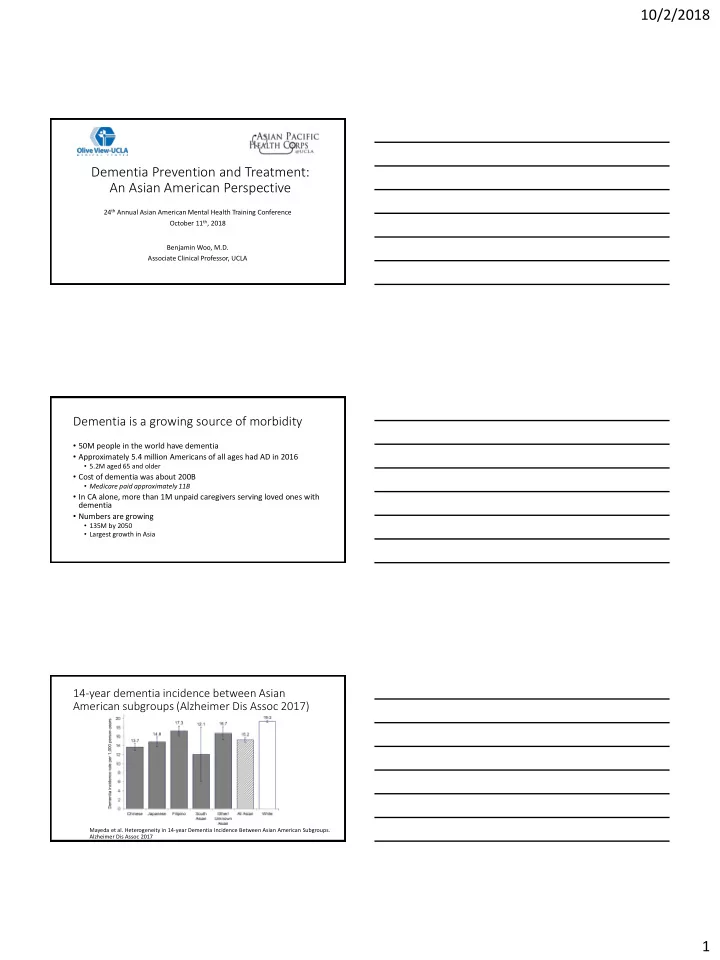
14-year dementia incidence between Asian American subgroups (Alzheimer Dis Assoc 2017)

Mayeda et al. Heterogeneity in 14-year Dementia Incidence Between Asian American Subgroups. Alzheimer Dis Assoc 2017

slide-2
SLIDE 2

10/2/2018 2

View of Dementia: Vietnamese American Immigrants (N=102)

  • 75% incorrectly believe dementia patients become unable to perform

familiar tasks all at once.

  • 70% incorrectly believe dementia patients are unable to recognize

their families.

  • 60% incorrectly believe dementia patients are unable to recognize

time, place, and person all at once.

View of Dementia: Chinese American Immigrants (N=288)

  • 60% incorrectly believe dementia can’t be prevented.
  • 62% incorrectly believe dementia wouldn’t shorten life expectancy.
  • 67% unable to identify some types of dementia can be treated.

Dementia

  • Many causes of dementia
  • Vascular dementia
  • LBDs
  • Alzheimer’s disease (Most common cause of dementia > age 65)

Symptoms

  • Memory

PLUS

  • Word finding
  • Planning
  • Organizing
  • Depression
  • Apathy

Slowly Progressive Impact ADLs

slide-3
SLIDE 3

10/2/2018 3

When the Clock Stops Ticking

  • Age-related cognitive impairment 

Mild cognitive impairment (MCI)  Dementia

Dementia risk factors

  • Genetics
  • Lack of physical exercise
  • “Western” diet – do not underestimate Lady M or Half & Half
  • Medical conditions (DM, HTN)
  • Sleep apnea
  • Brain-slowing Meds (Benadryl, Benzos, Terazosin, Paxil, etc.)
slide-4
SLIDE 4

10/2/2018 4

Alzheimer’s Genetics

  • Sporadic AD (>98%) onset > 65 yo
  • Sporadic: Many genes + environment
  • ApoE gene: ApoE4
  • No family history: Lifetime risk ~ 15%
  • - E4 9%
  • + E4 30%

But only 40% Chinese and 50% Vietnamese American Immigrants believe some types of dementia are hereditary.

  • Sporadic: Many genes + environment
  • ApoE gene: ApoE2/ApoE3/ApoE4
  • If no family hx, lifetime risk ~15% (with E4

increased to 30%)

  • One parent with AD: E3/E3: 30%; E3/E4: 45%;

E4/E4: 60%

How to make a dx of AD

  • History (r/o depression)
  • Physical exam (r/o Parkinson’s)
  • Cognitive exam
  • Brain MRI (r/o tumors)
  • Blood: B12, thyroid, others

* Reached 85% accuracy

slide-5
SLIDE 5

10/2/2018 5

Mini-Cog (<3)/Clock Drawing Test When dementia screening meets technology

slide-6
SLIDE 6

10/2/2018 6

The AD8: Washington University Dementia Screening Test (informants or friends)

Amyloid and tau detection with PET scans

slide-7
SLIDE 7

10/2/2018 7

PET Imaging predicts neuropsychiatric symptoms FDA approved treatments

Do not delay onset or slow progression

FDA approved treatments

slide-8
SLIDE 8

10/2/2018 8

Prevention Strategies

Family ask frequently, and new data is out every month!

  • Cognitive exercise
  • Diet
  • Sleep
  • Physical Exercise

In October of 2014 a group of more than seventy academics published what they called a consensus statement, asserting that playing brain games had been shown to improve little more than the ability to play brain games.

Advanced Cognitive Training for Independent and Vital Elderly (ACTIVE) study

  • Speed-of-processing training
slide-9
SLIDE 9

10/2/2018 9

Comparison of Online Information in Chinese and in English Languages (Cureus 2017)

  • A google search was performed

for the phrase “dementia” in simplified Chinese characters and in English.

  • No statistical significance was
  • bserved between the

prevalence of signs and symptom explanations and readability of the websites.

  • The simplified Chinese search

websites were more likely to be commercial.

Association of Daily Intellectual Activities with Lower Risk of Incident Dementia Among Older Chinese Adults

  • 1349 of 15582 older adults developed dementia over the 6-year.

Intellectual (reading books, newspapers, or magazines; playing board games, Mahjong, or card games; and betting on horse racing), Social (joining a social center, participating in voluntary work, meeting relatives or friends, and attending religious activities), and Other Recreational (watching television, listening to radio, shopping, and going to a teahouse).

Diet and Cognition (from the Honolulu-Asia Aging Study)

  • Examined midlife characteristics (nonsmoking, BMI, exercises, and

healthy diet)

  • Intake for fruit, vegetables (not including salted Japanese vegetables),

fish, ratio of monounsaturated to saturated fat, and cereals (including rice, noodles, breakfast cereal, and bread, both whole and refined grains) and low intake for meat and dairy.

  • Overweight and obesity in midlife have been linked with greater risk
  • f dementia.
slide-10
SLIDE 10

10/2/2018 10

Mediterranean diet and cognition

  • Eating primarily plant-based foods,

such as fruits and vegetables, whole grains, legumes and nuts

  • Replacing butter with healthy fats

such as olive oil and canola oil

  • Using herbs and spices instead of

salt to flavor foods

  • Limiting red meat to no more than

a few times a month

  • Eating fish and poultry at least

twice a week

  • Enjoying meals with family and

friends

  • Intakes of beta-carotene, flavonoids, and vitamins E or C were not

associated with modification the risk of late-life dementia. However…

  • Don’t take away hope, but talk with their PMD as supplements may

affect other medications.

Supplements

  • Omega-3 Fish Oil:
  • Normal aging: no effect
  • MCI: 4/5 small studies w/mild improvement
  • AD: Only 1/6 small studies with minimal effect
  • Vitamin E
  • Normal elderly: 400 IU/day: PREADVISE trial (2017) – no effect
  • Mild/mod AD: 2000 IU/day: 19% reduction rate decline in ADLs but no

cognitive effects (Dysken et al., 2014)

  • Vitamin D
  • While 3 small studies indicated improvement in executive functioning, we live

in California…

slide-11
SLIDE 11

10/2/2018 11

Traditional Chinese Medicine

  • According to the TCM, the brain is an outgrowth of and is nourished

by the kidney. (kidney stores essence to generate marrow)

  • Memory and cognitive are believed to be due to phlegm obstruction
  • f the channels by blocking upper orifices.
  • TCM also believe AD to be multifaceted.

Acupuncture

  • Five studies involving 677 participants were analyzed.
  • Acupuncture had mixed effects on cognitive functions.
  • Acupuncture combined with western medications did not improve

cognitive functions as measured by MMSE or MOCA in patients with mild cognitive impairment.

Sleep-disordered breathing:

  • 1.9X odds MCI at 5 years (JAMA 2001)
  • 1.7X odds dementia at 5 years (PLoS One 2013)
slide-12
SLIDE 12

10/2/2018 12

Sleep disruption increases CSF Aβ (Lucey et al 2018)

Total CSF Aβ (top) waned throughout the night in people who slept normally (blue)

  • r who took a sleep aid (green), but rose 30

percent in those who stayed awake (red). *likely due to elevated synthesis

Get some good sleep!

  • Acute sleep deprivation impacts amyloid burden in right hippocampal

regions.

Exercise?

slide-13
SLIDE 13

10/2/2018 13

Tai chi

  • 2 systematic reviews on tai chi for the treatment of cognitive impairment

showed improvements in MMSE scores. (Better than physical activity for improving EF.)

  • 1 recent short-term study in those with mild cognitive impairment did not

find any improvement.

  • Reduce the stress effects on brain health, nevertheless.

Exercise and amyloid reduction (Arch Neurol 2012)

  • Exercisers (past 10 years, 30

min mod 5X/wk)

  • Higher PIB binding in more

sedentary individuals

  • We were told that we can’t do

anything to our genes?

Exercise and dementia risk

  • How much? 30 min/day, 5days/week – moderate levels
  • Meta-analyses have consistently shown roughly a 40% reduced risk of

AD

  • If you have an hour with your elderly loved ones, walk and talk with

them for an hour!

slide-14
SLIDE 14

10/2/2018 14

When 68 elderly with probable AD enrolled in either 150 min/wk of aerobic exercise vs. non- aerobic stretching (PLOS 2017) Summary: FINGER (diet, exercise, cognitive training, and vascular risk monitoring) (Lancet 2015)

  • High consumption of

fruit/vegetables, consumption

  • f wholegrain products and

low-fat milk and meat products

  • Limiting sucrose intake to less

than 50g/day

  • Fish consumption at least two

portions per week

  • Physical exercises 5x/wk
  • Cognitive training

Older adults are less accurate than younger adults at identifying CVD as a cause of dementia in the Chinese American community (Int Psychogeriatr 2013)

  • 132 were young participants, while 76 participants were 65 years or
  • lder.
  • Both younger and older adults showed misconceptions that dementia

is due to old age and cannot be treated.

  • Older adults showed a significantly lower level of understanding that

dementia could result from cardiovascular disease.

slide-15
SLIDE 15

10/2/2018 15

Mahjong

What does the Asian American general public understand about prevention and treatment of dementia?

  • Normalization of memory loss in old age.
  • Social-cultural attribution and causal attribution
  • Lack of knowledge about course of dementia
  • Sketchy knowledge about dementia treatment (esp issues with

dementia caregiving group)

  • Stigma + “face saving”

Dementia knowledge and information seeking

  • f Chinese American Immigrants (JAGS 2013)
  • Fifty (36%) of the 139 participants demonstrated interest in receiving

further dementia education.

  • Had lower dementia knowledge, were more likely to inaccurately

believe that dementia is normal for aging, and were less likely to identify early signs of dementia.

  • Lack of initiative to seek help may be a deficiency of appropriate

language educational materials?

  • Also remember, willingness to follow doctor’s rec has nothing to do with

speaking a language or high education.

slide-16
SLIDE 16

10/2/2018 16

Duration of residence and dementia literacy among Chinese Americans (IJSP 2014)

  • 80 of the 151 respondents lived in the U.S. for < 20 years.
  • Overall, the 2 groups did not differentiate on the total dementia

knowledge scores.

  • Except DOR < 20 years was associated with lesser understanding

about how dementia may shorten the life expectancy after onset.

Exploring the role of YouTube in delivering dementia education to older Chinese (AJP 2018)

  • In the first 2-year study period, YouTube reached 4333 viewers with a

total watch time of 26554 min (an avg of 6.13 min).

  • In the Year 2 period, YouTube achieved a longer total watch time,

number of viewers, and reaching out to age group of viewers aged 55 and above.

slide-17
SLIDE 17

10/2/2018 17

Dementia Health Promotion for Chinese Americans (Cureus 2017)

Association between recognizing dementia as a mental illness and dementia knowledge among elderly Chinese Americans (WJP 2016)

  • 29% of 316 elderly Chinese Americans identified dementia as a

mental illness.

  • When dementia was being perceived as a mental illness, such

perception was associated with a higher level of baseline dementia understanding.

  • There is the potential of improving older Chinese Americans dementia

literacy by increasing awareness of its mental illness origin.

slide-18
SLIDE 18

10/2/2018 18

Poor caregiver mental health predicts mortality (PNAS 2017)