10/12/18 Outline 1. Epidemiology 2. Evaluation 3. Treatment - - PDF document

10 12 18
SMART_READER_LITE
LIVE PREVIEW

10/12/18 Outline 1. Epidemiology 2. Evaluation 3. Treatment - - PDF document

10/12/18 Outline 1. Epidemiology 2. Evaluation 3. Treatment Sports Concussion 2018: How much rest? Return to learn / work What the Clinician Needs to Know Return to sports Carlin Senter, MD 4. How many concussions is


slide-1
SLIDE 1

10/12/18 1

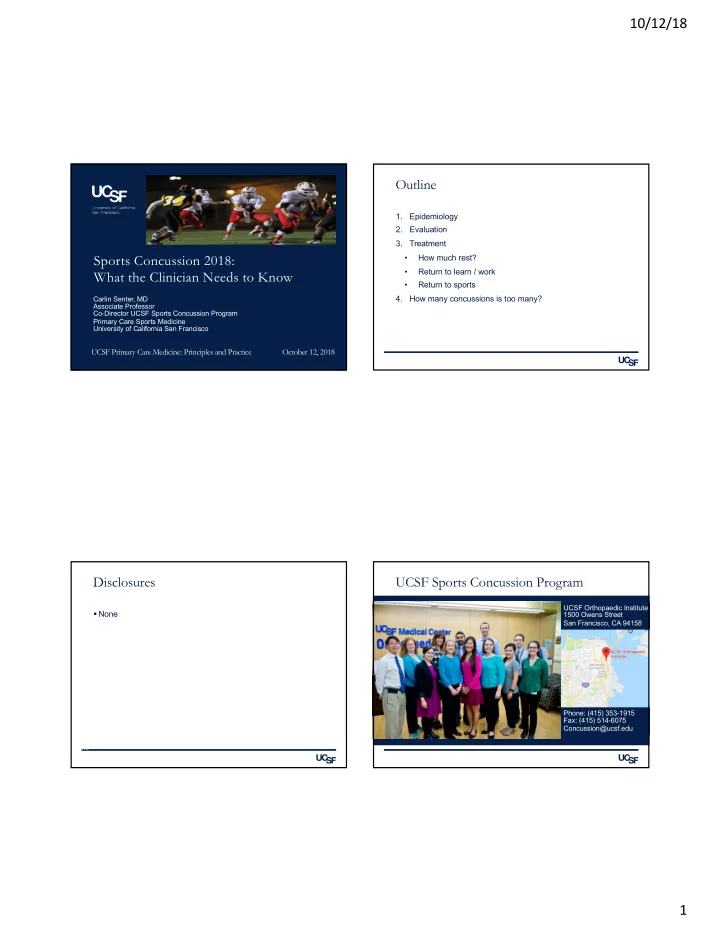
Sports Concussion 2018: What the Clinician Needs to Know

Carlin Senter, MD Associate Professor Co-Director UCSF Sports Concussion Program Primary Care Sports Medicine University of California San Francisco

UCSF Primary Care Medicine: Principles and Practice October 12, 2018

Outline

1. Epidemiology 2. Evaluation 3. Treatment

  • How much rest?
  • Return to learn / work
  • Return to sports

4. How many concussions is too many?

Disclosures

§ None

10/12/18

Phone: (415) 353-1915 Fax: (415) 514-6075 Concussion@ucsf.edu UCSF Orthopaedic Institute 1500 Owens Street San Francisco, CA 94158

UCSF Sports Concussion Program

slide-2
SLIDE 2

10/12/18 2

§ 2.8 million traumatic brain injuries (TBI)s / year in US

  • These are only those seeking care in ED – likely major

underestimate

  • Majority are mild TBI

§ Mechanism of injury

https://www.brainline.org/slideshow/infographic-leading-causes-traumatic-brain-injury. Accessed October 7, 2018.

slide-3
SLIDE 3

10/12/18 3

Master CL, Mayer AR, Quinn D, Grady MF. Concussion. Ann Intern Med. 2018 Jul 3;169(1):ITC1-ITC16.

https://www.cdc.gov/traumaticbraininjury/PediatricmTBIGuideline.html Accessed 9/10/18.

Concussion definition

§mTBI: mild traumatic brain injury §Blow to head, neck, body à neurological symptoms within 48 hours §CT and MRI normal §May or may not include loss of consciousness §Cannot be explained by drug, alcohol, medication use, or

  • ther injuries or comorbidities

http://bjsm.bmj.com/content/early/2017/04/26/bjsports-2017-097699. Accessed June 26, 2017. Physical Cognitive Emotional Sleep

Concussion symptoms

slide-4
SLIDE 4

10/12/18 4

Concussion pathophysiology

Force to brain, axonal stretching Ion fluxes; vasocon- striction Need glucose but less blood flow

Energy crisis

Giza CC and Hovda DA, J of Athletic Training, 2001. Vespa et al, J Cerebral Blood Flow and Metabolism, 2005.

Concussion recovery

§Concussion severity is determined retrospectively §Grading scales no longer used §Typical time to resolve

  • Adults: 10-14 days
  • Kids: Up to 4 weeks

§Counsel patients and families that most patients with concussion do not have significant difficulties that last more than 1-3 months post injury.

http://bjsm.bmj.com/content/early/2017/04/26/bjsports-2017-097699. Accessed June 26, 2017. https://www.cdc.gov/traumaticbraininjury/PediatricmTBIGuideline.html Accessed 9/10/18.

Case #1

§ 27 y/o software engineer presenting with concussion. § 5 days ago fell while skiing, helmeted. No LOC but immediate headache. § Friends took her to local ED, no head CT needed. Advised to rest and to follow up the following week in primary care. § Has not returned to work or exercise. § Mild-moderate headache is worse with bright light and with using computer / screens. Also feels foggy and tired. § Medications: none § PMHx: none (incl no h/o concussion, HA, ADHD, psych) § SHx: work is understanding of her injury. No drug use. 1-2 alcoholic beverages/week.

slide-5
SLIDE 5

10/12/18 5

Each of the following factors has been associated with longer recovery from concussion except for which?

  • A. Loss of consciousness at time of injury
  • B. Higher initial symptom burden
  • C. History of neurological disorder
  • D. History of psychiatric disorder
  • E. Learning difficulties
  • F. Family and social stressors

http://bjsm.bmj.com/content/early/2017/04/26/bjsports-2017-097699. Accessed June 26, 2017. https://www.cdc.gov/traumaticbraininjury/PediatricmTBIGuideline.html Accessed 9/10/18.

Concussion evaluation

1. Rule out 1. Intracranial hemorrhage 2. Cervical injury 2. Determine 1. Symptoms 2. Severity of symptoms 3. Risk factors for longer recovery 4. Post injury memory, balance, reaction time

https://www.seata.org/resources/Pictures/Sport%20concussion%20assessment%20 tool%20-%205th%20edition%20(1).pdf. Accessed June 26, 2017.

  • 1. Self-reported symptom assessment

Symptom severity score = 46 Clusters: headache, emotional

slide-6
SLIDE 6

10/12/18 6

  • 2. Neurological exam with balance

Balance Error Scoring System: BESS

http://paulhead.co.uk/wp-content/uploads/2013/11/balance.jpg

When to order head CT - pediatrics

§ Pediatric Emergency Care Applied Research Network (PECARN) Head Injury / Trauma Algorithm

  • https://www.mdcalc.com/pecarn-pediatric-head-injury-trauma-

algorithm § Plug risk factors for intracranial injury into calculator to rule out need for head CT.

  • Age < 2 y/o
  • Vomiting
  • LOC
  • Severe MOI
  • Severe or worsening headache
  • Amnesia
  • Non-frontal scalp

hematoma

  • GCS < 15
  • Concern for skull fx

https://www.mdcalc.com/canadian-ct-head-injury-trauma-rule. Accessed 9/10/18.

When to order head CT - adults Utility of brain MRI in concussion

§ 3T MRI more sensitive to micro hemorrhage than CT § In research setting, mTBI patients with normal head CT but abnormal acute brain MRI had poorer 3-month outcomes compared to those with normal imaging. § Despite this data, further investigation needed prior to recommending brain MRI for routine clinical care. § Routine brain MRI not recommended by American Academy of neurology nor the American Medical Society for Sports Medicine Giza CC et al. Neurology. 2013;80:2250-7. Harmon KG et al. Clin J Sport Med. 2013;23:1-18. Yuh EL et al. Magnetic resonance imaging improves 3-month outcome prediction in mild traumatic brain injury. Ann Neurol. 2013;73:224-35.

slide-7
SLIDE 7

10/12/18 7

Blood tests for concussion

§ Biomarkers for acute concussion § Genetic testing for alleles that can predispose to concussion § Used primarily in research settings § “Health care providers should not use biomarkers outside of a research setting for the diagnosis of children with mTBI.” https://www.cdc.gov/traumaticbraininjury/PediatricmTBIGuideline.html Accessed 9/10/18.

Master CL, Mayer AR, Quinn D, Grady MF. Concussion. Ann Intern Med. 2018 Jul 3;169(1):ITC1-ITC16.

Returning to case #1

§Symptom severity score high (46) §Clustering in headache, light sensitivity, mood §Neck exam normal §Neurological exam non-focal

  • BESS score of 15 (10-24th percentile for her age

group)

27 y/o woman 5 days s/p fall while skiing with concussion. Software engineer. Has been off work since injury.

How would you treat this patient?

  • A. Order urgent head CT to rule out subtle post

traumatic bleed, return to clinic after CT.

  • B. Gradually return to work now as tolerated, rest

from physical activity, f/u 1 week.

  • C. Rest from work and from physical activity until

symptom free, f/u 1 week.

  • D. Return to work and physical activity now.

Concussion treatment

§Reassurance §Cognitive rest §Physical rest §Medication: acetaminophen

  • r NSAIDs* prn headache

§Sleep §Nutrition §Mood

*Avoid NSAIDs acutely due to theoretical risk of intracranial hemorrhage.

slide-8
SLIDE 8

10/12/18 8

How much rest after a concussion?

§88 patients (11-22 y/o) seen at pediatric ED randomized §Strict rest x 5 days vs. “usual care” of 1-2 days rest, then stepwise return to activity §Neurocognitive and balance outcomes same at 3 and 10d post injury §Strict rest group had more daily post concussive symptoms and slower symptom resolution over the 10d study period

Thomas DG et al. Benefits of strict rest after acute concussion: a randomized controlled trial. Pediatrics. 2015 Feb;135(2):213-23. Slide courtesy of Cindy Chang, MD

How much rest after concussion?

http://bjsm.bmj.com/content/early/2017/04/26/bjsports-2017-097699. Accessed June 26, 2017.

1-2 days

Return to learn / work progression

No school / work. OK to do light reading, little bit TV, drawing, cooking as long as doesn’t worsen symptoms. 15 min cognitive activity at a time. Return to full day of school.

http://www.chop.edu/service/concussion-care- for-kids/returning-to-school.html

30 min schoolwork at a time until can do 1-2 hours. Return to ½ day of school.

qConcussion Information Sheet qAcute Concussion Notification Form qGraded Concussion Symptom Checklist qPhysician Letter to School After Concussion Visit qConcussion Return to Learn (RTL) Protocol qPhysician Recommended School Accommodations Following Concussion qConcussion Return to Play (RTP) Protocol

http://www.cifstate.org/sports-medicine/concussions/index Accessed June 26, 2017.
slide-9
SLIDE 9

10/12/18 9

Diet or supplements to expedite recovery?

§Diet: literature is sparse §No strong evidence for use of supplements in concussion management at this time.

  • Promising results in animal studies and a few

human studies on traumatic brain injury in recovery or prevention of concussion:

Ashbaugh A, McGrew C. Curr Sports Med Rep. 2016 Jan-Feb;15(1):16-9.

  • Omega-3 fatty acids
  • Curcumin
  • Resveratrol
  • Melatonin
  • Creatine
  • S. baicalensis
  • Vitamins C, D, E

Case #2

§15 y/o high school girls soccer player §Concussion f/u in clinic §Injured 1 week ago §Rested at home x 2 days then gradually returned to school with RTL protocol §Tolerating school 100% §Has not done any physical activity §No concussion symptoms §Soccer championship game in 2 days. She requests your clearance to play. §What do you recommend?

What do you recommend?

  • A. Clear her for game play in 2 days.
  • B. Clear her to practice today and if no symptoms,

clear for game in 2 days.

  • C. Clear her for practice today and to follow a

gradual return to play protocol of 7 days.

  • D. Recommend 1 more week of rest from physical

activity then f/u in office.

  • E. Recommend 1 month out of soccer post injury

then f/u in office.

Follow gradual RTP progression

slide-10
SLIDE 10

10/12/18 10

When is it safe to start physical activity after a concussion?

No concussion symptoms 100% back to school (work) Gradual return to play protocol

California concussion legislation

§ AB 25 –Concussion Law 2012 § 3 parts (education, remove from play, written medical note to return) § AB 1451—Coaches Concussion Training Law 2013 § Mandatory education every 2 years § AB 2127 – Concussion Safety Law 2015 § Limit FB full-contact practices § Mandatory RTP protocol of no less than 7 days from the diagnosed date of concussion § RTP under the supervision of LHCP § AB 2007 Concussion Mgmt in Youth Sports Act 2016 § Requires youth sports participants to undergo the same safety protocols as high school athletes

Slide courtesy of Cindy Chang, MD

Return to play progression

Daily activities that don’t provoke symptoms Light aerobic activity Sport specific activity Non- contact training Full contact practice Game play

Clinician clearance After 24-48 hours

http://bjsm.bmj.com/content/early/2017/04/26/bjsports-2017-097699. Accessed June 26, 2017. Per AB 27 this RTP protocol must last at least 7 days.

CIF: Return to play handout

slide-11
SLIDE 11

10/12/18 11

When can she play in a game?

No concussion symptoms Gradual return to play protocol Clear for game

Case #3

SJ is a 23 y/o semi pro rugby player presenting to you 6 months after her 5th concussion sustained when she was elbowed in the head during a game. Following her most recent injury she had 3 months of headache and light

  • sensitivity. She missed one month of work but has

now returned to full time work without issue. She would like to know if and when she can return to rugby.

Post concussion syndrome

§Concussion symptoms persist x months, usually <1 year. §Frequency unclear (0-15%).

Think about post concussion syndrome when…

§Symptoms not improving

  • Adults: expected recovery 10-14 days
  • Kids: expected recovery around 4 weeks

§Unable to return to school or work after 1-2 weeks

  • f treatment.

§History of migraine, anxiety, depression, sleep disorder. §History of concussion. §Multidisciplinary tx approach recommended

slide-12
SLIDE 12

10/12/18 12

What are the risks, benefits and alternatives

  • f SJ returning to rugby?

https://pulse-static-files.s3.amazonaws.com/worldrugby/photo/2015/03/03/82973c9c- cad7-491b-b13c-f4880bcbf21f/453038172.jpg

Repeat concussion: short term risks

§Increased risk of

  • Repeat injury
  • More severe symptoms
  • Longer duration of symptoms
  • Interruption of school / work / physical activity

Guskiewicz KM et al. JAMA 2003.

Concussion and long term risks

§Traumatic brain injury (TBI) and neurodegenerative disease

  • Multiple studies have shown TBI increases one’s

risk for neurodegenerative disease (Wilson L et al. The

chronic and evolving neurological consequences of traumatic brain injury. Lancet Neurol. 2017 Oct;16(10):813-825.)

  • Sport-related TBI and relationship to

neurodegenerative disease a recent focus

Chronic Traumatic Encephalopathy (CTE)

§ Originally thought to be exclusive to boxers: “punch drunk” § Now described in athletes, military personnel, survivors of intimate partner violence § Pathologic diagnosis made at autopsy: tau protein deposition in specific pattern § Chronic, progressive neurodegenerative syndrome

  • Behavioral changes: depression, aggression, impulsivity
  • Parkinsonism
  • Dysarthria
  • Cognitive deficits

Mez J et al. Clinicopathological evaluation of CTE in players of American football. JAMA. 2017;318(4):360-70. Rabinovici G. Advances and gaps in understanding CTE. JAMA July 25, 2017.

slide-13
SLIDE 13

10/12/18 13

What are the chances SJ will develop CTE?

§Difficult to draw causality between subconcussive blows + concussion and CTE §However, no reports of CTE without preceding traumatic brain injury §Concerning association between participation in collision sports and long term neuropsychiatric problems §We do not know the dose-response relationship between number of concussions and/or subconcussive blows and likelihood of CTE. §Need prospective, longitudinal data

Consider lower contact, lower risk sport. If returning to same sport consider lower risk position or longer time for recovery. Yellow flags

  • Multiple concussions
  • Post concussion

syndrome

  • Higher symptom

burden with each injury

  • Decreased injury

threshold

  • Younger age

Red flags

  • Abnormal imaging
  • Ongoing symptoms

Treat symptoms. Recommend non- contact, low risk sport or exercise

My approach to this conversation

Elicit and validate benefits of this sport and all physical activity for this athlete Discuss short term risks repeat injury Discuss potential long term risks of TBI (modify based

  • n h/o TBI)

Davis-Hayes C et al. Medical retirement from sport after concussions: A practical guide for a difficult discussion. Neurol Clin Pract. 2018 Feb;8(1):40-47.

Concussion care of the future? Diagnosis and prognosis

slide-14
SLIDE 14

10/12/18 14

Recovery and prevention Take-home points: Understanding concussion 2018

1. Concussion is a blow to head, neck or body leading to neurological symptoms within 48 hours. 2. Treatment is cognitive and physical rest x 24-48 hours 3. Gradual return to learn / work as tolerated by symptoms 4. Once symptom-free, gradual return to play 5. Average recovery time 14 days in adults, 4 weeks in kids 6. Risk of repeat concussion in short term: repeat injury, more symptoms, longer duration of symptoms (post conc syndrome) 7. Risk of repeat concussion in long term: less clear. CTE concern.

Concussion resources

§UCSF Sports Concussion Program

  • concussion@ucsf.edu

§California Interscholastic Federation

http://www.cifstate.org/sports-medicine/ concussions/index

§Consensus statement on concussion in sport, 2017.

http://bjsm.bmj.com/content/early/2017/04/26/bjsports-2017-097699

§CDC Pediatric mTBI Guidelines:

https://www.cdc.gov/traumaticbraininjury/PediatricmTBIGuideline.ht ml.

§CDC concussion toolkit for physicians

www.cdc.gov/concussion/HeadsUp/physicians_tool_kit.html

Thank You!

Carlin Senter, M.D. Carlin.Senter@ucsf.edu UCSF Sports Medicine