10.1 Blind Search 8.12. Basic Algorithms 8. Data Structures for - - PowerPoint PPT Presentation

10 1 blind search
SMART_READER_LITE
LIVE PREVIEW

10.1 Blind Search 8.12. Basic Algorithms 8. Data Structures for - - PowerPoint PPT Presentation

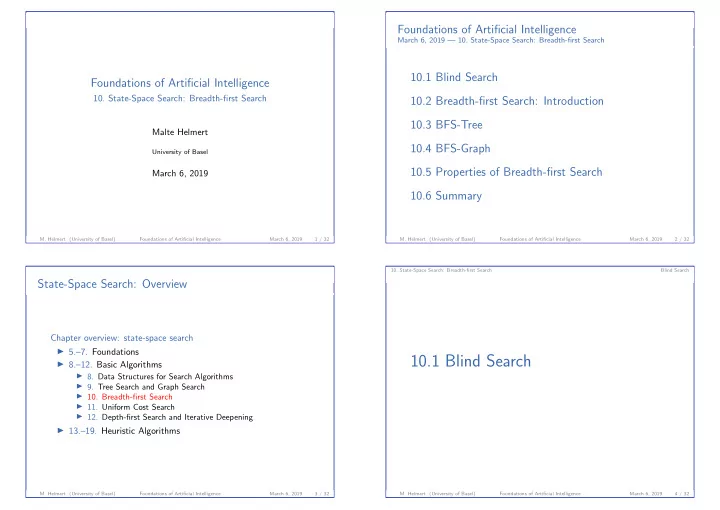
Foundations of Artificial Intelligence March 6, 2019 10. State-Space Search: Breadth-first Search 10.1 Blind Search Foundations of Artificial Intelligence 10. State-Space Search: Breadth-first Search 10.2 Breadth-first Search: Introduction


slide-1
SLIDE 1

Foundations of Artificial Intelligence

  • 10. State-Space Search: Breadth-first Search

Malte Helmert

University of Basel

March 6, 2019

  • M. Helmert (University of Basel)

Foundations of Artificial Intelligence March 6, 2019 1 / 32

Foundations of Artificial Intelligence

March 6, 2019 — 10. State-Space Search: Breadth-first Search

10.1 Blind Search 10.2 Breadth-first Search: Introduction 10.3 BFS-Tree 10.4 BFS-Graph 10.5 Properties of Breadth-first Search 10.6 Summary

  • M. Helmert (University of Basel)

Foundations of Artificial Intelligence March 6, 2019 2 / 32

State-Space Search: Overview

Chapter overview: state-space search ◮ 5.–7. Foundations ◮ 8.–12. Basic Algorithms

◮ 8. Data Structures for Search Algorithms ◮ 9. Tree Search and Graph Search ◮ 10. Breadth-first Search ◮ 11. Uniform Cost Search ◮ 12. Depth-first Search and Iterative Deepening

◮ 13.–19. Heuristic Algorithms

  • M. Helmert (University of Basel)

Foundations of Artificial Intelligence March 6, 2019 3 / 32

  • 10. State-Space Search: Breadth-first Search

Blind Search

10.1 Blind Search

  • M. Helmert (University of Basel)

Foundations of Artificial Intelligence March 6, 2019 4 / 32

slide-2
SLIDE 2
  • 10. State-Space Search: Breadth-first Search

Blind Search

Blind Search

In Chapters 10–12 we consider blind search algorithms: Blind Search Algorithms Blind search algorithms use no information about state spaces apart from the black box interface. They are also called uninformed search algorithms. contrast: heuristic search algorithms (Chapters 13–19)

  • M. Helmert (University of Basel)

Foundations of Artificial Intelligence March 6, 2019 5 / 32

  • 10. State-Space Search: Breadth-first Search

Blind Search

Blind Search Algorithms: Examples

examples of blind search algorithms: ◮ breadth-first search ( this chapter) ◮ uniform cost search ( Chapter 11) ◮ depth-first search ( Chapter 12) ◮ depth-limited search ( Chapter 12) ◮ iterative deepening search ( Chapter 12)

  • M. Helmert (University of Basel)

Foundations of Artificial Intelligence March 6, 2019 6 / 32

  • 10. State-Space Search: Breadth-first Search

Breadth-first Search: Introduction

10.2 Breadth-first Search: Introduction

  • M. Helmert (University of Basel)

Foundations of Artificial Intelligence March 6, 2019 7 / 32

  • 10. State-Space Search: Breadth-first Search

Breadth-first Search: Introduction

Breadth-first Search

Breadth-first search expands nodes in order of generation (FIFO). e.g., open list as linked list or deque

A

  • pen: A

◮ searches state space layer by layer ◮ always finds shallowest goal state first

  • M. Helmert (University of Basel)

Foundations of Artificial Intelligence March 6, 2019 8 / 32

slide-3
SLIDE 3
  • 10. State-Space Search: Breadth-first Search

Breadth-first Search: Introduction

Breadth-first Search

Breadth-first search expands nodes in order of generation (FIFO). e.g., open list as linked list or deque

A B C

  • pen: B, C

◮ searches state space layer by layer ◮ always finds shallowest goal state first

  • M. Helmert (University of Basel)

Foundations of Artificial Intelligence March 6, 2019 9 / 32

  • 10. State-Space Search: Breadth-first Search

Breadth-first Search: Introduction

Breadth-first Search

Breadth-first search expands nodes in order of generation (FIFO). e.g., open list as linked list or deque

A B D E C

  • pen: C, D, E

◮ searches state space layer by layer ◮ always finds shallowest goal state first

  • M. Helmert (University of Basel)

Foundations of Artificial Intelligence March 6, 2019 10 / 32

  • 10. State-Space Search: Breadth-first Search

Breadth-first Search: Introduction

Breadth-first Search

Breadth-first search expands nodes in order of generation (FIFO). e.g., open list as linked list or deque

A B D E C F G H

  • pen: D, E, F, G, H

◮ searches state space layer by layer ◮ always finds shallowest goal state first

  • M. Helmert (University of Basel)

Foundations of Artificial Intelligence March 6, 2019 11 / 32

  • 10. State-Space Search: Breadth-first Search

Breadth-first Search: Introduction

Breadth-first Search

Breadth-first search expands nodes in order of generation (FIFO). e.g., open list as linked list or deque

A B D I J E C F G H

  • pen: E, F, G, H, I, J

◮ searches state space layer by layer ◮ always finds shallowest goal state first

  • M. Helmert (University of Basel)

Foundations of Artificial Intelligence March 6, 2019 12 / 32

slide-4
SLIDE 4
  • 10. State-Space Search: Breadth-first Search

Breadth-first Search: Introduction

Breadth-first Search

Breadth-first search expands nodes in order of generation (FIFO). e.g., open list as linked list or deque

A B D I J E C F G H

◮ searches state space layer by layer ◮ always finds shallowest goal state first

  • M. Helmert (University of Basel)

Foundations of Artificial Intelligence March 6, 2019 13 / 32

  • 10. State-Space Search: Breadth-first Search

Breadth-first Search: Introduction

Breadth-first Search: Tree Search or Graph Search?

Breadth-first search can be performed ◮ without duplicate elimination (as a tree search) BFS-Tree ◮ or with duplicate elimination (as a graph search) BFS-Graph (BFS = breadth-first search). We consider both variants.

  • M. Helmert (University of Basel)

Foundations of Artificial Intelligence March 6, 2019 14 / 32

  • 10. State-Space Search: Breadth-first Search

BFS-Tree

10.3 BFS-Tree

  • M. Helmert (University of Basel)

Foundations of Artificial Intelligence March 6, 2019 15 / 32

  • 10. State-Space Search: Breadth-first Search

BFS-Tree

Reminder: Generic Tree Search Algorithm

reminder from Chapter 9: Generic Tree Search

  • pen := new OpenList
  • pen.insert(make root node())

while not open.is empty(): n := open.pop() if is goal(n.state): return extract path(n) for each a, s′ ∈ succ(n.state): n′ := make node(n, a, s′)

  • pen.insert(n′)

return unsolvable

  • M. Helmert (University of Basel)

Foundations of Artificial Intelligence March 6, 2019 16 / 32

slide-5
SLIDE 5
  • 10. State-Space Search: Breadth-first Search

BFS-Tree

BFS-Tree (1st Attempt)

breadth-first search without duplicate elimination (1st attempt): BFS-Tree (1st Attempt)

  • pen := new Deque
  • pen.push back(make root node())

while not open.is empty(): n := open.pop front() if is goal(n.state): return extract path(n) for each a, s′ ∈ succ(n.state): n′ := make node(n, a, s′)

  • pen.push back(n′)

return unsolvable

  • M. Helmert (University of Basel)

Foundations of Artificial Intelligence March 6, 2019 17 / 32

  • 10. State-Space Search: Breadth-first Search

BFS-Tree

BFS-Tree (1st Attempt): Discussion

This is almost a usable algorithm, but it wastes some effort: ◮ In a breadth-first search, the first generated goal node is always the first expanded goal node. (Why?) ◮ Hence it is more efficient to already perform the goal test upon generating a node (rather than upon expanding it). How much effort does this save?

  • M. Helmert (University of Basel)

Foundations of Artificial Intelligence March 6, 2019 18 / 32

  • 10. State-Space Search: Breadth-first Search

BFS-Tree

BFS-Tree (2nd Attempt)

breadth-first search without duplicate elimination (2nd attempt): BFS-Tree (2nd Attempt)

  • pen := new Deque
  • pen.push back(make root node())

while not open.is empty(): n := open.pop front() if is goal(n.state): return extract path(n) for each a, s′ ∈ succ(n.state): n′ := make node(n, a, s′) if is goal(s′): return extract path(n′)

  • pen.push back(n′)

return unsolvable

  • M. Helmert (University of Basel)

Foundations of Artificial Intelligence March 6, 2019 19 / 32

  • 10. State-Space Search: Breadth-first Search

BFS-Tree

BFS-Tree (2nd Attempt): Discussion

Where is the bug?

  • M. Helmert (University of Basel)

Foundations of Artificial Intelligence March 6, 2019 20 / 32

slide-6
SLIDE 6
  • 10. State-Space Search: Breadth-first Search

BFS-Tree

BFS-Tree (Final Version)

breadth-first search without duplicate elimination (final version): BFS-Tree

if is goal(init()): return

  • pen := new Deque
  • pen.push back(make root node())

while not open.is empty(): n := open.pop front() for each a, s′ ∈ succ(n.state): n′ := make node(n, a, s′) if is goal(s′): return extract path(n′)

  • pen.push back(n′)

return unsolvable

  • M. Helmert (University of Basel)

Foundations of Artificial Intelligence March 6, 2019 21 / 32

  • 10. State-Space Search: Breadth-first Search

BFS-Graph

10.4 BFS-Graph

  • M. Helmert (University of Basel)

Foundations of Artificial Intelligence March 6, 2019 22 / 32

  • 10. State-Space Search: Breadth-first Search

BFS-Graph

Reminder: Generic Graph Search Algorithm

reminder from Chapter 9: Generic Graph Search

  • pen := new OpenList
  • pen.insert(make root node())

closed := new ClosedList while not open.is empty(): n := open.pop() if closed.lookup(n.state) = none: closed.insert(n) if is goal(n.state): return extract path(n) for each a, s′ ∈ succ(n.state): n′ := make node(n, a, s′)

  • pen.insert(n′)

return unsolvable

  • M. Helmert (University of Basel)

Foundations of Artificial Intelligence March 6, 2019 23 / 32

  • 10. State-Space Search: Breadth-first Search

BFS-Graph

Adapting Generic Graph Search to Breadth-First Search

Adapting the generic algorithm to breadth-first search: ◮ similar adaptations to BFS-Tree (deque as open list, early goal test) ◮ as closed list does not need to manage node information, a set data structure suffices ◮ for the same reasons why early goal tests are a good idea, we should perform duplicate tests against the closed list and updates of the closed lists as early as possible

  • M. Helmert (University of Basel)

Foundations of Artificial Intelligence March 6, 2019 24 / 32

slide-7
SLIDE 7
  • 10. State-Space Search: Breadth-first Search

BFS-Graph

BFS-Graph (Breadth-First Search with Duplicate Elim.)

BFS-Graph

if is goal(init()): return

  • pen := new Deque
  • pen.push back(make root node())

closed := new HashSet closed.insert(init()) while not open.is empty(): n := open.pop front() for each a, s′ ∈ succ(n.state): n′ := make node(n, a, s′) if is goal(s′): return extract path(n′) if s′ / ∈ closed: closed.insert(s′)

  • pen.push back(n′)

return unsolvable

  • M. Helmert (University of Basel)

Foundations of Artificial Intelligence March 6, 2019 25 / 32

  • 10. State-Space Search: Breadth-first Search

Properties of Breadth-first Search

10.5 Properties of Breadth-first Search

  • M. Helmert (University of Basel)

Foundations of Artificial Intelligence March 6, 2019 26 / 32

  • 10. State-Space Search: Breadth-first Search

Properties of Breadth-first Search

Properties of Breadth-first Search

Properties of Breadth-first Search: ◮ BFS-Tree is semi-complete, but not complete. (Why?) ◮ BFS-Graph is complete. (Why?) ◮ BFS (both variants) is optimal if all actions have the same cost (Why?), but not in general (Why not?). ◮ complexity: next slides

  • M. Helmert (University of Basel)

Foundations of Artificial Intelligence March 6, 2019 27 / 32

  • 10. State-Space Search: Breadth-first Search

Properties of Breadth-first Search

Breadth-first Search: Complexity

The following result applies to both BFS variants: Theorem (time complexity of breadth-first search) Let b be the branching factor and d be the minimal solution length of the given state space. Let b ≥ 2. Then the time complexity of breadth-first search is 1 + b + b2 + b3 + · · · + bd = O(bd) Reminder: we measure time complexity in generated nodes. It follows that the space complexity of both BFS variants also is O(bd) (if b ≥ 2). (Why?)

  • M. Helmert (University of Basel)

Foundations of Artificial Intelligence March 6, 2019 28 / 32

slide-8
SLIDE 8
  • 10. State-Space Search: Breadth-first Search

Properties of Breadth-first Search

Breadth-first Search: Example of Complexity

example: b = 10; 100 000 nodes/second; 32 bytes/node

d nodes time memory 3 1 111 0.01 s 35 KiB 5 111 111 1 s 3.4 MiB 7 107 2 min 339 MiB 9 109 3 h 33 GiB 11 1011 13 days 3.2 TiB 13 1013 3.5 years 323 TiB 15 1015 350 years 32 PiB

  • M. Helmert (University of Basel)

Foundations of Artificial Intelligence March 6, 2019 29 / 32

  • 10. State-Space Search: Breadth-first Search

Properties of Breadth-first Search

BFS-Tree or BFS-Graph?

What is better, BFS-Tree or BFS-Graph? advantages of BFS-Graph: ◮ complete ◮ much (!) more efficient if there are many duplicates advantages of BFS-Tree: ◮ simpler ◮ less overhead (time/space) if there are few duplicates Conclusion BFS-Graph is usually preferable, unless we know that there is a negligible number of duplicates in the given state space.

  • M. Helmert (University of Basel)

Foundations of Artificial Intelligence March 6, 2019 30 / 32

  • 10. State-Space Search: Breadth-first Search

Summary

10.6 Summary

  • M. Helmert (University of Basel)

Foundations of Artificial Intelligence March 6, 2019 31 / 32

  • 10. State-Space Search: Breadth-first Search

Summary

Summary

◮ blind search algorithm: use no information except black box interface of state space ◮ breadth-first search: expand nodes in order of generation

◮ search state space layer by layer ◮ can be tree search or graph search ◮ complexity O(bd) with branching factor b, minimal solution length d (if b ≥ 2) ◮ complete as a graph search; semi-complete as a tree search ◮ optimal with uniform action costs

  • M. Helmert (University of Basel)

Foundations of Artificial Intelligence March 6, 2019 32 / 32