1 Summary Report of the West-Central Africa Division Biblical - - PDF document

1 summary report of the west central africa division
SMART_READER_LITE
LIVE PREVIEW

1 Summary Report of the West-Central Africa Division Biblical - - PDF document

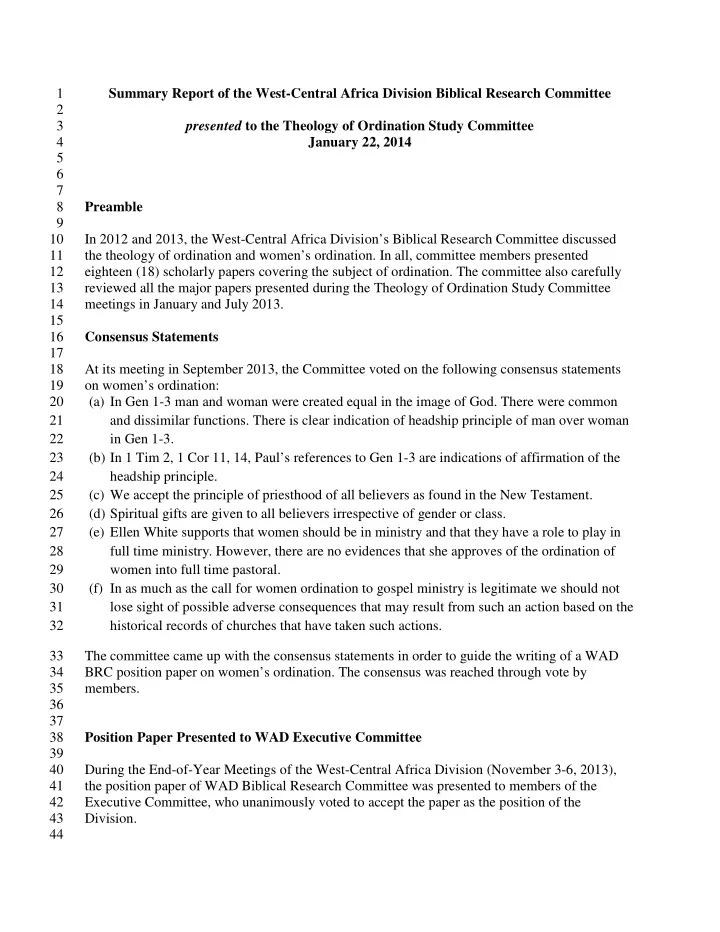
1 Summary Report of the West-Central Africa Division Biblical Research Committee 2 3 presented to the Theology of Ordination Study Committee 4 January 22, 2014 5 6 7 8 Preamble 9 10 In 2012 and 2013, the West-Central Africa Divisions


slide-1
SLIDE 1

Summary Report of the West-Central Africa Division Biblical Research Committee 1 2 presented to the Theology of Ordination Study Committee 3 January 22, 2014 4 5 6 7 Preamble 8 9 In 2012 and 2013, the West-Central Africa Division’s Biblical Research Committee discussed 10 the theology of ordination and women’s ordination. In all, committee members presented 11 eighteen (18) scholarly papers covering the subject of ordination. The committee also carefully 12 reviewed all the major papers presented during the Theology of Ordination Study Committee 13 meetings in January and July 2013. 14 15 Consensus Statements 16 17 At its meeting in September 2013, the Committee voted on the following consensus statements 18

  • n women’s ordination:

19 (a) In Gen 1-3 man and woman were created equal in the image of God. There were common 20 and dissimilar functions. There is clear indication of headship principle of man over woman 21 in Gen 1-3. 22 (b) In 1 Tim 2, 1 Cor 11, 14, Paul’s references to Gen 1-3 are indications of affirmation of the 23 headship principle. 24 (c) We accept the principle of priesthood of all believers as found in the New Testament. 25 (d) Spiritual gifts are given to all believers irrespective of gender or class. 26 (e) Ellen White supports that women should be in ministry and that they have a role to play in 27 full time ministry. However, there are no evidences that she approves of the ordination of 28 women into full time pastoral. 29 (f) In as much as the call for women ordination to gospel ministry is legitimate we should not 30 lose sight of possible adverse consequences that may result from such an action based on the 31 historical records of churches that have taken such actions. 32 The committee came up with the consensus statements in order to guide the writing of a WAD 33 BRC position paper on women’s ordination. The consensus was reached through vote by 34 members. 35 36 37 Position Paper Presented to WAD Executive Committee 38 39 During the End-of-Year Meetings of the West-Central Africa Division (November 3-6, 2013), 40 the position paper of WAD Biblical Research Committee was presented to members of the 41 Executive Committee, who unanimously voted to accept the paper as the position of the 42 Division. 43 44

slide-2
SLIDE 2

The paper overviewed the major biblical issues in the debate, including (1) headship in Gen 1-3; 1 (2) priesthood, prophetic ministry, and pastoral ministry; (3) the case of Deborah; (4) apostles, 2

  • verseers, and ordination; (5) headship in 1 Cor 11, 1 Cor 14, and 1 Tim 2; (6) “husband of one

3 wife” (1 Tim 3:2); (7) women, ministry, spiritual gifts and ordination; (8) the cases of Phoebe 4 and Junia; (9) the priesthood of all believers (Exod 19:4-6; 1 Pet 2:4-10; Rev 1:6; 5:10; 20:6); 5 and (10) Ellen White’s statements regarding headship and women’s ordination. 6 7 The paper concluded as follows: 8 9 Both Scripture and Ellen White seem to be consistent in their teaching of headship based on 10 Gen 2. What appears implicit in Gen 2 (before Fall) becomes explicit in Gen 3 (after Fall), is 11 taught in the New Testament (e.g., 1 Cor 11:2-16; 14:33-35; Eph 5:21-33; 1 Tim 2:11-15), 12 and affirmed by Ellen White (e.g., PP 46-57). The headship principle, being a creation order, 13 is applicable both in the husband-wife relationship at home and in the men-women 14 relationship in the church. This principle appears to have informed the selection of priests 15 (OT), apostles, overseers/elders (NT), and serves as the basis for Ellen White’s statements 16 with regards to spiritual leadership in the church. Women played several roles in the 17 covenant community both in the Old Testament (e.g., Miriam and Deborah) and in the New 18 Testament (e.g., Phoebe and Junia). Despite their engagement in ministry, however, Scripture 19 seems to be consistent in revealing that spiritual headship in the church is open to men who 20 meet certain other requirements for such function (e.g., 1 Tim 3). If the biblical portrait of 21 male headship is not influenced by pagan ancient Near Eastern culture, which we doubt, then 22 this principle should continue to guide the selection and ordination of individuals to pastoral 23 ministry today. 24 25 26 Recommendation 27 28 The West-Central Africa Division by consensus does not recommend the ordination of women 29 into ordained pastoral ministry. However, if at the General Conference Session the world church 30 votes in favor of women’s ordination, WAD will not threaten the unity of the church despite the 31 its disagreement to such a decision. Instead, we will consider women’s ordination as a matter of 32 conscience, and will continue to study and pray for light on the subject brighter than there is 33 now. 34 35 36 37 38 39 40 41 42 43 44 45 46

slide-3
SLIDE 3

Highlights from WAD-BRC Position Paper

1 2 Issues in the Old Testament 3 4

  • 1. Genesis 1-3

5 Gen 1 highlights the equality of man and woman; God creates them equal in nature (i.e., 6 image of God) and places stewardship responsibility on the two over the earth. Gen 2 speaks of 7 equality of man and woman as comparable partners but entrusts the man with leadership 8 responsibility within the human family. In Gen 3 the woman seems to take that responsibility 9 from the man (vv. 1-5, 12)—eating the fruit first and then having him eat next (vv. 6, 17)—and 10 drags the family into sin (vv. 7-8), but then God categorically reestablishes the headship of the 11 man over the woman (vv. 9-11, 16-19). This male headship principle in Gen 2-3 seems to serve 12 as the platform for male leadership attested in Scripture. Although both in Scripture and in 13 society male headship has been abused to the disadvantage of women, the headship principle has 14 its foundation in Scripture rather than paganism. The headship principle explains why Abraham, 15 not Sarah, is called and named the principal instructor in the family regarding the way of the 16 Lord (Gen 18:19). It explains why it is the patriarch who is the family priest (e.g., Gen 8:20; 17 12:7; 22:9). It also explains why it is men who serve in the army to protect wives and children 18 (Deut 20). Finally, it remains the best explanation for the selection of only males for the Israelite 19 priesthood, though this institution was further limited to a particular family (Exod 13; Num 3). 20 21

  • 2. Priesthood vs. Prophetic Ministry

22 We conclude that pastoral ministry shares similarities as well as marked differences with 23 both priesthood and prophetic ministry in the Old Testament and that pastoral ministry does not 24 constitute an exact replica of either of these ministry patterns. If neither priesthood nor prophetic 25 ministry is sufficient model for pastoral ministry, then a theology and practice of ordination 26 cannot be based on one of the Old Testament ministries or the other. Stated differently, neither 27 the Levitical priesthood nor the prophetic ministry provides enough basis for the inclusion or 28 exclusion of women from ordained pastoral ministry. 29 30

  • 3. The Case of Deborah

31 It appears that the Lord did not raise Deborah primarily as a deliverer-judge in Israel on 32 the same level as Othniel, Ehud, and Jephthah, for example. We find her judgeship to be 33 different in nature and scope from that of the other judges. Unlike these other judges who led the 34 Israelite army to battle, Deborah only encouraged Barak to take up the task of a deliverer-judge. 35 It follows that Barak was the judge in the true sense: he was ‘designated by the Lord Himself as 36 the one chosen to deliver Israel, and had received the assurance that God would go with him and 37 subdue their enemies’ [White, Daughters of God, 37] . . . In Judg 4-5, Deborah plays the role of 38 a prophetess rather than a judge. As the ‘mouth’ of God, she commands Barak to engage Sisera 39 in battle (4:6-7,14). She specifically calls herself a ‘mother in Israel’ (5:7)—a brave one! But 40 Barak does not request the presence of Deborah at the military camp because of her military 41 prowess but rather because she is the one through whom the Lord speaks (4:8). 42 The authority of Deborah to settle disputes would seem to result from her position as 43 prophetess instead of judge-deliverer. Her example does not violate the headship principle 44 established in Gen 2-3. As Ellen White states, Deborah ‘was known as a prophetess, and in the 45 absence of the usual magistrates, the people had sought to her for counsel and justice’ [ibid.] In 46

slide-4
SLIDE 4

any case, neither the office of the prophetess nor that of the judge was cultic to require an 1

  • rdination ritual, at least by humans. As it appears, Deborah’s example is does not give us

2 enough basis to conclude that women should be ordained into pastoral ministry. 3 4 Issues in the New Testament 5 6

  • A. Ordination in General

7 In the New Testament, we find ordination in relation to the appointments of the disciples 8 (Mark 3:13-15; Luke 6:12-13), Mathias (Acts 1:21-26), the Seven (Acts 6:1-7), Barnabas and 9 Paul (Acts 13:1-3), Timothy (1 Tim 4:14; 2 Tim 1:6; cf. Acts 16:1-3), and elders/overseers (Acts 10 14:21-23; 20:17,28; 1 Tim 5:17-22; Tit 1:5-9). While we do not find ordination of a “pastor” 11 (Greek poimen) in these passages, the position and responsibility of persons like Timothy and 12 Titus would seem to be equivalent to that of today’s ordained minister. We may infer from these 13 New Testament instances that ordination is necessary for the church, as there is the need to set 14 apart certain persons to take up special leadership responsibilities. The New Testament shows 15 that women were engaged in several kinds of ministries (e.g., Acts 9:36-43; 18:26; Rom 16:1-3, 16 6, 7, 12). However, in the instances of the church’s official appointment into leadership 17 ministries, we find none where a woman is specifically ordained. 18 19

  • B. 1 Cor 11; 1 Cor 13; 1 Tim 2; 1 Tim 3

20 21

  • 1. Summary

22 The New Testament seems incontrovertibly clear that in the home, the husband is the 23 head of the family (e.g., Eph 5:21-33; Col 3:18-19; 1 Peter 3:1-7). Some supporters of women’s 24

  • rdination believe that the husband is the head of the wife in the home, but that male headship is

25 a post-Fall institution and is limited only to marriage (Gen 3:16). It is interesting to observe, 26 however, that when Paul discusses headship and submission in Eph 5 he patterns husband’s 27 headship after that of Christ over the church and then supports his argument with statements 28 from Gen 2. If, as it appears, Paul finds the male headship principle as a reflection of Christ’s 29 relation to the church, then the same principle will naturally find expression in the church. And 30 Paul seems consistent: he does not limit the headship principle to the family but extends it to the 31 covenant community. In other words, he applies the headship principle in relation to church 32

  • rder and leadership and cites Gen 2 as theological grounds for his teaching (1 Cor 11; 1 Cor 14;

33 1 Tim 2). 34 35

  • 2. 1 Cor 11

36 Whatever cultural limitations the head covering practice may have, the main point of Paul 37 cannot be missed, namely respect for male headship. The juxtaposition of divine (God-Christ), 38 divine-human (Christ-man), and human (man-woman) relationships in the context of headship 39 makes amply clear that Paul finds the principle of male headship applicable in the church.1 And 40

1 For Paul, the man exercises headship responsibility not only in the home (Eph 5) but also in the church (1 Cor 11).

There is no need to insist that in 1 Cor 11:2-16 “man” and “woman” should be translated “husband” and “wife”

  • respectively. The second pair automatically includes in the first. And to say that the husband is head only of his wife

would mean also to read Paul as suggesting that Christ is head only of husbands, rather than men in general (cf. “every man,” v. 3). It is also not necessary to prolong the debate on whether kephale denotes authority or source in 1 Cor 11. When he states that God is “head” of Christ, Paul does not intend for us to understand that God is the source

slide-5
SLIDE 5

he further intimates that his instruction to the Corinthians is not an isolated instruction: “But if 1 anyone seems to be contentious, we have no such custom, nor do the churches of God” (v. 16). 2 3

  • 3. 1 Cor 14

4 In 1 Cor 11 Paul affirms that even though the woman may pray or prophesy in the 5 church, she must do so in full knowledge of the fact that the man is still the head. In 14:34-35, 6 the command that the women should not “speak” in church does not mean they could not offer 7 prayer or prophesy (chap. 11) or that they could not exercise their spiritual gifts (chaps. 12-14). 8 What Paul seems to correct in 14:33-35 is probably disruptive speech by some women in the 9

  • church. He hyperbolizes his disapproval of women “speaking” in church probably because the

10 behavior of the Corinthian women disregarded leadership and decorum in the church (14:37-40), 11 violating the male headship principle which he already sets forth in 1 Cor 11. Otherwise it is 12 difficult to explain why only women are addressed by the injunction. It is probably to the 13 headship principle—based on Gen 2-3—that Paul refers as “law” in 1 Cor 14:34. In sum, while 14 the command to keep silent in 1 Cor 14 does not mean women cannot exercise their spiritual 15 gifts in the church, the same needs to be understood within the male headship context of 1 Cor 16 11. 17 18

  • 4. 1 Tim 2

19 In 1 Tim 2 Paul addresses issues of proper worship and church order in the context of 20 man-woman relationship. His references to “learning,” “submission,” and “silence” of women 21 recalls 1 Cor 14:33-35. The general context of the passage suggests that the Ephesian church 22 faced tensions and possible divisions with regards to public worship and lifestyle, including 23 improper adornment and insubordination on the part of the women. After stating that prayer 24 should be offered for all people (vv. 1-7), Paul then “desires” that “the men pray everywhere, 25 lifting up holy hands, without wrath and doubting” (v. 8). For the women, Paul desires that they 26 “adorn themselves in modest apparel” (v. 9) and requires that they “learn in silence with all 27 submission” (v. 11). He would “not permit a woman to teach or have authority over a man” (v. 28

  • f Christ. What he ultimately implies is that Christ is the “Son” while God is the “Father”—and the Father exercises

authority over the Son. In the man-woman relationship, however, the man is the source of the woman (i.e., woman is created from and for the man, vv. 8-9) and exercises authority over her (i.e., “the head of woman is man,” v. 3). The man is head of the woman, but his exercise of headship responsibility must be done with the overall headship of Christ in view (Eph 5).

slide-6
SLIDE 6

12). The tone of the Paul’s injunction suggests that it should be considered prescriptive.2 The 1 meanings of the words “teach” and “authority” in 1 Tim 2:12 have been debated. Some may 2 assume that these words can be construed as a sort of hendiadys (cf. Matt 6:20), but the structure 3

  • f the Greek construction in v. 12 renders this assumption unlikely. Paul seems to have two

4 different things in mind. First, women are not to teach. The Greek didasko “teach” is the 5 common term used to describe transmission of doctrine in the church (1 Cor 4:17; 2 Tim 2:2). 6 Teaching is part of the gospel commission (Matt 28:19-20). Paul also refers to teaching as a 7 spiritual gift (1 Cor 12:27; Eph 4:11; Rom 12:7). While the gift of teaching is not gender- 8 specific, Paul particularly emphasizes teaching as a requirement of an overseer/elder (1 Tim 3:2; 9 Titus 1:9). Even though not everybody in the church may have the gift of teaching, an 10

  • verseer/elder must demonstrate a teaching ability. Yet it does not follow that anyone who has

11 the gift of teaching should become an overseer/elder. As we shall see in 1 Tim 3, Paul seems to 12 limit the office of the overseer/elder to qualified men, in spite of his awareness that it is the 13 prerogative of the Holy Spirit to endow believers with gifts or that any believer—male or 14 female—may be gifted with teaching ability. But Paul seems to require that an overseer/elder be 15 a teacher because teaching is a form of expressing leadership authority, at least in the faith 16

  • community. This perhaps could explain why he consistently on scriptural grounds requires

17 women not to teach but to assume a learner’s role in the church; to assume the role of a teacher is 18 to exercise authority or give spiritual direction. In view of the similarity in context and language 19

  • f 1 Cor 14 and 1 Tim 2, we may safely assume that “teaching” in 1 Tim 2 is equivalent to

20 “speaking” in 1 Cor 14. In both instances, Paul may not be excluding women from exercising 21 their spiritual gifts but may be requiring them to do so being fully conscious of the headship 22 principle, whereby men bear the primary leadership function of the church—guarding against 23 heterodoxy and upholding sound doctrine, among others. 24 The second part of Paul’s injunction is that women should not “have authority over men” 25 (1 Tim 2:12). The Greek authentein “to have authority” occurs only here in the New Testament, 26 leading to multiple scholarly conjectures. Scholars have assigned to the term nuances that may 27

2 Scholars have debated whether 1 Tim 2:11-12 is (1) descriptive, limiting Paul’s instructions to the Ephesian church

  • r (2) prescriptive, demanding a universal application. For Seventh-day Adventists, this question is particularly
  • significant. If we take the injunction against women’s teaching or exercising authority (vv. 11-12) to apply only to

the church at Ephesus, must we not then also take the instruction on adornment (vv. 9-10) to apply only to the Ephesian church? The unity of thought in 1 Tim 2:8-15 does not seem to allow for the application of different hermeneutical principles; the one and the same hermeneutical principle must guide the interpretation of the entire

  • passage. Several factors seem to require that the instructions of Paul in 1 Tim 8-15 be interpreted in a universal way.

First, both 1 and 2 Timothy show that not only women embraced false teachings nor were they the only ones susceptible to deceit; men actually propagated these false teachings (cf. 1 Tim 1:7, 18-20; 6:20,21; 2 Tim 3:6,7; 4:10-15). Consequently, it may be concluded that Paul did not address only women in 1 Tim 2:11-15 merely because of their susceptibility to heterodoxy. The basis for the injunction, as he himself gives, is biblical (Gen 2-3). Second, the words “I do not permit” (epitrepo) are too strong to merit only a temporary, local application. In 1 Cor 14, the same verb (epitrepo) appears in a similar context requiring women to submit to order and decorum in the church at Corinth. Third, Paul’s express desire that men pray “everywhere” lifting up holy hands (1 Tim 2:8) argues against limiting his instructions in 1 Tim 2 to the local church at Ephesus. Fourth, the biblical grounds for Paul’s instruction—male headship as creation order (Gen 2-3)—requires a universal application of 1 Tim 2:11-12. Finally, 1 Tim 3:13-14 clearly shows that the instructions to men and women in chap. 2 are meant for believers everywhere to know how to “conduct oneself in the house of God.”

slide-7
SLIDE 7

be negative (e.g., domineer) or positive (e.g., exercise authority). The immediate context is the 1

  • nly guide to understanding the word. It has already been suggested that teaching and authority

2 here do not necessarily refer to the same thing as in a hendiadys, though teaching is a form of 3 expressing authority. Interestingly in 1 Tim 2:12, the alternative to teaching and exercising 4 authority is “to be in silence” in accordance with Paul’s usual command (cf. 14:33-35). On this 5 basis, authentein does not need to be assigned a negative connotation. If “teaching” is not a 6 negative term in 1 Tim 2, “having authority” does not have to be construed otherwise. Had Paul 7 intended to silence those who domineered or abused authority, his injunction in v. 12 would 8 certainly have included some men rather than only women. We would then also have expected 9 Paul to address only those women who were thus domineering rather than generalize the 10

  • injunction. All told, Paul seems in this verse to rule that women are not to take positions of

11 headship or spiritual leadership in the church. 12 The specific issues in 1 Cor 11, 14, and 1 Tim 2 such as head covering, silence, and 13 teaching and authority are still debatable and cannot be fully treated in this study. Nonetheless, 14

  • ne fundamental principle seems to underlie Paul’s instructions to women in each of these texts:

15 male headship as a creation order (Gen 2). Among other things, some have argued that Paul 16 appeals to creation—“for Adam was formed first, then Eve”—in 1 Tim 2 not to present a male 17 headship principle but simply to correct a prevailing female superiority ideology associated with 18 the cult of Artemis. In other to maintain such understanding, they suggest that the Greek 19 conjunction gar “for” in v. 13 has explanatory (i.e., for, you see) rather than causative (i.e., for, 20 because) function. This argument does not seem to hold, given that Paul refers not only to the 21 priority of Adam in creation sequence (Gen 2) but also to the Fall of the human race through the 22 deception of Eve (Gen 3). If Paul was concerned only with correcting an ideology about creation 23 sequence, he would not need to insist that a woman “will be saved through childbearing” (v. 15), 24 whatever that means! The reference to “childbearing” as a woman’s primary responsibility, 25 coupled with the injunction that women should not “teach” or “have authority over men” but 26 “learn in silence,” implies that Paul is concerned with something more than just a pagan 27

  • ideology. He seems to be concerned with the headship principle, which he finds in Gen 2-3.

28 29

  • 5. 1 Tim 3

30 The locus of scholarly discussion in 1 Tim 3 seems to be the injunction that the overseer 31 must be “husband of one wife” (v. 2). The immediate context—a list of qualities rather than 32 statuses—as well as variations of the phrase in v. 12 (“husbands of one wife,” also Tit 1:6) and in 33 1 Tim 5:9 (“woman of one husband”) implies that by his use of these phrases Paul does not 34 necessarily have polygamy or polyandry in mind. But can “husband of one wife” refer to a 35 woman? In this phrase, it seems clear that aner and gyne are gender-specific; when Paul refers to 36 the overseer as “husband of one wife” he definitely has a male in mind, and vice versa with 37 “wife of one husband.” Stated differently, Paul does not include females in the one-wife-husband 38 qualification for overseers/deacons (1 Tim 3:2, 12) any more than he includes males in the one- 39 husband-wife qualification for widows who should receive support from the church (5:9). 40 Further, if by gunaika (women) in v. 11 Paul has in mind women deacons in contrast with 41 diakonoi (male deacons), then the lack of a distinct reference to women in vv. 1-10 is an 42 indication that here only male overseers are in view. Among the alternative suggestions, it seems 43 more probable that Paul’s theology of male headship, as demonstrated in 1 Cor 11:2-16, 14:33- 44 35, and 1 Tim 2:11-15, provides the guiding principle for his exclusion of women from officially 45 appointed headship positions of the church which require ordination. From 1 Tim 3, we conclude 46

slide-8
SLIDE 8

that spiritual leadership in the church is a function entrusted to men who have faithfully 1 demonstrated their role as spiritual heads in their families. 2 3

  • C. Women, Ministry, Spiritual Gifts, and Ordination

4 5

  • 1. General Observations

6 Paul teaches clearly that spiritual gifts are given to believers for ministry (Romans 12:3- 7 8;1 Cor. 7:7;12-14; Eph 4:8-12). Both male and female believers receive gifts, and it is the 8 prerogative of the Spirit to endow the believer with the gift(s). We can cite a number of women 9 in the New Testament who engaged in ministry, for example Anna (Luke 2:36-37), Mary 10 Magdalene (Luke 24:9-11), Dorcas, Lydia (Acts 9:36-43), daughters of Philip (Acts 21:9), 11 Priscilla (Acts 18:1, 18, 26; Rom 16:3), Phoebe (Rom 16:1), Mary (16:6), Junia (v. 7), Tryphena, 12 Tryphosa, and Persis (v. 12). These women played a variety of supportive roles in the ministries 13

  • f Jesus and the apostles. Without doubt, they received the gifts of the Holy Spirit and put their

14 gifts to use for the benefit of the church in various ways. However, there is no evidence that any 15

  • f these women exercised headship function in the church as we find elders/overseers do (e.g.,

16 Acts 20:17,28; 1 Tim 3:1-7; Tit 1:5-9; 1 Pet 5:2). We noted already that (1) it is not mandatory 17 that the church ordains everyone who exhibits the gift of teaching as an elder/overseer and that 18 (2) while Paul teaches that “some” have been given the gift of pastor-teacher, he seems to limit 19 the office of the elder/overseer to men. Moreover, ordination is not required before one can 20 exercise his or her spiritual gift, otherwise we might ordain everybody in the church. In 1 Tim 3 21 and Tit 5 where Paul lists the qualifications of overseer/elder, for example, the list does not 22 explicitly include a spiritual gift, though this may be assumed. The implication is that possession 23

  • f a spiritual gift—say pastor-teacher (Eph 4:11)—does not automatically satisfy the criteria

24 Paul outlines for the position of overseer/elder. It does not follow, therefore, that since women 25 can be given any spiritual gift including that of the pastor-teacher (Eph 4:11)—should we want 26 to equate this gift with the office of overseer/elder—they must equally be ordained into pastoral 27

  • ministry. The principle of headship, which Paul consistently upholds and applies, means that

28 men are eligible for ordination into spiritual headship positions. Thus, while Paul indicates that 29 the Spirit endows believers with gifts according to His will, he teaches also that some positions 30 in the church are reserved for men. It is in this context that we should understand the ministries 31

  • f Phoebe and Junia, two women who are described as “servant/deacon” and—it seems—

32 “apostle” respectively (Rom 16:1, 7). 33 34

  • 2. Phoebe

35 Phoebe was a diakonos “servant/deacon” and “patron” of many believers including Paul. 36 She may have been very helpful in the church in Chrenchea and Paul is asking that she be 37 received and given the needed assistance by the church in Rome. The word diakonos generally 38 means “servant” (Matt 20:26; 22:13; Rom 13:4), but as a technical term it means “deacon” (e.g., 39 1 Tim 3:8-13). A “deacon” was an appointed officer in the church, who may have performed 40 their duty under the supervision of the elder/overseer (Phil 1:1; 1 Tim 3:8-16). It is possible to 41 read gunaika “women” in 1 Tim 3:11 as a reference to female deacons rather than “wives” of 42

  • deacons. First, gunaika are referred to in a context where Paul discusses the qualifications of

43 “deacons” (vv. 8-12). Second, Paul shifts to discuss qualifications of gunaika with the adverb 44 hosautos “likewise” (cf. v. 8), meaning probably that he uses diakonoi and gunaika to refer to 45 deacons of opposite genders. Third, Paul seems to use gunaika to describe female deacons 46

slide-9
SLIDE 9

because there was no feminine form for diakonos and using diakonoi in v. 11 would blur the 1 distinction he makes between male and female deacons. It would thus appear that the New 2 Testament church recognized the role of women in the supportive office of deacon. The office of 3 the deacon, however, is clearly distinguished from that of the overseer/elder in 1 Tim 3. We 4 cannot be certain about the meaning of diakonos in Rom 16:1, but we may conclude that even if 5 Phoebe was “deacon,” and 1 Tim 3:11 could possibly refer to female deacons, her function in the 6 church should not be equated with that of the elder/overseer. 7 8

  • 3. Junia

9 Rom 16 contains a long list of greetings from Paul to individuals in the church in Rome. 10 Among these are Andronicus and Junia (v. 7), probably a couple, of whom Paul either says were 11 “outstanding among the apostles” (NASB) or “well known to the apostles” (ESV). Despite the 12 challenge in translation, there is some indication in the context to consider “apostle” here not in 13 the technical sense of the term. The fact that Paul mentions Andronicus and Junia somewhere in 14 the middle of the long list would suggest that the couple were among ordinary church members. 15 We are not to assume that these were resident “apostles” in Rome on an equal status with Paul, 16

  • therwise he would treat them differently rather than list them among the string of church

17

  • members. Subsequently, an ambiguous and non-technical reference to a couple as “apostles”

18 cannot be used as a scriptural basis for the ordination of women into pastoral ministry. 19 20

  • D. Priesthood of All Believers

21 The New Testament contains some references to Christian priesthood. In the first place, 22 the book of Hebrews indicates that the Aaronic priesthood prefigured the sacrificial death and 23 ministry of Jesus Christ. As such, He is the “High Priest of our confession” (Heb 3:1). Paul also 24 seems to picture himself as a priest, whose offering is the Gentiles (Rom 15:16). Christians are 25 referred to as a “royal priesthood” (1 Pet 2:4-10) and “kings and priests” (Rev 1:6; 5:10; 20:6). 1 26 Pet 2 specifically recalls Exod 19, where Israel was inaugurated at Sinai as a people of God. In 27 Exod 19:4-6, the Lord stresses the fact that He redeemed Israel from Egypt in order to make her 28 His own, and that if Israel obeyed Him they would be a “kingdom of priests” and a “holy 29 nation.” When Peter echoes Exod 19, he does so within a similar context (1 Pet 2). Like Israel 30 delivered from Egypt (Exod 19:4), believers have been redeemed by Christ (1 Pet 2:1-4, 10). 31 They “once were not a people but are now the people of God, who had not obtained mercy but 32 now have obtained mercy” (v. 10). In v. 5, he states that Christians are “living stones … being 33 built up a spiritual house, a holy priesthood, to offer up spiritual sacrifices acceptable to God 34 through Jesus Christ.” Here, “holy priesthood” is appositive to “spiritual house.” Yet unlike the 35 Jews to whom Christ became a stumbling block, Christians are “a chosen generation, a royal 36 priesthood, a holy nation” (v. 10). In this context, the concept of priesthood is defined in relation 37 to unbelievers, just as Israel was selected from among the nations in the world. The phrases 38 “holy priesthood,” “spiritual house,” “chosen generation,” “royal priesthood,” and “holy nation” 39 are synonymous. They all mean that Christians as a “special people” called out of darkness to 40 proclaim the gospel (v. 10). So Peter does not really go beyond Exod 19; he applies God’s 41 promise in Exod 19 to Christians. If the Exod 19 promise did not envision every Israelite 42 becoming a priest,3 1 Pet 2 does not either. Some emphasize the concept of the priesthood of 43

3 Some have suggested that God intended to make all Israelites—men and women—as priests but then because of

their disobedience (Exod 32), He selected only the family of Levi to serve as priests. Such argument, despite its widespread acceptance, is not to be pressed too hard. If the Levites were chosen because they stood on the Lord’s

slide-10
SLIDE 10

believers to mean that every believer can be ordained into the office of a pastor. But even within 1 the chosen tribe of Levi in the Old Testament, for example, there were differences in function; 2

  • nly the sons of Aaron could be priests, the others played supportive roles (i.e., Levites). Several

3 factors further suggest that Peter does not intend to teach that both men and women could now 4 assume spiritual headship responsibility because they equally share in a holy or royal priesthood. 5 First, 1 Pet 2 discusses nothing about church leadership, so it is out of context to discuss 6

  • rdination based on this text. Second, despite his teaching of a priesthood of all believers, Peter

7 recognizes clearly holds that even in the church husbands are heads of their families, including 8 their wives (1 Pet 3:1-7). Like the “holy women” in the past (e.g., Sarah), women are exhorted to 9 be “submissive” to their husbands (vv. 5-6), who, in turn, are to give honor to their wives (v. 7). 10 In other words, the priesthood of all believers does not bring about a change in male headship. 11 And Paul certainly does not disregard such priesthood when he teaches that spiritual headship is 12 a responsibility of men (1 Cor 11:2-16; 14:33-35; 1 Tim 2:2-15; 3:1-15). Third, the priesthood of 13 all believers does not undo the multiplicity of ministries that the Holy Spirit enables believers to 14

  • undertake. Within this priesthood in which all Christians share, each believer is still endowed

15 with some spiritual gift(s) to engage in a different kind of ministry. The priesthood of believers is 16 nowhere presented to supersede the headship principle which Paul consistently understands to 17 bear directly on spiritual leadership in the church. 18 In the book of Revelation, John states that Christ has washed believers in His blood and 19 has made them “kings and priests” (1:6). The four living creatures and the twenty-four elders 20 also refer to themselves as “kings and priests to our God” who shall “reign on the earth” (5:9). 21 Also those who have part in the first resurrection are referred to as “priests of God and of Christ” 22 who shall rule with Christ “a thousand years” (22:6). The contexts of these references associate 23 kinship and priesthood with rulership, at least in two instances (5:10; 20:6). But as in Exod 19 24 and 1 Pet 2, the priesthood of believers is defined in relation to the world. Thus, the key 25 emphasis is that Christ has redeemed His people (i.e., believers) and, through that, they have 26 become royals with Him. There is nothing in the priesthood passages to suggest that after the 27 death of Christ both women and men may be appointed to positions of headship or leadership in 28 the church. Whether in 1 Peter or in Revelation, priesthood of believers does not address the 29

side, why was Aaron maintained as priest when he was directly responsible for the making of the golden calf (Exod 32:1-5; Deut 9:20)? Even if we assume that God intended for all Israelites to serve as priests, the question as to why women in the tribe of Levi were still left out is not answered. In the Hebrew, the phrase “holy nation” stands in apposition to “kingdom of priests.” This means that since “holy nation” is corporate, “kingdom of priests” should equally be understood in a corporate sense. We are not to interpret the passage to mean that every Israelite was to become a priest. In a corporate sense, “kingdom” of priests may mean that Israel as a “holy nation” would be the means of blessings to the Gentiles (cf. Gen 12:1-3). It does not mean that the Lord would no longer choose spiritual leaders in Israel. We find clues to this in Exod 19-31. First, in the same chapter where God promises to make Israel a kingdom of priests, He makes references to “the priests and the people” (Exod 19:22, 24). Second, the Lord named Aaron and his sons as priests before the rebellion (28:1,41; 29:1, 44; 30:30; 31:10). These references to “priests” as well as “elders” (e.g., 17:5; 19:7; 24:1) suggest the Lord may have intended to have some individuals serve as spiritual heads in Israel, notwithstanding its position as a “kingdom of priests.” Moreso, as we noted earlier, the selection of the Levite males for service in the tabernacle is connected with the concept of the male firstborn (Exod 12:29; 13:1-15; Num 3:12-13; 8:16-18). Since the Lord replaced the male firstborns with the Levite males in the service of the tabernacle, we can only assume that these firstborns would have performed the priestly duty in Israel. It is not true, therefore, that the Lord abandoned an original all-inclusive priesthood to appoint one family because Israel disobeyed God. Such understanding does not explain why even within the tribe of Levi only the sons of Aaron (who was primarily responsible for the rebellion in Exod 32) could become priests, with the others helping the priests.

slide-11
SLIDE 11

issue of leadership in the church. It does not answer whether women now can be chosen as 1 spiritual heads of the church, not even whether the church should appoint leaders at all. 2 3

  • E. Ellen White, Headship, and Ordination

4 Ellen White indicates that at creation the man, Adam, was given some responsibility as 5 head of the human family. According to her (1) Adam “was lord in his beautiful domain” (FE 6 38); (2) he was “the monarch of the world” (RH, February 24, 1874, par. 19), “crowned king in 7 Eden” and made “the rightful sovereign over all the works of His hands” (1BC 1082); (3) he 8 “was to stand at the head of the earthly family, to maintain the principles of the heavenly family” 9 (6T 236); (4) as the “vicegerent of the Creator” (DA 129), God committed His laws to “Adam, 10 the father and representative of the whole human family” (PP 48). These references, among 11 many others, suggest that Adam was given some leadership responsibility in the garden. In his 12 relationship with Eve, Adam also exercised a headship responsibility. White specifically states 13 (1) that the woman was created “to stand by his side as an equal, to be loved and protected by 14 him” (PP 46); (2) that “the angels had cautioned Eve to beware of separating herself from her 15 husband while occupied in their daily labor in the garden; with him she would be in less danger 16 from temptation than if she were alone. But absorbed in her pleasing task, she unconsciously 17 wandered from his side” (PP 53); (3) that Adam “mourned that he had permitted Eve to wander 18 from his side” (PP 56) and “reproached his companion for her folly in leaving his side and 19 permitting herself to be deceived by the serpent” (PP 57). Interestingly, White remarks further 20 that Satan was able to cause “the overthrow of Adam” only through Eve (PP 57). We find these 21 statements as affirmation that the man exercised both physical and spiritual leadership in the 22 garden. 23 Despite some claims that she herself was ordained, it has been argued that White carried 24

  • nly ministerial license without being ever ordained into the office of the pastor. However, she

25 recommends the ordination of women into different forms of ministry as clearly stated in RH 26 July 9, 1895. For Ellen White, women have roles to play in full time ministry as she approves of 27 the ordination of women into several ministries. There is no evidence from her writings, 28 however, that she approves of the ordination of women into full time pastoral ministry. 29 30