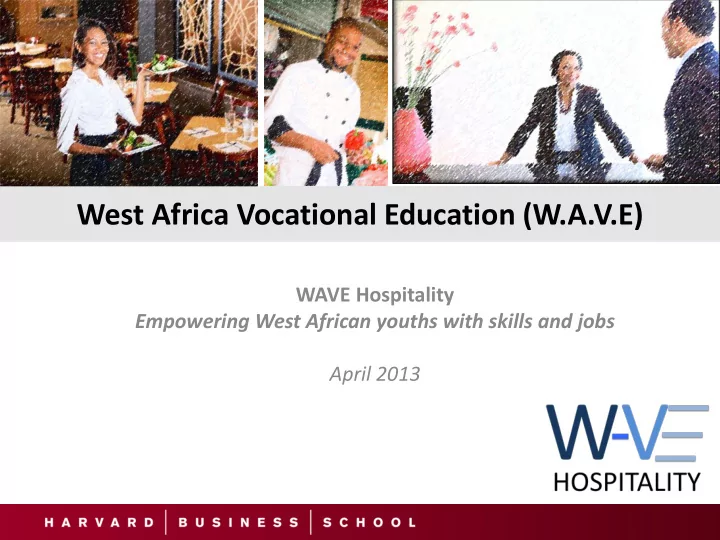
West Africa Vocational Education (W.A.V.E) WAVE Hospitality - - PowerPoint PPT Presentation
West Africa Vocational Education (W.A.V.E) WAVE Hospitality Empowering West African youths with skills and jobs April 2013 Over 300 million people, 15 countries, over 43 million unemployed youth (aged 15-30) across West Africa Senegal: 49%
Over 300 million people, 15 countries, over 43 million unemployed youth (aged 15-30) across West Africa
Source: African Economic Outlook, allAfrica.com, ILO, IYF reports
Nigeria: 42% Youth unemployment Conakry, Guinea: Youth
unemployment among graduates > 66%
Senegal: 49% national unemployment Liberia: Youth unemployment > 85% Abidjan, Cote d’Ivoire: 35% Unemployment Accra, Ghana: 25% unemployment Sierra Leone: Youth unemployment > 60% Gambia: Youth
unemployment >
40%
Beyond the statistics are real faces…
However jobs are being created…with the retail & hospitality sector projected to generate 8.8 – 13 million stable jobs by 2020
Meet Friday
JOB
- 25 years old
- Lives on < $2/day
- No college education
- Limited /no soft or technical skills
- No networks/connections
- Resilient, flexible, creative thinker
- Chronically unemployed and
locked out of the formal economy
Today’s Reality
- Entry-level frontline job
that leverages innate abilities
- Learning a range of
technical, business and life skills
- Stable growing income
- Responsibility,
professional growth + Career advancement
Tomorrow’s Promise “I hope to build a stage that is mine, and have my future”
Meet Ada, HR Manager of Wheatbaker Hotel
- Sizeable recruiting and training
budget
- No efficient way to vet for soft
skills when recruiting…emphasizes work experience as a proxy
- Customer service becoming a
bigger problem as competition Lack of critical soft skills hindering staff performance “Staff unable to preempt situations (when customers have unscripted need)” “We were having generator issues and the staff weren’t good about communicating with hotel guests about the power issue” “The customer wanted a refund after a bad experience…but our staff did not know how to escalate the situation to upper management…customer was extremely frustrated”
“I am looking for new ways to hire people whose skills match my needs”
Screening
- Emotional
Intelligence (EQ) assessments to determine actual skills base
- Levels the playing
field for Friday Training
- Training modules
tailored to industry needs
- Up-skills Friday to
prepare him for relevant jobs Placement
- Paid
apprenticeships & placement partnerships with employers
- Gives Friday the
leg-up during the job search Continuous learning
- Data-tracking and
performance monitoring of on- the-job learning
- Supports Friday’s
learning on-the- job
Introducing
We up-skill West African youth to fill employment gaps in high job-creating sectors such as hospitality & retail sectors
50,000 WAVE youth trained in marketable skills to reach their true potential and supported in stable jobs Average WAVE Alumni would have experienced increased income of 2-3x …Converting Africa’s youth from demographic liabilities to “demographic dividends”
By 2018…
Cost Relevance Quality Convenience
WAVE’s Unique Value Proposition
Can I get in?
Government- led institutes, e.g. NIHOTOUR Private sector programs, e.g. WaveCrest Placement / Recruiting agencies In-house HR
Considerations for the average trainee Access
Can I afford it? Will I get a job? Will I learn useful skills? Will it fit my schedule?
WAVE
Low Medium High
How will we deliver?
Training Placement Continuous learning Screening
- Employer-driven EI
assessment tool
- Based on group
exercises, role plays & visual tests
- Basic literacy &
numeracy tests
Lean, data-driven, highly-efficient delivery mechanism
- Industry-centric
curriculum design
- In-class and
mobile/online- based learning
- Instructor training
- Program cycles (2-
3 weeks)
- Class size (60:1)
- Partnerships with
strategic employers + training for their current employees
- Fast-track placement
available to top- performing trainees
- Ongoing support for
un-placed trainees
- Top-up training
modules
- Ongoing database
- f talent/skills and
employer role requirements
- KPI monitoring
Go-to-Market Approach
Stage 1
- Target youth clusters (e.g.
youth groups, non-profits)
- Brand-building social +
traditional media
- Target smaller hotels /
retailers with limited recruiting $$
- Leverage personal
networks
- Build preferred supplier
status
“Low-hanging fruit”
Stage 3
- Leverage public sector
and social impact partnerships
- Target multi-chain multi-
sector conglomerates with scale economies
“Partner for Scale”
Stage 2
- Pull strategy based on
results – placement success and income transformation
- Target larger employers
- Introduce new offerings
for hotels, e.g. plug-and play software
“Establish Credibility”
Trainees Employers
WAVE offers two paths for potential trainees
Training Training + Support
- $60 upfront per trainee
- Self-directed trainee
job search
- Paid job
placements to develop technical skills
- $70-80
additional fee from first paycheck
- $150 employer
charge
Guaranteed Placement
2 1
- $80 upfront per trainee
- Job search support
(interview facilitation)
- Problem-solving
- Critical thinking
- Expectations
management
- Communication
- Job readiness
- Team work
- Negotiation
- Literacy (grammar)
& numeracy
Top 50th percentile of trainees
Bottom 50th percentile Ongoing job support through access to WAVE job database
What we’ve done so far to test our major assumptions
Customer Value Proposition Tech, Ops & Management Go-to-Market Profit Formula
- 5 ‘prototype’
training sessions
- Focus groups to
understand motivations
- Curriculum
development
- Learning techniques
- EI testing
- Performance
measurement
- Effectiveness of
social media + mobile-based marketing vs. traditional marketing
- Youth + Employer
Willingness-to-Pay Payment features
- Hotels, restaurants
+ retail partners signed Summer Pilot
- July 2013
- 2-3 weeks
- 30-40
students Hypothesis Testing
- March
2013
- 5 days
- 100
students
WAVE Team is uniquely poised to deliver
Misan Rewane (HBS)
- Strategy + Operations experience
in education/ youth development
- Monitor Group, TechnoServe,
Bridge Int’l Academies
- (Nigeria, Cote d’Ivoire, Kenya)
Bryan Mezue (HBS)
- Social Enterprise operations
- BOP consumer marketing
- Bain & Co, dLight, Actis
- (Nigeria)
Karan Chopra (HBS)
- Startup Fundraising and
Operations Experience
- McKinsey & Co, GADCO
- (Ghana, Ethiopia)
Navid Rahimi (HBS)
- International development
- Secondary education
- World Bank, Global Good of
Intellectual Ventures
- (Togo)
Deep Understanding of the local context
Modupe Fadugba (HGSE)
- Curriculum Development +
technology
- Education start-up
- African University of Sci & Tech
- (Togo, Nigeria, Tanzania)
DongGun Sim (HGSE)
- Human Development
and Psychology
- (Uganda, South Africa)
1 2 Ability to Execute in Africa
“We are the counterfactual”
3
Engagement with Advisors and Partners
Technology
Institute for Venture Design
- Mobile recruitment and
web-centered learning companies
Emotional Intelligence
- Emotional intelligence
experts, psychologists and career assessment platforms
Curriculum Development
- Best-in-class customer
service excellence and hospitality experts
- Prof. Anita Tucker, HBS; Prof. Vincent Magnini, Cornell Center for Hospitality Research
M.A.D. Hospitality
Job Placements
- Commitments for
placements from 5 hotels and 1 apparel retailer
Strategic Partnerships
- Industrial Training Funds
- Government training schemes
- Graduate Internship schemes
- Vocational education
government programs
Program Level Economics
- Attractive program level economics: each course program has ability to generate strong EBITDA
returns ($90k per program)
- Key financial drivers identified and tested: through MVP and fieldwork, 4 of the 6 critical assumptions
have been tested; other drivers will be tested in the pilot
- Unit economics will improve with scale: current economics do not factor in scale benefits (multiple
programs with same overhead) and other revenue streams (e.g., training existing employees)
Program Level Economics (USD) At scale of 3 program office Conservative Base Case Optimistic Level of Certainty Trainees per Program 60 60 60 High Program length (weeks) 3 3 2 Low Trainee : Teacher ratio 30 30 30 High Trainee Fee (per Trainee not Placed) $50 $70 $70 High Trainee Fee (per Trainee Placed) $110 $150 $150 High Employer Fee (per Trainee Placed) $110 $150 $150 Medium Annual number of trainees 960 960 1440 Annual Revenue per Program $129,600 $177,600 $266,400 Rent $15,000 $15,000 $15,000 Teacher Salaries $23,333 $23,333 $23,333 Staff $30,500 $30,500 $30,500 Admin (including BD, Marketing) $18,773 $18,773 $13,993 Cost per Office $87,607 $87,607 $82,827 Annual Cost per Program $29,202 $29,202 $27,609 Annual EBITDA per Program $41,993 $89,993 $183,573 % of revenue 32.4% 50.7% 68.9%
Scaling & Funding Plan
- Scalable and Sustainable Model : break-even in year 3 with strong revenue growth and margins from
driving high asset utilization and leveraging technology
- Funding Requirement: $400,000 of initial capital required
- $50,000 New Venture Prize Winning to cover content development and July pilot
- ~$150k for technology platforms (training + placement), instructor recruiting/training
- ~$200k for operating expenses (salaries, rent, customer acquisition, business development)
In 5 years, WAVE aims to:
- Empower ~50,000 trainees with marketable soft skills
- Create ~$27M of incremental wealth amongst disadvantaged youth
- Build a model that is replicable across sectors and geographies
Wave Projections Year 1 Year 2 Year 3 Year 4 Year 5 Revenue $35,366 $492,441 $1,411,838 $3,017,102 $6,817,466 Net income ($118,681) $80,738 $402,427 $925,859 $2,210,360 Cash surplus / (Deficit) ($307,631.6) $72,644 $394,696 $887,290 $2,182,823 Number of students trained 300 2,240 5,760 14,400 25,920 Number of students placed 150 1,120 2,880 7,200 12,960 Estimated Income Transformation $162,000 $1,209,600 $3,110,400 $7,776,000 $13,996,800
Rigorous Testing and Performance Measurement
Business & Operating Model Social Impact Key Driver Performance Indicator
- Effective customer acquisition (both
trainees and employers)
- Customer acquisition cost
- Application and enrollment
- Value proposition for trainees
- Trainee placement rates
- Value proposition for employers
- Performance of “WAVEr” relative to existing staff
- Placement departure rate (% fired within apprenticeship
phase)
- Employer retention rate + placement allocation to WAVE
- Unit economics for each student,
program and office
- Contribution margin
- Cost per placement
- Overhead cost
- Youth employment opportunity
- Number of people trained
- Trainee retention rate
- Number of trainees directly placed
- Number of trainees indirectly placed*
- Income transformation
- Increase in income (pre and post)
- Increase in skills and preparedness
- Soft skills and job readiness assessment (pre and
post WAVE training)
Constant and rigorous testing, refining and measurement of key drivers
- f business and impact model
- Indirect placement through WAVE-facilitated interviews or mobile recruitment app