1 Recommendations 1. GOVERNANCE 1.a Health Management Cadre: - - PDF document

1 recommendations 1 governance 1 a health management
SMART_READER_LITE
LIVE PREVIEW

1 Recommendations 1. GOVERNANCE 1.a Health Management Cadre: - - PDF document

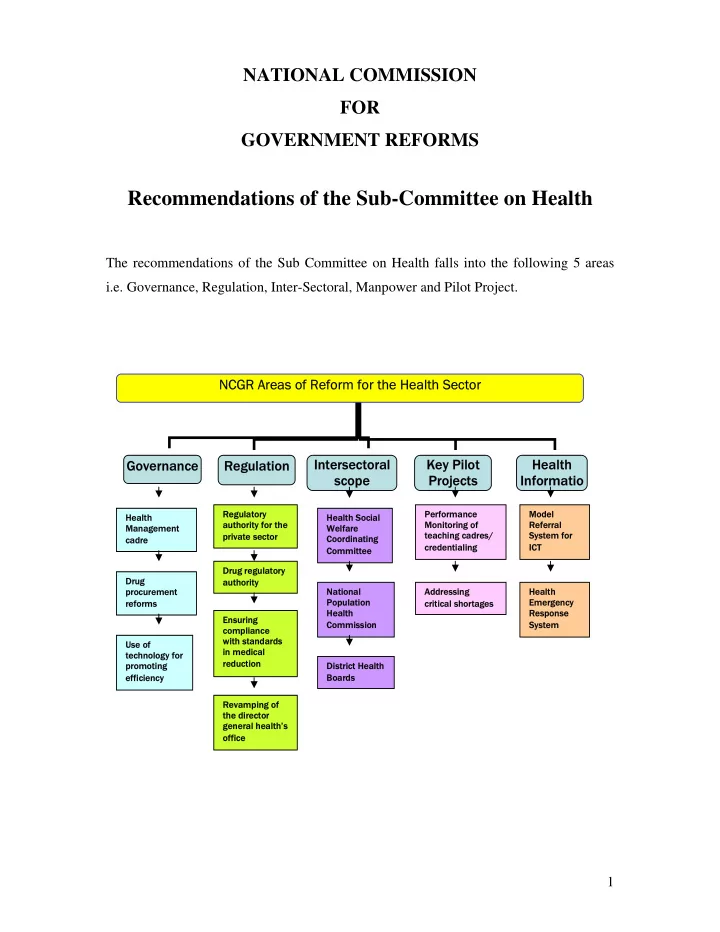
NATIONAL COMMISSION FOR GOVERNMENT REFORMS Recommendations of the Sub-Committee on Health The recommendations of the Sub Committee on Health falls into the following 5 areas i.e. Governance, Regulation, Inter-Sectoral, Manpower and Pilot


slide-1
SLIDE 1

NATIONAL COMMISSION FOR GOVERNMENT REFORMS

Recommendations of the Sub-Committee on Health

The recommendations of the Sub Committee on Health falls into the following 5 areas i.e. Governance, Regulation, Inter-Sectoral, Manpower and Pilot Project. NCGR Areas of Reform for the Health Sector NCGR Areas of Reform for the Health Sector Inte tersecto rsectoral ral scope scope Key Pilo Key Pilot t Projects Projects Hea Health th Informat Informatio io Gove Governa rnance nce Regulation Regulation 1

Regu Regulatory tory auth author

  • rity for

ity for the the pri private ate s sect ctor Performa Performance nce Moni Monito tori ring o ng of teac teaching cad hing cadres/ es/ crede credentia tialing ing Mo Mode del Referral Referral Sy System for stem for ICT ICT Heal Health th So Soci cial al Welfare Welfare Co Coor

  • rdin

dinating Comm mmittee ittee Drug re ug regulat gulatory ry auth author

  • rity

ity Dr Drug procurement procurement ref reform rms Nati National al Po Populati tion

  • n

Heal Health th Co Comm mmissi ssion Addre Addressing ng cr crit itica ical sh shortage

  • rtages

s Heal Health th Emer Emergency gency Resp spon

  • nse

se Sy System stem Ens Ensuring ng co compli liance wi with s standards in med in medical cal reduct reduction ion Us Use o e of tec technology f nology for promot

  • moting

ing eff efficiency ency Dis Distri rict H Heal alth Bo Boards ds Heal Health th Manage Management ment cadre cadre Revamp Revamping o g of the the director director gene general hea ral health’ th’s

  • f
  • ffi

fice ce

slide-2
SLIDE 2

Recommendations

  • 1. GOVERNANCE

1.a Health Management Cadre:

Situation Analysis Improving governance in health and reconfiguring the stewardship role of the government is the single most important factor in improving health outcomes. This is so for two reasons; firstly, the bulk of health service delivery, especially essential health services must be provided by the state and secondly because the state also has the responsibility to regulate the delivery of health services by the private sector. However, as opposed to this, it is widely established that there are many gaps in these areas. The absence of a health management cadre has led to serious inefficiencies in the delivery of health care at all levels. As promotions of medical staff to higher grades are linked to management positions such as Medical Superintendents, Executive Directors of Hospitals there is a misallocation of human resources. Given the complexity of running a facility every medical doctor cannot be expected to perform the functions of logistics, finance, operations, human resources etc. Aptitude and management skills are needed in addition to technical knowledge. Recommendations:- It is proposed that s separate Health Management Cadre be established by each Provincial Government to provide duly trained and experienced managers for administrative/ managerial posts in hospitals and institutions in development projects/ programmes and District and Provincial health administration. The persons selected to man this cadre would fill in all positions of administrations of Tehsil, district, teaching and specialized health cadre facilities, DDOs and EDOs Health and other management positions in the Provincial Health Department. An open, transparent, merit based system of recruitment and satisfactory completion of mandatory training at different levels would be used to select the persons in this Cadre. 2

slide-3
SLIDE 3

3 This Cadre would be different from the Clinical and Teaching Cadre with its own career progression path. The members of other cadres in health and outside professionals can compete for entry into this cadre provided they meet the eligibility criteria. It is not obvious that there will be a minimum critical mass of posts at the Federal Government that can justify the creation of a separate management cadre. The few Federal institutions and projects should openly advertise the jobs with eligibility criteria and select the best available management talent in the country. Recruitment rules should allow both internal and external recruitment. However, all senior level management positions should be advertised and selections should be based

  • n merit. The recruitment rules for direct appointments in the Management Cadre should

include the qualifying degree of MPH or equivalent. For Promotion, course at National Health Academy as well as provincial health academies should be instituted with a common content. For higher management posts, eligibilities should include training courses at School of Public Policy (Senior Management and National Management Course). The above principles should also apply as and when Direct Cadres are created in the health sector for management related posts. Since it may take some time before qualified individuals are available, management cadre may be introduced in a phased manner. Within the structure of the new management cadre, reforms centered on good governance, accountability, and performance monitoring should be institutionalized and safeguards may be built against political and external interference, albeit while building appropriate incentives.

slide-4
SLIDE 4

1.b Strengthening Governance

Situation Analysis The Ministry of Health (MoH) is the principal state agency at the Federal level mandated with a policy making, regulatory and normative role in the health sector. Although, health is a provincial subject with responsibility for service delivery now devolved to the districts after the passage of the Local Government Ordinance 2001, the Ministry of Health still retains a key overarching role in the areas of policy making, donor coordination, regulation of healthcare providers, inter-provincial coordination and support through the public health programs. Despite this mandate, the capacity of the Ministry of Health is weak in many areas. The Ministry of Health has many allied, attached and subordinate institutions, which either have a reporting relationship with the MoH or the MoH has a key role in their governance arrangements. The Ministry of Health can use this leverage for achieving several purposes. Capacity within the MoH is critical for the stewardship and oversight role that the MoH is mandated to play; this becomes even more important as we move towards new models of delivery of services, which will involve a role of the private sector. The technical, regulatory and evidence gathering capacity of the MoH and its stewardship role underpins the success of any reform in the health sector. A similar situation is seen in the provincial departments of health, which are supposed to provide oversight to service delivery at the district level, however they face the same capacity challenge as their federal counterparts. In addition the existing administrative structure creates administrative bottlenecks and decision- making delays, which undermine program implementation and the effectiveness of the implementation of policies. Following the principles that underpin the basic framework of organization of the Federal Government the MoH of Health Division Secretariat should be responsible for policy formulation, monitoring and oversight of the executive departments or autonomous bodies for implementation and operations and the regulatory bodies for

  • regulation. As soon as the Drug Regulatory Authority (DRA) is established this

separation between policy making and regulation would become complete. However, the boundary between policy making and implementation remains blurred as the DG, Health is an integral part of the Secretariat. 4

slide-5
SLIDE 5

Recommendations: The offices of the Federal and Provincial Director Generals of Health should be revamped keeping in view the contemporary role and challenges of the health sector. The DG Health should be head of the executive and implementing arms of the Health Ministry and Provincial Health Departments. They must function separately from the

  • Secretariat. Focal points and dedicated institutional arrangements should be created

within the offices for the following essential functions: I) apex responsibility for the coordination of the national public health programs; ii) standard setting for medical education, credentialing and accreditation of health related human resources and infrastructure; iii) dedicated parallel institutional arrangements and responsibility for liaison with regulatory authorities (drugs, private sector, institutions and human resource; iv) apex responsibility for inter-sectoral collaboration; and v) international health regulation. These executive departments should be given technical manpower, financial and legal powers and authorities and adequate resources to carry out these functions. Once the proposal is accepted in principle the terms of reference for the DG Health can be worked

  • ut later.

1.c Procurement Reforms: Another governance function that necessitates reforming is the process of procurement of drugs and other supplies which constitute a bulk of the spending in addition to being a critical input to the health system; however, there are impressions of pilferage in this

  • area. The Government of Pakistan has established the Public Sector Procurement

Regulatory Authority (PIPRA), according to which procurements are made in general. However, due to the special nature of drugs, additional considerations are important, which form the basis of recommendations in this area. 5

slide-6
SLIDE 6

6 Recommendations: In order to enhance transparency in procurements, standard PIPRA regulations should be followed; for procurement beyond a certain level, electronic bidding process should be adopted to ensure speed and transparency. In addition, electronic public expenditure tracking procedures and electronic equipment and supply inventories should be established to track leakages from the system. One Appeal with right of hearing against procurement decisions at administrative level must be allowed so that aggrieved parties do not proceed to courts straightway in the absence of an administrative level appeal. Oversight organization(s) in civil society/ private sector may be engaged to act as a consumer protection organization providing information to Federal/ Provincial authorities about availability of essential drugs/ supplies in the public sector, and transparency in the procurement process.

  • 2. REGULATION

2.a The Public-private interface Situation Analysis The Government of Pakistan’s current policies focuses on privatization, liberalization and deregulation on the premise that the role of the government is to create an enabling policy

  • environment. In the case of education and health, the state has the added responsibility of

ensuring that every citizen has access to these basic services. This leads to reconfiguration of the public and private roles and enables the public sector to leverage the strength of the private sector for fostering growth and development. However, these considerations also impact the discourse over public goods and the role played by governments in financing and providing social services – health and education, in

  • particular. It is therefore plausible to explore different mixed arrangements for the

delivery of public goods.

slide-7
SLIDE 7

It is well established that leveraging the potential of the private sector partners including a growing number of philanthropic and charitable health care providers and facilities can significantly improve outcomes across a range of social services and can enable the State to share responsibility for getting programmes out to communities by relying on groups and organizations that have complementary mandates. While developing frameworks for public private partnerships, lessons learnt from the current contracting models, especially in the Punjab must be highlighted. A detailed analysis based on survey conducted by Heartfile has shown that the current contracting framework does not ensure equity for the vulnerable and the poor. Secondly, it overlooks the essential function of First Level Health Care in Pakistan, i.e. emphasis on preventive and promotive services such as immunization and infectious diseases. Thirdly, the aspect

  • f LHW’s training is not adequately underscored. Consequently necessary amendments

in the contracting documents are indicated. This has been developed as a separate paper for NCGR by Heartfile (Appendix A). Recommendations: The office of the DG Health at the federal and provincial levels should be made responsible for developing norms and standards with reference to establishing a policy,

  • perational and regulatory frameworks for fostering public private partnerships;

Health regulatory authorities should be created at the federal and provincial levels, to implement these frameworks in order to mainstream the role of the private sector into the delivery of healthcare and mainstream the services of bona fide NGOs into the national development process and foster public-not-for-profit relationships at an overarching level; Existing private-public arrangements in the area of the FLHC should be revisited to ensure that private and primitive aspects, including responsibility for immunization at training of LHWs and BHUs are fully secured. 7

slide-8
SLIDE 8

2.c Drug Regulation:

Timely and transparent procurement of drugs in the public sector is most essential for patient welfare in order to ensure availability of safe and high quality drugs. The present government has commenced a reform process in the area of drug regulation through initializing work to establish a Drug Regulatory Authority. The Draft should be made available for public comment so that full benefit of consultation is available. Recommendations: An independent Drug Regulatory Authority (DRA) must be setup as a priority. In terms

  • f its governance arrangements, the DRA should be fully autonomous. The DRA should

be mandated with the task of developing regulatory frameworks and their

  • implementation. Its relationship with the Ministry of Health should be clearly defined;

the Ministry should have the policy making prerogative in line with the definition provided in the OGRA legislation and the Rules of Business, 1973. As in NEPRA’s law, due provision should be kept for public hearings and complaint redressal in the proposed DRA legislation. Provincial DRA may be of great value in giving credibility to it.

  • 3. The inter-sectoral scope of health

It is widely recognized that factors which determine health status range much broader than those that are within the realm of the health sector and that modem healthcare has less of an impact on population health outcomes than economic status, education, housing, nutrition, sanitation, population dynamics, human development and improvements at a governance level. In view of the aforementioned, the proposed reforms within an inter-sectoral scope entail developing alternative policy approaches to health within its inter-sectoral scope. 8

slide-9
SLIDE 9

9 In Pakistan's context, there is a need to strengthen intersectoral linkages of the health sector with social welfare and the population sectors. In addition it must be recognized that after the passage of the Local Government Ordinance of 2001, the development mandate has been devolved to the district level. Within this context, it is important to create a district level coordination mechanism to synergize the roles and contributions

  • f all the actors in the health sector at the district level to common objectives and

envisaged outcomes. Integration of national vertical health programmes should also be done through district coordination mechanism. 3.a Social Protection: Situation Analysis: Social protection is generally regarded as a mechanism to address poverty and vulnerability by providing protection against uninsured hazards such as illness, unemployment and disasters, which push vulnerable households into poverty and the poor into persistent poverty. If equity funds are made part of social protection measures they enable exemption at the point of service and therefore mitigate the risk of exclusion based on access. Pakistan is fortunate to have developed a Social Protection Strategy; the short term recommendations of this Strategy are to "extend existing cash transfer programmes to reach the poorest ten percent of households, and to introduce conditional cash transfer programs to achieve specific objectives". Cash transfers are important because such funds can be used in waiver and exemption systems in health facilities where health services have been contracted out and where user charges have been

  • introduced. However this would entail inter-ministerial coordination and support by the

Ministry of Social Welfare to the Ministry of Health and the departments of health in terms of linking Zakat and funds from the Bait-ul-Mal to waiver systems in health care

  • facilities. In the long run, this responsibility needs to be taken up by an empowered

Ministry of Social Protection.

slide-10
SLIDE 10

10 Recommendations: It is recommended that pending creation of a dully empowered Ministry of Social Protection, a health-social welfare intersectoral coordination committee should be constituted with representation from both ministries; this committee should be given the mandate to create/maximize operational linkages of the health sector with social welfare so as to institutionalize cash transfers for waiver and exemption systems in hospitals and

  • ther health facilities. This committee should also monitor the implementation of policy

decisions in this filed. 3.b Integrated and synchronized delivery of population and health Integrated and synchronized delivery of both population as well as health services can significantly enhance the state's ability to achieve population and health outcomes. The importance of significant decline in fertility rates for reaping the demographic dividend can hardly be sufficiently stressed The population-health (strategic and operational) disconnect is unfortunately embedded in structural administrative and institutional issues within the country. Many

  • pportunities exist to create better linkages for improving outcomes through approaches

that can be acceptable to stakeholders on both sides. For example, the existing quasi-- integration of population and health, at the Executive District Officer level, under administrative devolution can be further built upon; population welfare services can also be integrated for patients/clients in the newly evolving public-private partnership frameworks that the health sector is pursuing. In addition, family planning can be brought

  • n the mainstream agenda of the Ministry of Health and integrated with programs such as

the Lady Health Worker program more effectively. Recommendations: It is proposed that the scope of the National Population Commission be broadened to the National Population-Health Commission so as to institutionally integrate the delivery

  • f population and health services in Pakistan and mainstream population planning and the

delivery of its services into health policy and planning. The District Population Officers are not reporting to the District Govt at present. This is a very serious gap and must be rectified urgently.

slide-11
SLIDE 11

11 3.c District Health Boards The division of responsibilities for health care – preventive and creative – is not clearly

  • delineated. Although some overlap is inevitable a more clear demarcation of boundaries

among the various tiers of the government is highly desirable. The District is the most important administrative unit in terms of health delivery administration especially after the Local Government Ordinance of 200 1. District Health Administration needs to be strengthened on the following lines: The basic health units the rural health centres, the urban clinics and dispensaries, the tehsil headquarters hospitals and the district headquarters hospitals form the core layer of public sector health service delivery system. The recent attempts to integrate the Lady Health Workers and vertical preventive programmes such as immunization, vaccination etc. at the BHU and RHC should be extended to other health facilities also. The inclusion of the population programme within this integrated framework will also help this process further. In addition to these public sector facilities a number of private for profit and charitable facilities and private practitioners do exist at Union, Tehsil and District levels. It has also been observed that unqualified quacks posing as medical practitioners are carrying out brisk business particularly in remote and poor areas. Local hakims and homeopaths are too involved in the health care delivery. But there is no mechanism at the District level that coordinates, monitors, enforces standards and regulations and ensures that the family receives advice and quality care at the time of need. The Provincial Governments should be responsible for setting the norms, standards, regulations, licencing etc. and monitoring that they are being observed. They should also set up and operate teaching hospitals, specialized hospitals such as Cardiovascular, Urology, and Cancer etc. They should also provide conditional grants-in- aid to private and charitable facilities for taking care of the poor and destitute patients. The federal Government should not only set up Centres of excellence but also be responsible for the overall policy, planning and investment for future health care needs. The production and training of health manpower and filling in the shortages in critical

slide-12
SLIDE 12

12 areas such as nursing, allied health sciences etc. health financing mechanics, Research and Development, health infrastructure development, coordination of international assistance, inter-provincial coordination would all fall under their domain. Health policy development will be initiated by the Federal Government in collaboration with the Provincial Governments. Recommendations: It is recommended that District Health Boards should be created within each district. Membership of the Board should be interdisciplinary both from the public and private sectors; the EDO health should be the secretary of the board with operational responsibilities whereas an eminent personality from the public/private sector in the district should be requested to chair the board on a two yearly basis. Broadly, the Board should be mandated as an oversight body, to plan, guide, oversee and coordinate the delivery of health within the district in line with local needs, albeit within the national health policy framework. The following roles should be assigned to the board: 1. Developing mutually agreed strategic workplans for the district with participatory consensus of all stakeholders in the health and development sectors. 2. Providing a point of contact for stakeholders in the health and population sectors and other areas relevant to the intersectoral scope of health for coordinating plans and activities. 3. Coordinating public and private roles for the delivery of health care based on locally relevant evidence. 4. Providing oversight to decisions on contracting out services to the private sector at a basic healthcare level and contracting in private sector services for public sector secondary level hospitals, which fall within the jurisdiction of the districts. 5. Developing locally suited monitoring and evaluation plans and overseeing compliance to these. 6. Reviewing and critically analyzing district level data from the health management and information systems for decision making.

slide-13
SLIDE 13

13 7. Liaising and negotiating with the Federal and provincial governments for resource allocations from development budgets 8. Monitoring and ensuring that the regulations developed b y the Provincial and Federal regulatory agencies are enforced. 9. Coordination and integration functions and powers vis-à-vis all vertical health programmes, both national and provincial. 10. Public Mobilization including interaction with Civil Society/ NGOs

  • 4. Manpower

4.a Teaching Cadres in Teaching Hospitals Institutions Teaching Cadres already exist in teaching hospitals with separate Recruitment Rules. The hierarchy of posts includes: Demonstrators, Senior Registrars, Assistant Professors, Associate Professors, and Professors. Members of the teaching cadres are expected to pay equal attention to patient care, student training and medical research. In actual practice, a major proportion of their time is devoted to clinic-based practice and related areas and perfunctory attention is given to medical research. In theory, Rules of Recruitment make minimum number of research papers mandatory for promotion in teaching cadres. However, in practice plagiarism characterizes the state of medical research generally emerging from teaching hospitals. The situation calls for reform measures. Recommendations The annual performance reports of members belonging to the Teaching Cadres should include columns indicating proportion of time given to patient care (daily rounds/ward- visits/OPD/cases attended), time spent in student training (lectures; supervision of thesis etc); and contribution in the field of medical research (number of publications in peer reviewed journals and not local hospital journals). Promotions criteria should be revised; teaching staff should statutorily be bound to contribute to research and tangible quality outputs should be criteria for promotion. HEC should b provided assessment role in research papers.

slide-14
SLIDE 14

14 Institutional arrangements should be created to foster research, such as the creation of research funds in teaching institutions through linkages with the Higher Education Commission and the creation of ethics committees. Regulation should be strengthened against plagiarism to encourage original research. 4.b Overcoming manpower shortages The health system is suffering from some critical manpower shortages, which need to be addressed in the short run. Some of these shortages need urgent attention such as in the case of Nurses, Paramedics, Anesthetists, Midwives and health administrators. Recommendations It is proposed that medical and vocational training in the above categories may be allowed in the private sector subject to proper regulation for complying with quality of

  • utput. Incentives may be provided to private investors to set up institutions

complying with minimum prescribed standards particularly in areas where the government has the absorptive capacity; in such areas, the government can suitably subsidize the private sector for training manpower. Ministry of Health should prepare a 5 to 10 years Health Manpower Plan for which resources may be provided.

  • 5. Key pilot project

Development of a pilot referral system Tertiary care hospitals are generally swamped with huge numbers of patients who are brought from large catchments areas bypassing tehsil or district level hospitals. In this way, both time and expenses of the patients are consumed while unnecessary load is created on tertiary facilities. A desirable tool to control unnecessary rush at major hospitals is to develop a Referral System whereby the bulk of cases are handled at tehsil

slide-15
SLIDE 15

15 and district level and only complicated cases are referred to tertiary hospitals. However the mode of health financing determines the success of such a referral system. Where the systems makes it binding on the patients to see a first level provider before the next level, because of the manner in which care is financed, referral systems get inherently. It is therefore recommended that a viable and sustainable referral system should be developed

  • n a pilot basis in Islamabad.

Recommendation It is recommended that a Model Referral System may be developed for ICT whereby the BHUs, RHCs, and other hospitals may be linked through a Referral System to PIMS. The task of developing such a system should be undertaken by PIMS. The administrative and financial requirements should be worked out by a committee to be set up for the purpose by the Ministry of Health. Comprehensive operating procedures including establishment of filter clinics should be worked out. Public sector facilities in ICT should be networked for purposes of developing a Model Referral System. The system should start functioning within 6 months to 1 year for which PSDP support may be

  • provided. It should serve as a springboard for replication across the country.