
1
CS553 Lecture Static Single Assignment Form 3
Data Dependence
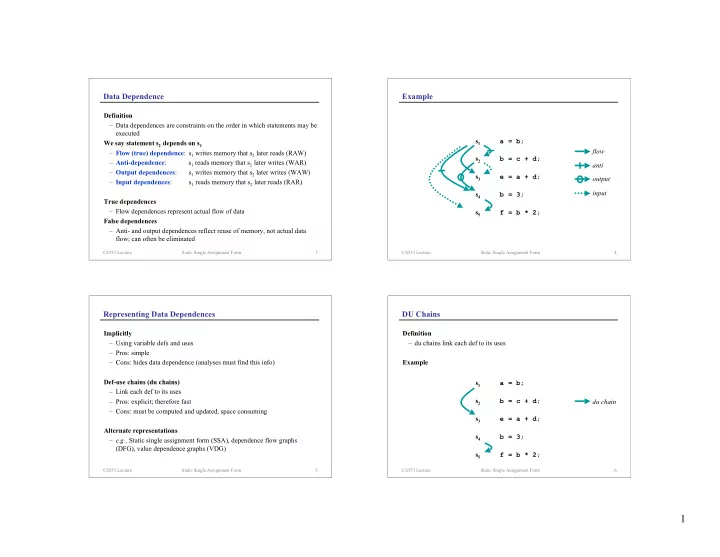
Definition– Data dependences are constraints on the order in which statements may be executed
We say statement s2 depends on s1– Flow (true) dependence: s1 writes memory that s2 later reads (RAW) – Anti-dependence: s1 reads memory that s2 later writes (WAR) – Output dependences: s1 writes memory that s2 later writes (WAW) – Input dependences: s1 reads memory that s2 later reads (RAR)
True dependences– Flow dependences represent actual flow of data
False dependences– Anti- and output dependences reflect reuse of memory, not actual data flow; can often be eliminated
CS553 Lecture Static Single Assignment Form 4
Example
s1 a = b; s2 b = c + d; s3 e = a + d; s4 b = 3; s5 f = b * 2; flow anti
- utput
input
CS553 Lecture Static Single Assignment Form 5
Representing Data Dependences
Implicitly– Using variable defs and uses – Pros: simple – Cons: hides data dependence (analyses must find this info)
Def-use chains (du chains)– Link each def to its uses – Pros: explicit; therefore fast – Cons: must be computed and updated, space consuming
Alternate representations– e.g., Static single assignment form (SSA), dependence flow graphs (DFG), value dependence graphs (VDG)
CS553 Lecture Static Single Assignment Form 6
DU Chains
Definition– du chains link each def to its uses
Examples1 a = b; s2 b = c + d; s3 e = a + d; s4 b = 3; s5 f = b * 2; du chain