1 SCD Landscape Magnitude of SCD in the US 167,366 SCD claims - - PowerPoint PPT Presentation

1
SMART_READER_LITE
LIVE PREVIEW

1 SCD Landscape Magnitude of SCD in the US 167,366 SCD claims - - PowerPoint PPT Presentation

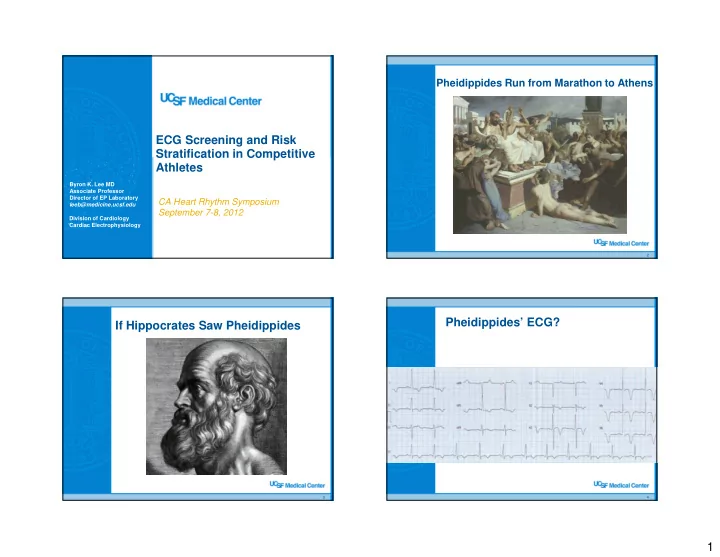
Pheidippides Run from Marathon to Athens ECG Screening and Risk Stratification in Competitive Athletes Byron K. Lee MD Associate Professor CA Heart Rhythm Symposium Director of EP Laboratory leeb@medicine.ucsf.edu September 7-8, 2012


slide-1
SLIDE 1

1 ECG Screening and Risk Stratification in Competitive Athletes

Byron K. Lee MD Associate Professor Director of EP Laboratory leeb@medicine.ucsf.edu Division of Cardiology Cardiac Electrophysiology

CA Heart Rhythm Symposium September 7-8, 2012

Pheidippides Run from Marathon to Athens

2

If Hippocrates Saw Pheidippides

3 4

Pheidippides’ ECG?

slide-2
SLIDE 2

2 450,000

1 U.S. Census Bureau, Statistical Abstract of the United States: 2001. 2 American Cancer Society, Inc., Surveillance Research, Cancer Facts and Figures 2001. 3 2002 Heart and Stroke Statistical Update, American Heart Association. 4 Circulation. 2001;104:2158-2163.

Magnitude of SCD in the US

Breast Cancer2

SCD 4 42,156 40,600 157,400 167,366

AIDS1 Lung Cancer2 Stroke3

SCD claims more lives each year than these

  • ther

diseases combined #1 Killer in the U.S.

SCD Landscape

Huikuri et. al. NEJM 2001 (adapted from Myerburg)

SCD-HeFT AVID MADIT

Causes of SCD (Age>35)

7

Huikuri et al. NEJM 2001

SCD due to CAD: Darryl Kile

8

slide-3
SLIDE 3

3 Causes of SCD (age<35)

  • #1: Hypertrophic CM

– 1 in 500 – Scarred and disordered myocardium – Confirmed HCM in 26.4% of SCDs – Probable HCM in 7.5% additional cases of SCD – Diagnosis

  • PE
  • ECG
  • Echo

9

Maron NEJM 2003

ECG in Hypertrophic CM

10

Hypertrophic CM: Hank Gathers

11

Causes of SCD (age<35)

  • #2: Commotio Cordis

– Blunt blow to the chest 15-30ms before T-wave peak (vulnerable phase of repolarization) – Mean age 13 years old

  • Compliant chest wall

– 19.9% of SCDs – Structural normal heart – Normal ECG

12

slide-4
SLIDE 4

4 Commotio Cordis

13

Protection Against Commotio Cordis

14

Causes of SCD (age<35)

  • #3: Congenital Coronary Artery Anomalies

– Artery arises from wrong aortic sinus – Classic presentation: CP or syncope with exercise – 13.7% of SCDs – Diagnosis:

  • Stress test
  • Echo
  • MRI
  • CT
  • Cath

– Normal ECG

15

Coronary-Artery Anomalies:Pete Maravich

16

slide-5
SLIDE 5

5

17

Maron NEJM 2003

Athlete’s Heart

  • Triggers

– Endurance sports (rowing, cross country skiing, swimming) – Isometric sports (weightlifting, wrestling)

  • Cardiac changes

– Heart size and chamber enlargement – Increased LV wall thickness – Increased LA – Preservation of systolic and diastolic function

  • Associated with abnormal ECG patterns
  • Considered a benign adaptation to training

18

  • Referred for Abnormal ECG
  • Sees you for evaluation

– No syncope – No symptoms of cardiac disease – No FH of SCD – Appears to be extremely physically fit – Rest of exam benign except for a soft systolic murmur

19

17 year old Swimmer

Basavarajaiah et al. Br J of Sports Med 2006

17 year old Swimmer

20

Basavarajaiah et al. Br J of Sports Med 2006

slide-6
SLIDE 6

6

  • Echo

– Significant concentric LVH with maximal wall thickness of 14 mm (normal <12 mm) – Normal LV cavity of 48 mm – Normal systolic and diastolic function – Normal valves

  • MRI normal except for wall thickening
  • ETT normal
  • 24 hour holter normal
  • Now what?

21

17 year old Swimmer

Basavarajaiah et al. Br J of Sports Med 2006

After 8 week of Deconditioning

22

Basavarajaiah et al. Br J of Sports Med 2006

LVH regressed from 14 mm to 11 mm Pelliccia A, et al. Circulation 2000;102:278-284

slide-7
SLIDE 7

7 Detraining in 40 Elite Athletes

  • Pelliccia A, et al. Circulation 2002;105:944-949

Detraining in 40 Elite Athletes

Pelliccia A, et al. Circulation 2002;105:944-949

Automatic External Defibrillator (AED) ICD Size

slide-8
SLIDE 8

8 ICDs and Exercise

29

Lempert et al. JCE 2006

Pre-participation Screening in Italy

30

Corrado et al. JAMA 2006

slide-9
SLIDE 9

9

33

Corrado et al. JAMA 2006

Israel and Minnesota Data

34

Steinvil et al. JACC 2011 Maron et al. Am J Cardiol 2009

AHA Recommendation

35

Maron et al. Circulation 2007

If age >35, add ETT if RF for CAD If age >65, add ETT

AHA Cost Analysis for U.S.

  • 10M middle school and high school athletes
  • Initial Screen

– $25 for H&P – $50 for ECG

  • Follow-up Screen

– $100 for H&P – $400 for Echo

  • Administrative Cost: 500M
  • Total Cost: $2B
  • $330,000 for every relevant disease diagnosed

36

slide-10
SLIDE 10

10 Other Cost Effectiveness Analysis

37

HRS 2011 Annals of Internal Medicine 2010

AHA Recommendation

38

Maron et al. Circulation 2007

If age >35, add ETT if RF for CAD If age >65, add ETT

39 40

slide-11
SLIDE 11

11

41 42

Pre-participation Screening at UCSF

  • 80 total volunteers

– Half were RNs and MDs

  • 40 volunteers for cardiac screening

– 7 ECG machines

  • 10 ECGs per hour per machine

– 2 Echo machines

  • 1.5 Echo’s per hour per machine

43

ECG Screening at UCSF

  • By the Numbers

– 2009: 155 athletes – 2010: 349 athletes – 2011: 327 athletes – 2012: 540 athletes

  • 1371 total screened
  • 1216 unique athletes
  • 52 (4.28%) with abnormal ECG leading to Echo
  • 8 (0.7%) not approved for sports and need further

work-up by their own MDs

44

slide-12
SLIDE 12

12 Findings

  • 8 non-approved athletes

– 2 WPW – 2 Long QT – 1 RVE with ASD – 1 LVH with syncope – 1 Bicuspid AV and PFO – 1 Orthopedic injury

45 46

Conclusions

  • Most SCDs occur in otherwise healthy individuals
  • Main cause of SCD

– Over 35: CAD – Under 35: HCM, Commotio Cordis, Coronary Anomalies

  • ICDs can be life-saving but will limit physical activity
  • Young athletes screening:

– H&P – ECG?

  • Master athletes (age >35) screening:

– H&P – ETT (if RFs for CAD or age>65)

  • Community based programs can find new disease and

save lives

SECTION HEADING

47

10 20 30 40 50 60 70 80 90 100 1 2 3 4 5 6 7 8 9

% Success *Non-linear Time (minutes)

Chance of success reduced 7 - 10% each minute

Adapted from text: Cummins RO, Annals Emerg Med. 1989, 18:1269-1275.

Resuscitation Success vs. Time*

slide-13
SLIDE 13

13

Corrado et al. JAMA 2006

50

Anthony Van Loo

51