SLIDE 1 1
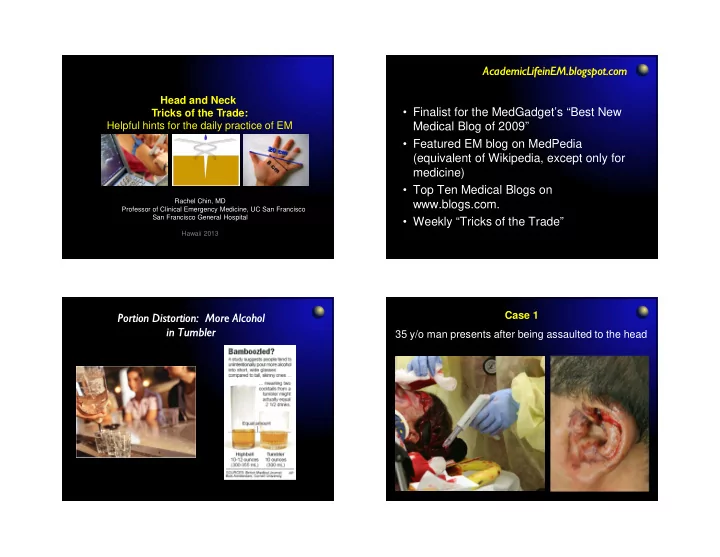
Head and Neck Tricks of the Trade: Helpful hints for the daily practice of EM
Rachel Chin, MD Professor of Clinical Emergency Medicine, UC San Francisco San Francisco General Hospital Hawaii 2013
AcademicLifeinEM.blogspot.com
- Finalist for the MedGadget’s “Best New
Medical Blog of 2009”
- Featured EM blog on MedPedia
(equivalent of Wikipedia, except only for medicine)
www.blogs.com.
- Weekly “Tricks of the Trade”
Portion Distortion: More Alcohol in Tumbler
Case 1 35 y/o man presents after being assaulted to the head
SLIDE 2
2
Case 1 Have I missed any additional scalp lacerations? Manual palpation of the scalp
Case 1: Scalp Laceration
How do you minimize missing a 2nd laceration?
Good lighting is the key! LED flashlight ($8-30)
Case 1 Have I missed any additional scalp lacerations? Adequate visualization using bright LED flashlight Case 1 You find and repair 3 scalp lacerations with staples. You suture the ear laceration. How do you prevent an auricular hematoma?
SLIDE 3
3
Case 1 How do you prevent an auricular hematoma? Traditional teaching: Gauze in antihelix. Case 1 How do you prevent an auricular hematoma? Traditional teaching: Gauze in antihelix + sutures. Case 1 How do you prevent an auricular hematoma? Trick of the trade: Make a plaster splint. Case 1 How do you prevent an auricular hematoma? Trick of the trade: Make a plaster splint.
SLIDE 4
4
Case 1 How do you prevent an auricular hematoma? Trick of the trade: Make a plaster splint. Case 1 How do you prevent an auricular hematoma? Trick of the trade: Make a plaster splint. Case 1 How do you prevent an auricular hematoma? Trick of the trade: Make a plaster splint. Case 1 How do you prevent an auricular hematoma? Trick of the trade: Make a plaster splint.
Vulcan and Ferengi extraterrestrial race from the Star Trek universe
SLIDE 5 5
Case 1 How do you apply a pressure dressing on the head? Traditional teaching Case 1 How do you apply a pressure dressing on the head? Trick of the trade: Beanie hat
Thanks to
Case 1 How do you apply a pressure dressing on the head? Trick of the trade: Beanie hat Case 1 How do you apply a pressure dressing on the head? Trick of the trade: Beanie hat
SLIDE 6
6
Case 1 How do you apply a pressure dressing on the head? Trick of the trade: Beanie hat Case 1 How do you apply a pressure dressing on the head? Trick of the trade: Beanie hat Case 1 How do you apply a pressure dressing on the head? Trick of the trade: Beanie hat Case 2 Can I close a scalp lacerations without staples?
SLIDE 7 7
Case 2 Can I close scalp lacerations without staples? Modified Hair Apposition Technique (HAT trick)
* Uses opposing hair strands & adhesive * One full 360o revolution twist of hair * Apply adhesive at twisting point * Repeat this along length of wound * Do NOT over-twist the hair. * Do NOT tie a knot.
- 1. Ong et al, Annals of EM, 2005
- 2. Hock et al, Annals of EM, 2002
Case 2 Can I close scalp lacerations without staples?
Contraindications to the HAT trick:
- Laceration >10 cm long
- Grossly contaminated wounds
- Active bleeding from the laceration
- Significant wound tension
- Hair strands <3 cm long
Use Trendelenberg or reverse Trendelenberg Case 2 Speaking of tissue adhesives, how can I prevent tissue adhesives from “running” into undesired areas? Use petroleum-based gel as a barrier. Case 2 Speaking of tissue adhesives, how can I prevent tissue adhesives from “running” into undesired areas?
SLIDE 8 8
Use a tegaderm tape as a barrier.
Thanks to Dr. Hagop Afarian (Fresno-Community Regional Medical Ctr)
Case 2 Speaking of tissue adhesives, how can I prevent tissue adhesives from “running” into undesired areas? Use a tegaderm tape as a barrier. Case 2 Speaking of tissue adhesives, how can I prevent tissue adhesives from “running” into undesired areas? Case 2 What are other uses of tissue adhesives?
In combination with steristrip tapes, can close wounds under slight tension
Layers: Glue-tape-glue
tape-glue
Case 2 What are other uses of tissue adhesives?
In combination with absorbable sutures, can close wounds under slight tension or inverted
Trick by Dr. Jonathan Davis and Dr. Matt Borloz (Georgetown/ Washington Hospital)
SLIDE 9
9
Case 3 A 78 year old woman sustains an arm laceration.
How would you repair this laceration?
Case 3 A 78 year old woman sustains an arm laceration.
How would you repair this laceration? Use steristrips to strengthen skin wound edges in combination with sutures.
Davis M et al. J Emerg Med. 2011, 40(3):322-3.
Case 4 Pediatric Pearls An 8 yo boy’s mother mentions that his asthma has been acting up for the past 2 days. You maybe hear wheezing. The patient is only partly cooperative with the exam.
How can you get a better exam?
Pediatric Pearls
Candle flame app Balloonimals app
SLIDE 10 10 Asthma Exacerbation
You successfully treat a 8 y/o boy with a moderate asthma
- exacerbation. What do you include in D/C instructions?
Discharge patient home with a MDI Avoid asthma exacerbation while patient waits at pharmacy to refill albuterol MDI.
Asthma Exacerbation
You successfully treat a 8 y/o boy with a moderate asthma
- exacerbation. What do you include in D/C instructions?
Consider discharging patient with a spacer.
Case 4: Asthma Exacerbation
You successfully treat a 8 y/o boy with a moderate asthma
- exacerbation. What do you include in D/C instructions?
Consider discharging patient with a spacer. Attach to short strip of ventilator tubing Or attach to back of styrofoam cup
Thanks to Dr. Mary Jo Wagner (Synergy Medical Education Alliance)
Case 5: Ocular Injury
50 y/o man s/p altercation presents with eye pain from pepper spray by a robber.
SLIDE 11 11 Case 5: Ocular Injury
The patient is extremely sensitive to application of anesthetic eyedrops. How can you apply them more gently?
“Blink it in” * Apply drops into medial canthus. * Have patient then “blink” the drops in.
Case 5: Ocular Injury
Courtesy of Dr. Sam Ko and Kimberly Chan Loma Linda
Foreign Body Eye Removal
- Dr. Tamara Bogush Metrowest Medical Center
Ken Sheil PAC Tacoma General Hospital
SLIDE 12 12 Case 5: Ocular Injury
Now that he can open his eyes, let’s check his visual acuity.
Free iPhone and Driod app EyeChart
Case 5: Ocular Injury
How can we determine if his blurred vision is the result of the pepper spray? The patient had taken out his contacts because of eye
- pain. His visual acuity is 20/200 in both eyes.
Pinhole correction
Case 5: Ocular Injury
You try to apply Morgan lens for ocular irrigation, but the patient pulls them out. How can you irrigate the eyes?
Case 5: Ocular Injury
You try to apply Morgan lens for ocular irrigation, but the patient pulls them out. How can you irrigate the eyes?
Nasal cannula irrigation
Tip: Add 10 mL of 1% lidocaine into 1 liter of saline bag
SLIDE 13
13 Case 5: Ocular Injury
You try to apply Morgan lens for ocular irrigation, but the patient pulls them out. How can you irrigate the eyes? Nasal cannula irrigation
Exorcist Case 5: Ocular Injury
After irrigation, soft tissue swelling of the eyelid makes it difficult to get an unobstructed view. You do not have an eyelid retractor. How do you retract the eyelids?
Paperclip eyelid retraction Examine traumatized orbit early before soft tissue swelling worsens.
Case 5: Ocular Injury
Alternative: “Roll up” the upper eyelid with Q-tip
Think about the retractable projector screen
SLIDE 14 14 Case 5: Ocular Injury
Think about the retractable projector screen
Case 6: Epistaxis Nasal Packing - Epistaxis
- Wadded Paper
- Cotton Balls
- Ativene, Telfa, Surgicel, Gelfoam
- Iodaform gauze, Vaseline Gauze
Specialized Balloon Packs
- PVA (Polyvinyl Alcohol) Foam
- Rhino-Rocket
- The Slik-Pak
SLIDE 15
15 Salt Pork Case 7: Peritonsillar Abscess
23 y/o male presents with a sore throat and left-sided peritonsillar swelling.
Case 7: Peritonsillar Abscess
23 y/o male presents with a sore throat and left-sided peritonsillar swelling.
Suboptimal view of aspiration
SLIDE 16 16 Case 7: Peritonsillar Abscess
How would you visualize the abscess during needle aspiration?
Use a laryngoscope with a Macintosh (curved) blade.
- Obstructs view less than a tongue blade plus penlight
- Provides focused lighting
- If cooperative, have patient retract inferiorly.
Case 7: Peritonsillar Abscess
How would you perform the needle aspiration?
Use a spinal needle with the sheath trimmed such that just 1.5 cm of the needle is exposed.
- Longer needle keeps syringe outside of the mouth
- Reduces risk of too a deep puncture
Case 7: Peritonsillar Abscess
How would you perform the needle aspiration?
Courtesy of
SLIDE 17 17 Case 8: Odors in the ED
How do you minimize the smell of pus during the I&D?
Suction the pus directly into closed canister.
Aerosolized beverage in an enclosed room: * Orange juice * Coffee
Case 8 How do you minimize the smell of “toxic sock syndrome”? Case 8
“It’s about ME… everyone for themselves!” Wear 2 face masks with a fresh tea bag in between.
Thanks to Dr. James Juarez (Rogue Valley Medical Center)
Termination of intractable hiccups with digital rectal massage
- Annals of Emergency Medicine, Fesmire
F, 1988;17(8):872.
- Journal of Internal Medicine, Oden M et al.
1990;227(2):145-6.
- Archives of Otolaryngology, Oliven A et al.1993;119:1383.
SLIDE 18
18 QUESTIONS Weekly “Tricks of the Trade” updated at: AcademicLifeinEM.blogspot.com