1 Translation model Language model Dictionaries used Languages - - PowerPoint PPT Presentation

1
SMART_READER_LITE
LIVE PREVIEW

1 Translation model Language model Dictionaries used Languages - - PowerPoint PPT Presentation

Motivation Classification of CLIR methods Cross-Language IR at We developed an automatic transliteration query translation method University of Tsukuba method for Japanese and English CLIR document translation method Automatic


slide-1
SLIDE 1

1 Cross-Language IR at University of Tsukuba

Automatic Transliteration for Japanese, English, and Korean

Atsushi Fujii, Tetsuya Ishikawa University of Tsukuba

2

Motivation

  • We developed an automatic transliteration

method for Japanese and English CLIR

  • the method has been used in commercial

CL patent service

  • In NTCIR-4 CLIR, we applied our method

to Korean and realized JEK transliteration in a single framework

3

Classification of CLIR methods

  • query translation method
  • document translation method
  • interlingual method (thesauri and LSI)
  • hybrid method (combining QT and DT)

4

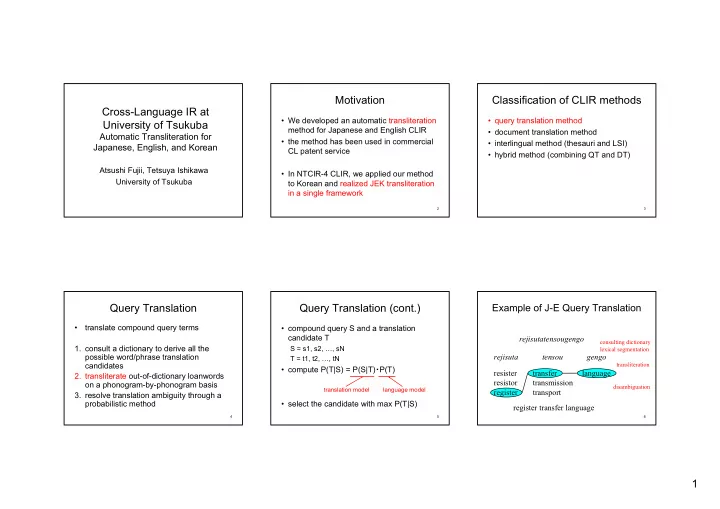
Query Translation

  • translate compound query terms
  • 1. consult a dictionary to derive all the

possible word/phrase translation candidates

  • 2. transliterate out-of-dictionary loanwords
  • n a phonogram-by-phonogram basis
  • 3. resolve translation ambiguity through a

probabilistic method

5

Query Translation (cont.)

  • compound query S and a translation

candidate T

S = s1, s2, …, sN T = t1, t2, …, tN

  • compute P(T|S) = P(S|T)・P(T)
  • select the candidate with max P(T|S)

translation model language model

6

Example of J-E Query Translation

rejisutatensougengo rejisuta tensou gengo resister resistor register transfer transmission transport language register transfer language

consulting dictionary lexical segmentation transliteration disambiguation

slide-2
SLIDE 2

2

7

Translation model

  • P(S|T) = Π P(si | ti)

si and ti are base words in compound words

  • EM algorithm to estimate P(si | ti) in

bilingual dictionary

8

Dictionaries used

technical 548K Cross Language E-K/K-E general 134K UNISOFT K-J general 213K UNISOFT J-K general 108K EDICT J-E/E-J technical 1M Cross Language E-J technical 1M Cross Language J-E Type #Entries Name Languages

9

Language model

  • word-based trigram model
  • 100K vocabulary in a target document

collection

  • Palmkit is used

10

Document retrieval

  • Okapi BM25
  • word and character indexes for Japanese
  • word index for English and Korean

11

Transliteration method

  • out-of-dictionary word S and a

transliteration candidate T

S = s1, s2, …, sN T = t1, t2, …, tN s1 and t1 are letters (substrings of words)

  • compute P(T|S) = P(S|T)・P(T)
  • select the candidate with max P(T|S)

transliteration model language model (word unigram)

12

Producing J-E dictionary

  • 1. extract Japanese Katakana words and

English translations from J-E dictionary

  • 2. romanize Katakana words
  • ne-to-one mapping b/w Katakan and

Roman characters can easily be performed

  • 3. correspond romanized Katakana words

and English on a letter-by-letter basis

  • 4. find the best path from a corresponding

matrix

slide-3
SLIDE 3

3

13

テ キ ス ト $ t 3 1 2 3 0 e 0 0 0 0 0 x 1 2 1 1 0 t 3 1 2 3 0 $ 0 0 0 0 3

Example matrix

テ te キス x ト t

14

Producing J-K dictionary

  • In EUC-KR, characters are coded

independent of pronunciation

  • one-to-one mapping b/w Hangul and

Roman characters cannot easily be performed

– # of Hangul characters is approx. 11,000 – # of common characters is approx. 2,000

  • we used Unicode, in which character is

coded according to pronunciation

15

Romanizing Korean words

  • first consonant changes every 21 lines
  • vowel changes every line and repeats every 21 lines
  • last consonant changes every column

specific Hangul characters can be identified by pronunciation

16

Example of transliteration

유고슬라비아 Yugoslavia ユーゴスラビア 031 비아그라 viagra バイアグラ 008 마이클 조던 Michael Jordan マイケル・ ジョーダン 006 다이옥신 dioxin ダイオキシン 005 Korean English Japanese Topic ID

17

Experiments (J/E)

<TITLE>, mean average precision (rigid) transliteration was effective for small dictionaries

0.0857 0.0612 108K E-J (EDICT) 0.1383 0.1147 108K J-E (EDICT) 0.1250 0.1250 1M E-J 0.2182 0.2174 1M J-E w/ transliteration w/o transliteration #Entries Languages < < < =

18

Experiments (Korean)

0.1746 0.1486 K-J 0.2153 0.2026 E-K 0.1231 0.1017 K-E 0.2457 0.2177 J-K w/ transliteration w/o transliteration Languages

<TITLE>, mean average precision (rigid) transliteration was also effective for Korean

< < < <