1 Investment Committee Manager Performance 4th Qtr., 2015 Market - - PDF document

1
SMART_READER_LITE
LIVE PREVIEW

1 Investment Committee Manager Performance 4th Qtr., 2015 Market - - PDF document

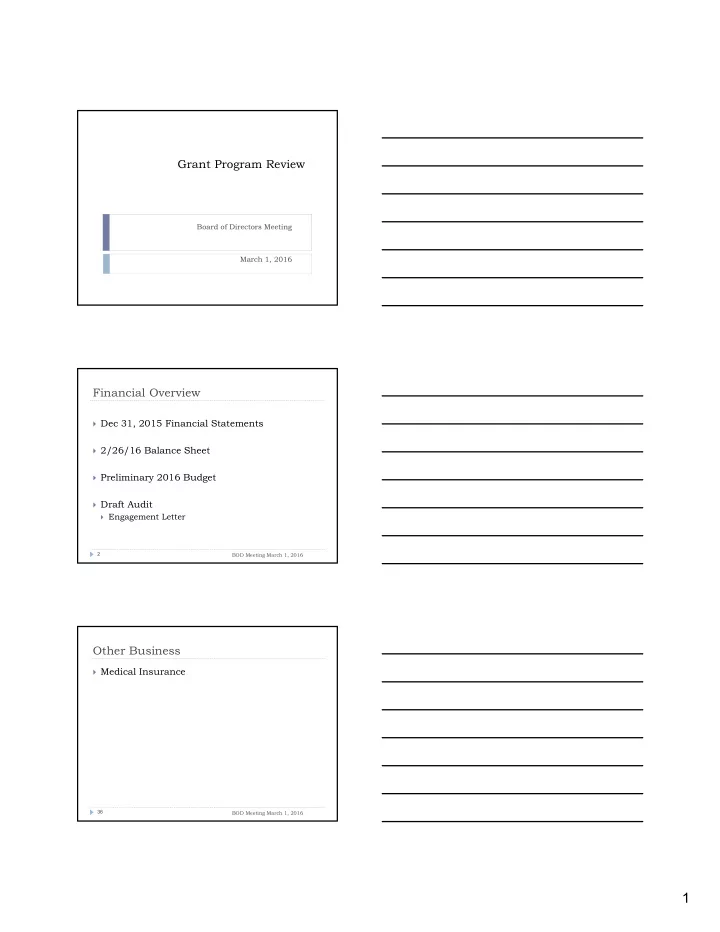
Grant Program Review Board of Directors Meeting March 1, 2016 Financial Overview Dec 31, 2015 Financial Statements 2/26/16 Balance Sheet Preliminary 2016 Budget Draft Audit Engagement Letter 2 BOD Meeting March 1, 2016


slide-1
SLIDE 1

1

Grant Program Review

Board of Directors Meeting March 1, 2016

Financial Overview

 Dec 31, 2015 Financial Statements  2/26/16 Balance Sheet  Preliminary 2016 Budget  Draft Audit

 Engagement Letter

2 BOD Meeting March 1, 2016

Other Business

 Medical Insurance

36 BOD Meeting March 1, 2016

slide-2
SLIDE 2

2

Investment Committee

 Manager Performance  4th Qtr., 2015  Market Update 2016  Asset Allocation  Equity level, Income & Cash  Re-balancing update  New Ideas

35 BOD Meeting March 1, 2016

Program Agenda

 Recap 2015 payout results and ten-

year trend

 Implications of 2016 budget to

program areas

 Program updates  Four grant proposals

5 BOD Meeting March 1, 2016 Dollars in 000s

$2,089 $35 $2,098 $1,528 $23 $330

Grants paid in 2015 Cancer Rehab Disabilities Entrepreneurship

Public Affairs Giving Tuesday

2015 was the first year in CFI history that Disabilities was the area of greatest payout, edging out Cancer

3 BOD Meeting March 1, 2016

slide-3
SLIDE 3

3

Ten year trends show transitions in grant area focus

Note: Giving Tuesday reported as part of relevant focus area

$- $500 $1,000 $1,500 $2,000 $2,500 $3,000 $3,500 $4,000 Entrep Cancer and Rehab Disabilities Other

BOD Meeting March 1, 2016 4

If all staff recommendations are approved today, about $1.2MM in payout would remain to be committed in ‘16 Cancer Rehab Disab Entrep Other Total Target $2,730 $130 $2,093 $1,365 $182 $6,500 Approved 2,360 20 1,247 490 15 4,132 To Go 370 110 846 875 245 2,368 March Reco 60 -- 615 500* -- 1,175 Remaining 310 110 231 375 245 1,193 “Pipeline”

  • $1,200

$385 $73 $1,658

Budget % of pipe

NA NA 19% 97% 336% 72%

* Prospective Coleman Fellows awards

5 BOD Meeting March 1, 2016

Impact Plan - Entrepreneurship

STRATEGIES IMMEDIATE OUTCOMES INTERMEDIATE OUTCOMES INTENDED IMPACT

1 Fund efforts to improve academic curriculums' ability to build core self- employment skills Collegiate programs will: commit financial and internal resources to promote E-ship as an interdisciplinary learning; sustain greater external stakeholder engagement; link experiential opportunities to the curriculum, employ student entrepreneurial portfolios Entrepreneurship Faculty Business and Non-Business instructors will

  • ptimally employ curricular and co-curricular

components to engage and support students in their pursuit of self-employment 2 Fund efforts to increase the quality and frequency of experiential/co-curricular activities Emerging student entrepreneurs will experience richer experiential co-curricular activities over the course of their programs 3 Fund efforts to increase frequency and quality of interdisciplinary learning Entrepreneurship Students Youth Programs will: sustain greater external stakeholder engagement; link experiential

  • pportunities to the curriculum; employ

experiential portfolios Aspiring entrepreneurs will have the motivation to act, have the right knowledge and have the opportunity to practice the right skills to apply to their business venture 4 Fund efforts to increase stakeholder engagement Emerging entrepreneurs will be successful at starting and running businesses 5 Explore efforts to develop "Portfolio" experiential approaches and link them directly to academic E-ship programs 6 Fund collaborative efforts between academic programs and community based accelerators and incubators Academic and Community based accelerator programs will develop programmatic collaborations continuing the pathway concept Emerging entrepreneurs will have ready

  • pportunities to participate in accelerators /

incubators as the next steps in their development Definitions: Core skill development could include: Vision, Opportunity Recognition, Network and Team development, Financial Management, Marketing, Technology utilization, Sales, Leadership Experiential / Co-curricular activities: Direct quality time with Business owners, Mentorships, Internships, Incubation/Acceleration, Alumni engagement, Entrepreneurs-in-residence, Opportunities to practice applied skills Interdisciplinary: interdepartmental, cross campus student activity and faculty collaboration including Fellows models Stakeholders: faculty and administration, community supporters, practitioners, alumni Entrepreneurial portfolio: A proactively developed set of experiential learning opportunities that engage students with entrepreneurs and the self-employment experience which are linked to the curriculum as per attached example

9 BOD Meeting March 1, 2016

slide-4
SLIDE 4

4

Entrepreneurship Program Updates

 SEA  DePaul  Northwestern 11th Annual Entrepreneurship

Law Conference

 Millikin  NACCE

10 BOD Meeting March 1, 2016

Entrepreneurship Program Updates

 Opportunites / Areas of Interest

 High School Incubators  Community Incubators

 Cal State Fresno

11 BOD Meeting March 1, 2016

Expiring Chair grants

 St. Louis University

 Dr. Jerry Katz is chairholder since 2005

 California State University, Fresno

 Dr. Timothy Stearns is chairholder since 1999

 These chair grants have been continuously

renewed with recent transitions towards Fellows Program activity

 How do we address the expiration of these

grants?

12 BOD Meeting March 1, 2016

slide-5
SLIDE 5

5

Fellows Program will continue into 2016-2017 academic year

 $500,000 in grants and $150,000 in program

support approved

 Joe Roberts developing new program elements

which include local entrepreneurs-in-residence

 Expect that participants will include some but

not all of existing 19 schools

13 BOD Meeting March 1, 2016

Impact Plan – Developmental Disabilities

STRATEGIES IMMEDIATE OUTCOMES INTERMEDIATE OUTCOMES INTENDED IMPACT 1 Fund grantees' ability to assess client residential and vocational interests in light of the changing environment Grantees must discern the vocational and residential goals of program participants and facilitate their efforts to achieve them

Vocational

Individuals in the Chicago metropolitan area with developmental disabilities will experience a higher quality of life and increased self-determination through success in their work, comfort in their home and satisfaction across the varied stages of their lives

2 Fund efforts to expand job

  • pportunities and prepare

individuals for workplace success

Individuals in the Chicago metropolitan area with developmental disabilities have the opportunity to identify from a variety of

  • ptions the work that helps

them to be fulfilled and to participate in the economy

3 Fund efforts to increase self- employment 4 Fund efforts to increase the supply

  • f housing alternatives, including

emerging models which allow for

  • wnership by residents and other

parties

Residential

5 Explore efforts to improve client health outcomes enabling them to reach vocational and residential goals

Individuals in the Chicago metropolitan area with developmental disabilities can choose from a varied and increasing set of

  • ptions the residential

arrangement that gives them comfort and helps them to be fulfilled

6 Catalyze collaboration among grantees 7 Support grantees’ development of non-governmental revenue streams

14 BOD Meeting March 1, 2016

Emerging opportunities for disabilities grantmaking in 2016

1.

Advance an understanding of “Quality of Life”

2.

Support transitions of sheltered workshops to community-integrated & employment programs

3.

Create and renew residential environments

4.

Improve direct care staffing

5.

Mobilize individual philanthropic support

15 BOD Meeting March 1, 2016

slide-6
SLIDE 6

6

These opportunities align with our disabilities Impact Plan

1.

Advance understanding

  • f “Quality of Life”

2.

Support transitions of sheltered workshops to more community- integrated & employment programs

3.

Create and renew residential environments

4.

Improve direct care staffing

5.

Mobilize individual philanthropic support

  • 1. Intended Impact is

“higher quality of life”

  • 2. Driven by explicit

goals of participants and funders

  • 3. Outcome of

“comfort”

  • 4. Fundamental issue

for providers

  • 5. Response to State

Budget crisis

16 BOD Meeting March 1, 2016

Potential projects in pipeline are addressing these opportunities

1.

Advance understanding

  • f “Quality of Life”

2.

Support transitions of sheltered workshops to more community- integrated & employment programs

3.

Create and renew residential environments

4.

Improve direct care staffing

5.

Mobilize individual philanthropic support 1.

CQL training of I4A staff

2.

CHOICE and related programs at other providers

3.

Residential Renewal

4.

I4A collaboration in development

5.

Giving Tuesday match; Forefront

17 BOD Meeting March 1, 2016

On Jan 13th, The Douglas Center

  • pened its Multi-therapy Sensory Room

18

  • Funded by $25,000 CFI

grant

  • State-of-the art environment assists

participants in improvement and management of ability to interact and engage with their surroundings

  • Multi-sensory therapy shown to be

effective in increasing concentration, alertness and awareness of environment

  • Has reduced problems with self-

injurious behaviors, relieved agitation, promoted relaxation and calmness, and modulation of emotions BOD Meeting March 1, 2016

slide-7
SLIDE 7

7

On Jan 22nd, Park Lawn opened its CHOICE program location in Crestwood

19

  • Funded through $200,000 CFI funds (June, 2015)
  • Transitions of sheltered workshop to community

BOD Meeting March 1, 2016

We have toured 23 group homes to validate the need for Residential Renewal

20 BOD Meeting March 1, 2016 21 BOD Meeting March 1, 2016

slide-8
SLIDE 8

8

Residential Renewal pilot would improve homes with resident input

 6-7 participating organizations would each

select one home for renewal

 Designs for Dignity would assemble design

team(s) for pro bono assignment

 Home residents would participate in decisions  $20,000 budget per home for fixtures,

furnishings, painting, flooring, etc.

 Grants to participating organizations  If pilot successful, expand in fall to more

  • rganizations and homes

22 BOD Meeting March 1, 2016

Exponent Philanthropy’s Philanthropy Lessons includes I4A example of collaboration

 Philanthropy Lessons is a video series and

campaign produced by Exponent Philanthropy, funded by the Fund for Shared Insight, and released in partnership with The Chronicle of Philanthropy.

 Interviewed 27 grantmakers and 13 grantees to  Nine-part video series launched in January

2016

 CFI featured in six of the nine videos

23 BOD Meeting March 1, 2016

Impact Plan - Cancer

STRATEGIES IMMEDIATE OUTCOMES INTERMEDIATE OUTCOMES INTENDED IMPACT 1 Fund capital and program projects that enable the delivery

  • f comprehensive treatment.

Health Care Providers Health Care Providers 2 Fund education programs1 for cancer patients, physicians and health care professionals. Grantees will offer the most effective tools and resources possible to cancer patients, and employ supportive oncology practices4 in which healthcare professionals collaborate Medical professionals will be able to develop and deliver an

  • ptimal comprehensive

treatment plan for the cancer patient. Cancer patients in the Chicago Metro area are fully engaged in their cancer treatment plan, and achieve the best possible

  • utcome and quality of life.

3 Fund collaborative

2 efforts that

include comprehensive clinics

3 ,

psychosocial support and palliative care. Cancer Patients Cancer Patients Cancer patients must be fully engaged in development of a treatment plan and empowered to make decisions regarding their continuity of care. Individuals with cancer are knowledgeable and actively participate in cancer treatment. 4 Fund efforts to promote clear communication of treatment

  • ptions to patients.

1 education programs refer to professional development, disease or treatment specific education, and mentoring, not medical school education 2 collaborations would include efforts between doctors and other health care professionals at same or across institutions 3 multidisciplinary medical team develops treatment options and discusses advantages and disadvantages with the patient 4 refers to services from diagnosis to end of life

24 BOD Meeting March 1, 2016

slide-9
SLIDE 9

9

Cancer Program Updates

Coleman Supportive Oncology Initiative (CSOI)

 Program Assessment & Planning  Program Dissemination/Exposure

 American Society of Clinical Oncologists (ASCO)

Annual Meeting

 ASCO Quality Symposium 25 BOD Meeting March 1, 2016

ASCO Quality Symposium Feb 2016

26 BOD Meeting March 1, 2016

Cancer Program Updates

Coleman Primary Palliative Medicine Training Program

 Winter 2016 Conference at Rush University  American Academy of Hospice and Palliative

Medicine (AAHPM)

 Social Work Hospice & Palliative Care Network  Program Assessment

27 BOD Meeting March 1, 2016

slide-10
SLIDE 10

10

#ILGive for Giving Tuesday

 CFI granted $588,000 to 48 participating

  • rganizations

 $1.2 million raised from more than 5,100 donors  Over 2,500 new donors contributed $380,000  Three debrief sessions held with participants  Working with Forefront to plan 2016 campaign

22 BOD Meeting March 1, 2016

Feedback from grantees was strongly positive

“This year, we saw significant growth in both the number of gifts and the total amount raised on Giving Tuesday. In fact, we raised over twice as much this year over last year, and almost doubled the total number of gifts.”

“It was a great December for us. Thank you for this opportunity. It really helped us rally a great amount of support from our base and beyond. People really get excited about this match prospect! It's a game changer.”

“We had a wonderful campaign and raised a significant amount of money more than last year. Being able to offer the match incentive to our donors allows us to maximize giving on this day.”

“We repeatedly heard from Donors that the Coleman Match was important to them and that it drove people to make a new and/or increased donation -

  • bviously our results reflect those statements.”

“The match allowed us to both expand our network of supporters and potential supporters, and also provided us with the opportunity to learn new skills and techniques for using social media. It was a steep learning curve for us but extremely worthwhile.”

“A huge thank you for all the support you provided leading up to Giving

  • Tuesday. We implemented many of strategies that were sent and presented in

the webinars and found them to be particularly effective.”

29 BOD Meeting March 1, 2016

Feedback from grantees was strongly positive

“Giving Tuesday and the Coleman Foundation challenge really pushed us to look at a more varied approach to communicating our story. So we not only shared the opportunity for the matching grant in our traditional annual fund mailing, but we launched an aggressive social media campaign, urging staff, volunteers and board members to share their affiliation with our organization via social media. One of our staff members posted our Giving Tuesday request on

  • Facebook. Her 26-year-old daughter "liked" and "shared" that message.

Then one of her daughter's friends "liked" and "shared" it with her contacts, which included her sister who lives in California but calls Chicago her home town. She donated a first-time gift of $5,000. That is remarkable, and taught us a valuable lesson about the importance of reaching out to a younger audience in a new way. We couldn't be more thrilled about this lesson, and we certainly credit the opportunity the Coleman Foundation challenge provided. It nudged us a bit out of our comfort zone to think more creatively and more comprehensively about

  • ur annual fund efforts. We thank you for that."

30 BOD Meeting March 1, 2016

slide-11
SLIDE 11

11

Opportunity to advance via Forefront investment

31

 Forefront is focusing on four key areas of

leadership, one of which is “Attracting Investment to the (non-profit) Sector”

 “Increasing individual giving” is a key component of

this area and Forefront is fundraising $175M for it

 CFI has invited a proposal for $100M over two

years to advance the #ILGive campaign and increase results from $6M in ‘15 to $9M in ‘16

 Such support will ensure #ILGive and “Increasing

Individual Giving” remain a Forefront priority and gain visibility in philanthropy community

 Proposal due in weeks; likely need decision prior to

June BOD Meeting

BOD Meeting March 1, 2016

Agenda

Program Request Recommended Cancer $60,000 $60,000 Disabilities 744,807 740,000 Total $844,807 $800,000

32 BOD Meeting March 1, 2016

Agenda - Cancer

Program Request Recommended CAP Foundation $60,000 $60,000 Total Cancer $60,000 $60,000

33 BOD Meeting March 1, 2016

slide-12
SLIDE 12

12

CAP Foundation See, Test & Treat Initiative at LUMC Recommended Amount: $60,000

Strengths

 Replication of successful 2015 program which provided

testing to 54 individuals and education to them and many more attendees

 Effective model of local (LUMC) leadership and CAP Fdn

program support

 Potential for other local hospitals to adopt model; linkage

  • pportunity

Weaknesses

Relies on philanthropy and, at present, CFI to sustain Why to Fund

Advances multiple strategies of Cancer Impact Plan

34 BOD Meeting March 1, 2016

Agenda - Disabilities

Applicant Request Recommended Aspire $444,807 $440,000 CTF Illinois 200,000 200,000 El Valor 100,000 100,000 Total $744,807 $740,000

35 BOD Meeting March 1, 2016

Aspire Career Center Recommended Amount: $440,000

Strengths

 Thoughtful and staged transformation of sheltered workshop

responds to important current challenge

 Potential for meaningful employment pipelines for program

participants

 Involvement of Designs for Dignity brings expertise,

contributions

 Opens viable private-pay revenue stream

Weaknesses

 Unclear how connections will be made to emerging employers

Why to Fund

 Response to changing demands by participants/parents for

alternative to workshop with path to employment

36 BOD Meeting March 1, 2016

slide-13
SLIDE 13

13

CTF Illinois Art Studio and Advocacy Center Recommended Amount: $200,000

Strengths

 Replication of prior successful transition of Charleston

sheltered workshop

 Advance concept of options for participants in art,

community, employment alternatives

 Brings new grantee into portfolio as CTF and SCC merge to

serve far south and downstate market Weaknesses

 Not perfectly aligned with CHOICE methodology of ongoing

  • ptions

Why to Fund

 Response to changing demands by participants/parents for

alternative to workshop with path to employment

37 BOD Meeting March 1, 2016

El Valor Individualized Placement Services Program Recommended Amount: $100,000

Strengths

 Strong record of assessing individual’s vocational interests

and finding suitable work

 Expansion of successful employment program; placed 122

adults in the last two years

 Built relationships in Hispanic community with local

businesses and families Weaknesses

 Program impacted by state budget impasse.

Why to Fund

 Intent is to identify options for young adults after they age out

  • f formal education to provide training that helps them

experience self determination and be fulfilled through their work.

38 BOD Meeting March 1, 2016

New Business

 Technology  2016 Meeting Schedule

 Annual BOD Meeting:

6/7-8/16

 Regular BOD Meeting:

8/25/16

 Regular BOD Meeting:

11/16/16 or 11/17/16  Impact  Adjournment

36 BOD Meeting March 1, 2016

slide-14
SLIDE 14

14

Impact Plan - Cancer

STRATEGIES IMMEDIATE OUTCOMES INTERMEDIATE OUTCOMES INTENDED IMPACT 1 Fund capital and program projects that enable the delivery

  • f comprehensive treatment.

Health Care Providers Health Care Providers 2 Fund education programs1 for cancer patients, physicians and health care professionals. Grantees will offer the most effective tools and resources possible to cancer patients, and employ supportive oncology practices4 in which healthcare professionals collaborate Medical professionals will be able to develop and deliver an

  • ptimal comprehensive

treatment plan for the cancer patient. Cancer patients in the Chicago Metro area are fully engaged in their cancer treatment plan, and achieve the best possible

  • utcome and quality of life.

3 Fund collaborative

2 efforts that

include comprehensive clinics

3 ,

psychosocial support and palliative care. Cancer Patients Cancer Patients Cancer patients must be fully engaged in development of a treatment plan and empowered to make decisions regarding their continuity of care. Individuals with cancer are knowledgeable and actively participate in cancer treatment. 4 Fund efforts to promote clear communication of treatment

  • ptions to patients.

1 education programs refer to professional development, disease or treatment specific education, and mentoring, not medical school education 2 collaborations would include efforts between doctors and other health care professionals at same or across institutions 3 multidisciplinary medical team develops treatment options and discusses advantages and disadvantages with the patient 4 refers to services from diagnosis to end of life

40 BOD Meeting March 1, 2016

Impact Plan – Developmental Disabilities

STRATEGIES IMMEDIATE OUTCOMES INTERMEDIATE OUTCOMES INTENDED IMPACT 1 Fund grantees' ability to assess client residential and vocational interests in light of the changing environment Grantees must discern the vocational and residential goals of program participants and facilitate their efforts to achieve them Vocational Individuals in the Chicago metropolitan area with developmental disabilities will experience a higher quality of life and increased self-determination through success in their work, comfort in their home and satisfaction across the varied stages

  • f their lives

2 Fund efforts to expand job

  • pportunities and prepare

individuals for workplace success Individuals in the Chicago metropolitan area with developmental disabilities have the

  • pportunity to identify from a variety
  • f options the work that helps them

to be fulfilled and to participate in the economy 3 Fund efforts to increase self- employment 4 Fund efforts to increase the supply

  • f housing alternatives, including

emerging models which allow for

  • wnership by residents and other

parties Residential 5 Explore efforts to improve client health outcomes enabling them to reach vocational and residential goals Individuals in the Chicago metropolitan area with developmental disabilities can choose from a varied and increasing set of options the residential arrangement that gives them comfort and helps them to be fulfilled 6 Catalyze collaboration among grantees 7 Support grantees’ development of non-governmental revenue streams

41 BOD Meeting March 1, 2016

Impact Plan - Entrepreneurship

STRATEGIES IMMEDIATE OUTCOMES INTERMEDIATE OUTCOMES INTENDED IMPACT

1 Fund efforts to improve academic curriculums' ability to build core self- employment skills Collegiate programs will: commit financial and internal resources to promote E-ship as an interdisciplinary learning; sustain greater external stakeholder engagement; link experiential opportunities to the curriculum, employ student entrepreneurial portfolios Entrepreneurship Faculty Business and Non-Business instructors will

  • ptimally employ curricular and co-curricular

components to engage and support students in their pursuit of self-employment 2 Fund efforts to increase the quality and frequency of experiential/co-curricular activities Emerging student entrepreneurs will experience richer experiential co-curricular activities over the course of their programs 3 Fund efforts to increase frequency and quality of interdisciplinary learning Entrepreneurship Students Youth Programs will: sustain greater external stakeholder engagement; link experiential

  • pportunities to the curriculum; employ

experiential portfolios Aspiring entrepreneurs will have the motivation to act, have the right knowledge and have the opportunity to practice the right skills to apply to their business venture 4 Fund efforts to increase stakeholder engagement Emerging entrepreneurs will be successful at starting and running businesses 5 Explore efforts to develop "Portfolio" experiential approaches and link them directly to academic E-ship programs 6 Fund collaborative efforts between academic programs and community based accelerators and incubators Academic and Community based accelerator programs will develop programmatic collaborations continuing the pathway concept Emerging entrepreneurs will have ready

  • pportunities to participate in accelerators /

incubators as the next steps in their development Definitions: Core skill development could include: Vision, Opportunity Recognition, Network and Team development, Financial Management, Marketing, Technology utilization, Sales, Leadership Experiential / Co-curricular activities: Direct quality time with Business owners, Mentorships, Internships, Incubation/Acceleration, Alumni engagement, Entrepreneurs-in-residence, Opportunities to practice applied skills Interdisciplinary: interdepartmental, cross campus student activity and faculty collaboration including Fellows models Stakeholders: faculty and administration, community supporters, practitioners, alumni Entrepreneurial portfolio: A proactively developed set of experiential learning opportunities that engage students with entrepreneurs and the self-employment experience which are linked to the curriculum as per attached example

42 BOD Meeting March 1, 2016