1 Comments from previous renditions 1. Go to office hours, 2. Go to - - PDF document

1
SMART_READER_LITE
LIVE PREVIEW

1 Comments from previous renditions 1. Go to office hours, 2. Go to - - PDF document

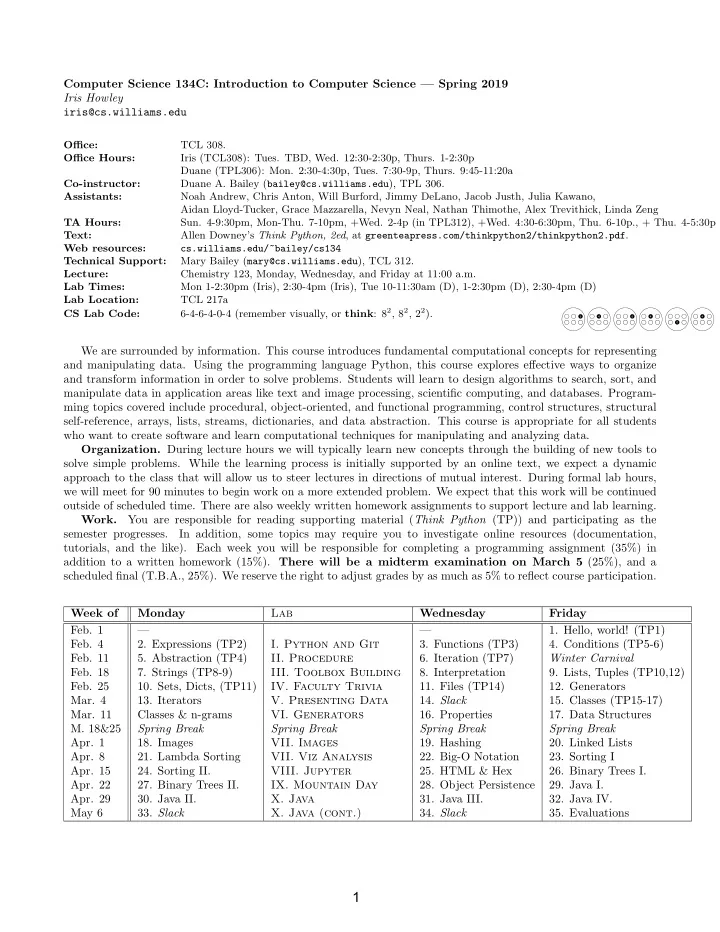
Computer Science 134C: Introduction to Computer Science Spring 2019 Iris Howley iris@cs.williams.edu Office: TCL 308. Office Hours: Iris (TCL308): Tues. TBD, Wed. 12:30-2:30p, Thurs. 1-2:30p Duane (TPL306): Mon. 2:30-4:30p, Tues. 7:30-9p,


slide-1
SLIDE 1

Computer Science 134C: Introduction to Computer Science — Spring 2019 Iris Howley iris@cs.williams.edu

Office: TCL 308. Office Hours: Iris (TCL308): Tues. TBD, Wed. 12:30-2:30p, Thurs. 1-2:30p Duane (TPL306): Mon. 2:30-4:30p, Tues. 7:30-9p, Thurs. 9:45-11:20a Co-instructor: Duane A. Bailey (bailey@cs.williams.edu), TPL 306. Assistants: Noah Andrew, Chris Anton, Will Burford, Jimmy DeLano, Jacob Justh, Julia Kawano, Aidan Lloyd-Tucker, Grace Mazzarella, Nevyn Neal, Nathan Thimothe, Alex Trevithick, Linda Zeng TA Hours:

  • Sun. 4-9:30pm, Mon-Thu. 7-10pm, +Wed. 2-4p (in TPL312), +Wed. 4:30-6:30pm, Thu. 6-10p., + Thu. 4-5:30p

Text: Allen Downey’s Think Python, 2ed, at greenteapress.com/thinkpython2/thinkpython2.pdf. Web resources: cs.williams.edu/~bailey/cs134 Technical Support: Mary Bailey (mary@cs.williams.edu), TCL 312. Lecture: Chemistry 123, Monday, Wednesday, and Friday at 11:00 a.m. Lab Times: Mon 1-2:30pm (Iris), 2:30-4pm (Iris), Tue 10-11:30am (D), 1-2:30pm (D), 2:30-4pm (D) Lab Location: TCL 217a CS Lab Code: 6-4-6-4-0-4 (remember visually, or think: 82, 82, 22).

6 4 6 4 4

We are surrounded by information. This course introduces fundamental computational concepts for representing and manipulating data. Using the programming language Python, this course explores effective ways to organize and transform information in order to solve problems. Students will learn to design algorithms to search, sort, and manipulate data in application areas like text and image processing, scientific computing, and databases. Program- ming topics covered include procedural, object-oriented, and functional programming, control structures, structural self-reference, arrays, lists, streams, dictionaries, and data abstraction. This course is appropriate for all students who want to create software and learn computational techniques for manipulating and analyzing data.

  • Organization. During lecture hours we will typically learn new concepts through the building of new tools to

solve simple problems. While the learning process is initially supported by an online text, we expect a dynamic approach to the class that will allow us to steer lectures in directions of mutual interest. During formal lab hours, we will meet for 90 minutes to begin work on a more extended problem. We expect that this work will be continued

  • utside of scheduled time. There are also weekly written homework assignments to support lecture and lab learning.

Work. You are responsible for reading supporting material (Think Python (TP)) and participating as the semester progresses. In addition, some topics may require you to investigate online resources (documentation, tutorials, and the like). Each week you will be responsible for completing a programming assignment (35%) in addition to a written homework (15%). There will be a midterm examination on March 5 (25%), and a scheduled final (T.B.A., 25%). We reserve the right to adjust grades by as much as 5% to reflect course participation. Week of Monday Lab Wednesday Friday

  • Feb. 1

— —

  • 1. Hello, world! (TP1)
  • Feb. 4
  • 2. Expressions (TP2)
  • I. Python and Git
  • 3. Functions (TP3)
  • 4. Conditions (TP5-6)
  • Feb. 11
  • 5. Abstraction (TP4)
  • II. Procedure
  • 6. Iteration (TP7)

Winter Carnival

  • Feb. 18
  • 7. Strings (TP8-9)
  • III. Toolbox Building
  • 8. Interpretation
  • 9. Lists, Tuples (TP10,12)
  • Feb. 25
  • 10. Sets, Dicts, (TP11)
  • IV. Faculty Trivia
  • 11. Files (TP14)
  • 12. Generators
  • Mar. 4
  • 13. Iterators
  • V. Presenting Data
  • 14. Slack
  • 15. Classes (TP15-17)
  • Mar. 11

Classes & n-grams

  • VI. Generators
  • 16. Properties
  • 17. Data Structures
  • M. 18&25

Spring Break Spring Break Spring Break Spring Break

  • Apr. 1
  • 18. Images
  • VII. Images
  • 19. Hashing
  • 20. Linked Lists
  • Apr. 8
  • 21. Lambda Sorting
  • VII. Viz Analysis
  • 22. Big-O Notation
  • 23. Sorting I
  • Apr. 15
  • 24. Sorting II.
  • VIII. Jupyter
  • 25. HTML & Hex
  • 26. Binary Trees I.
  • Apr. 22
  • 27. Binary Trees II.
  • IX. Mountain Day
  • 28. Object Persistence
  • 29. Java I.
  • Apr. 29
  • 30. Java II.
  • X. Java
  • 31. Java III.
  • 32. Java IV.

May 6

  • 33. Slack
  • X. Java (cont.)
  • 34. Slack
  • 35. Evaluations

1

slide-2
SLIDE 2

Comments from previous renditions “1. Go to office hours, 2. Go to TA sessions, 3. Don’t stress about homeworks.” “Go to office hours! GO TO OFFICE HOURS! Go to office hours!” ⋆ “Read the textbook.” “Look at the code Duane posts after class; don’t try to copy it down in class.” ⋆ “Think about how your code should works logically before typing anything.” ⋆ “Stop complaining and start coding!!! Feel swervy!” “Don’t be intimidated...a programming language is just a language...practice the idioms.” “Practice writing code outside of class.” ⋆ “Write code on paper beforehand; it helps to pinpoint errors.” “TAs are soooo helpful and just great to talk to.” ⋆ “You are learning a lot...Enjoy!” ⋆ “Stay swervy.” Intellectual Property. No part of this course may be reproduced and distributed in any manner without prior permission from the instructors.

  • Community. We embrace diversity. We welcome all students and expect everyone to contribute and support a

respectful and welcoming environment. If you have concerns, please share them with us or the college administration. Students Who Need Accommodations. If formal accommodations need to be made to meet your specific learning or physical abilities, please contact one of us as soon as possible to discuss appropriate accommodations. Please also contact the Director of Accessible Education, Dr.

  • G. L. Wallace (4135974672) or the Dean’s office

(4135974171). We will work together to ensure this class is as accessible and inclusive as possible. Mental Health. Students experiencing mental or physical health challenges that are significantly affecting their academic work are encouraged to contact one of us or to speak with a dean. The deans can be reached at 4135974171. Honor Code. The Honor Code as it applies to non-programming assignments is outlined in the Student Handbook. For programming assignments in computer science courses, the honor code is interpreted in very specific ways. When a program is assigned, it will be described as a “test” or “laboratory” program. The Honor Code applies to each as follows (unless otherwise specified): Test Programs. Any assignment designated as a test program is to be treated exactly as a take-home, open-book

  • test. You are allowed to read your textbook, class notes, and any other source approved by your instructor. You

may not consult anyone other than your instructor. The instructor encourages the asking of questions, but reserves the right not to answer, just as you would expect during an exam. Guideline: Any work that is not your own is considered a violation of the Honor Code. Laboratory Programs. Laboratory programs are expected to be the work of the individual student, designed and coded by him or her alone. Help locating errors and interpreting error messages are allowed, but a student may

  • nly receive help in correcting errors of syntax; help in correcting errors of logic is strictly forbidden. In general,

if you are taking photos of someone else’s screen, looking at someone else’s screen, or telling someone else what to type, it is likely your work is no longer the work of an individual student. Guideline: Assistance in the design or coding of program logic will be considered a violation of the Honor Code. If you do not understand how the Honor Code applies to a particular assignment, consult your instructor. Students should be aware of the Computer Ethics outlined in the Student Handbook. Violations (including uninvited access to private information and malicious tampering with or theft of computer equipment or software) are subject to disciplinary action. Guideline: To protect your work dispose of printouts and copies of your work carefully, and avoid leaving your programs on hard disks in labs and other public storage areas. The Department of Computer Science takes the Honor Code seriously. Violations are easy to identify and will be dealt with promptly. The College and Department also have computer usage policies that apply to courses that make use of computers. You can read more about these policies at csci.williams.edu/the-cs-honor-code-and-computer-usage-policy Anonymous ID. We grade anonymously. When asked, your Anonymous ID (AID) is:

2

slide-3
SLIDE 3

8/5/19 1

On your way in…

Pick-up:

  • 1. Homework 7

Drop-off:

  • 1. Homework 6 on the side table (two piles)

Welcome to CS 134!

Introduction to Computer Science Iris Howley

  • Hashing & Linked Lists-

Spring 2019

HASHING

Finding dictionary values quickly

Dictionary Keys

  • d[[‘bill l’,’bill j’]] = ‘williams college’

§ERROR

  • d[(‘bill l’,’bill j’)] = ‘williams college’

§ d

  • {('bill l', 'bill j'): 'williams college’}

What’s the difference?

Dictionary keys must be immutable types

int, float, string, bool, tuple, frozenset

Dictionary Keys

Why?

Dictionary keys must be immutable types

int, float, string, bool, tuple, frozenset

Mutable Types as Dictionary Keys

  • Lists are mutable
  • When you append() to a list, it changes that list object
  • If you used a list object as a key in a dictionary, you wouldn’t be able

to find it again, after it’s been changed mylist = [‘a’, ’b’] mydict = dict() mydict[mylist] = ‘throws an error’ mylist.append(‘c’) print(mydict[mylist]) # Now mylist is no longer findable in the dict!

We’re going to see why!

3

slide-4
SLIDE 4

8/5/19 2

Dictionary Keys

  • Dictionaries index their items by a hash
  • A hash is an fixed sized integer that identifies a particular value.
  • Each value needs to have its own hash

§ For the same value you will get the same hash even if it's not the same object.

Why not just index items based on their value? Hashing Hashing

FIND:

Hashing Hashing

FIND:

Hashing

FIND:

4

slide-5
SLIDE 5

8/5/19 3

Hashing

  • We could organize all words in memory by the letter they start with…
  • But words that start with ‘A’ could be numerous
  • Compared to words that start with ‘Z’

§ …Sort of like arranging clothes by color

  • Hashing is a different way of mapping items to make them easier to

find

Why not just index items based on their value? Hashing

  • Other concerns

§ Bad hashing function for your data, resulting in clustering § Running out of space in the pile you’ve assigned § Placing shirts in the wrong pile

  • Stored in the order that makes it easiest to look them up

hash(o) à o.__hash__()

  • s = “hello world”
  • t = s + “!”
  • hash(s)

à 4960501519247167238

  • hash(s)

à 4960501519247167238

  • hash(t)

à -8774050965770600213

  • hash(t[:-1])

à 4960501519247167238

If the 2 strings are the same, they’ll get the same hash If the 2 strings are different, they *might* get a different hash.

hash(o) à o.__hash__()

  • hash(1) à 1
  • hash(2) à 2
  • hash(1000000000000000000) à 1000000000000000000
  • hash(10000000000000000000) à 776627963145224196

Some hash codes are expensive (million-long tuple) At some length, it starts treating the numbers like a string If the hash codes are the same, the values might be the same

Hash Tables

Keys

‘pixel’ ‘tally’ ‘wally’ ‘linus’

Hashes

1 2 3 4

Buckets

tally linus bananas everything pixel cheese wally carrots x How to access mydict[‘wally’]?

Overflow

collision! What to do with Wally? Could re-hash into new table and increase # buckets… …or…

Immutable Objects

  • Have no way to set/change the attributes, without creating a new
  • bject

§ Like int, string, etc. § Like the Color class from this week’s lab! § __slots__ = []

  • Can be used in sets

§ i.e., you cannot have a set of lists

  • Can be used as keys for dictionaries

§ If the class has a __hash__() function defined!

slide-6
SLIDE 6

8/5/19 4

questions?

? ? ? ? ?

Leftover Slides Hashing

  • Don’t know how it’s computed à Abstraction
  • There’s many ways to implement a hash function, here’s a description
  • f some of them:

§ https://www.cs.hmc.edu/~geoff/classes/hmc.cs070.200101/homework10/ha shfuncs.html

Tuples, Strings, other built-in

types aren’t particularly special! You can build your own!

Thought question: How would you build a doubly-linked list?

MAKING OUR OWN DATA STRUCTURES

Classes, Part IV

6

slide-7
SLIDE 7

8/5/19 5

What is a list? What is a list? What is a list?

What is the last elephant holding onto?

None

What is a list?

_next _next _next class Element: _value _value _value

Linked Lists

  • See example code in shared/examples/03.15 !
  • Lecture notes from that day are also useful!

_next _next _next class Element: _value _value _value _head class LinkedList: