1 Example: Policy Evaluation Policy Evaluation Always Go Right - - PDF document

1
SMART_READER_LITE
LIVE PREVIEW

1 Example: Policy Evaluation Policy Evaluation Always Go Right - - PDF document

Solving MDPs CSE 473: Introduction to Artificial Intelligence Markov Decision Processes II Value Iteration Policy Iteration Reinforcement Learning Based on slides by: Dan Klein and Pieter Abbeel --- University of California, Berkeley


slide-1
SLIDE 1

1

CSE 473: Introduction to Artificial Intelligence

Markov Decision Processes II

Based on slides by: Dan Klein and Pieter Abbeel --- University of California, Berkeley

[These slides were created by Dan Klein and Pieter Abbeel for CS188 Intro to AI at UC Berkeley. All CS188 materials are available at http://ai.berkeley.edu.]

Solving MDPs

§ Value Iteration § Policy Iteration § Reinforcement Learning

Policy Evaluation Fixed Policies

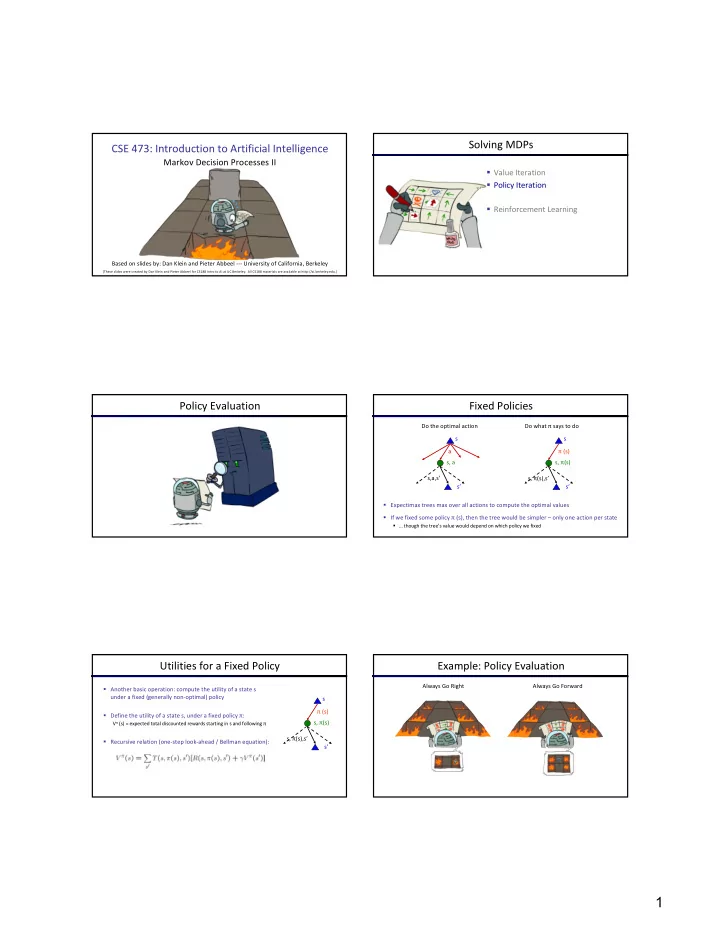
§ Expectimax trees max over all actions to compute the optimal values § If we fixed some policy π (s), then the tree would be simpler – only one action per state

§ … though the tree’s value would depend on which policy we fixed

a s s, a s,a,s’ s’ π (s) s s, π(s) s, π(s),s’ s’ Do the optimal action Do what π says to do

Utilities for a Fixed Policy

§ Another basic operation: compute the utility of a state s under a fixed (generally non-optimal) policy § Define the utility of a state s, under a fixed policy π:

Vπ (s) = expected total discounted rewards starting in s and following π

§ Recursive relation (one-step look-ahead / Bellman equation): π (s) s s, π(s) s, π(s),s’ s’

Example: Policy Evaluation

Always Go Right Always Go Forward

slide-2
SLIDE 2

2

Example: Policy Evaluation

Always Go Right Always Go Forward

Policy Evaluation

§ How do we calculate the V’s for a fixed policy π? § Idea 1: Turn recursive Bellman equations into updates (like value iteration) § Efficiency: O(S2) per iteration § Idea 2: Without the maxes, the Bellman equations are just a linear system

§ Solve with Matlab (or your favorite linear system solver)

π (s) s s, π(s) s, π(s),s’ s’

Policy Iteration

§ Alternative approach for optimal values:

§ Step 1: Policy evaluation: calculate utilities for some fixed policy (not optimal utilities!) until convergence § Step 2: Policy improvement: update policy using one-step look-ahead with resulting converged (but not optimal!) utilities as future values § Repeat steps until policy converges

§ This is policy iteration

§ It’s still optimal! Can converge (much) faster under some conditions

Comparison

§ Both value iteration and policy iteration compute the same thing (all optimal values) § In value iteration: § Every iteration updates both the values and (implicitly) the policy § We don’t track the policy, but taking the max over actions implicitly recomputes it § In policy iteration: § We do several passes that update utilities with fixed policy (each pass is fast because we consider only one action, not all of them) § After the policy is evaluated, a new policy is chosen (slow like a value iteration pass) § The new policy will be better (or we’re done) § Both are dynamic programs for solving MDPs

Summary: MDP Algorithms

§ So you want to….

§ Compute optimal values: use value iteration or policy iteration § Compute values for a particular policy: use policy evaluation § Turn your values into a policy: use policy extraction (one-step lookahead)

§ These all look the same!

§ They basically are – they are all variations of Bellman updates § They all use one-step lookahead expectimax fragments § They differ only in whether we plug in a fixed policy or max over actions

Manipulator Control

Arm with two joints (workspace) Configuration space
slide-3
SLIDE 3

3

Manipulator Control Path

Arm with two joints (workspace) Configuration space

Manipulator Control Path

Arm with two joints (workspace) Configuration space

Double Bandits Double-Bandit MDP

§ Actions: Blue, Red § States: Win, Lose

W L

$1 1.0 $1 1.0 0.25 $0 0.75 $2 0.75 $2 0.25 $0

No discount 100 time steps Both states have the same value

Offline Planning

§ Solving MDPs is offline planning

§ You determine all quantities through computation § You need to know the details of the MDP § You do not actually play the game!

Play Red Play Blue Value

No discount 100 time steps Both states have the same value

150 100 W L

$1 1.0 $1 1.0 0.25 $0 0.75 $2 0.75 $2 0.25 $0

Let’s Play!

$2 $2 $0 $2 $2 $2 $2 $0 $0 $0

slide-4
SLIDE 4

4

Online Planning

§ Rules changed! Red’s win chance is different. W L

$1 1.0 $1 1.0 ?? $0 ?? $2 ?? $2 ?? $0

Let’s Play!

$0 $0 $0 $2 $0 $2 $0 $0 $0 $0

What Just Happened?

§ That wasn’t planning, it was learning!

§ Specifically, reinforcement learning § There was an MDP, but you couldn’t solve it with just computation § You needed to actually act to figure it out

§ Important ideas in reinforcement learning that came up

§ Exploration: you have to try unknown actions to get information § Exploitation: eventually, you have to use what you know § Regret: even if you learn intelligently, you make mistakes § Sampling: because of chance, you have to try things repeatedly § Difficulty: learning can be much harder than solving a known MDP

Next Time: Reinforcement Learning!