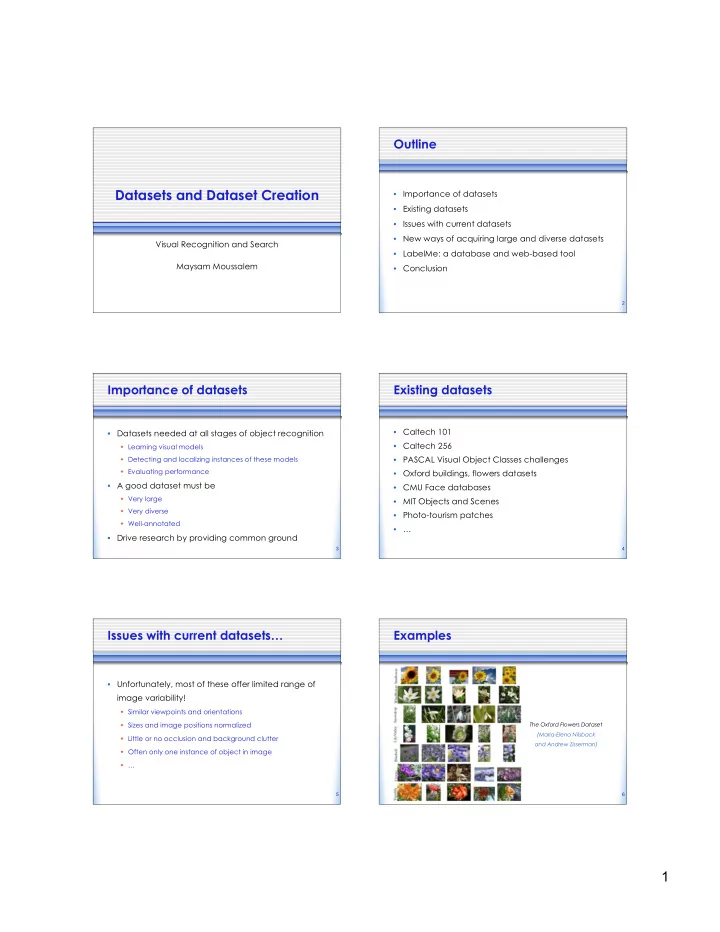
1 Examples The ETH-80 Dataset (Bastian Leibe and Bernt Schiele) - - PDF document

1
SMART_READER_LITE
LIVE PREVIEW

1 Examples The ETH-80 Dataset (Bastian Leibe and Bernt Schiele) - - PDF document

Outline Datasets and Dataset Creation Importance of datasets Existing datasets Issues with current datasets New ways of acquiring large and diverse datasets Visual Recognition and Search LabelMe: a database and web-based tool


slide-1
SLIDE 1

1 Datasets and Dataset Creation

Visual Recognition and Search Maysam Moussalem

2

Outline

  • Importance of datasets
  • Existing datasets
  • Issues with current datasets
  • New ways of acquiring large and diverse datasets
  • LabelMe: a database and web-based tool
  • Conclusion

3

Importance of datasets

  • Datasets needed at all stages of object recognition

 Learning visual models  Detecting and localizing instances of these models  Evaluating performance

  • A good dataset must be

 Very large  Very diverse  Well-annotated

  • Drive research by providing common ground

4

Existing datasets

  • Caltech 101
  • Caltech 256
  • PASCAL Visual Object Classes challenges
  • Oxford buildings, flowers datasets
  • CMU Face databases
  • MIT Objects and Scenes
  • Photo-tourism patches

5

Issues with current datasets…

  • Unfortunately, most of these offer limited range of

image variability!

 Similar viewpoints and orientations  Sizes and image positions normalized  Little or no occlusion and background clutter  Often only one instance of object in image  …

6

Examples

The Oxford Flowers Dataset (Maria-Elena Nilsback and Andrew Zisserman)

slide-2
SLIDE 2

2

7

Examples

The ETH-80 Dataset (Bastian Leibe and Bernt Schiele)

8

The Caltech 101 average image (constructed by A. Torralba)

9

A bit better… The Pascal 2006 average image (constructed by T. Malisiewicz)

10

Problems with existing datasets

  • Some algorithms may exploit restrictions in datasets

 E.g. those lacking scale, rotation invariance…

  • Images are not challenging enough

 More sophisticated algorithms might not show better results

  • Results tend to converge around 100% accuracy

11

Outline

  • Importance of datasets
  • Existing datasets
  • Issues with current datasets
  • New ways of acquiring large and diverse datasets
  • LabelMe: a database and web-based tool
  • Conclusion

12

New ways of acquiring large and diverse datasets

  • Web-based annotation tools

 Rely on collaborative effort of large population online

  • Examples

 ESP  Peekaboom  LabelMe

slide-3
SLIDE 3

3

13

ESP (von Ahn and Dabbish)

  • Two-player online game
  • Rules of the game

 Partners don’t know each other  Partners can’t communicate  Only thing in common: image  Objective is to type in same word

  • Since 2003, 34, 334, 076 images

have been labeled this way!

14

Peekaboom (von Ahn, Liu, and Blum)

15

LabelMe: a database and web-based tool

16

LabelMe

  • Online annotation tool
  • Allows sharing of images and annotations
  • Provides many functionalities

 Drawing polygons  Querying images  Browsing the database

17

LabelMe (technical specs)

  • Runs on (almost) any web browser
  • Includes standard Javascript drawing interface
  • Stores resulting labels in XML file

 Portable, annotations easy to extend

  • Provides Matlab toolbox for manipulating database

 Database queries  Communication with online tool  Image transformations  …

18

Browsing the images online

slide-4
SLIDE 4

4

19

Downloading the dataset, or a part of it… (much slower!)

20

Labeling the images

  • User has to draw boundary

around image by placing polygon control points  How many control points should there be?

  • Then, a popup balloon

comes up an user needs to give a name to the object  How to choose the label?

21

LabelMe: Examples of annotated scenes

22

LabelMe: Issues and Concerns

  • Quality control

 Provided by users who go over and correct labeling

  • Complexity of polygons drawn by users

 Simple or convex polygons

  • Choice of objects to label

 E.g. crowd of people: do you label individuals or all together

  • User decides
  • Labels themselves

 Level of precision, specificity

23

LabelMe: Issues and Concerns

24

Issues with polygons

slide-5
SLIDE 5

5

25

Issues with labels

  • What to do when users

choose labels such as  Car  Cars  Red car  Car frontal  Taxi  …?

  • Analysis and retrieval hard
  • LabelMe + WordNet!

 Electronic dictionary  Tree with semantic categories

26

As a result of this extension

  • Synonyms return (almost) the same results

 Here, motorcycle (left) and motorbike (right)

27

Interesting…

  • If you enter as query “apple”, first few entries are actually

“pineapple”!!

28

Statistics

  • Description

 Raw description entered by user; single or multiple words

  • Average

 Average intensity of object patches with same description

  • Shown when at least 10 instances of object available
  • Occupied area

 Percentage of pixels occupied relative to image size

  • Boundary points

 Number of points used

  • Object location

 Distribution of locations occupied by each instance

  • Helps understand photographers’ biases

29 30

Summary and Conclusion

  • Importance of datasets
  • Existing datasets
  • Issues with current datasets
  • New ways of acquiring large and diverse datasets
  • LabelMe: a database and web-based tool
  • Conclusion