1 We Will Cover Requirements specification The OO Development - - PDF document

1
SMART_READER_LITE
LIVE PREVIEW

1 We Will Cover Requirements specification The OO Development - - PDF document

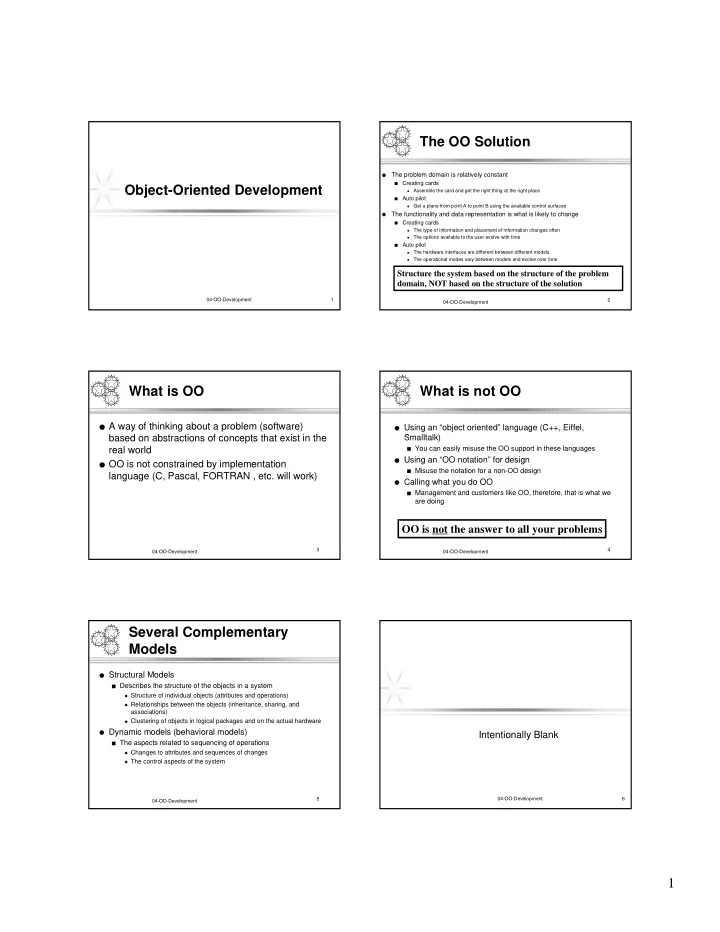
The OO Solution The problem domain is relatively constant Object-Oriented Development Creating cards Assemble the card and get the right thing at the right place Auto pilot Get a plane from point A to point B using the


slide-1
SLIDE 1

1

04-OO-Development 1

Object-Oriented Development

2 04-OO-Development

Structure the system based on the structure of the problem domain, NOT based on the structure of the solution

The OO Solution

  • The problem domain is relatively constant

Creating cards

◆ Assemble the card and get the right thing at the right place

Auto pilot

◆ Get a plane from point A to point B using the available control surfaces

  • The functionality and data representation is what is likely to change

Creating cards

◆ The type of information and placement of information changes often ◆ The options available to the user evolve with time

Auto pilot

◆ The hardware interfaces are different between different models ◆ The operational modes vary between models and evolve over time

3 04-OO-Development

What is OO

  • A way of thinking about a problem (software)

based on abstractions of concepts that exist in the real world

  • OO is not constrained by implementation

language (C, Pascal, FORTRAN , etc. will work)

4 04-OO-Development

OO is not the answer to all your problems

What is not OO

  • Using an “object oriented” language (C++, Eiffel,

Smalltalk)

■ You can easily misuse the OO support in these languages

  • Using an “OO notation” for design

■ Misuse the notation for a non-OO design

  • Calling what you do OO

■ Management and customers like OO, therefore, that is what we

are doing

5 04-OO-Development

Several Complementary Models

  • Structural Models

■ Describes the structure of the objects in a system

◆ Structure of individual objects (attributes and operations) ◆ Relationships between the objects (inheritance, sharing, and

associations)

◆ Clustering of objects in logical packages and on the actual hardware

  • Dynamic models (behavioral models)

■ The aspects related to sequencing of operations

◆ Changes to attributes and sequences of changes ◆ The control aspects of the system

04-OO-Development 6

Intentionally Blank

slide-2
SLIDE 2

2

04-OO-Development 7

The OO Development Process

8 04-OO-Development

We Will Cover

  • Requirements specification

■ Very briefly

  • Iterative development
  • Different models

■ Three distinct models for which you can use UML

◆ Domain (or conceptual) model ◆ Analysis (specification) model ◆ Design (implementation) model

  • How do we move between the models

9 04-OO-Development

Process Overview

  • Inception
  • Elaboration
  • Construction

■ Many iterations

  • Transition

Inception Elaboration

Construction 1 Construction 2 Construction 3 Construction n

Transition

10 04-OO-Development

Inception

  • Creation of the basic idea that we want to implement

(presumably with software)

  • Could take many shapes

■ A discussion over a beer at the pub ■ A full fledged feasibility study

  • Figure out (roughly)

■ The business case

◆ How much money will this make the company

■ Project scope 11 04-OO-Development

Elaboration

  • Answer the following:

■ What is it you are going to build? ■ How are you going to build it? ■ What technology are you going to use?

  • Your decisions should be guided by the risks

■ Requirements risks ■ Technological risks ■ Skills risks ■ Political risks 12 04-OO-Development

Requirements Risks

  • Poor or wrong requirements a serious problem
  • Use UML notations to help you understand the customers

requirements and the inherent structure of the problem domain

■ Use-case diagrams and use cases to understand customer

requirements

■ Class diagrams, activity diagrams, and possibly other diagrams to

understand the domain

slide-3
SLIDE 3

3

13 04-OO-Development

Plan the Construction Phase

  • We will never build the entire system at once

■ Incremental development

  • Categorize the use cases

■ “I absolutely must have this function in the system” ■ “I can live without this feature for a little while” ■ “This is an important function, but we might be able to live without

it”

  • Time estimate and allocate the use cases to iterations

14 04-OO-Development

Construction

  • Construct the system as a series of iterations

■ Each iteration is a “mini” project

◆ Analyze the use case, design, code, test, and integrate.

  • Refine your domain model

■ Identify all attributes and operations ■ Define the dynamic behavior of all objects

◆ State machines ◆ “Contracts”

  • Make decisions influenced by platform and language

15 04-OO-Development

Transition

  • The phase between the beta release and the final product
  • Wrap up all the issues that should not be done or cannot

be done during the iterations

■ Examples include performance evaluation and optimization ■ Complete system testing

  • No new functionality added

■ Fix bugs ■ Refactor your system a final time 16 04-OO-Development

Three Distinct Models

  • A conceptual model (domain model)

■ Try to figure out what is really going on ■ Build a model to better understand the problem ■ Used to communicate with the customer and “domain” experts

  • An analysis model (specification model)

■ Model the software that will implement the system ■ Focus on the software structure and the module interfaces

  • Design model (implementation model)

■ A detailed design of the software ■ Including all attributes and detailed descriptions of the operations 17 04-OO-Development

Summary

  • Inception
  • Elaboration
  • Construction

■ Many iterations

  • Transition

Inception Elaboration

Construction 1 Construction 2 Construction 3 Construction n

Transition