1 Hello, World! Hello, World! System.out is an A program is a - - PDF document

1
SMART_READER_LITE
LIVE PREVIEW

1 Hello, World! Hello, World! System.out is an A program is a - - PDF document

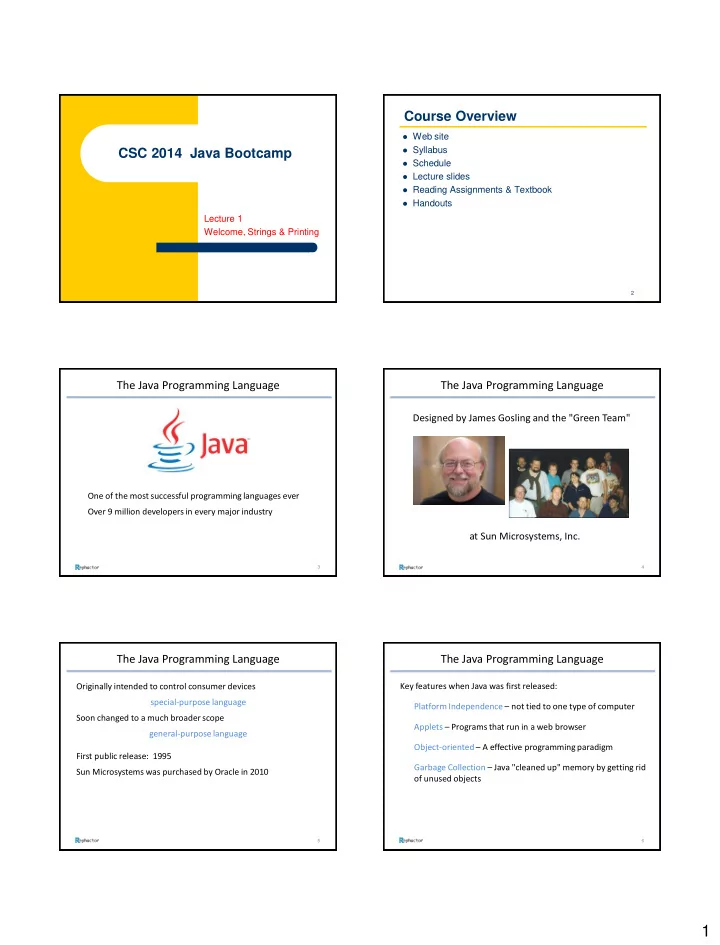
Course Overview Web site Syllabus CSC 2014 Java Bootcamp Schedule Lecture slides Reading Assignments & Textbook Handouts Lecture 1 Welcome, Strings & Printing 2 The Java Programming Language The Java


slide-1
SLIDE 1

1

CSC 2014 Java Bootcamp

Lecture 1 Welcome, Strings & Printing

2

Course Overview

 Web site  Syllabus  Schedule  Lecture slides  Reading Assignments & Textbook  Handouts

The Java Programming Language

One of the most successful programming languages ever Over 9 million developers in every major industry

3

The Java Programming Language

4

Designed by James Gosling and the "Green Team" at Sun Microsystems, Inc.

The Java Programming Language

Originally intended to control consumer devices special-purpose language Soon changed to a much broader scope general-purpose language First public release: 1995 Sun Microsystems was purchased by Oracle in 2010

5

The Java Programming Language

Key features when Java was first released: Platform Independence – not tied to one type of computer Applets – Programs that run in a web browser Object-oriented – A effective programming paradigm Garbage Collection – Java "cleaned up" memory by getting rid

  • f unused objects

6

slide-2
SLIDE 2

2

Hello, World!

A program is a sequence of instructions expressed in a particular programming language such as Java We'll start with a classic first example

7

System.out.println("Hello, World!");

Program statement:

Hello, World!

Output:

Hello, World!

8

System.out.println("Hello, World!"); System.out is an

  • bject representing the

console window

println is the name

  • f a method

A method is a group of program statements that can be called (or invoked) The println method is part of a big library of code that we can make use of in any Java program

Hello, World!

9

public static void main(String[] args) { System.out.println("Hello, World!"); }

The main method is the starting point of any Java program The header of the main method must be written like this For now, just consider this the scaffolding necessary to write a main method The code between the { and } is called the method body

Hello, World!

10

public class HelloWorld { public static void main(String[] args) { System.out.println("Hello, World!"); } }

Finally, every Java method must be defined in a class Similar to a method, a class has a class header and a class body Consistent indentation makes the program more readable Spaces and tabs in a program are called white space

Hello, World!

11

public class Proverb { public static void main(String[] args) { System.out.println("Tell me and I forget."); System.out.println("Show me and I remember."); System.out.println("Involve me and I understand."); } }

Another example:

Tell me and I forget. Show me and I remember. Involve me and I understand.

Hello, World!

12

Make use of the download and R & R buttons on code in the textbook

Download the program to your computer Run & Revise the code right in the browser

slide-3
SLIDE 3

3

The print and println Methods

The System.out object prints output to the console window The println method moves to the next line after it prints its

  • utput

The print method does not

13

System.out.println("One"); System.out.print("Two"); System.out.println("Three"); One TwoThree

The print and println Methods

14

System.out.print("One, "); System.out.print("Two, "); System.out.println("Buckle my shoe."); System.out.println(); System.out.print("Three, "); System.out.print("Four, "); System.out.println("Close the door."); One, Two, Buckle my shoe. Three, Four, Close the door. No argument required Result: blank line

The print and println Methods

The print and println methods can print any type of data

15

System.out.println(25); 69

This is an example of method overloading – a method accepting different types of data Expressions in the arguments are evaluated and the results are sent to the method

System.out.println(38 + 31);

The print and println Methods

Character strings cannot be broken across lines:

16

System.out.println("No word in the English language rhymes with the words month or orange");

The plus sign can be used to perform string concatenation

System.out.println("No word in the English language " + "rhymes with the words month or orange");

The two strings are joined into one long string which is passed to the method

The print and println Methods

Strings can be concatenated to numbers:

17

The number is converted to a string and the strings are joined That's more helpful when using variables

System.out.println("The total is: " + 4321); System.out.println("The total is: " + total);

The print and println Methods

The plus sign is an overloaded operator – it operates on different types of data It determines which operation to perform based on the types of its operands The plus operator is evaluated left to right

18

Concatenated: 123456 System.out.println("Concatenated: " + 123 + 456); Added: 579 System.out.println("Added: " + (123 + 456));

slide-4
SLIDE 4

4

Comments and Programming Style

Comments explain a program's purpose and processing They are intended for the human reader – they have no effect on a program A single-line comment begins with a // and continues until the end of the line

19

// This is a comment

It might be put on the end of a line of code

balance = balance – fees; // deduct monthly fees

Comments and Programming Style

A multi-line comment begins with a /* and ends with a */ It might span multiple lines

20

/* A multi-line comment that only spans one line */ /* A multi-line comment that spans multiple lines might be formatted like this. */

A variation of the multi-line comment begins with /** and is called a JavaDoc comment JavaDoc comments are used to generate online documentation

Comments and Programming Style

21

/* * Demonstrates the use of comments. */ public class SimpsonQuote { /* * Prints a quote from The Simpsons TV show. */ public static void main(String[] args) { // From the episode "Bart vs. Thanksgiving" System.out.println("Operator, what's the number " + "for 9-1-1?"); // season 2, ep 7 System.out.println(" - Homer Simpson"); } }

Compiling and Executing a Java Program

A software development environment is software that helps you develop software create, run, organize, modify, test, debug There are many options, some free and some not It's important to get comfortable with whatever development environment you use There are only a few crucial tools you need initially – learn the rest over time Two categories: command-line and integrated environments

22

Compiling and Executing a Java Program

A command-line environment is a suite of separate tools executed as individual commands in a console window

23

The Java Development Kit (JDK) from Oracle is a free command-line environment

Compiling and Executing a Java Program

An integrated development environment is one large program that combines the various tools

24

This one is Eclipse Others BlueJ DrJava JEdit jGRASP NetBeans

slide-5
SLIDE 5

5

Compiling and Executing a Java Program

Bytecode is a "low-level" version of a Java program – it's not something you edit directly Bytecode is not associated with any particular type of computer That's what makes Java platform-independent The Java Virtual Machine is implemented in software designed to execute the bytecode A Java program can be run on any computer with a JVM Java's original slogan:

Write once, run anywhere.

25

Programming Errors

26

The key is the relationship between two language aspects: syntax – the rules that determine how words and symbols can be combined semantics – the meaning of a syntactic element An English sentence can be syntactically valid and have multiple semantic interpretations In a programming language, syntax determines semantics If a programming statement is syntactically valid, it has only one interpretation

Programming Errors

27

Programming errors occur when we violate the language syntax rules or when the semantics we set up are not what we intended There are three types of programming errors: syntax errors runtime errors logic errors Errors happen. They are a part of programming. Don't sweat it. Just learn how to deal with them.

Programming Errors

The compiler analyzes a program and reports any syntax errors

28

public class Mistakes { pulbic static void main(String[] args) { System.out.println("No mistakes, just lessons.) } } public spelled wrong missing quote mark missing semicolon

Programming Errors

Syntax errors are reported in various ways depending on the development environment

29

Mistakes.java:3: <identifier> expected pulbic static void main(String[] args) ^ Mistakes.java:5: unclosed string literal System.out.println("No mistakes, just lessons.) ^ Mistakes.java:5: ';' expected System.out.println("No mistakes, just lessons.) ^ Mistakes.java:7: reached end of file while parsing } ^ 4 errors

Programming Errors

A runtime error occurs when an operation can't be carried out for some reason The program terminates (crashes) immediately In Java, a runtime error is usually represented by an exception

30

System.out.println(123 / 0)

Exception in thread "main" java.lang.ArithmeticException: / by zero at DivisionAttempt.main(DivisionAttempt.java:5)

line number

slide-6
SLIDE 6

6

Programming Errors

A logic error occurs when the program doesn't produce the desired results

31

System.out.println("The perimiter of a square with " + "3 inch sides is "); System.out.println(4 * 4 + "feet."); The perimiter of a square with 3 inch sides is 16feet

perimeter is spelled wrong wrong answer (16) wrong output units (feet) missing space between 16 and feet

The Java API

Java is supported by a massive class library of code you can use The standard class library is called the Java API API – Application Programmer Interface There are hundreds of classes in the Java API containing thousands of methods For example, the System class is part of the Java API It's rare to write a program that doesn't use classes from the API

32

The Java API

Java programmers rely heavily on the online documentation about the Java API docs.oracle.com/javase/8/docs/api/ Bookmark it. Get comfortable navigating it. Make it your friend. The textbook contains links to specific classes as needed

33