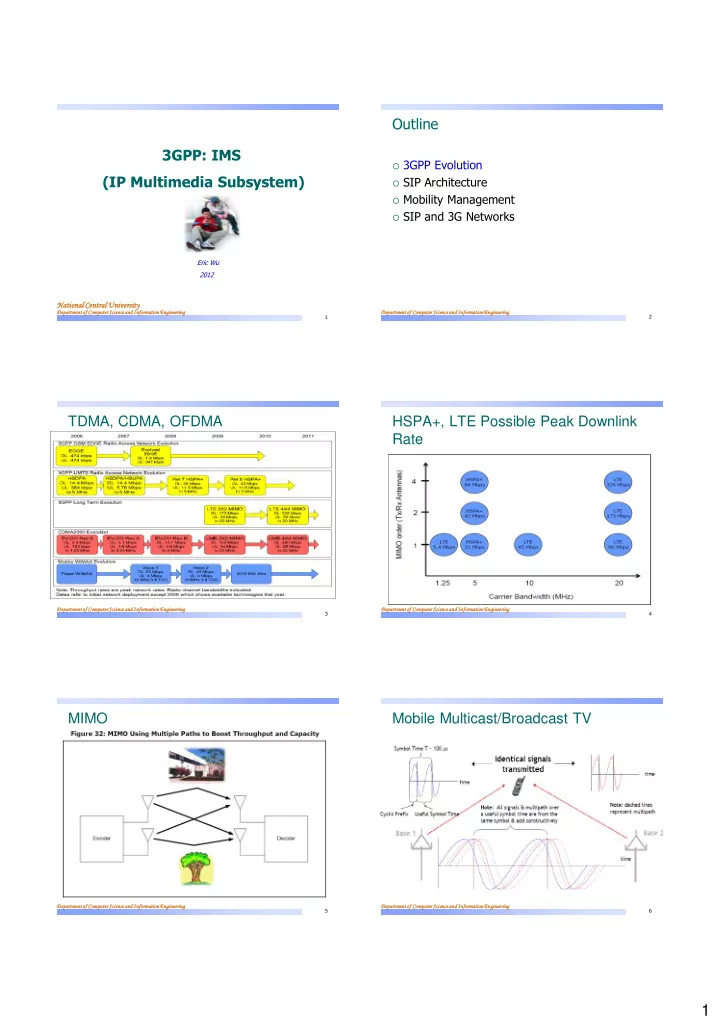
1 3GPP Release GPRS/EDGE Data Infrastructure R8 R9 R10 R99 R4 - - PDF document

1
SMART_READER_LITE
LIVE PREVIEW

1 3GPP Release GPRS/EDGE Data Infrastructure R8 R9 R10 R99 R4 - - PDF document

Outline 3GPP: IMS 3GPP Evolution (IP Multimedia Subsystem) SIP Architecture Mobility Management SIP and 3G Networks Eric Wu 2012 National Central University Department of Computer Science and Information Engineering Department


slide-1
SLIDE 1

1

National Central University

Department of Computer Science and Information Engineering

1

3GPP: IMS (IP Multimedia Subsystem)

Eric Wu

2012

Department of Computer Science and Information Engineering

2

Outline

 3GPP Evolution  SIP Architecture  Mobility Management  SIP and 3G Networks

Department of Computer Science and Information Engineering

TDMA, CDMA, OFDMA

3

Department of Computer Science and Information Engineering

HSPA+, LTE Possible Peak Downlink Rate

4

Department of Computer Science and Information Engineering

MIMO

5

Department of Computer Science and Information Engineering

Mobile Multicast/Broadcast TV

6

slide-2
SLIDE 2

2

Department of Computer Science and Information Engineering

3GPP Release

7

2011 2010 2009 2008 2007 2006 2005 2004 2003 2002 2001 2000

R99 R4 R5 R6 R7 R8 R9 R10

UMTS HSPA DL HSPA UL LTE LTE Adv HSPA + EPC Common IMS IMS MMTel

Releases cover the areas of: . Accesses (GSM, EDGE, HSPA, UMTS, LTE, LTE-Advanced, etc.) . Core Network (GSM Core, EPC) . Services (IMS, MMTel)

Department of Computer Science and Information Engineering

GPRS/EDGE Data Infrastructure

8

Department of Computer Science and Information Engineering

9

Department of Computer Science and Information Engineering

UMTS Voice and Data Traffic

10

Department of Computer Science and Information Engineering

Flat Architecture (Release 7-> 8)

11

Department of Computer Science and Information Engineering

EPC (Evolved-Packet Core)

12

slide-3
SLIDE 3

3

Department of Computer Science and Information Engineering

IMS-IP Multimedia Subsystem

13

Department of Computer Science and Information Engineering

IMS: IP Multimedia Subsystem

14

Department of Computer Science and Information Engineering

MMTel (Multimedia Telephony)

15

Department of Computer Science and Information Engineering

16

Session Initiation Protocol (SIP)

Department of Computer Science and Information Engineering

17

Session Initiation Protocol

 SIP is originally proposed by Columbia University

and is specified by IETF.

 SIP is an end-to-end application-layer protocol

 Establish, modify and terminate interactive multimedia

sessions, e.g., VoIP and video conference, between SIP- based users.

 Signaling protocol.  Client-Server framework.

 H.323 is a alternative signaling protocol to support

VoIP.

Department of Computer Science and Information Engineering

18

Microsoft Voice .NET Services

Internet Telephony Service Provider (ITSP)

slide-4
SLIDE 4

4

Department of Computer Science and Information Engineering

19

Features of SIP

 Text-based

 Easy implementation in Java or Perl

 JSIP open source library

 Easy debugging  Flexible and extensible

 Less signaling comparing to H.323

 QoS

 Transport-layer independence

 UDP is commonly used.

 Forking a call request

 Call forwarding  Parallel rings at different places

Department of Computer Science and Information Engineering

20

H.323

Department of Computer Science and Information Engineering

21

 Introduction to SIP  SIP Architecture  Mobility management  SIP and 3G Networks

Department of Computer Science and Information Engineering

22

Four SIP Logical Entities

 User agent  Proxy Server  Registrar  Redirect Server

Department of Computer Science and Information Engineering

23

User Agent

 User applications  Both software and hardware

Department of Computer Science and Information Engineering

24

Type of SIP Servers

 Proxy Server

 Application layer router used to relay SIP messages.

 Registrar

 Accept registration request from user agent.

 Redirect Server

 Redirects caller to other servers. Typically, “SIP server” implements the functionality of Proxy, Registrar and Redirect Servers.

slide-5
SLIDE 5

5

Department of Computer Science and Information Engineering

25

SIP Addressing

 SIP give you a globally reachable address.

 Email-like address.

 sip: leonard@a.ntu.edu.tw  sip: 82828888@a.ntu.edu.tw

 User agents bind this address to Registrar by

using SIP REGISTER message.

 Each user agent communicates with one

another by using this address.

Department of Computer Science and Information Engineering

26

SIP messages

Request Line Status Line Department of Computer Science and Information Engineering

27

Example: SIP Registration

Department of Computer Science and Information Engineering

28

Example: Session Establishment

Department of Computer Science and Information Engineering

29

Routing Information

Department of Computer Science and Information Engineering

30

Example: Session Forwarding

slide-6
SLIDE 6

6

Department of Computer Science and Information Engineering

31

Session Description Protocol (SDP)

 The message body of SIP  SDP is used to describe a multimedia

session

Department of Computer Science and Information Engineering

32

RTP, RTCP, and RTSP

 Real Time Transport Protocol (RTP)

 Encode and decode media stream  Recover the possible loss and jitter

 Real Time Control Protocol (RTCP)

 QoS feedback  …

 Real Time Streaming Protocol (RTSP)

 Control stored media  VCR remote control  Support play, record , pause, fast forward, and etc. Department of Computer Science and Information Engineering

33

RTSP protocol session

Department of Computer Science and Information Engineering

34

SIP Interworking with the SS7

Department of Computer Science and Information Engineering

35

 Introduction to SIP  SIP Architecture  Mobility management  SIP and 3G Networks

Department of Computer Science and Information Engineering

36

Wireless Technologies Convergence

slide-7
SLIDE 7

7

Department of Computer Science and Information Engineering

37

Mobility Management

 Mobility Classification

 Roaming  Macro-mobility

 Domain mobility

 Micro-mobility

 Subnet mobility

 Solutions

 Network layer solution: Mobile IP  Application layer solution: SIP

Department of Computer Science and Information Engineering

38

Mobile IPv4: Registration Example

Home Agent Home Link Foreign Link Foreign Agent Foreign Link Tunnel Movement

2.0.0.3 2.0.0.3 2.0.0

Correspondent Host Internet MH visits a foreign link Mobile IP kicks in Home address: 2.0.0.3 Care-of-address: 1.0.2.4 MH is at home Mobile IP is not used Home address: 2.0.0.3 Foreign Agent Department of Computer Science and Information Engineering

39

Mobile IPv4: CH-to-MH Routing Example

Home Agent Home Link Foreign Link Foreign Agent Foreign Link Tunnel

2.0.0.3 2.0.0

Correspondent Host Internet MH visits a foreign link Mobile IP kicks in Home address: 2.0.0.3 Care-of-address: 1.0.2.4 Foreign Agent Department of Computer Science and Information Engineering

40

Mobile IPv4: MH-to-CH Routing Example

Home Agent Home Link Foreign Link Foreign Agent Foreign Link Tunnel

2.0.0

Correspondent Host Router Infrastructure MH visits a foreign link Mobile IP kicks in Home address: 2.0.0.3 Care-of-address: 1.0.2.4 Foreign Agent

2.0.0.3

Department of Computer Science and Information Engineering

41

Mobile IPv4

 Triangle route problem  Micro-mobility improvement

 Cellular IP, Campbell in Column University.  Regional Registration, Perkins, Nokia Center.  …

Department of Computer Science and Information Engineering

42

Mobile IPv6: Binding Update

slide-8
SLIDE 8

8

Department of Computer Science and Information Engineering

43

Application Layer Mobility Using SIP

 Terminal Mobility  Session Mobility

Department of Computer Science and Information Engineering

44

Terminal Mobility

Department of Computer Science and Information Engineering

45

Terminal Mobility

Department of Computer Science and Information Engineering

46

Session Mobility

 Allow a user to maintain a media session even

while changing terminals.

Department of Computer Science and Information Engineering

47

Comparison

Department of Computer Science and Information Engineering

48

 Introduction to SIP  SIP Architecture  Internetworking  Mobility management  SIP and 3G Networks

slide-9
SLIDE 9

9

Department of Computer Science and Information Engineering

49

3G UMTS

Department of Computer Science and Information Engineering

50

Pure IP connectivity vs. Dedicated Multimedia subsystem

 Some mechanisms should be defined in 3G to

support multimedia session transfers?

 Market Perspective

 Subscriber perspective  Network operator perspective  Third-party service provider perspective

Department of Computer Science and Information Engineering

51

Subscriber Perspective

 Advantages

 It is free and flexible to choose applications.  Reuse application in wired-networks

 Disadvantage

 Trouble to choose the application and service

provider.

 The demand of service package and one bill.  Some application may lose QoS guarantee.

Department of Computer Science and Information Engineering

52

Network Operator Perspective

 Advantages

 Operators may not have experience in IP

multimedia applications. They only focus in the IP connectivity.

 Disadvantages

 Circuit-switch revenue will be decayed.  Loss possible revenue for paving basic IP

multimedia application, e.g., VoIP.

 Issue of customer dissatisfaction for IP multimedia

applications.

Department of Computer Science and Information Engineering

53

Third-Party Service Provider Perspective

 Advantages

 They don’t have to bother the peculiarity of

wireless networks. They don not need extensive knowledge of wireless telecommunication networks and protocols.

 Disadvantages

 They are unable to take advantage of the wireless

network, e.g., user location information.

Department of Computer Science and Information Engineering

54

IP Multimedia Subsystem (IMS)

 Appear in Release 5 and beyond  IMS comprises the network elements for

control of multimedia sessions.

 Network operator provides both

 IP connectivity  Multimedia session management

slide-10
SLIDE 10

10

Department of Computer Science and Information Engineering

55

Basic Add-in Features

 Call State Control Function (CSCF)

 Provisioning of call control for IP multimedia

  • applications. P-CSCF, I-CSCF, S-CSCF.

 Open Service Access (OSA)

 Third-party are expected to stimulate innovative

application, taking advantage of knowing the capabilities provided by wireless network providers.

Department of Computer Science and Information Engineering

56

IP Multimedia Subsystem

Media Resource Function Processor Media Resource Function Controller Perform internetworking related functions with PSTN Enhanced HLR

Department of Computer Science and Information Engineering

57

Serving-CSCF

Third-paty application Home Application

Department of Computer Science and Information Engineering

58

S-CSCF

 Session control.  Retrieve the information from HSS.  Connect to Application Servers.  Each user agent needs to attach a S-CSCF

before setup a session.

 Analog to Registrar in SIP.

Department of Computer Science and Information Engineering

59

Proxy-CSCF (P-CSCF)

 The first contact point within the IMS.  Mobile node communicate with S-CSCF via P-

  • CSCF. Direct communication with S-CSCF is not

allowed.

 Integrity protection of SIP signaling.  Compression due to sparse wireless resource

(Sigcom).

 Inspect SIP signaling if the mobile node is in a

visited network.

Department of Computer Science and Information Engineering

60

Interrogating-CSCF (I-CSCF)

 Entry Point in a network operator.  Hide the configurations, topology and capacity

from outside.

 Analog to Proxy and redirect servers in SIP.

slide-11
SLIDE 11

11

Department of Computer Science and Information Engineering

61

Registration

Department of Computer Science and Information Engineering

62

Session Setup

Department of Computer Science and Information Engineering

MMTel and Circuit Switch internetworking

63

Department of Computer Science and Information Engineering

64

Reference

Mobile IP: Charles E. Perkins http://people.nokia.net/~charliep SIP: http://www.cs.columbia.edu/sip IMS: 3GPP TS 23.228 v2.0 http://www.3gpp.org/ftp