1 Optimality Summary What is Search For? Tree search: Models of - - PDF document

1
SMART_READER_LITE
LIVE PREVIEW

1 Optimality Summary What is Search For? Tree search: Models of - - PDF document

Announcements Introduction to Artificial Intelligence Please ask for help on assignment V22.0472-001 Fall 2009 Lecture 4: Constraint Lecture 4: Constraint Satisfaction Problems Rob Fergus Dept of Computer Science, Courant Institute,


slide-1
SLIDE 1

1

Introduction to Artificial Intelligence

V22.0472-001 Fall 2009 Lecture 4: Constraint Lecture 4: Constraint Satisfaction Problems

Rob Fergus – Dept of Computer Science, Courant Institute, NYU Many slides from Dan Klein, Stuart Russell or Andrew Moore

Announcements

  • Please ask for help on assignment

2

Today

  • Search Conclusion

C S f P bl

  • Constraint Satisfaction Problems

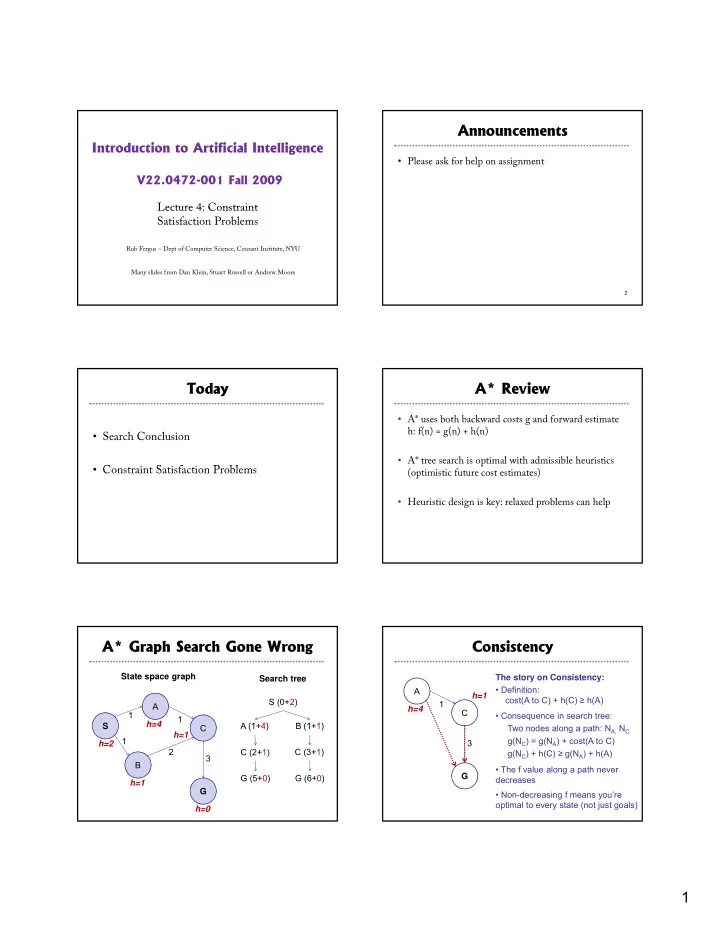
A* Review

  • A* uses both backward costs g and forward estimate

h: f(n) = g(n) + h(n)

  • A* tree search is optimal with admissible heuristics

p (optimistic future cost estimates)

  • Heuristic design is key: relaxed problems can help

A* Graph Search Gone Wrong

S A 1 1 h=4 S (0+2) A (1 4) B (1 1) S A State space graph Search tree S B C G 1 2 3 h=2 h=1 h=4 h=1 h=0 A (1+4) B (1+1) C (2+1) G (5+0) C (3+1) G (6+0) S B C G

Consistency

A C h=4 h=1 1 The story on Consistency:

  • Definition:

cost(A to C) + h(C) ≥ h(A)

  • Consequence in search tree:

3 G Two nodes along a path: NA, NC g(NC) = g(NA) + cost(A to C) g(NC) + h(C) ≥ g(NA) + h(A)

  • The f value along a path never

decreases

  • Non-decreasing f means you’re
  • ptimal to every state (not just goals)
slide-2
SLIDE 2

2

Optimality Summary

  • Tree search:
  • A* optimal if heuristic is admissible (and non-negative)
  • Uniform Cost Search is a special case (h = 0)
  • Graph search:

p

  • A* optimal if heuristic is consistent
  • UCS optimal (h = 0 is consistent)
  • In general, natural admissible heuristics tend to be

consistent

  • Remember, costs are always positive in search!

What is Search For?

  • Models of the world: single agents, deterministic actions, fully
  • bserved state, discrete state space
  • Planning: sequences of actions
  • The path to the goal is the important thing
  • The path to the goal is the important thing
  • Paths have various costs, depths
  • Heuristics to guide, fringe to keep backups
  • Identification: assignments to variables
  • The goal itself is important, not the path
  • All paths at the same depth (for some formulations)
  • CSPs are specialized for identification problems

8

Constraint Satisfaction Problems

  • Standard search problems:
  • State is a “black box”: arbitrary data structure
  • Goal test: any function over states
  • Successor function can be anything
  • Constraint satisfaction problems (CSPs):
  • A special subset of search problems

A special subset of search problems

  • State is defined by variables Xi with values from a

domain D (sometimes D depends on i)

  • Goal test is a set of constraints specifying allowable

combinations of values for subsets of variables

  • Simple example of a formal representation language
  • Allows useful general-purpose algorithms with more

power than standard search algorithms

9

Example: N-Queens

  • Formulation 1:
  • Variables:
  • Domains:
  • Constraints

Constraints

10

Example: N-Queens

  • Formulation 1.5:
  • Variables:
  • Domains:

Domains:

  • Constraints:

… there’s an even better way! What is it?

Example: N-Queens

  • Formulation 2:
  • Variables:
  • Domains:

Domains:

  • Constraints:

Implicit: Explicit:

  • or-
slide-3
SLIDE 3

3

Example: Map-Coloring

  • Variables:
  • Domain:
  • Constraints: adjacent regions must have

different colors

  • Solutions are assignments satisfying all

constraints, e.g.:

13

Constraint Graphs

  • Binary CSP: each constraint

relates (at most) two variables

  • Binary constraint graph: nodes are

variables, arcs show constraints

  • General-purpose CSP algorithms

use the graph structure to speed up

  • search. E.g., Tasmania is an

independent subproblem!

14

Example: Cryptarithmetic

  • Variables (circles):
  • Domains:
  • Constraints (boxes):

15

Example: Sudoku

Variables: Each (open) square Domains: Domains: {1,2,…,9} Constraints:

9-way alldiff for each row 9-way alldiff for each column 9-way alldiff for each region

Example: The Waltz Algorithm

  • The Waltz algorithm is for interpreting line drawings of solid

polyhedra

  • An early example of a computation posed as a CSP
  • Look at all intersections
  • Adjacent intersections impose constraints on each other

?

17

Waltz on Simple Scenes

  • Assume all objects:
  • Have no shadows or cracks
  • Three-faced vertices
  • “General position”: no junctions

change with small movements of the eye eye.

  • Then each line on image is one of

the following:

  • Boundary line (edge of an object)

(→) with right hand of arrow denoting “solid” and left hand denoting “space”

  • Interior convex edge (+)
  • Interior concave edge (-)

18

slide-4
SLIDE 4

4

Legal Junctions

  • Only certain junctions are physically

possible

  • How can we formulate a CSP to

label an image?

  • Variables: vertices
  • Domains: junction labels
  • Constraints: both ends of a line

should have the same label

x y (x,y) in

, , …

19

Varieties of CSPs

  • Discrete Variables
  • Finite domains
  • Size d means O(dn) complete assignments
  • E.g., Boolean CSPs, including Boolean satisfiability (NP-complete)
  • Infinite domains (integers, strings, etc.)
  • E g job scheduling variables are start/end times for each job
  • E.g., job scheduling, variables are start/end times for each job
  • Linear constraints solvable, nonlinear undecidable
  • Continuous variables
  • E.g., start/end times for Hubble Telescope observations
  • Linear constraints solvable in polynomial time by LP methods (see

cs170 for a bit of this theory)

20

Varieties of Constraints

  • Varieties of Constraints
  • Unary constraints involve a single variable (equiv. to shrinking domains):
  • Binary constraints involve pairs of variables:
  • Higher-order constraints involve 3 or more variables:

e.g., cryptarithmetic column constraints

  • Preferences (soft constraints):
  • E.g., red is better than green
  • Often representable by a cost for each variable assignment
  • Gives constrained optimization problems
  • (We’ll ignore these until we get to Bayes’ nets)

21

Real-World CSPs

  • Assignment problems: e.g., who teaches what class
  • Timetabling problems: e.g., which class is offered when and

where?

  • Hardware configuration
  • Transportation scheduling

p g

  • Factory scheduling
  • Floorplanning
  • Fault diagnosis
  • … lots more!
  • Many real-world problems involve real-valued variables…

22

Standard Search Formulation

  • Standard search formulation of CSPs (incremental)
  • Let's start with the straightforward, dumb approach, then fix it
  • States are defined by the values assigned so far

y g

  • Initial state: the empty assignment, {}
  • Successor function: assign a value to an unassigned variable
  • Goal test: the current assignment is complete and satisfies all

constraints

  • Simplest CSP ever: two bits, constrained to be equal

23

Search Methods

  • What does BFS do?
  • What does DFS do?

What does DFS do?

  • What’s the obvious problem here?
  • What’s the slightly-less-obvious problem?

24

slide-5
SLIDE 5

5

Backtracking Search

  • Idea 1: Only consider a single variable at each point
  • Variable assignments are commutative, so fix ordering
  • I.e., [WA = red then NT = green] same as [NT = green then WA = red]
  • Only need to consider assignments to a single variable at each step
  • How many leaves are there?
  • Idea 2: Only allow legal assignments at each point

y g g p

  • I.e. consider only values which do not conflict previous assignments
  • Might have to do some computation to figure out whether a value is ok
  • “Incremental goal test”
  • Depth-first search for CSPs with these two improvements is called

backtracking search

  • Backtracking search is the basic uninformed algorithm for CSPs
  • Can solve n-queens for n ≈ 25

25

Backtracking Search

  • What are the choice points?

26

Backtracking Example

27

Improving Backtracking

  • General-purpose ideas can give huge gains in speed:
  • Which variable should be assigned next?
  • In what order should its values be tried?
  • Can we detect inevitable failure early?
  • Can we take advantage of problem structure?

28

Minimum Remaining Values

  • Minimum remaining values (MRV):
  • Choose the variable with the fewest legal values
  • Why min rather than max?
  • Also called “most constrained variable”
  • “Fail-fast” ordering

29

Degree Heuristic

  • Tie-breaker among MRV variables
  • Degree heuristic:
  • Choose the variable participating in the most constraints
  • n remaining variables
  • Why most rather than fewest constraints?

30

slide-6
SLIDE 6

6

Least Constraining Value

  • Given a choice of variable:
  • Choose the least constraining value
  • The one that rules out the fewest

values in the remaining variables

  • Note that it may take some

computation to determine this! p

  • Why least rather than most?
  • Combining these heuristics

makes 1000 queens feasible

31

Forward Checking

  • Idea: Keep track of remaining legal values for unassigned

variables (using immediate constraints)

  • Idea: Terminate when any variable has no legal values

WA SA NT Q

NSW

V 32

Constraint Propagation

  • Forward checking propagates information from assigned to adjacent

unassigned variables, but doesn't detect more distant failures:

WA SA NT Q

NSW

V

  • NT and SA cannot both be blue!
  • Why didn’t we detect this yet?
  • Constraint propagation repeatedly enforces constraints (locally)

33

Arc Consistency

  • Simplest form of propagation makes each arc consistent
  • X → Y is consistent iff for every value x there is some allowed y

WA SA NT Q

NSW

V 34

  • If X loses a value, neighbors of X need to be rechecked!
  • Arc consistency detects failure earlier than forward checking
  • What’s the downside of arc consistency?
  • Can be run as a preprocessor or after each assignment

Arc Consistency

  • Runtime: O(n2d3), can be reduced to O(n2d2)
  • … but detecting all possible future problems is NP-hard – why?

35

Limitations of Arc Consistency

  • After running arc

consistency:

  • Can have one solution left
  • Can have multiple solutions

l f left

  • Can have no solutions left

(and not know it)

slide-7
SLIDE 7

7

Problem Structure

  • Tasmania and mainland are independent

subproblems

  • Identifiable as connected components of

constraint graph

  • Suppose each subproblem has c variables
  • ut of n total
  • Worst-case solution cost is O((n/c)(dc)),

linear in n

  • E.g., n = 80, d = 2, c =20
  • 280 = 4 billion years at 10 million nodes/sec
  • (4)(220) = 0.4 seconds at 10 million nodes/sec

37

Tree-Structured CSPs

  • Choose a variable as root, order

variables from root to leaves such that every node's parent precedes it in the ordering

  • For i = n : 2, apply RemoveInconsistent(Parent(Xi),Xi)
  • For i = 1 : n, assign Xi consistently with Parent(Xi)
  • Runtime: O(n d2)

38

Tree-Structured CSPs

  • Theorem: if the constraint graph has no loops, the CSP can be solved in

O(n d2) time!

  • Compare to general CSPs, where worst-case time is O(dn)
  • This property also applies to logical and probabilistic reasoning: an

important example of the relation between syntactic restrictions and the complexity of reasoning.

39

Nearly Tree-Structured CSPs

  • Conditioning: instantiate a variable, prune its neighbors' domains
  • Cutset conditioning: instantiate (in all ways) a set of variables such that the

remaining constraint graph is a tree

  • Cutset size c gives runtime O( (dc) (n-c) d2 ), very fast for small c

40

Iterative Algorithms for CSPs

  • Greedy and local methods typically work with “complete”

states, i.e., all variables assigned

  • To apply to CSPs:
  • Allow states with unsatisfied constraints
  • Operators reassign variable values

Operators reassign variable values

  • Variable selection: randomly select any conflicted variable
  • Value selection by min-conflicts heuristic:
  • Choose value that violates the fewest constraints
  • I.e., hill climb with h(n) = total number of violated constraints

41

Example: 4-Queens

  • States: 4 queens in 4 columns (44 = 256 states)
  • Operators: move queen in column
  • Goal test: no attacks
  • Evaluation: h(n) = number of attacks

42

slide-8
SLIDE 8

8

Performance of Min-Conflicts

  • Given random initial state, can solve n-queens in almost constant time for

arbitrary n with high probability (e.g., n = 10,000,000)

  • The same appears to be true for any randomly-generated CSP except in a

narrow range of the ratio

43

Summary

  • CSPs are a special kind of search problem:
  • States defined by values of a fixed set of variables
  • Goal test defined by constraints on variable values
  • Backtracking = depth-first search with one legal variable assigned per node
  • Variable ordering and value selection heuristics help significantly
  • Forward checking prevents assignments that guarantee later failure
  • Constraint propagation (e.g., arc consistency) does additional work to constrain values and

detect inconsistencies

  • The constraint graph representation allows analysis of problem structure
  • Tree-structured CSPs can be solved in linear time
  • Iterative min-conflicts is usually effective in practice

44

Node Class

class Node: def __init__(self, state, parent, action, path_cost): "Create a search tree Node, derived from a parent by an action." “YOUR CODE HERE: Set state, parent, action, path_cost" self.state = state etc……. if parent: “YOUR CODE HERE: If valid parent, increment depth, path_cost” def path(self): "Create a list of nodes from the root to this node." “ i.e. Follow parent pointers back up to root” def expand(self, problem): "Return a list of nodes reachable from this node" return [Node(next, self, act, path_cost) for (next, act, path_cost) in problem.getSuccessors(self.state)]

Graph Search

def graph_search(problem, fringe): "Search through the successors of a problem to find a goal.” return None def depthFirstSearch(problem): def depthFirstSearch(problem): “Search the deepest nodes in the search tree first” return graph_search(problem, util.Stack()) def breadthFirstSearch(problem): "Search the shallowest nodes in the search tree first” return graph_search(problem, util.Queue())