
SLIDE 1
1
1
Adapted from UCB CS252 S01, Revised by Zhao Zhang in IASTATE CPRE 585, 2004
Lecture 14: Hardware Approaches for Cache Optimizations
Cache performance metrics, reduce miss rates, improve hit time, reduce miss penalty
Adapted from UCB CS252 S01
2
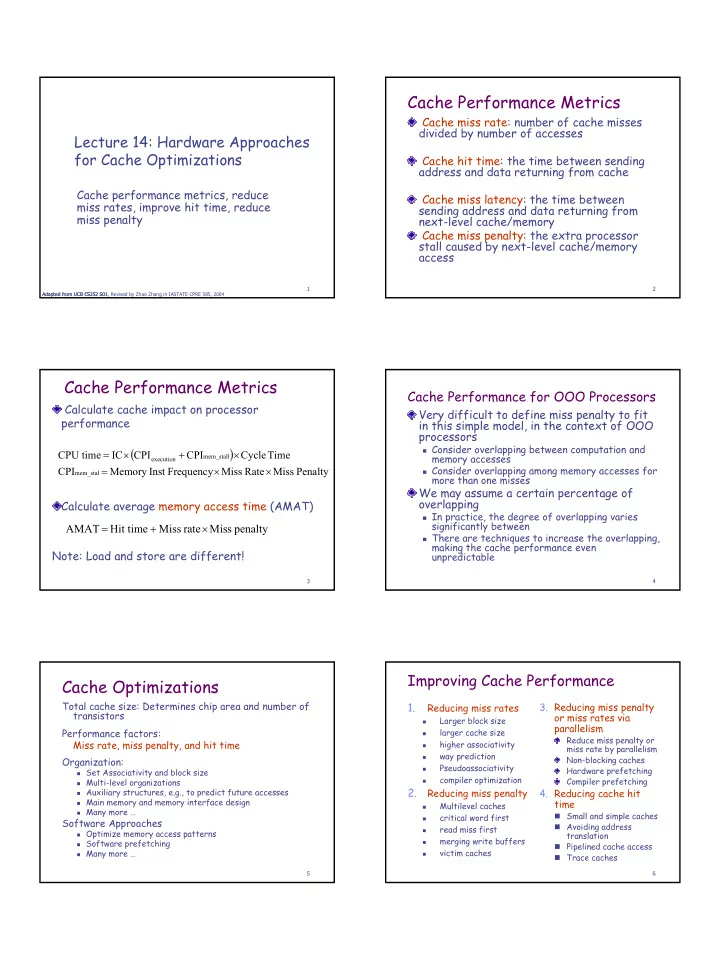
Cache Performance Metrics
Cache miss rate: number of cache misses divided by number of accesses Cache hit time: the time between sending address and data returning from cache Cache miss latency: the time between sending address and data returning from next-level cache/memory Cache miss penalty: the extra processor stall caused by next-level cache/memory access
3
Calculate cache impact on processor performance Calculate average memory access time (AMAT) Note: Load and store are different!
Cache Performance Metrics
penalty Miss rate Miss Hit time AMAT × + =
( )
Penalty Miss Rate Miss Frequency Inst Memory CPI Time Cycle CPI CPI IC time CPU
mem_stal mem_stall execution
× × = × + × =
4
Cache Performance for OOO Processors
Very difficult to define miss penalty to fit in this simple model, in the context of OOO processors
Consider overlapping between computation and
memory accesses
Consider overlapping among memory accesses for
more than one misses
We may assume a certain percentage of
- verlapping
In practice, the degree of overlapping varies
significantly between
There are techniques to increase the overlapping,
making the cache performance even unpredictable
5
Cache Optimizations
Total cache size: Determines chip area and number of transistors Performance factors: Miss rate, miss penalty, and hit time Organization:
Set Associativity and block size Multi-level organizations Auxiliary structures, e.g., to predict future accesses Main memory and memory interface design Many more …
Software Approaches
Optimize memory access patterns Software prefetching Many more …
6
Improving Cache Performance
- 3. Reducing miss penalty
- r miss rates via
parallelism
Reduce miss penalty or miss rate by parallelism Non-blocking caches Hardware prefetching Compiler prefetching
- 4. Reducing cache hit
time
Small and simple caches Avoiding address translation Pipelined cache access Trace caches
1.
Reducing miss rates
- Larger block size
- larger cache size
- higher associativity
- way prediction
- Pseudoassociativity
- compiler optimization
2.
Reducing miss penalty
- Multilevel caches
- critical word first
- read miss first
- merging write buffers
- victim caches