1 Lambda vs. Def Statements Newtons Method Background Finds - - PDF document

1
SMART_READER_LITE
LIVE PREVIEW

1 Lambda vs. Def Statements Newtons Method Background Finds - - PDF document

Announcements HW3 out, due Tuesday at 7pm Midterm next Wednesday at 7pm Keep an eye out for your assigned location Old exams posted soon Review sessions Saturday 2 4pm in TBA CS61A Lecture 7 Extend office hours


slide-1
SLIDE 1

1

CS61A Lecture 7

Amir Kamil UC Berkeley February 6, 2013

 HW3 out, due Tuesday at 7pm  Midterm next Wednesday at 7pm

 Keep an eye out for your assigned location  Old exams posted soon  Review sessions

 Saturday 2‐4pm in TBA  Extend office hours Sunday 11‐3pm in TBA  HKN review session Sunday 3‐6pm in 145 Dwinelle

 Environment diagram handout on website  Code review system online

 See Piazza post for details

Announcements

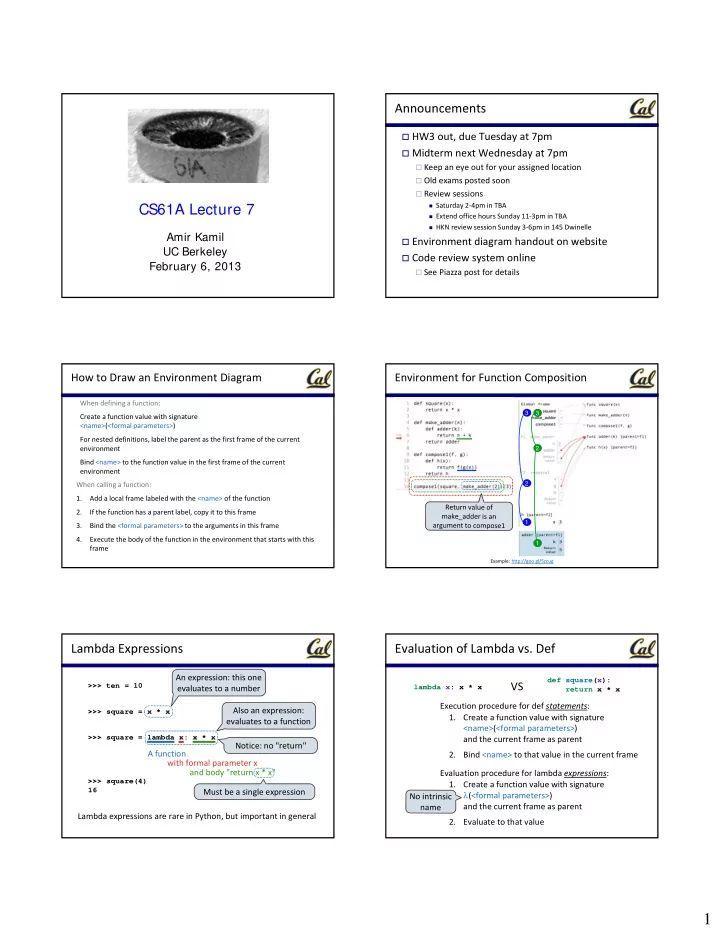
How to Draw an Environment Diagram

When defining a function: Create a function value with signature <name>(<formal parameters>) For nested definitions, label the parent as the first frame of the current environment Bind <name> to the function value in the first frame of the current environment When calling a function: 1. Add a local frame labeled with the <name> of the function 2. If the function has a parent label, copy it to this frame 3. Bind the <formal parameters> to the arguments in this frame 4. Execute the body of the function in the environment that starts with this frame

Environment for Function Composition

2 1 3 1 2 3

Example: http://goo.gl/5zcug

Lambda Expressions

>>> ten = 10 >>> square = x * x >>> square = lambda x: x * x >>> square(4) 16

An expression: this one evaluates to a number Also an expression: evaluates to a function and body "return x * x" with formal parameter x A function Lambda expressions are rare in Python, but important in general Notice: no "return" Must be a single expression

Evaluation of Lambda vs. Def

Execution procedure for def statements: 1. Create a function value with signature <name>(<formal parameters>) and the current frame as parent 2. Bind <name> to that value in the current frame Evaluation procedure for lambda expressions: 1. Create a function value with signature (<formal parameters>) and the current frame as parent 2. Evaluate to that value

lambda x: x * x def square(x): return x * x

VS

slide-2
SLIDE 2

2

Lambda vs. Def Statements

square = lambda x: x * x def square(x): return x * x

VS

Both create a function with the same arguments & behavior Both of those functions are associated with the environment in which they are defined Both bind that function to the name "square" Only the def statement gives the function an intrinsic name The Greek letter lambda

Newton’s Method Background

Finds approximations to zeroes of differentiable functions

f(x) = x2 ‐ 2 A “zero”

Application: a method for (approximately) computing square roots, using only basic arithmetic. The positive zero of f(x) = x2 ‐ a is

x=1.414213562373095

Newton’s Method

Compute the value of f at the guess: f(x) Compute the derivative of f at the guess: f'(x) Update guess to be: Begin with a function f and an initial guess x (x, f(x)) ‐f(x)/f'(x) ‐f(x)

Visualization: http://en.wikipedia.org/wiki/File:NewtonIteration_Ani.gif

Using Newton’s Method

>>> f = lambda x: x*x - 2 >>> find_zero(f) 1.4142135623730951

How to find the square root of 2? How to find the log base 2 of 1024?

>>> g = lambda x: pow(2, x) - 1024 >>> find_zero(g) 10.0

g(x) = 2x ‐ 1024 f(x) = x2 ‐ 2

Special Case: Square Roots

How to compute square_root(a) Idea: Iteratively refine a guess x about the square root of a What guess should start the computation? How do we know when we are finished? Implementation questions: Update: Babylonian Method x ‐ f(x)/f'(x)

Special Case: Cube Roots

How to compute cube_root(a) Idea: Iteratively refine a guess x about the cube root of a What guess should start the computation? How do we know when we are finished? Implementation questions: Update: x ‐ f(x)/f'(x)

slide-3
SLIDE 3

3

Iterative Improvement

def iter_improve(update, done, guess=1, max_updates=1000): """Iteratively improve guess with update until done returns a true value. >>> iter_improve(golden_update, golden_test) 1.618033988749895 """ k = 0 while not done(guess) and k < max_updates: guess = update(guess) k = k + 1 return guess

First, identify common structure. Then define a function that generalizes the procedure.

Newton’s Method for nth Roots

def nth_root_func_and_derivative(n, a): def root_func(x): return pow(x, n) - a def derivative(x): return n * pow(x, n-1) return root_func, derivative def nth_root_newton(a, n): """Return the nth root of a. >>> nth_root_newton(8, 3) 2.0 """ root_func, deriv = nth_root_func_and_derivative(n, a) def update(x): return x - root_func(x) / deriv(x) def done(x): return root_func(x) == 0 return iter_improve(update, done)

x – f(x)/f’(x) Definition of a function zero Exact derivative