1 Path Expressions Bib &o1 Examples: paper paper book - - PDF document

1
SMART_READER_LITE
LIVE PREVIEW

1 Path Expressions Bib &o1 Examples: paper paper book - - PDF document

Introduction to Semistructured Data and XML Chapter 27, Part E Based on slides by Dan Suciu University of Washington Database Management Systems, R. Ramakrishnan 1 Management of XML and Semistructured Data Based upon slides by Dan Suciu


slide-1
SLIDE 1

1

Database Management Systems, R. Ramakrishnan 1

Introduction to Semistructured Data and XML

Chapter 27, Part E Based on slides by Dan Suciu University of Washington

Database Management Systems, R. Ramakrishnan 2

Management of XML and Semistructured Data

Based upon slides by Dan Suciu

Database Management Systems, R. Ramakrishnan 3

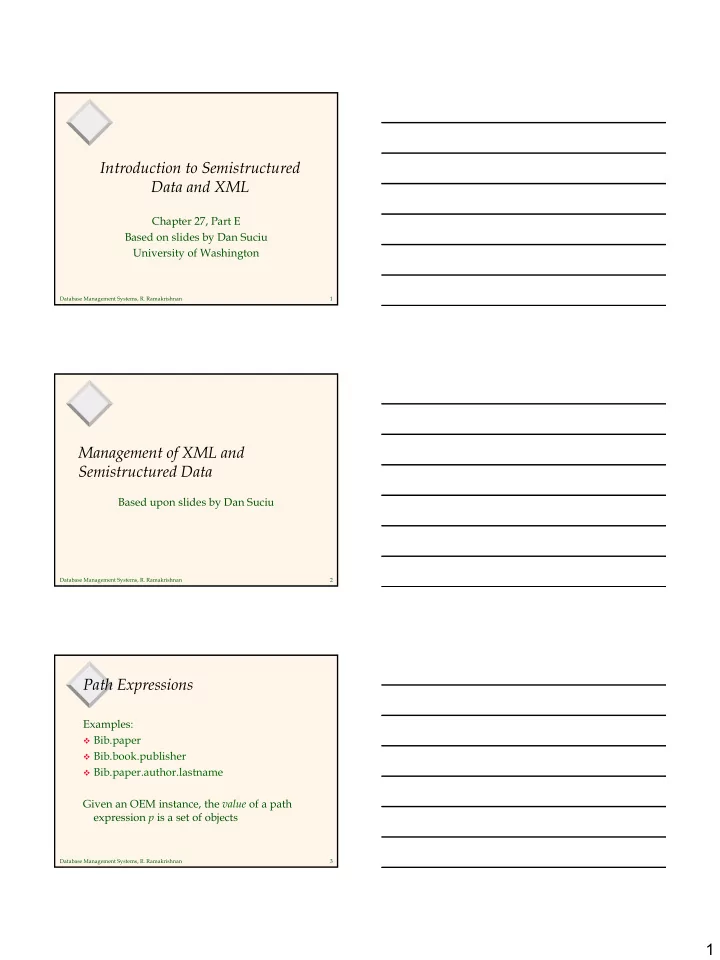
Path Expressions

Examples:

Bib.paper Bib.book.publisher Bib.paper.author.lastname

Given an OEM instance, the value of a path expression p is a set of objects

slide-2
SLIDE 2

2

Database Management Systems, R. Ramakrishnan 4

Path Expressions

Examples: DB =

&o1 &o12 &o24 &o29 &o43 &o70 &o71 &96 &243 &206 &25 “Serge” “Abiteboul” 1997 “Victor” “Vianu” 122 133 paper book paper references references references authortitle year http author author author title publisher author author title page firstname lastname firstname lastname first last Bib &o44 &o45 &o46 &o47 &o48 &o49 &o50 &o51 &o52

Bib.paper={&o12,&o29} Bib.book.publisher={&o51} Bib.paper.author.lastname={&o71,&206} Bib.paper={&o12,&o29} Bib.book.publisher={&o51} Bib.paper.author.lastname={&o71,&206}

Database Management Systems, R. Ramakrishnan 5

XQuery

Summary:

FOR-LET-WHERE-ORDERBY-RETURN = FLWOR

FOR/LET Clauses WHERE Clause ORDERBY/RETURN Clause List of tuples List of tuples Instance of Xquery data model

Database Management Systems, R. Ramakrishnan 6

XQuery

FOR $x in expr -- binds $x to each value in

the list expr

LET $x = expr -- binds $x to the entire list

expr

  • Useful for common subexpressions and for

aggregations

slide-3
SLIDE 3

3

Database Management Systems, R. Ramakrishnan 7

FOR v.s. LET

FOR $x IN document("bib.xml")/bib/book RETURN <result> $x </result> FOR $x IN document("bib.xml")/bib/book RETURN <result> $x </result>

Returns:

<result> <book>...</book></result> <result> <book>...</book></result> <result> <book>...</book></result> ...

LET $x IN document("bib.xml")/bib/book RETURN <result> $x </result> LET $x IN document("bib.xml")/bib/book RETURN <result> $x </result>

Returns:

<result> <book>...</book> <book>...</book> <book>...</book> ... </result>

Database Management Systems, R. Ramakrishnan 8

Path Expressions

Abbreviated Syntax

  • /bib/paper[2]/author[1]
  • /bib//author
  • paper[author/lastname=“Vianu"]
  • /bib/(paper|book)/title

Unabbreviated Syntax

  • child::bib/descendant::author
  • child::bib/descendant-or-self::*/child::author
  • parent, self, descendant-or-self, attribute

Database Management Systems, R. Ramakrishnan 9

XQuery

Find all book titles published after 1995:

FOR $x IN document("bib.xml")/bib/book WHERE $x/year > 1995 RETURN $x/title FOR $x IN document("bib.xml")/bib/book WHERE $x/year > 1995 RETURN $x/title Result: <title> abc </title> <title> def </title> <title> ghi </title>

slide-4
SLIDE 4

4

Database Management Systems, R. Ramakrishnan 10

XQuery

For each author of a book by Morgan Kaufmann, list all books she published:

FOR $a IN distinct(document("bib.xml") /bib/book[publisher=“Morgan Kaufmann”]/author) RETURN <result> $a, FOR $t IN /bib/book[author=$a]/title RETURN $t </result> FOR $a IN distinct(document("bib.xml") /bib/book[publisher=“Morgan Kaufmann”]/author) RETURN <result> $a, FOR $t IN /bib/book[author=$a]/title RETURN $t </result>

distinct = a function that eliminates duplicates

Database Management Systems, R. Ramakrishnan 11

XQuery

Result:

<result> <author>Jones</author> <title> abc </title> <title> def </title> </result> <result> <author> Smith </author> <title> ghi </title> </result>

Database Management Systems, R. Ramakrishnan 12

XQuery

count = a (aggregate) function that returns the number of elms

<big_publishers> FOR $p IN distinct(document("bib.xml")//publisher) LET $b := document("bib.xml")/book[publisher = $p] WHERE count($b) > 100 RETURN $p </big_publishers> <big_publishers> FOR $p IN distinct(document("bib.xml")//publisher) LET $b := document("bib.xml")/book[publisher = $p] WHERE count($b) > 100 RETURN $p </big_publishers>

slide-5
SLIDE 5

5

Database Management Systems, R. Ramakrishnan 13

XQuery

Find books whose price is larger than average:

LET $a=avg(document("bib.xml")/bib/book/price) FOR $b in document("bib.xml")/bib/book WHERE $b/price > $a RETURN $b LET $a=avg(document("bib.xml")/bib/book/price) FOR $b in document("bib.xml")/bib/book WHERE $b/price > $a RETURN $b

Database Management Systems, R. Ramakrishnan 14

FOR v.s. LET

FOR

Binds node variables iteration

LET

Binds collection variables one value

Database Management Systems, R. Ramakrishnan 15

Collections in XQuery

Ordered and unordered collections

  • /bib/book/author = an ordered collection
  • Distinct(/bib/book/author) = an unordered collection

LET $a = /bib/book $a is a collection $b/author a collection (several authors...)

RETURN <result> $b/author </result> RETURN <result> $b/author </result>

Returns:

<result> <author>...</author> <author>...</author> <author>...</author> ... </result>

slide-6
SLIDE 6

6

Database Management Systems, R. Ramakrishnan 16

Collections in XQuery

What about collections in expressions ?

  • $b/price

list of n prices

  • $b/price * 0.7 list of n numbers??
  • $b/price * $b/quantity list of n x m numbers ??
  • Valid only if the two sequences have at most one element
  • Atomization

$book1/author eq "Kennedy" - Value Comparison $book1/author = "Kennedy" - General Comparison Database Management Systems, R. Ramakrishnan 17

Sorting in XQuery

<publisher_list> FOR $p IN distinct(document("bib.xml")//publisher)

ORDERBY $p

RETURN <publisher> <name> $p/text() </name> , FOR $b IN document("bib.xml")//book[publisher = $p]

ORDERBY $b/price DESCENDING

RETURN <book> $b/title , $b/price </book> </publisher> </publisher_list> <publisher_list> FOR $p IN distinct(document("bib.xml")//publisher)

ORDERBY $p

RETURN <publisher> <name> $p/text() </name> , FOR $b IN document("bib.xml")//book[publisher = $p]

ORDERBY $b/price DESCENDING

RETURN <book> $b/title , $b/price </book> </publisher> </publisher_list>

Database Management Systems, R. Ramakrishnan 18

If-Then-Else

FOR $h IN //holding

ORDERBY $h/title

RETURN <holding> $h/title, IF $h/@type = "Journal" THEN $h/editor ELSE $h/author </holding> FOR $h IN //holding

ORDERBY $h/title

RETURN <holding> $h/title, IF $h/@type = "Journal" THEN $h/editor ELSE $h/author </holding>

slide-7
SLIDE 7

7

Database Management Systems, R. Ramakrishnan 19

Existential Quantifiers

FOR $b IN //book WHERE SOME $p IN $b//para SATISFIES contains($p, "sailing") AND contains($p, "windsurfing") RETURN $b/title FOR $b IN //book WHERE SOME $p IN $b//para SATISFIES contains($p, "sailing") AND contains($p, "windsurfing") RETURN $b/title

Database Management Systems, R. Ramakrishnan 20

Universal Quantifiers

FOR $b IN //book WHERE EVERY $p IN $b//para SATISFIES contains($p, "sailing") RETURN $b/title FOR $b IN //book WHERE EVERY $p IN $b//para SATISFIES contains($p, "sailing") RETURN $b/title

Database Management Systems, R. Ramakrishnan 21

Other Stuff in XQuery

If-then-else Universal and existential quantifiers Sorting Before and After

  • for dealing with order in the input

Filter

  • deletes some edges in the result tree

Recursive functions

slide-8
SLIDE 8

8

Database Management Systems, R. Ramakrishnan 22

Group-By in Xquery ??

No GROUPBY currently in XQuery A recent proposal (next)

  • What do YOU think ?

Database Management Systems, R. Ramakrishnan 23

Group-By in Xquery ??

FOR $b IN document("http://www.bn.com")/bib/book, $y IN $b/@year WHERE $b/publisher="Morgan Kaufmann" RETURN GROUPBY $y WHERE count($b) > 10 IN <year> $y </year> FOR $b IN document("http://www.bn.com")/bib/book, $y IN $b/@year WHERE $b/publisher="Morgan Kaufmann" RETURN GROUPBY $y WHERE count($b) > 10 IN <year> $y </year>

SELECT year FROM Bib WHERE Bib.publisher="Morgan Kaufmann" GROUPBY year HAVING count(*) > 10 SELECT year FROM Bib WHERE Bib.publisher="Morgan Kaufmann" GROUPBY year HAVING count(*) > 10

with GROUPBY Equivalent SQL

Database Management Systems, R. Ramakrishnan 24

Group-By in Xquery ??

FOR $b IN document("http://www.bn.com")/bib/book, $a IN $b/author, $y IN $b/@year RETURN GROUPBY $a, $y IN <result> $a, <year> $y </year>, <total> count($b) </total> </result> FOR $b IN document("http://www.bn.com")/bib/book, $a IN $b/author, $y IN $b/@year RETURN GROUPBY $a, $y IN <result> $a, <year> $y </year>, <total> count($b) </total> </result>

FOR $a IN document(“http://www.bn.com”)/ bib/book/author, $y IN $a/../@year LET $b = document("http://www.bn.com")/bib/book[author=$a,@year=$y] RETURN <result> $a, <year> $y </year>, <total> count($b) </total> </result> FOR $a IN document(“http://www.bn.com”)/ bib/book/author, $y IN $a/../@year LET $b = document("http://www.bn.com")/bib/book[author=$a,@year=$y] RETURN <result> $a, <year> $y </year>, <total> count($b) </total> </result>

with GROUPBY Without GROUPBY Not equivalent if the GROUPBY is value-based Correct if the GROUPBY is node-identity based

slide-9
SLIDE 9

9

Database Management Systems, R. Ramakrishnan 25

Group-By in Xquery ??

FOR $b IN document("http://www.bn.com")/bib/book, $a IN $b/author, $y IN $b/@year RETURN GROUPBY $a, $y IN <result> $a, <year> $y </year>, <total> count($b) </total> </result> FOR $b IN document("http://www.bn.com")/bib/book, $a IN $b/author, $y IN $b/@year RETURN GROUPBY $a, $y IN <result> $a, <year> $y </year>, <total> count($b) </total> </result>

FOR $a IN distinct(document(“http://www.bn.com”)/ bib/book/author) $y IN distinct(document(“http://www.bn.com”)/bib/book/@year) LET $b = document("http://www.bn.com")/bib/book[author=$a,@year=$y] RETURN IF count($b) > 0 THEN <result> $a, <year> $y </year>, <total> count($b) </total> </result> FOR $a IN distinct(document(“http://www.bn.com”)/ bib/book/author) $y IN distinct(document(“http://www.bn.com”)/bib/book/@year) LET $b = document("http://www.bn.com")/bib/book[author=$a,@year=$y] RETURN IF count($b) > 0 THEN <result> $a, <year> $y </year>, <total> count($b) </total> </result>

with GROUPBY Without GROUPBY

Database Management Systems, R. Ramakrishnan 26

Group-By in Xquery ??

FOR $b IN document("http://www.bn.com")/bib/book, $a IN $b/author, $y IN $b/@year RETURN GROUPBY $a, $y IN <result> $a, <year> $y </year>, <total> count($b) </total> </result> FOR $b IN document("http://www.bn.com")/bib/book, $a IN $b/author, $y IN $b/@year RETURN GROUPBY $a, $y IN <result> $a, <year> $y </year>, <total> count($b) </total> </result>

FOR $Tup IN distinct(FOR $b IN document("http://www.bn.com")/bib, $a IN $b/author, $y IN $b/@year RETURN <Tup> <a> $a </a> <y> $y </y> </Tup>), $a IN $Tup/a/node(), $y IN $Tup/y/node() LET $b = document("http://www.bn.com")/bib/book[author=$a,@year=$y] RETURN <result> $a, <year> $y </year>, <total> count($b) </total> </result> FOR $Tup IN distinct(FOR $b IN document("http://www.bn.com")/bib, $a IN $b/author, $y IN $b/@year RETURN <Tup> <a> $a </a> <y> $y </y> </Tup>), $a IN $Tup/a/node(), $y IN $Tup/y/node() LET $b = document("http://www.bn.com")/bib/book[author=$a,@year=$y] RETURN <result> $a, <year> $y </year>, <total> count($b) </total> </result>

with GROUPBY Without GROUPBY

Database Management Systems, R. Ramakrishnan 27

Group-By in Xquery ??

FOR $b IN document("http://www.bn.com")/bib/book, $a IN $b/author, $y IN $b/@year, $t IN $b/title, $p IN $b/publisher RETURN GROUPBY $p, $y IN <result> $p, <year> $y </year>, GROUPBY $a IN <authorEntry> $a, GROUPBY $t IN $t <authorEntry> </result>

Nested GROUPBY’s