
SLIDE 1
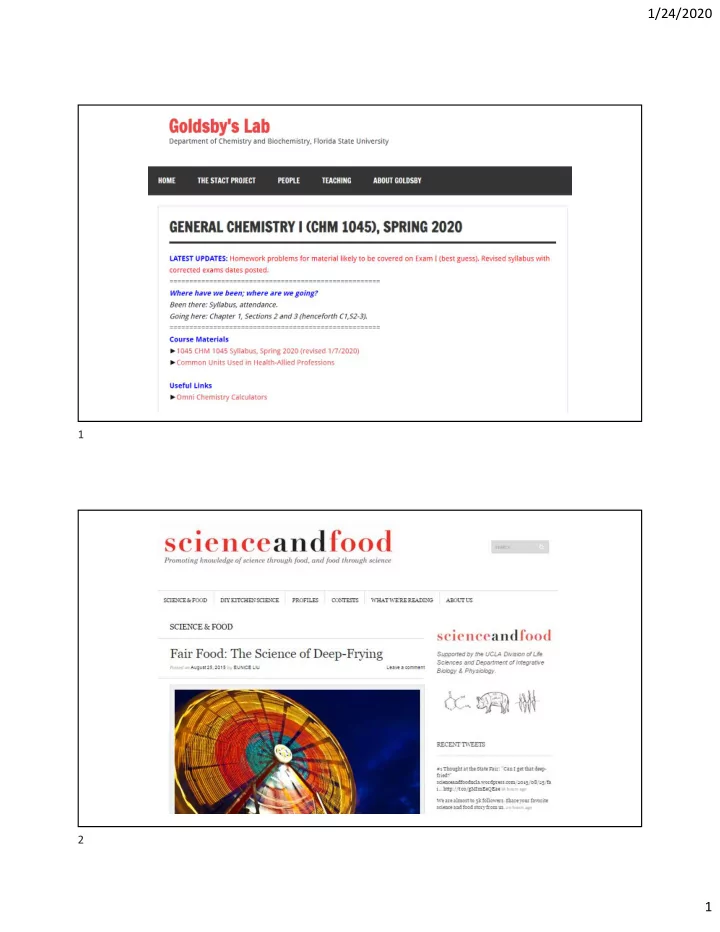
1/24/2020 1 2 1 1/24/2020 The process of deep-frying can be - - PDF document
1/24/2020 1 2 1 1/24/2020 The process of deep-frying can be divided into four stages: (1) Initial heating. The surface of the food reaches the boiling point of water. (2) Surface boiling. The hot oil surrounding the food causes water inside the
https://scienceandfooducla.wordpress.com/2015/08/25/fair-food-deep-frying/
http://tmagazine.blogs.nytimes.com/ 2009/01/20/fresh-raw-milk-on-tap-in-turin/
900 megahertz, 21.1-tesla NMR magnet at the FSU National High Magnetic Field Laboratory (Mag Lab)
(4.8 x 10⁻¹⁹ C)/(1.6 x 10-19 C) = 3 3 e (3.2 x 10⁻¹⁹ C)/(1.6 x 10-19 C) = 2 2 e (6.4 x 10⁻¹⁹ C)/(1.6 x 10-19 C) = 4 4 e (1.6 x 10⁻¹⁹ C)/(1.6 x 10-19 C) = 1 1 e (4.8 x 10⁻¹⁹ C)/(1.6 x 10-19 C) = 3 3 e
Assuming the lowest charge corresponds to having only one electron transferred to the oil drop, implies....
http://www.school-for-champions.com/science/static_materials.htm
Become positive in charge
The following materials will tend to give up electrons when brought in contact with
electrons to those that barely give up electrons. Dry human skin Greatest tendency to giving up electrons and becoming highly positive (+) in charge Leather Rabbit fur Fur is often used to create static electricity Glass The glass on your TV screen gets charged and collects dust Human hair "Flyaway hair" is a good example of having a moderate positive (+) charge Nylon Wool Lead A surprise that lead would collect as much static electricity as cat fur Cat fur Silk Aluminum Gives up some electrons Paper
Neutral
There are very few materials that do not tend to readily attract or give up electrons when brought in contact or rubbed with other materials. Cotton Best for non-static clothes Steel Not useful for static electricity
Become negative in charge
The following materials will tend to attract electrons when brought in contact with
electrons to those that readily attract electrons. Wood Attracts some electrons, but is almost neutral Amber Hard rubber Some combs are made of hard rubber Nickel, Copper Copper brushes used in Wimshurst electrostatic generator Brass, Silver Gold, Platinum It is surprising that these metals attract electrons almost as much as polyester Polyester Clothes have static cling Styrene (Styrofoam) Packing material seems to stick to everything Saran Wrap You can see how Saran Wrap will stick to things Polyurethane Polyethylene (like Scotch Tape) Pull Scotch Tape off surface and it will become charged Polypropylene Vinyl (PVC) Many electrons will collect on PVC surface Silicon Teflon Greatest tendency of gathering electrons on its surface and becoming highly negative (-) in charge
An effort to reconstruct Millikan's "exemplary" experimental thinking revealed serious discrepancies between Millikan's notebooks and his published "raw" data (Holton, 1978). The numerous notes which are scattered across the pages cast further doubt
This is almost exactly right & the best one I ever had!!! [20 December 1911] Exactly right [3 February 1912] Publish this Beautiful one [24 February 1912] Publish this surely / Beautiful !! [15 March 1912, #1] Error high will not use [15 March 1912, #2] Perfect Publish [11 April 1912] Won't work [16 April 1912, #2] Too high by 1½% [16 April 1912, #3] http://www1.umn.edu/ships/ethics/millikan.htm The notebooks reveal that, indeed, substantial data are missing from Millikan's published reports. Of 175 total drops documented in the notebooks, only 58 (barely one-third) appear in the final paper. By contrast, Millikan had announced in his 1913 paper that "It is to be remarked, too, that this is not a selected group
days, during which time the apparatus was taken down several times and set up anew" [his own emphasis!]. In his 1917 book, The Electron, he repeats this statement and then adds, "These drops represent all of those studied for 60 consecutive days, no single drop being omitted.“ At first blush, this outrageous violation of scientific integrity would seem to discredit Millikan's findings. Even if one assumes that standards of reporting data earlier in the century were less rigorous, Millikan clearly misrepresented the extent of his data. One may caution students, however, that we may not want to conclude that therefore there was no good, "scientific" basis for his selective use
nature of the experimental task that they crudely document, reveals more tellingly the reasons that Millikan included some drops and excluded others. http://www1.umn.edu/ships/ethics/millikan.htm
http://www.moviemistakes.com/film3843
https://en.wikipedia.org/wiki/Nitrogen_oxide 35 36