1 What does this mean? Limits the species of service animals to - - PDF document

1
SMART_READER_LITE
LIVE PREVIEW

1 What does this mean? Limits the species of service animals to - - PDF document

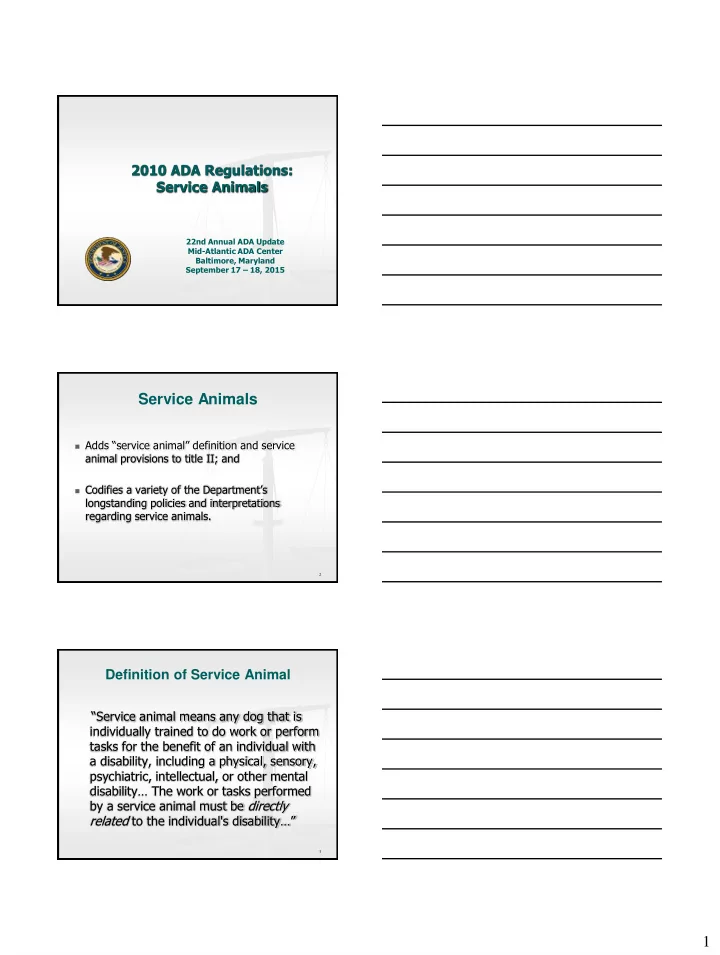
2010 ADA Regulations: Service Animals 22nd Annual ADA Update Mid-Atlantic ADA Center Baltimore, Maryland September 17 18, 2015 Service Animals Adds service animal definition and service animal provisions to title II; and


slide-1
SLIDE 1

1

2010 ADA Regulations: Service Animals

22nd Annual ADA Update Mid-Atlantic ADA Center Baltimore, Maryland September 17 – 18, 2015

Service Animals

 Adds “service animal” definition and service

animal provisions to title II; and

 Codifies a variety of the Department’s

longstanding policies and interpretations regarding service animals.

2

Definition of Service Animal

“Service animal means any dog that is individually trained to do work or perform tasks for the benefit of an individual with a disability, including a physical, sensory, psychiatric, intellectual, or other mental disability… The work or tasks performed by a service animal must be directly related to the individual's disability…”

3

slide-2
SLIDE 2

2

What does this mean?

 Limits the species of service animals to

dogs;

 Makes clear that comfort or emotional

support animals are not covered; and

 Makes clear that individuals with physical,

sensory, psychiatric or other mental disabilities can use service animals.

4

Definition: Species Limitation

 Service animals are now limited to one

species — dogs.

 The definition provides that other animals

besides dogs, whether wild or domestic, do not qualify as service animals.

 The Department’s rules do not affect

coverage of other animals under other laws, like the Fair Housing Act or Air Carrier Access Act.

5

Definition: Do Work or Perform Tasks

 Requires that the dog be individually

trained to do work or perform tasks.

 The work or tasks performed by a service

animal must be directly related to the individual's disability.

6

slide-3
SLIDE 3

3 Definition: Do Work or Perform Tasks ……. Continued

 Includes a non-exhaustive list of examples of

work and tasks, such as retrieving items, e.g., medicine or telephone.

 Covers individuals with psychiatric,

intellectual, or other mental disability that use service animals.

Example: Helping persons with psychiatric and neurological disabilities by reminding to take medication, preventing or interrupting impulsive

  • r destructive behaviors.

7

Emotional Support Animals

 The provision of emotional support,

well-being, comfort, or companion- ship do not constitute work or tasks for the purposes of the service animal definition.

 Because service animals must do work or

perform tasks, emotional support and comfort animals are not included in the definition of service animal.

8

Revisions to General Service Animal Provisions

Overview of changes:

 Provides when a service animal can be

excluded.

 Requires animal to be under handler’s control.  Provides guidance on inquiries.  Care and supervision.  Access to all areas open to public.  Surcharges.

9

slide-4
SLIDE 4

4

Exclusion of Service Animals

 General rule is that covered entities must permit

service animals. The revised rules, however, add two specific exceptions for when service animals can be excluded:

 The animal is out of control and the handler

does not take effective action to control it; or

 The animal is not housebroken.  The handler should be given the opportunity to

participate without the animal.

10

“Under Handler’s Control”

 Must have harness, leash, or other tether.  If handler is unable to use these because of his

  • r her disability or because use would interfere

with the safe and effective performance of work

  • r tasks, then the animal must otherwise be

under the handler’s control ( i.e., voice control, signals, or other effective means.)

11

Permissible Inquiries

 Only two inquiries may be made by

covered entities:

 Whether the animal is required because of a

disability; and

 What work or task the animal has been

trained to perform.

 Generally, inquiries may not be made when it

is readily apparent that an animal is trained to do work or perform tasks for an individual with a disability.

12

slide-5
SLIDE 5

5 Miscellaneous Provisions

 Covered entities are not responsible for the

care or supervision of a service animal.

 Service animals may accompany their

handlers to areas of a public accommodation

  • r public entity.

 Covered entities may not require people with

disabilities to pay pet fees or surcharges that are not applicable to individuals without pets.

13

Miniature Horses

Beyond Service Animals

14

Miniature Horse Requirements

 Rules require reasonable modifications to permit

a miniature horse that has been individually trained to do work or perform tasks.

 Rules provide assessment factors to assist

entities in determining whether reasonable modifications can be made.

15

slide-6
SLIDE 6

6

Miniature Horses

 Miniature horses range in weight from 70 to 100

pounds.

 Miniature horses can range in height from 24 to

34 inches.

16

Assessment Factors

 The type, size, and weight of the horse and

whether the facility can accommodate those features.

 Handler has sufficient control of the horse.  Horse must be housebroken.  Whether the horse’s presence in a specific

facility compromises legitimate safety requirements.

17

Other Requirements for Miniature Horses

 § 35.136(c)-(h)’s and

§ 36.302(c)(3)-(8)’s service animal requirements also apply to miniature horses.

 Admit person with a

disability even if animal is properly excluded.

 Care and supervision.  Inquiries.  Access to all public

areas.

 Surcharges.

18

slide-7
SLIDE 7

7

Resources

Regulations, appendices, standards are available at DOJ’s ADA web site at www.ada.gov. For answers to specific questions, DOJ toll-free confidential ADA information line: 800-514-0301 (Voice) 800-514-0383 (TTY) Mid-Atlantic ADA Center: 800-949-4232 (Voice/TTY) www.adata.org

19