Service Animals and the ADA Breakout Session #2.2 Mid-Atlantic ADA - - PDF document

service animals and the ada
SMART_READER_LITE
LIVE PREVIEW

Service Animals and the ADA Breakout Session #2.2 Mid-Atlantic ADA - - PDF document

9/2/2016 Service Animals and the ADA Breakout Session #2.2 Mid-Atlantic ADA Update Conference John L. Wodatch Reasonable Modification Legal Basis: General Rule in ADA regulation: A public entity shall make reasonable modifications in


slide-1
SLIDE 1

9/2/2016 1

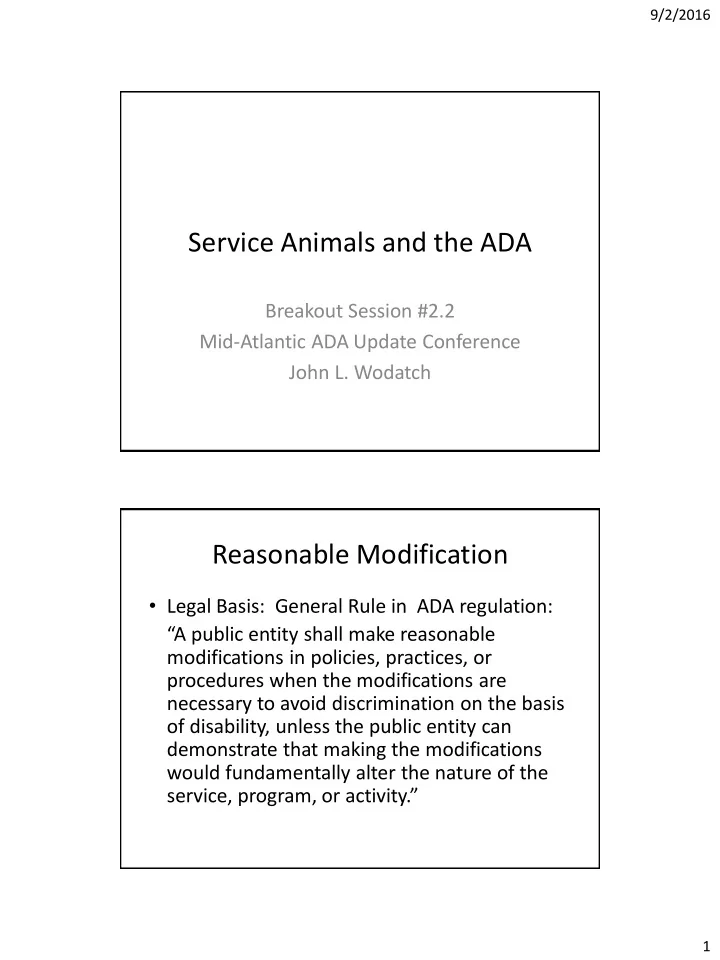
Service Animals and the ADA

Breakout Session #2.2 Mid-Atlantic ADA Update Conference John L. Wodatch

Reasonable Modification

  • Legal Basis: General Rule in ADA regulation:

“A public entity shall make reasonable modifications in policies, practices, or procedures when the modifications are necessary to avoid discrimination on the basis

  • f disability, unless the public entity can

demonstrate that making the modifications would fundamentally alter the nature of the service, program, or activity.”

slide-2
SLIDE 2

9/2/2016 2

SERVICE ANIMALS and the ADA

Basic Provision: A public entity shall modify its policies, practices, or procedures to permit the use of a service animal by an individual with a disability. Rule of Thumb: Allow service animal to go anywhere members of public go

3

Service Animal: definition

A dog that is individually trained to do work or perform tasks for the benefit of an individual with a disability, including a physical, psychiatric, sensory, intellectual or other mental disability 28 CFR 35.104

4

slide-3
SLIDE 3

9/2/2016 3

What does this definition mean?

  • Limits the species of service animals to dogs

for the ADA

  • Comfort or emotional support animals are

not covered

  • Those with psychiatric, intellectual, or other

mental disabilities can use service dogs

slide-4
SLIDE 4

9/2/2016 4

Examples of Tasks (1)

  • Guiding or wayfaring for persons who are

blind or have low vision

  • Alerting persons who are deaf or hard of

hearing to sounds

  • Pulling a wheelchair
  • Retrieving items for persons who use

wheelchairs

Examples of tasks (2)

  • Detect the onset of a seizure and assist during

seizure

  • Remind person with a disability to take

medication or retrieve medicine or other items

  • Enter and examine unfamiliar space and come

back and signal it is safe to enter

  • Help individual with dissociative

identity disorder to remain grounded

8

slide-5
SLIDE 5

9/2/2016 5

9

Examples of tasks (3)

  • Prevent/interrupt

impulsive or destructive behavior

  • Assist with balance,

stability

  • Provide non-violent

protection or rescue work

Emotional support/comfort?

The provision of emotional support, comfort,

  • r companionship are not considered work
  • r tasks

Animals performing only such tasks are not considered service animals for the ADA

10

slide-6
SLIDE 6

9/2/2016 6

What Can I Ask? May Ask for a Demonstration?

Permissible Inquiries: Can ask only two questions (when it’s not obvious)

  • 1. Whether dog is required because
  • f a disability
  • 2. What work or tasks

the dog is trained to perform Cannot ask for demonstration

11

Exclusion of Service Dogs

  • General Rule: Covered entities must permit

service animals to enter all areas where members of the public go

  • Two specific exceptions:

– When the animal is out of control and the handler does not take effective action to control it – The animal is not housebroken

slide-7
SLIDE 7

9/2/2016 7

What is Handler’s Control?

  • Must have harness, leash, or other tether
  • If handler is unable to use these because of

disability, animal must otherwise be under the handler’s control: voice control, signals, or

  • ther effective means

General: Limitations

  • Entity not required to take steps that:

– “fundamentally alter” the nature of the program

  • r activity.

– result in a direct threat to the health or safety of

  • thers.
  • Rare that presence of service dog meets these

limitations

slide-8
SLIDE 8

9/2/2016 8

General: Direct Threat

– A direct threat is a significant risk that cannot be eliminated or reduced to an acceptable level by the modification of its policies, practices, or procedures, or by the provision of auxiliary aids or services. – The public entity's determination that a person poses a direct threat to the health or safety of

  • thers may not be based on generalizations or

stereotypes about the effects of a particular disability

Other issues

  • Entity is not responsible for care or supervision
  • f the dog
  • No “service animal” license or documentation

required.

  • No deposits or pet fees
  • Cannot exclude service dog because of the

allergies or religious beliefs of others, including employees, but may consider these issues in how access is provided

  • No exclusion of certain breeds of dogs
  • Dog not required to wear vest, patch, or special

harness

16

slide-9
SLIDE 9

9/2/2016 9

Issues Recently Addressed by Department of Justice

  • Hotels: no fee, can’t leave dog in room
  • Ambulances, Arrest vehicles: must take dog or

make arrangements for pick-up and care

  • Local ordinances: local dog licensing and

vaccination requirement are ok, special registration of service dogs is not

  • Pools: no dogs in pool, but can wait at edge
  • Multiple service dogs allowed
  • Hospitals: dog can join patient in room

Issues in Health Care Facilities

Controlling infection and ensuring health and safety of patients with health conditions, health care workers, and other individuals. Centers for Disease Control and Prevention has issued guidelines which are instructive: Guidelines for Environmental Infection Control in Health Care Facilities (CDC Guidelines) (2003).

slide-10
SLIDE 10

9/2/2016 10

CDC Guidelines: Health Risks Posed by Service Animals No evidence exists that animals pose a more significant risk of transmitting infection than people. Therefore, a service animal should not be excluded from an area in a health care facility unless a patient’s situation or a particular animal poses a greater risk that cannot be mitigated through reasonable measures.

CDC Guidelines: General Principle

Wherever health care personnel, visitors, and patients are permitted to enter care areas of a health care facility without taking additional precautions to prevent transmission of infection, then service animals must also be allowed access with their handlers.

slide-11
SLIDE 11

9/2/2016 11

What Health Care Providers Are Covered?

Hospitals Nursing homes Doctors’ offices Pharmacies Home health agencies Community health centers and health clinics Alcohol and drug treatment centers

21

What Health Care Activities Are Covered?

 All treatment, including surgery, and diagnostic and testing procedures and examinations  Emergency room care  Admission and discharge activities  Outpatient services  Physical and mental therapy  Business activities, such as discussions of insurance, payment, and records  Visiting health care providers as a companion or family member of a patient or member of the public  Public education events  Activities in all parts of a health provider’s facility, including cafeterias, gift shops, waiting areas, lobbies, and restrooms

slide-12
SLIDE 12

9/2/2016 12

Where May a Service Animal Go?

Generally, Yes  Emergency room  Patient rooms  Radiology unit  Treatment rooms  Allergy clinic  Cafeteria  Waiting areas  Nursing homes Generally, No

  • Operating room
  • Areas treating

immunocompromised patients

  • Some ICUs
  • Burn units
  • Isolation rooms
  • Rooms requiring special

ventilation

The focus is on the use of the particular area.

Other Disability Rights Laws

  • Remember other disability rights laws may also

apply to entities covered by the ADA

  • And these laws may have different, more

extensive coverage of service animals

– Fair Housing Act covers emotional support animals and covers more than dogs – Air Carrier Access Act allows more questions to be asked – State and local laws may provide different provisions

  • Federal Agencies are covered by Section 504, not

the ADA

slide-13
SLIDE 13

9/2/2016 13

Resources

  • www.ADA.gov
  • Frequently Asked Questions about Service Animals and

the ADA on ADA.gov

  • Revised ADA Requirements: Service Animals on

ADA.gov

  • ADA National Network

– 800-949-4232 – www.adata.org

  • ADA Information Line

– 800-514-0301 – 800-514-0383 (tty)