1 Management support Management support Management will support - - PDF document

1
SMART_READER_LITE
LIVE PREVIEW

1 Management support Management support Management will support - - PDF document

PSP: the background Chair of Softw are Engineering CMMI: Capability Maturity Model Integration Software Engineering (originally: CMM) Prof. Dr. Bertrand Meyer From late 1980s, Software Engineering Institute MarchJune 2007 (At


slide-1
SLIDE 1

1

Software Engineering

  • Prof. Dr. Bertrand Meyer

March–June 2007

Chair of Softw are Engineering

Lecture 2: The Personal Software Process

Software Engineering, lecture 1: Personal Soft ware Process for Engineers: Introduction to PSP 2

2

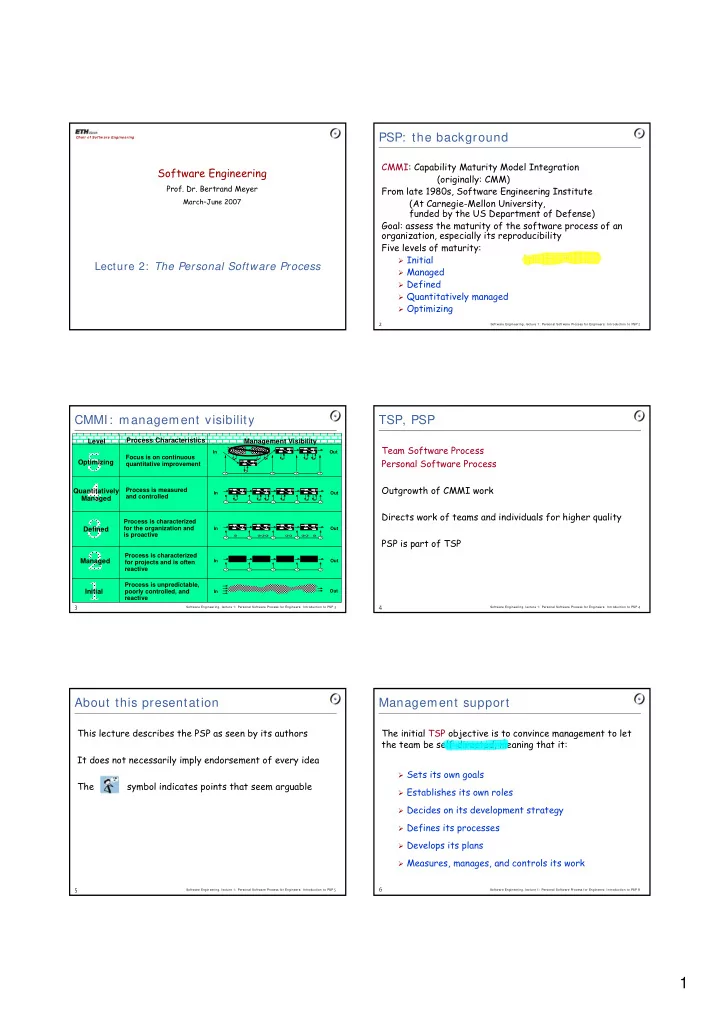
PSP: the background

CMMI: Capability Maturity Model Integration (originally: CMM) From late 1980s, Software Engineering Institute (At Carnegie-Mellon University, funded by the US Department of Defense) Goal: assess the maturity of the software process of an

  • rganization, especially its reproducibility

Five levels of maturity:

Initial Managed Defined Quantitatively managed Optimizing

Software Engineering, lecture 1: Personal Soft ware Process for Engineers: Introduction to PSP 3

3

Initial Managed Defined Quantitatively Managed Optimizing Level Process Characteristics Management Visibility

Out In In Out In Out In Out In Out

Process is unpredictable, poorly controlled, and reactive Process is characterized for projects and is often reactive Process is characterized for the organization and is proactive Process is measured and controlled Focus is on continuous quantitative improvement

CMMI: management visibility

Software Engineering, lecture 1: Personal Soft ware Process for Engineers: Introduction to PSP 4

4

TSP, PSP

Team Software Process Personal Software Process Outgrowth of CMMI work Directs work of teams and individuals for higher quality PSP is part of TSP

Software Engineering, lecture 1: Personal Soft ware Process for Engineers: Introduction to PSP 5

5

About this presentation

This lecture describes the PSP as seen by its authors It does not necessarily imply endorsement of every idea The symbol indicates points that seem arguable

Software Engineering, lecture 1: Personal Soft ware Process for Engineers: Introduction to PSP 6

6

Management support

The initial TSP objective is to convince management to let the team be self-directed, meaning that it:

Sets its own goals Establishes its own roles Decides on its development strategy Defines its processes Develops its plans Measures, manages, and controls its work

slide-2
SLIDE 2

2

Software Engineering, lecture 1: Personal Soft ware Process for Engineers: Introduction to PSP 7

7

Management support

Management will support you as long as you:

Strive to meet their needs Provide regular reports on your work Convince them that your plans are sound Do quality work Respond to changing needs Come to them for help when you have problems

Software Engineering, lecture 1: Personal Soft ware Process for Engineers: Introduction to PSP 8

8

Management support

Management will agree to your managing your own work as long as they believe that you are doing a superior job. To convince them of this, you must:

Maintain and publish precise, accurate plans Measure and track your work Regularly show that you are doing superior work

The PSP helps you do this

Software Engineering, lecture 1: Personal Soft ware Process for Engineers: Introduction to PSP 9

9

PSP principles

The quality of a software system is determined by the quality of its worst component The quality of a component is governed by the individual who developed it, and especially by the quality of the process he or she used to develop it Every software professional is responsible for his or her personal process. Key to quality is each individual developer’s skill, commitment, and personal process discipline

Software Engineering, lecture 1: Personal Soft ware Process for Engineers: Introduction to PSP

10

10

PSP essential practices

Measure, track, and analyze your work Learn from your performance variations Incorporate lessons learned into your personal practices

Software Engineering, lecture 1: Personal Soft ware Process for Engineers: Introduction to PSP

11

11

What does a PSP provide?

A stable, mature PSP allows you to

Estimate and plan your work Meet your commitments Resist unreasonable commitment pressures

You will also

Understand your current performance Improve your expertise as a professional

Software Engineering, lecture 1: Personal Soft ware Process for Engineers: Introduction to PSP

12

12

PSP fundamentals

As a personal process, PSP includes:

Defined steps Forms Standards A measurement and analysis framework for

characterizing and managing your personal work

A defined procedure to help improve your personal

performance

slide-3
SLIDE 3

3

Software Engineering, lecture 1: Personal Soft ware Process for Engineers: Introduction to PSP

13

13

The PSP process flow

Requirements Finished product Project summary Project and process data summary report Planning Design Code Compile Test PM Scripts

guide

Logs Requirements Finished product Project summary Project and process data summary report Planning Design Code Compile Test Postmortem Scripts

guide

Logs Logs

Software Engineering, lecture 1: Personal Soft ware Process for Engineers: Introduction to PSP

14

14

A progressive approach

PSP is introduced in six upward-compatible steps At each step:

Write one or more modules Gather and analyze data on your work Use results to improve your personal performance

Software Engineering, lecture 1: Personal Soft ware Process for Engineers: Introduction to PSP

15

15

The steps

PSP1

Size estimating Test report

PSP2

Code reviews Design reviews

TSP

Team development

PSP2.1

Design templates

PSP1.1

Task planning Schedule planning

PSP0

Current process Time recording Defect recording Defect type standard

PSP0.1

Coding standard Size measurement Process improvement proposal (PIP)

Software Engineering, lecture 1: Personal Soft ware Process for Engineers: Introduction to PSP

16

16

Goals at each level

PSP0: Establish a measured performance baseline PSP1: Make size, resource, and schedule plans PSP2: Practice defect and yield management

Software Engineering, lecture 1: Personal Soft ware Process for Engineers: Introduction to PSP

17

17

PSP0

Objective:

Demonstrate use of defined

process for small programs

Incorporate basic

measurements in process

Minimize changes to your

personal practices PSP1

Size estimating Test report

PSP2

Code reviews Design reviews

PSP2.1

Design templates

PSP1.1

Task planning Schedule planning

PSP0.1

Coding standard Size measurement Process improvement proposal (PIP)

PSP0

Current process Time recording Defect recording Defect type standard Software Engineering, lecture 1: Personal Soft ware Process for Engineers: Introduction to PSP 18

18

PSP0 setup

PSP0 is a simple, defined, personal process:

Make a plan Use your current design and development methods to

produce a small program

Gather time and defect data on your work Prepare a summary report

slide-4
SLIDE 4

4

Software Engineering, lecture 1: Personal Soft ware Process for Engineers: Introduction to PSP

19

19

The six phases of PSP0

Produce plan for developing program from requirements Produce design specification for the program. Turn design into executable code (In Eiffel, 2 & 3 are one step)

Plan Design Code Compile Test Postmortem 1 2 3 5 4 6

Translate into executable code Verify that code satisfies requirements Summarize & analyze project data

Software Engineering, lecture 1: Personal Soft ware Process for Engineers: Introduction to PSP

20

20

Phase order

PSP looks like waterfall but is not Phase order is determined by dependencies:

Can’t test code before it’s

compiled

Can’t compile before it’s written Can’t use design if produced

after code is written

No reason to make a plan

after you’re done Conclusion: start here with a plan

Plan Design Code Compile Test Postmortem

Software Engineering, lecture 1: Personal Soft ware Process for Engineers: Introduction to PSP

21

21

Cyclic process flow

Programs that are large programs or not well understood may require an iterative approach In this example, each module is separately coded, compiled, and tested The example uses PSP0 phases and 2 code-compile- test cycles

Plan Design Code Compile Test Postmortem Requirements Code Compile Test

Module A Module B

Program and Project data

Software Engineering, lecture 1: Personal Soft ware Process for Engineers: Introduction to PSP

22

22

Cyclic process flow

There can be more than 2 cycles Part size is key factor for determining cycles:

Line of code: too small Program: usually too large

Typical: one or more classes or features Determine what works for you

Plan Design Code Compile Test Postmortem Requirements

Module B

Design Code Compile Test

Module A Module C

Design Code Compile Test Program and Project data

Software Engineering, lecture 1: Personal Soft ware Process for Engineers: Introduction to PSP

23

23

PSP0.1

Objective: help you to

Measure size of programs

that you produce

Perform size accounting for

these programs

Make accurate and precise

size measurements PSP1

Size estimating Test report

PSP2

Code reviews Design reviews

PSP2.1

Design templates

PSP1.1

Task planning Schedule planning

PSP0.1

Coding standard Size measurement Process improvement proposal (PIP)

PSP0

Current process Time recording Defect recording Defect type standard Software Engineering, lecture 1: Personal Soft ware Process for Engineers: Introduction to PSP 24

24

Process measurement

To be useful, measurements should be

Gathered for a specific purpose Explicitly defined Properly managed Properly used

We measure to

Understand and manage change Predict or plan Compare one product, process, or organization with

another

Determine adherence to standards Provide a basis for control

slide-5
SLIDE 5

5

Software Engineering, lecture 1: Personal Soft ware Process for Engineers: Introduction to PSP

25

25

Measurement objectives

Measurements only produce numbers To be useful, they must

Relate to business objectives Be properly interpreted Lead to appropriate action

If the business purposes for the measurements are not understood

The wrong data may be gathered Data may not be properly used

Software Engineering, lecture 1: Personal Soft ware Process for Engineers: Introduction to PSP

26

26

PSP measurements

Basic PSP data:

Program size Time spent by phase Defects found and injected by phase

On every item, gather both actual and estimated data Measures derived from these data:

Support planning Characterize process quality

Software Engineering, lecture 1: Personal Soft ware Process for Engineers: Introduction to PSP

27

27

PSP1

Objective: Establish orderly & repeatable procedure for size estimation

PSP1

Size estimating Test report

PSP2

Code reviews Design reviews

PSP2.1

Design templates

PSP1.1

Task planning Schedule planning

PSP0

Current process Time recording Defect recording Defect type standard

PSP0.1

Coding standard Size measurement Process improvement proposal (PIP)

New process elements:

PROBE size estimating method

& template

Test report template

Software Engineering, lecture 1: Personal Soft ware Process for Engineers: Introduction to PSP

28

28

Estimating with PROBE

Stands for PROxy Based Estimating Uses proxies to estimate program size and development time A good proxy helps make accurate estimates

Software Engineering, lecture 1: Personal Soft ware Process for Engineers: Introduction to PSP

29

29

The PROBE estimating method

Conceptual design

Start

Identify and size the proxies

Number of items Part Type Relative size Reuse categories Estimate other element sizes Estimate program size Calculate prediction interval

Size estimate and range

Estimate resources Calculate prediction interval

Resource estimate and range

Software Engineering, lecture 1: Personal Soft ware Process for Engineers: Introduction to PSP

30

Conceptual design

Conceptual design relates the requirements to the parts needed to produce the program Parts categories:

Reused: Can be used as-is Base: Exists, requires modifications Added: needs to be developed

slide-6
SLIDE 6

6

Software Engineering, lecture 1: Personal Soft ware Process for Engineers: Introduction to PSP

31

Sizing parts

Reused part: Use actual size Added part: define proxy

Identify part type, e.g. parsing, GUI, network… Estimate number of items, e.g. routines Estimate relative size, i.e. very small, small, medium,

large, or very large

Find size of an item of this part type and relative size

in the relative size table

Estimated size = item size ∗ number of items

Base part: start from actual size; estimate additions, deletions, modifications

Software Engineering, lecture 1: Personal Soft ware Process for Engineers: Introduction to PSP

32

32

PSP1.1

Objective: introduce & practice methods for

Making resource & schedule

plans

Tracking your performance

against them

Judging likely project

completion dates PSP1

Size estimating Test report

PSP2

Code reviews Design reviews

PSP2.1

Design templates

PSP1.1

Task planning Schedule planning

PSP0

Current process Time recording Defect recording Defect type standard

PSP0.1

Coding standard Size measurement Process improvement proposal (PIP)

Two new process elements:

Task planning template Schedule planning template

Typically used for projects that take several days or weeks

Software Engineering, lecture 1: Personal Soft ware Process for Engineers: Introduction to PSP

33

33

PSP2

Objective: introduce

Design & code reviews Methods for evaluating

and improving quality

  • f reviews

PSP1

Size estimating Test report

PSP2

Code reviews Design reviews

PSP2.1

Design templates

PSP1.1

Task planning Schedule planning

PSP0

Current process Time recording Defect recording Defect type standard

PSP0.1

Coding standard Size measurement Process improvement proposal (PIP)

Two key capabilities added at this level:

Design and code reviews Quality planning

Two new process elements, separate:

Design review checklist Code review checklist

Software Engineering, lecture 1: Personal Soft ware Process for Engineers: Introduction to PSP

34

34

Quality planning

PSP2 introduces quality planning. This involves estimating:

Total number of defects that will be injected Number of defects injected & removed in each

process phase

Amount of time for design and code reviews

& adjusting these parameters to ensure high-quality result

Software Engineering, lecture 1: Personal Soft ware Process for Engineers: Introduction to PSP

35

35

Arguments for reviews over tests

In testing, you must

Detect unusual behavior Figure out what the test program was doing Find where the problem is in the program Figure out which defect could cause such behavior

This can take a lot of time With reviews you

Follow your own logic Know where you are when you find a defect Know what the program should do, but did not Know why this is a defect Are in a better position to devise a correct fix

Software Engineering, lecture 1: Personal Soft ware Process for Engineers: Introduction to PSP

36

36

PSP review process principles

Defined review process: guidelines, checklists, standards. Goal is to find every defect before first compile/test To meet it, you must:

Review before compiling or testing Use coding standards Use design completeness criteria Measure and improve your review process Use a customized personal checklist

slide-7
SLIDE 7

7

Software Engineering, lecture 1: Personal Soft ware Process for Engineers: Introduction to PSP

37

37

Code review checklist

Reviews are most effective with personal checklist customized to your own defect experience:

Use your own data to select the checklist items Gather and analyze data on the reviews Adjust the checklist with experience

Do the reviews on a printed listing, not on screen The checklist defines steps and suggests their order:

Review for one checklist item at a time Check off each item as you complete it

Software Engineering, lecture 1: Personal Soft ware Process for Engineers: Introduction to PSP

38

38

Design review principles

In addition to reviewing code, you should also review your designs Requires that you

Produce designs that can be reviewed Follow an explicit review strategy Review design in stages Verify that logic correctly implements requirements

Software Engineering, lecture 1: Personal Soft ware Process for Engineers: Introduction to PSP

39

39

PSP2.1

PSP1

Size estimating Test report

PSP2

Code reviews Design reviews

PSP2.1

Design templates

PSP1.1

Task planning Schedule planning

PSP0

Current process Time recording Defect recording Defect type standard

PSP0.1

Coding standard Size measurement Process improvement proposal (PIP)

Objective: introduce

Additional measures for

managing process quality

Design templates that

provide an orderly framework and format for recording designs New process elements:

Design review script Design review checklist Operational specification template Functional specification template State specification template Logic specification template

Software Engineering, lecture 1: Personal Soft ware Process for Engineers: Introduction to PSP

40

40

PSP: an assessment

Ignore technology assumptions (strict design-code-compile- test cycle) which is not in line with today’s best practices. Retain emphasis on professional engineer’s approach:

Plan Record what you do both qualitatively and quantitatively:

Program size Time spent on parts and activities Defects

Think about your personal process Improve your personal process

Tool support, integrated in development environment, is essential.