1 3 ) Delegation of Rights A student w ith the capacity to do so m - - PDF document

1
SMART_READER_LITE
LIVE PREVIEW

1 3 ) Delegation of Rights A student w ith the capacity to do so m - - PDF document

SPECI AL EDUCATI ON LAW UPDATE Barbara Drayton, Deputy General Counsel Office of General Counsel South Carolina Departm ent of Education TRANSFER OF RI GHTS AT AGE OF MAJORI TY 3 4 C.F.R 3 0 0 .3 2 0 ( c) Prior to the passage of the


slide-1
SLIDE 1

1

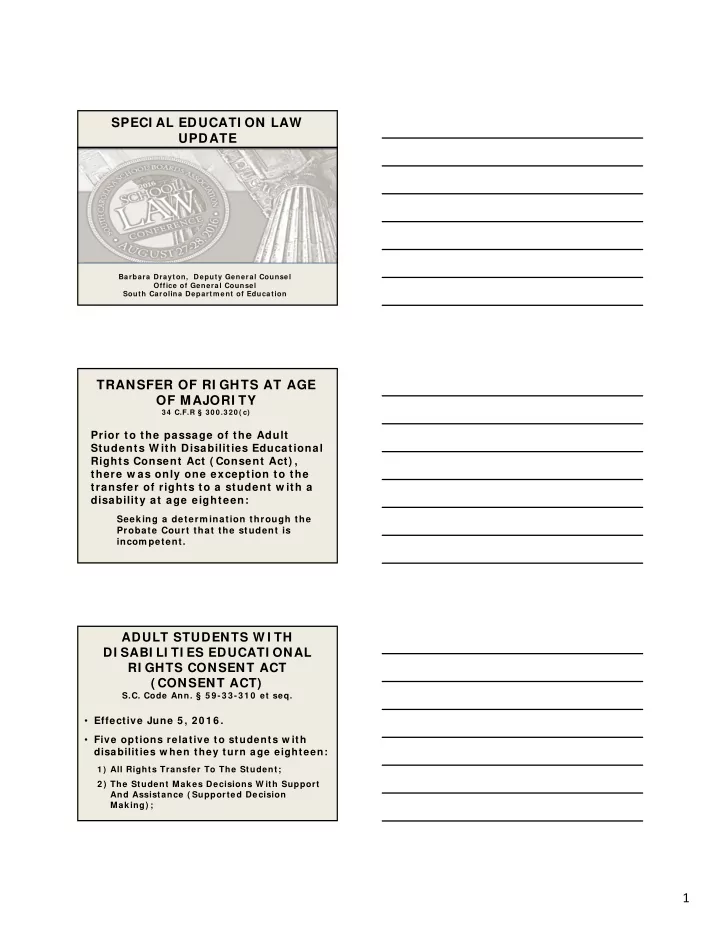
SPECI AL EDUCATI ON LAW UPDATE

Barbara Drayton, Deputy General Counsel Office of General Counsel South Carolina Departm ent of Education

TRANSFER OF RI GHTS AT AGE OF MAJORI TY

3 4 C.F.R § 3 0 0 .3 2 0 ( c)

Prior to the passage of the Adult Students W ith Disabilities Educational Rights Consent Act ( Consent Act) , there w as only one exception to the transfer of rights to a student w ith a disability at age eighteen:

Seeking a determ ination through the Probate Court that the student is incom petent.

ADULT STUDENTS W I TH DI SABI LI TI ES EDUCATI ONAL RI GHTS CONSENT ACT ( CONSENT ACT)

S.C. Code Ann. § 5 9 -3 3 -3 1 0 et seq.

  • Effective June 5 , 2 0 1 6 .
  • Five options relative to students w ith

disabilities w hen they turn age eighteen:

1 ) All Rights Transfer To The Student; 2 ) The Student Makes Decisions W ith Support And Assistance ( Supported Decision Making) ;

slide-2
SLIDE 2

2

3 ) Delegation of Rights

A student w ith the capacity to do so m ay sign a pow er of attorney and delegate his or her rights to an agent ( such as a parent) or delegate his or her rights using the form developed by the SCDE.

4 ) Certification of an Educational Representative

A student w ho is unable to com m unicate his or her w ishes, interests, or preferences w ith respect to an educational program m ay have an educational representative certified to act on his or her behalf.

5 ) Guardianship of the Student

I f a student is incapacitated, the parents or other appropriate person m ay seek guardianship of the adult child through the Probate Court process. The Consent Act does not apply if the student has a court-appointed guardian.

W HAT I S THE PROCESS FOR THE APPOI NTMENT OF AN EDUCATI ONAL REPRESENTATI VE? ( OPTI ON 4 )

Step 1 – A Medical Exam ination

  • The student first needs a m edical

exam ination that m ust be conducted by one

  • f the follow ing m edical professionals:

 Physician;  Nurse practitioner;  Physician’s assistant;  Psychologist; or  Psychiatrist

  • The licensed m edical professional m ay not

be an em ployee of the school district.

slide-3
SLIDE 3

3

Step 2 – The Medical Professional Must Exam ine the Student and Certify in W riting that the Student is I ncapable of Com m unicating, W ith or W ithout Reasonable Accom m odations, the Student’s W ishes, I nterests, or Preferences Regarding His or Her Educational Program .

  • The Certification m ay be inform al, but it m ust

include the follow ing inform ation:

 The date of the exam ination;  The basis for the determ ination that the student is not able to com m unicate his or her w ishes; and  A statem ent of w hether the inability to com m unicate is likely to last until age tw enty-

  • ne.

Step 3 – The Medical Professional Must Send the Letter to the Superintendent or Other Designated School Official

  • Upon receipt of a certification letter, there is a

requirem ent to notify the student in w riting that a m edical professional certified that he or she is incapable of com m unicating and an educational representative w ill be designated to represent him

  • r her.
  • The notice m ust inform the student that he or she

m ay challenge the designation of the educational representative.

  • I f the student challenges the certification of an

educational representative, the school district m ay not rely upon the educational representative for any decision-m aking purpose.

R.6 1 -1 0 3 , RESI DENTI AL TREATMENT FACI LI TI ES FOR CHI LDREN AND ADOLESCENTS

Effective June 2 4 , 2 0 1 6

  • An education program , including a program

for students w ith disabilities, that m eets all applicable federal and state requirem ents, as defined by the South Carolina Departm ent of Education ( SCDE) .

  • The education program m ay be provided at

the facility, if appropriate space is available to provide a free appropriate public education in the least restrictive environm ent, or an alternate location.

slide-4
SLIDE 4

4

  • A facility shall be planned, designed, and

equipped to provide and prom ote the health, safety, and w ell- being of each resident.

  • Spaces w ithin or associated w ith the facility

provided educational program , w hether dedicated solely to education or shared w ith

  • ther activities, shall m eet the requirem ents of

the m ost recent edition of the South Carolina School Facilities Planning and Construction Guide.

  • I f the facility w ill provide space for the

educational program , plans and specifications shall be subm itted to the SCDE, Office of School Facilities ( OSF) for approval. Subm ittal and other requirem ents listed in Section 1 9 0 0 for the Departm ent shall be required for the SCDE, OSF.

PROVI SO 1 .4 2 - SDE: RESI DENTI AL TREATMENT FACI LI TI ES STUDENT ENROLLMENT AND FUNDI NG

Each South Carolina resident of law ful school age residing in licensed residential treatm ent facilities ( RTFs) for children and adolescents as defined under Section 4 4 -7 -1 3 0 of the 1 9 7 6 Code, ( “students”) shall be entitled to receive educational services from the school district in w hich the RTF is located ( “facility school district”) . The responsibility for providing appropriate educational program s and services for these students, both w ith and w ithout disabilities, w ho are referred or placed by the State is vested in the facility school districts.

W HAT ARE THE STEPS TO COLLECT PAYMENT AND THE TI MELI NES?

  • Facility school districts providing the

educational services shall notify the resident district in w riting w ithin forty-five calendar days that a student from the resident district is receiving educational services pursuant to the provisions of the proviso.

  • Reim bursem ents shall be paid w ithin sixty

days of billing, provided the facility district has sent a copy of the invoice to both the district superintendent and the finance office

  • f the resident district being invoiced.
slide-5
SLIDE 5

5

HOW MUCH CAN YOU COLLECT?

  • The facility school districts are entitled to receive

the base student cost m ultiplied by the Education Finance Act pupil w eighting for Hom ebound pupils

  • f 2 .1 0 , as set forth in Section 5 9 -2 0 -4 0 of the 1 9 7 6

Code and any eligible categorical and federal funds.

  • A facility school district is entitled to

reim bursem ent from a resident school district for the difference betw een ( 1 ) the reasonable costs expended for the educational services provided directly by the facility school district or the am ount paid to the RTF and ( 2 ) the aggregate am ount of federal and state funding received by the facility school district for that student. How ever, the reim bursem ent rate m ay not exceed $ 4 5 per student per day.

RTF LOCATI ONS

  • Charleston
  • Dorchester Tw o
  • Florence One
  • Greenville
  • Horry
  • Lexington Tw o
  • Pickens
  • Richland One
  • W illiam sburg
  • York Three

( Rock Hill)

OUT-OF-STATE RTF PLACEMENTS

( New Provision)

  • RTF facilities on the State Qualified Provider List

not located w ithin the boundaries of the state shall be reim bursed at a rate that m ay not exceed $ 4 5 per student per day for education services and school districts shall be eligible to receive a base student cost w eighted funding of 2 .1 0 provided that the student rem ains enrolled in the school district.

  • Facilities providing the educational services shall

notify the resident district in w riting w ithin forty- five calendar days that a student from the resident district is receiving educational services pursuant to the provisions of the proviso.

slide-6
SLIDE 6

6

REQUI REMENTS FOR OUT-OF-STATE RTF EDUCATI ON PROGRAMS?

Qualified RTF providers’ general education curriculum m ust be aligned to the South Carolina academ ic standards in the core content areas. All students w ith disabilities w ho are eligible for special education and related services under the I ndividuals w ith Disabilities Education Act ( I DEA) , as am ended, and the State Board of Education ( SBE) regulations, as am ended, shall receive special education and related services in the least restrictive environm ent by appropriately certified personnel.

  • Students in a qualified RTF w ill at all tim es be

eligible to receive the educational credits ( e.g., Carnegie Units) earned through their educational efforts.

  • The resident school district and the RTF should

develop a m em orandum of understanding to

  • utline the responsibilities of the RTF in

providing the educational services and responsibilities, if any, of the resident school district w hile the student is housed in the RTF.

  • I f a child is placed in a RTF by the child’s parent
  • r guardian and is not referred, authorized, or

placed by the State, the facility school district m ay choose to provide the educational program to the child, and upon doing so, m ust negotiate w ith the resident school district for services through m edical hom ebound procedures.

MEDI CAI D

slide-7
SLIDE 7

7

GENERAL APPROPRI ATI ON ACT PROVI SO 1 .2

( SDE: DHEC - Com prehensive Health Assessm ent)

All school districts shall participate, to the fullest extent possible, in the Medicaid program by seeking appropriate reim bursem ent for services and adm inistration of health and social

  • services. Reim bursem ents to the school

districts shall not be used to supplant funds currently being spent on health and social services.

ARE THERE SPENDI NG RESTRI CTI ONS ON MEDI CAI D REI MBURSEMENTS?

  • There are no specific state-level or federal

restrictions on the school districts' use of Medicaid reim bursem ent funds. How the funds should be expended is a m atter for your school district to decide.

  • Best Practice: Use the funding to replace

m oney from the fund source used to pay for the Medicaid-reim bursable service. I f the services w ere paid our of special services, the funds should go back to the special services budget.

REHABI LI TATI VE BEHAVI ORAL HEALTH SERVI CES ( RBHS)

slide-8
SLIDE 8

8

  • Anderson Three
  • Anderson Five
  • Bam berg One
  • Berkeley
  • Charleston
  • Florence One
  • Florence Tw o
  • Florence Four
  • Georgetow n
  • Horry
  • Kershaw
  • Marion
  • Oconee
  • Pickens
  • Spartanburg Six
  • Spartanburg Seven
  • Sum ter
  • W illiam sburg
  • York Three ( Rock Hill)
  • York Four ( Fort Mill)

APPROVED RBHS PROGRAMS

RBHS – I N THE SCHOOL ENVI RONMENT

  • Offered to students in kindergarten through tw elfth

grade, w ho are currently identified as needing additional behavioral support services to succeed in a general educational environm ent.

  • Serves students w ith behaviors that are

inappropriate or undesirable in the school environm ent.

  • Provides students w ith regularly-scheduled

interventions designed to optim ize em otional and behavioral functioning in the natural environm ent through the application of clinically-planned techniques that prom ote the developm ent of healthy coping skills, adaptive interactions w ith others, and appropriate responses to environm ental stim uli.

RBHS

  • Before services can be rendered in the RBHS

program , a diagnostic assessm ent ( DA) m ust be rendered to the child to establish or confirm a diagnosis, to assist in the developm ent of a individualized plan of care ( I POC) based upon the child's strengths, needs, and/ or to assess progress in treatm ent and confirm the need for continued treatm ent.

  • This assessm ent includes a com prehensive bio-

psychosocial interview , review of relevant psychosocial history, m edical, and education records.

slide-9
SLIDE 9

9

LI ST OF RI SK FACTORS

( Medical Necessity - At Risk Of Being Placed Out Of The Hom e)

  • I nvolvem ent w ith the Departm ent of Social Services

( DSS) ;

  • I n-school suspension, out-of-school suspension,

alternative educational placem ent, or expulsion;

  • Lack of parenting supervision or guidance in the

hom e that results in the student being left to his or her ow n devices, increasing the likelihood of confinem ent in the Departm ent of Juvenile Justice ( DJJ) or another state placem ent; or

  • The student has m ental health issues and engages

in behaviors that increase the probability of being placed in a psychiatric residential treatm ent facility ( PRTF) , group hom e, or other types of treatm ent centers.

HOW SCHOOL DI STRI CTS PROVI DE BEHAVI ORAL HEALTH SERVI CES

Must have an approved contract w ith the

South Carolina Departm ent of Health and Hum an Services ( SCDHHS) .

  • A contract w ith the Departm ent of Mental

Health ( DMH) – w here DMH com es into the school setting and provides behavioral health services;

  • Utilizing school district personnel;
  • Referrals to private providers; or
  • A com bination of all three.

RBHS

( CHANGES FOR THE 2 0 1 6 -1 7 SCHOOL YEAR)

To continue billing Medicaid for RBHS and other services that fall under the um brella of RBHS, as of July 1 , 2 0 1 6 , school districts m ust com plete certain requirem ents.

slide-10
SLIDE 10

10

School districts m ust:

1 ) Com plete the packet w ith the Certificate

  • f Ow nership, Credentialing

Docum entation, Certificate of Occupancy, and other required docum ents; 2 ) Contract w ith Managed Care Organizations ( MCOs) by Septem ber 3 0 , 2 0 1 6 , to continue billing Medicaid; 3 ) Obtain a prior authorization before billing the MCO for Medicaid reim bursem ent; 4 ) Obtain parental consent on the revised Medicaid RBHS consent form regardless

  • f w hether the student has an

individualized education program ( I EP) ; 5 ) Provide the Medicaid General Consent Annual Notification of the intent to bill third-party insurance com panies and Medicaid and obtain parental consent to bill Medicaid on the revised Medicaid General Consent form ; 6 ) Bill any third-party insurer; and then 7 ) Bill the MCO for any Medicaid reim bursem ent.

THI RD-PARTY LI ABI LI TY

slide-11
SLIDE 11

11

EFFECTI VE JANUARY 1 , 2 0 1 7

To bill and receive paym ent from Medicaid, the DHHS is requiring school districts to first bill any third-party insurer for diagnostic and psychological evaluation services, behavioral health services, and other health-related screenings and treatm ent.

THI S I NCLUDES

SCHOOL-BASED REHABI LI TATI VE SERVI CES

  • Audiological services;
  • Speech-language services;
  • Physical therapy services;
  • Occupational therapy services;
  • Orientation and m obility services; and
  • School district adm inistrative claim ing,

w hich does not equate to adm inistration and billing costs.

  • The school district cannot bill Medicaid or the

student’s private insurance if it w ill decrease available lifetim e coverage or any other insurance benefit, result in the fam ily paying for services that w ould otherw ise be covered, increase insurance prem ium s, or risk loss of eligibility for w aivered program s.

  • The fam ily is not responsible for paying any
  • utstanding deductibles, co-paym ents, or co-

insurance related to the school district billing Medicaid or the student’s insurance program for services provided by the school district.

  • I f there is a deductible that is not m et, bill
  • Medicaid. I f there is a co-paym ent or co-

insurance, bill Medicaid.

slide-12
SLIDE 12

12

W ORKFORCE I NNOVATI ON AND OPPORTUNI TY ACT OF 2 0 1 4 ( W I OA)

  • The m ost recent am endm ents to the

Rehabilitation Act, now part of W I OA, are expected to push to the integrated em ploym ent agenda for youth transitioning from school to w ork.

  • Com petitive integrated em ploym ent is

identified as the optim al em ploym ent

  • utcom e of VR services.
  • Com petitive integrated em ploym ent

refers to jobs held by people w ith disabilities in w orkplaces in w hich the m ajority of em ployees do not have disabilities.

  • I n these jobs, em ployees w ith

disabilities are paid directly by their em ployers and earn w ages consistent w ith those paid to em ployees w ithout disabilities perform ing the sam e or sim ilar w ork.

ELI GI BI LI TY

I n-school youth m ust be aged 1 4 -2 1 , attending school, low incom e, and m eet one or m ore additional conditions, w hich could include:

  • Basic skills deficient
  • English language learner
  • An offender
  • Hom eless, runaw ay, in foster care or aged out
  • f the foster care system
  • Pregnant or parenting
  • An individual w ith a disability
  • Person w ho requires additional assistance to

enter or com plete an educational program or to secure and hold em ploym ent

slide-13
SLIDE 13

13

MAI NTENANCE STATE FI SCAL SUPPORT ( MSFS)

I n the Matter of The S.C. Departm ent of Education ( SCDE) v. The United States Education Departm ent ( USED)

  • On Septem ber 1 7 , 2 0 1 5 , the U.S. Departm ent
  • f Education’s Office of Special Education and

Rehabilitative Services ( OSERS) issued an am ended proposed determ ination that the State of South Carolina.

  • The determ ination found the State w as not

eligible for $ 5 1 ,3 3 6 ,5 7 8 of its section 6 1 1 grant under Part B of the I ndividuals w ith Disabilities Education ACT ( I DEA) because of its failure to m aintain State financial support for special education and related serviced by that am ount in State fiscal year ( SFY) 2 0 1 0 ( July 1 , 2 0 0 9 -June 2 0 , 2 0 1 0 ) under 2 0 U.S.C. 1 4 1 2 ( a) ( 1 8 ) ( A) and 3 4 CFR § 3 0 0 ,1 6 3 ( a) .

SETTLEMENT AGREEMENT

  • Throughout a series of negotiations w ith staff

from OSERS and the South Carolina Departm ent

  • f Education ( SCDE) , a settlem ent agreem ent

w as reached.

  • As required of the settlem ent agreem ent, the

SCDE m ust ensure that additional State funds are appropriated either as a new or supplem ental appropriation for special education and related services, totaling $ 5 1 ,3 3 6 ,5 7 8 . I n addition, the SCDE m ust provide a spending plan to the U.S. Departm ent

  • f Education, Office of Special Education

Program s ( OSEP) , and receive approval prior to im plem entation.

slide-14
SLIDE 14

14

PROPOSED ALLOCATI ON/ PAYMENT METHODOLOGY

1 . The State w ill allocate $ 5 1 ,3 3 6 ,5 7 8 in State funds beginning in fiscal year 2 0 1 6 – 1 7 , through a tiered- system and funding calculation. 2 . Each local educational agency ( LEA) w ill sign a m em orandum of agreem ent that outlines both program m atic and financial requirem ents. 3 . Funds w ill be allocated using a tiered- m odel:

  • a. Tier I w ill include all school districts

and special schools.

  • b. Tier I I w ill include thirty specified LEAs

identified w ith high poverty and/ or targeted through SCDE m onitoring. 4 . Funds w ill be allocated based on the child count figures reported by LEAs to the OSES in October 2 0 1 5 .

  • a. Funds w ill be disbursed to LEAs from the

SCDE using a specific revenue code. All expenditures m ust be recorded in the required sub-fund. As part of the settlem ent agreem ent, the SCDE w ill track these expenditures for state reporting.

  • b. Tier One funds w ill be disbursed over a

three- m onth period once w e receive approval of the spending plan.

  • c. Tier Tw o funds w ill be disbursed over a

three-m onth period at a later date in 2 0 1 7 .

slide-15
SLIDE 15

15

  • The Tier Three - Transform ational Zone - includes

the ten LEAs currently com m itted to w orking w ith the State as part of its State System ic I m provem ent Plan ( SSI P) .

  • Given that Phase I I I is currently underw ay and

federal I DEA funds from State-level activities are being used, in part, to support this Tier, the MFS funds w ill not be used in support of Tier Three.

Aiken Lexington Tw o Charleston Orangeburg Five Florence Tw o Pickens Georgetow n Richland Tw o Greenw ood Fifty Spartanburg Five

Transform ational Zone LEAs

  • The funds w ill be used by LEAs and SOPs

to augm ent, and not replace, federal, State, and local funding that has already been allocated for, or is being used to support, South Carolina’s Results Driven Accountability ( RDA) and SSI P program s and initiatives.

  • The SCDE w ill require LEAs to attend

intensive training related to the spending plan prior to fund dispersal. Ongoing training and technical assistance w ill be provided.

  • The evaluation of the plan w ill be

conducted by an external evaluation team from the University of South Carolina ( USC) w ith assistance from SCDE staff.

  • The additional targeted funds w ill not

increase the LEA’s m aintenance of effort ( MOE) or excess cost requirem ents.

slide-16
SLIDE 16

16

PROHI BI TED USES OF FUNDS

  • New teachers or staff for existing program s
  • Salaries for current staff m em bers
  • Construction or expansion of facilities
  • General education personnel
  • I ndirect or adm inistrative costs
  • Renting extra classroom space
  • Superintendents or principals salary and fringe

benefits

  • Non-educational expenditures ( i.e. gam es,

m ovies, bow ling etc.)

  • Medicaid school- based services
  • Equipm ent ( unless approved by OSES in spending

plan)

  • The SCDE w ill reserve the right to w ithdraw

funding issued pursuant to the m em orandum of agreem ent if the SCDE determ ines that the LEA is not utilizing funding in a m anner consistent w ith use of funds and responsibilities as outlined in the approved LEA’s spending plan.

  • There w ill be very specific funding

requirem ents.

  • There w ill be very specific, com prehensive

fiscal m onitoring.

  • All funds m ust be expended by June 3 0 ,

2 0 1 8 .

The failure to appropriately im plem ent the settlem ent agreem ent w ill result in a reduction of funding in the am ount of $ 8 5 ,3 9 7 ,9 6 7 .

slide-17
SLIDE 17

17

REMI NDER

Service anim als

– The Departm ent of Justice ( DOJ) guidance: W hen it is not obvious w hat service an anim al provides staff m ay only ask tw o questions: ( 1 ) is the service anim al required because

  • f a disability, and

( 2 ) w hat w ork or task has the anim al been trained to perform . Staff cannot require a special identification card or training docum entation for the dog, or ask that the dog dem onstrate its ability to perform the w ork or task.

  • Allergies and fear of dogs are not valid

reasons for denying access or refusing service to people using service anim als. W hen a person w ho is allergic to dog dander and a person w ho uses a service anim al m ust spend tim e in the sam e room or facility, for exam ple in a school classroom , they both should be accom m odated by assigning them , if possible, to different locations w ithin the room or different room s in the facility.

  • People ( students or personnel) w ith

disabilities w ho use service anim als cannot be isolated from others, treated less favorably than others, or charged fees that are not charged to other people w ithout anim als.

slide-18
SLIDE 18

18

  • The Am ericans w ith Disabilities Act

( ADA) does not require service anim als to w ear a vest, I D tag, or specific harness.

  • The LEA m ay ask parents to show that

the anim al has been vaccinated, spayed

  • r neutered, and treated for fleas and

ticks.

  • The LEA should develop a policy before

receiving a request or a com plaint from the DOJ.

Monitoring Schedule

2 0 1 6 -1 7 SCHEDULE

LEA Name Date of Visit

Calhoun Se pte mbe r 6-8 Ne wbe r r y Se pte mbe r 20-22 Spar tanbur g T wo Oc tobe r 4-6 F lor e nc e F

  • ur

Oc tobe r 17-19 F lor e nc e T hr e e Nove mbe r 2-4 SC Sc hool for the De af and the Blind Nove mbe r 15-17 Yor k T hr e e / R

  • c k Hill

De c e mbe r 5-8 R ic hland One Januar y 9-12

2 0 1 6 -1 7 SCHEDULE

( CONTI NUED)

LEA Name Date of Visit

Saluda Januar y 24-26 Mar lbor

  • F

e br uar y 7-9 Che ste r F e br uar y 21-23 Aiken Mar c h 6-9 Ande r son F

  • ur

Mar c h 21-23 Gr e e nwood F ifty -One Apr il 4-6 Bamber g T wo Apr il 18-20

slide-19
SLIDE 19

19