1 Attachment B Training Materials about Effort Page 2 of 13 - - PDF document

1
SMART_READER_LITE
LIVE PREVIEW

1 Attachment B Training Materials about Effort Page 2 of 13 - - PDF document

Attachment B Training Materials about Effort Page 1 of 13 This is a topic of intense federal scrutiny. Auditors sometimes visit with individual faculty members to discuss effort reporting and we do not want you to be in the uncomfortable


slide-1
SLIDE 1

1

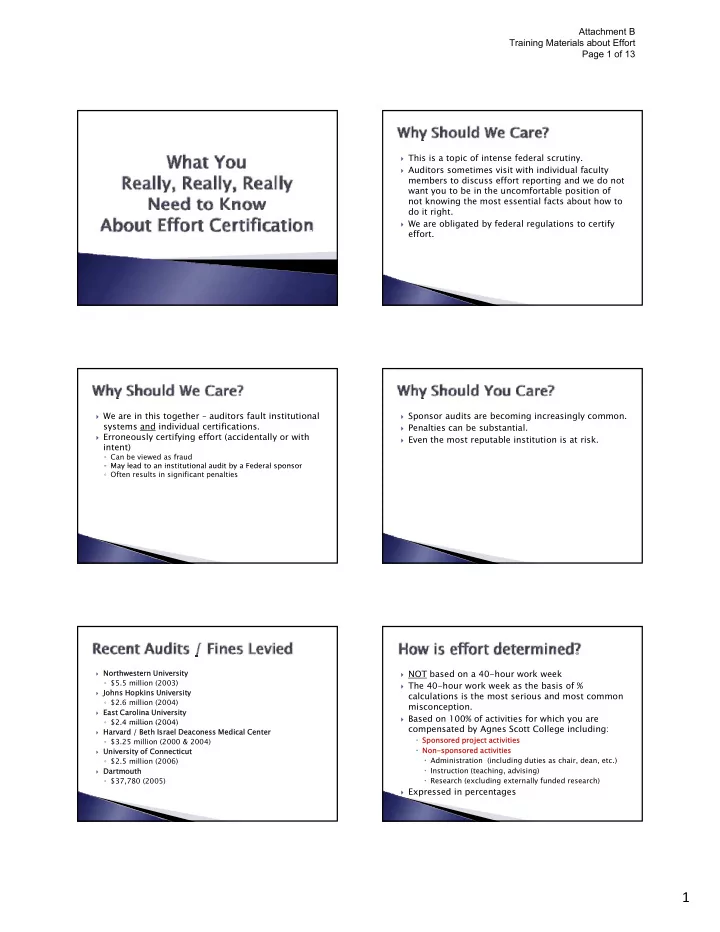
 This is a topic of intense federal scrutiny.  Auditors sometimes visit with individual faculty

members to discuss effort reporting and we do not want you to be in the uncomfortable position of not knowing the most essential facts about how to do it right.

 We are obligated by federal regulations to certify

effort.

 We are in this together – auditors fault institutional

systems and individual certifications.

 Erroneously certifying effort (accidentally or with

intent)

  • Can be viewed as fraud
  • May lead to an institutional audit by a Federal sponsor
  • May lead to an institutional audit by a Federal sponsor
  • Often results in significant penalties

 Sponsor audits are becoming increasingly common.  Penalties can be substantial.  Even the most reputable institution is at risk.

 North

Northweste tern Un Univer ersi sity ty

  • $5.5 million (2003)

 Johns H

Johns Hopkins ins Un Universit sity

  • $2.6 million (2004)

 East Ca

st Carolin rolina a Un Universi sity ty

  • $2 4 million (2004)

$2.4 million (2004)

 Harv

Harvard / / Bet Beth Is Israe rael Deaco Deaconess ss Medi Medical Cent Center

  • $3.25 million (2000 & 2004)

 Unive

Universit sity of

  • f Conne

Connect ctic icut

  • $2.5 million (2006)

 Dartm

Dartmouth

  • $37,780 (2005)

 NOT based on a 40-hour work week  The 40-hour work week as the basis of %

calculations is the most serious and most common misconception.

 Based on 100% of activities for which you are

compensated by Agnes Scott College including:

 Spon Sponsore red project act project activities  Non-spo Non-sponso sored a d activ tiviti ties  Administration (including duties as chair, dean, etc.)  Instruction (teaching, advising)  Research (excluding externally funded research)

 Expressed in percentages

Attachment B Training Materials about Effort Page 1 of 13

slide-2
SLIDE 2

2

 Academic Year Pizza Crust

  • “worth” your IBS
  • “weighs” your job description

 100% is 100%  There are no nights and weekends  Exempt employees (faculty and staff) are not

paid by the hour — they are paid to accomplish their job

Spo Sponsor sored project activities include:

 Effort on federal grants or contracts* (e.g. , NIH, NSF, NASA – including federal funds that have flowed to ASC from other institutions)  Effort on non-federal research projects* (e g a foundation grant) (e.g. , a foundation grant)  Administrative effort related to a sponsored project*

  • Writing progress reports
  • Holding a meeting with staff
  • Presenting research results at a scientific conference
  • Reading scientific journals to keep up to date with the latest

advances in the project topic area.

* Even if your effort is not completely paid by the sponsor (i.e., salary cost sharing) Non-sp n-sponso

  • nsored

red activities include:

 Teaching  Advising  Research funded by ASC

  • (i.e., research you do as part of your regular workload for ASC)

 Department Chair duties  Attending general departmental faculty meetings  Serving on College committees  Proposal preparation  External professional activities paid through an

agreement outside your Agnes Scott college workload (e.g., consulting engagements, incidental work for ASC that is over and above your workload)

 Serving on an NIH Study Section or NSF Peer Review

Panel

If you have any questions about whether an activity is or is not part of the effort considered in the 100% i % institu stitutiona nal b l base s salary lary, check with the Office of Sponsored Programs.

 OMB Circular A21 J 10 b(1)(c)

  • “In the use of any methods for apportioning salaries, it is

recognized that, in an academic setting, teaching, research, service and administration are often inextricably intermingled ” intermingled.

  • “A precise assessment of factors that contribute to costs is

not always feasible, nor is it expected. Reliance, therefore, is placed on estimates in which a degree of tolerance is appropriate.”

The degree of tolerance at Agnes Scott College is +/- 5%

Attachment B Training Materials about Effort Page 2 of 13

slide-3
SLIDE 3

3

 Salary and wages charged to sponsored projects

should reasonably reflect the proportionate share

  • f time spent on the project

 Cost share commitments must be included in the

effort distribution

 Salary payments cannot be made for effort not

applied to the project

 Each employee reviews and signs her/his own effort

certification form.

 Exceptions are sometimes necessary (e.g., the

researcher is out of the country or is on temporary leave of absence) Contact Sponsored Programs to leave of absence). Contact Sponsored Programs to determine if an exception is necessary.

 Federal requirements stipulate that anyone

certifying effort for another individual must credibly have first hand knowledge of that individual’s actual effort. It depends on your classification:

 For 9-month faculty employees, effort report is

preprinted with promised effort distribution

  • Each academic term and each half of summer

 For 12-month exempt employees (even those who

hold faculty rank), effort report is preprinted with promised effort distribution

  • Every six months

 Non-exempt employees (those paid by the hour)

certify their effort when they submit their time sheets (they certify their time)

  • Each pay period

Individual inserts percentages of actual effort and verifies the report as a re reasonab

  • nable e

le esti timate o mate of actua actual effort effort worked by signing the report

A variety of resources may be relied upon to jog

  • ne’s memory and document effort allocations:
  • ne s memory and document effort allocations:
  • Calendars
  • Journals, logs, and blogs
  • Teaching schedules
  • Leave reports
  • Correspondence
  • Outside activity forms

 Difference between

  • potential effort
  • actual effort

 Limits on amount allowed

 Late effort reports  Effort certified by someone lacking first-hand

knowledge of the individual’s actual effort

 Percentage outside of sponsored project is

insufficient to credibly cover teaching insufficient to credibly cover teaching, administrative, or other College work

 Multiple post-certification revisions  Significant data inconsistency between effort report

and other documentation such as:

 Calendar  Leave reports  Other support forms  Outside activity forms

Attachment B Training Materials about Effort Page 3 of 13

slide-4
SLIDE 4

4

 Effort reporting is under scrutiny by the Office of

Inspector General at NIH, NSF, and other agencies.

 Each individual is responsible for certifying his or

her own effort.

 The effort % is NOT based on a 40-hour work week.

It is based on the individual’s actual amount.

 Effort reporting tracks the re

reas asonable able appro pproximation imation of actual activ actual activity on projects. *It should *It should not not simply simply mimic mimic budgete budgeted amoun amounts.

 Effort reporting is our means of providing

assurance to sponsors that faculty and staff have met their commitments, paid or unpaid, to extramural projects.

  • Pamela Napier
  • Buttrick 207
  • 404-471-6951

@ d

  • Emily Kandetzki
  • Buttrick 109
  • 404-471-6952
  • osp@agnesscott.edu

 For our effort reporting system to have integrity

and pass audit,

  • The College’s procedure needs to be based on the federal

accounting principles for effort

d and

  • Individual effort certification needs to follow the basic

guidelines published by the Office of Sponsored Programs

 We want to assist you in any way we can

Attachment B Training Materials about Effort Page 4 of 13

slide-5
SLIDE 5

The “logic” of effort reporting. Think of “effort” as a pizza crust. Academic Year: For the academic year, you are given a lump of pizza dough that weighs “your job description” and is worth whatever your “institutional base salary (IBS)” is. You accept that lump of pizza dough and agree to roll it out for as many hours as are needed into a pizza crust that is worth your IBS. Your pizza crust can be up to nine months in size and up to 9/9ths of your IBS. The size pan you use will depend on whether you roll thick crust (fewer hours) or thin crust (more hours) or cracker-like crust (for those of you who never sleep). You get to decide how many hours you spend performing your job description. Your only requirement is to get your job done. Whatever work you do to earn that IBS equals 100% of your “effort.” There is no expectation that any particular number of hours is the correct number of hours. All that is expected is that however many hours you work equals 100% of your effort. Once you roll out your pizza crust to however many hours/days/weeks/months you need, you must divide it into “slices” (i.e., percentages). Each slice will be labeled as some percentage of your 100%

  • effort. All the slices together must add up to 100%. Everything you do for which you receive part of

your IBS must get a slice of the crust. Some of your slices will be for instruction, some for advising, some for service, some for research, some for administration, etc. Some of the slices will be paid for by ASC. If none of your salary comes from external funds, then 100%

  • f your effort is paid for by ASC. If some of your salary comes from external funds for work you do for

an external sponsor, then part of your 100% will be charged to an ASC account (an 11-account), and part

  • f your 100% will be charged to a grant account (a 14-, 15-, or 17-).

What the auditors review at the end of the year is the total amount you were paid for your nine-month academic year, and how you have divided your pizza crust. If the effort pizza is sliced the same way the dollars were sliced, everybody is happy. The auditors compare the ASC payroll records to the effort certification forms you complete at the end of each semester. If none of your effort is spent working on grant projects, then you have a pizza crust that is 100% ASC-

  • funded. If part of your effort has been promised to an external sponsor, then you have to complete an

effort certification form that tells how your pizza crust was divided between ASC and any external sponsors. Summer: Now, in the summer, nobody gives you a lump of pizza dough to get started with. Since you have no pizza dough, you can choose not to make a crust.

Attachment B Training Materials about Effort Page 5 of 13

slide-6
SLIDE 6

If you choose not to make a crust, you are “on vacation” for the three summer months (beginning mid- May and ending mid-August). [And, yes, we all know that you are working much of the summer, trying to catch up from last academic year, and plan for next academic year. However, all auditors see is that you are not getting paid for any summer effort, so you are technically not expending any effort.] Or, if you want, you can gather up some work to do for which you will be paid summer salary, thus making your own lump of pizza dough. For example, you can agree to teach a summer course, or do some work on one or more grant projects,

  • r take on some administrative task, or some combination of all of the above. [There may be other

things for which you receive pay during the summer.] There are limits to how much your summer dough can weigh and how much it can be worth. All the work you do during the summer can add up (in dollars) to no more than 1/3 of your IBS – and you have to get special permission to earn that much, since College policy is to limit summer earnings to 5/6

  • f your IBS (or 2.5 summer months).

All the work you do during the summer must fit during the 3 summer months that are not covered by your academic year job description. Whatever work you do equals 100% of your actual summer effort. So, in order to certify/quantify your summer effort, you have to list all of the work you are getting paid for during the summer. You can’t include in your summer lump of dough the work you are doing that ASC is not paying you for. You can only include the work for which you get a check from ASC. [It won’t be a separate check, it will just be additional pay added to your paycheck in June, July, August, or September—after the work has been performed and the effort has been certified.] Your summer pizza crust (which represents your summer “effort”) might be as small as one week, and it might be as large as twelve weeks. It will all depend on how much you get paid for summer work. It will be a different size depending on your individual circumstance. If you work for one summer month and get paid 1/9th of your IBS, then that is 100% of your summer

  • effort. If you work for two summer months and get paid 2/9ths of your IBS, then that is 100% of your

summer effort. This is what makes sense to auditors, so this is the way we need to understand it. Here’s the really tricky part. One month of summer effort, for which you are paid 1/9th of your IBS, cannot be measured in hours/days/weeks. When you and the sponsor paying for your summer work agree to “one month” worth “1/9th of your IBS,” that “month” is nebulous. It does not have to be one continuous month. You do not have to keep a time sheet to show hours/days/weeks worked. You only have to produce “one summer month” of results. You document those results using lab notebooks, articles submitted for publication, trips taken to do field work or examine source documents, or in any number of other ways. BUT, what auditors will ask you is how many hours/days/weeks you “worked” on the project, because auditors just don’t think the same way faculty members and program officers think. So, that’s why ASC

Attachment B Training Materials about Effort Page 6 of 13

slide-7
SLIDE 7

has to get you to sign effort certification forms and sign a waiver if you are going to earn the equivalent

  • f more than 2.5/9ths of your IBS during the summer.

One month might be 33.3% of your potential summer effort, and two months might be 66.6% of your potential summer effort, and three months might be 100% of your potential summer effort, BUT any of those amounts might be 100% of your actual summer effort. This is the logic of effort reporting and certification.

Attachment B Training Materials about Effort Page 7 of 13

slide-8
SLIDE 8

Effort Reporting Guidelines for Agnes Scott College

  • 1. The principal investigator (PI) is responsible and accountable for compliance with all federal

regulations associated with sponsored projects awarded under his or her supervision. (see Note 1) Effort certification is a compliance requirement of accepting federal awards. (see Note 2)

  • 2. Effort is not based on a 40-hour work week, nor is it based on full time equivalent (FTE). Effort

is an employee’s total activity within her or his primary appointment (sometimes referred to as “contract” or “job description”) and includes research, teaching, and administrative duties. Effort comprises all elements included in an employee’s Agnes Scott College appointment. This excludes any income that an individual is permitted to earn outside of his or her primary duties for Agnes Scott College or from off-campus consulting. Effort is expressed in percentage terms and must total 100% of the appointment for which the institutional base salary (IBS) is paid. (see Note 3 )

  • 3. The individual signing an effort certification confirms that the percentage distribution of activity
  • n the report represents a reasonable estimate of the work performed by the listed employee for

the documented period.

  • 4. In preparing effort reports, employees are encouraged to refresh their memories by consulting

available resources documenting their activities during the period. These documents may include leave reports for the period, calendars, schedules, correspondence, telephone logs, meeting documentation, journals, etc. They are also resources that external auditors or other reviewers may consult to help resolve effort report questions, if they arise.

  • 5. Federal regulations require the individual who certifies effort to have first-hand knowledge of the

employee's activities (see Note 4). This requirement is met when the employee signs his or her

  • wn effort certification, except in pre-approved and clearly documented circumstances that

warrant a departure from the standard procedure, e.g. the individual is on leave of absence.

  • 6. Timely certification and return of effort reports by College-established deadlines is a federal

compliance requirement.

  • 7. Sometimes there are legitimate reasons to modify the effort on a project subsequent to
  • certification. These modifications are referred to as retroactive adjustments. Legitimate reasons

DO NOT include manipulating funds for budget purposes or to charge one grant or contract to cover work activity actually expended for another project or work related duty.

  • 8. Any request for a retroactive adjustment requires a Letter of Justification (LOJ) that clearly sets

forth why previous effort was erroneously certified, and why the requested change is more appropriate within the context of law, Federal requirements, or College policies and procedures. LOJs are submitted to the Vice President for Academic Affairs, with copies to the Office of Sponsored Programs. Retroactive adjustments requested via a LOJ must occur within 90 days of recording the expenditure for which a reclassification is requested.

  • 9. Federal requirements generally allow up to 90 days after the project period end date for final
  • reporting. Final effort reporting and any retroactive adjustments must be completed before the

final reporting deadline.

  • 10. Remember, whether or not you agree philosophically with this structure for effort reporting, it is a

federal requirement and a current focus of federal auditing programs. Recent non-compliance findings have resulted in multimillion dollar fines at major, respected research institutions.

Attachment B Training Materials about Effort Page 8 of 13

slide-9
SLIDE 9

Note 1: Principal Investigator (PI) Definition: The individual designated by the grantee, and approved by NSF, who will be responsible for the scientific or technical direction of the project. (Source: NSF Policy Office website) Responsibility: The PI (also referred to as Program/Project Director) is the individual, designated by the grantee, responsible for the scientific or technical aspects of the grant and for day-to-day management of the project or program. The PI is not required to be an employee of the grantee. However, because the grant, if awarded, is made to the organization, the applicant organization must have a formal written agreement with the PI that specifies an official relationship between the parties even if the relationship does not involve a salary or other form of remuneration. The PI is a member of the grantee team responsible for ensuring compliance with the financial and administrative aspects of the

  • award. This individual works closely with designated officials within the grantee organization to create and maintain necessary

documentation, including both technical and administrative reports; prepare justifications; appropriately acknowledge Federal support of research findings in publications, announcements, news programs, and other media; and ensure compliance with other Federal and organizational requirements. (Source: NIH Policy website) Note 2: Effort Certification Amounts charged to grant-supported projects for personal services must be based on an adequate payroll distribution system. Standards for payroll distribution systems are contained in the applicable cost principles. Examples of acceptable methods for payroll distribution are as follows:

  • A plan confirmation system for professorial or professional staff based on budgeted, planned, or assigned work activity,

updated to reflect any significant changes in work distribution.

  • Activity records system reflecting an after-the-fact reporting of the percentage distribution of activity of employees. For

professorial and professional staff, the reports will be prepared each academic term, but no less frequently than every 6

  • months. For other employees, unless alternative arrangements are agreed to, the reports will be prepared no less

frequently than monthly and will coincide with one or more pay periods.

  • Multiple confirmation records system for professorial and professional staff, prepared each academic term, but no less

frequently than every 6 months.

  • By mutual agreement, any other method meeting the criteria specified in paragraph J.10.b.(2) of OMB Circular A-21.

Note 3: Effort Must total 100% Agnes Scott College has elected to use a system of after-the-fact confirmation reports to document wages, as required by Section J10 of Federal OMB Circular A-21. These reports must account for 100% of each individual's effort. Note 4: Signature Certifications To confirm that distribution of activity represents a reasonable estimate of the work performed by the employee during the period, the record for each employee must include the signature of the employee or of a person having direct knowledge of the work, confirming that the record of activities allocable as direct costs of each sponsored agreement is appropriate. (Source: OMB website)

Attachment B Training Materials about Effort Page 9 of 13

slide-10
SLIDE 10

Five Frequently Asked Questions (FAQs) about Effort Reporting

  • 1. Why is a 40-hour work week NOT the basis for “100% effort”
  • Under federal regulations on effort reporting, 100% effort is an employee’s total hours

actually spent on work within the scope of his or her employment regardless of how many or how few hours an employee works and regardless of the percent FTE listed on the appointment.

  • Even though you do not get paid by the hour, auditors will ask you about the number of hours

you spend performing the work upon which your institutional base salary (IBS) is based.

  • Effort certification must reflect actual work performed and cannot be budget driven.
  • Just as an employee’s total effort is not defined by regular business hours of the employer or

by the percent FTE of the appointment, research effort does not necessarily take place only in the research facility/lab or only on university premises. Research effort can occur at home, at a conference, in off-site research-related meetings, or other places. If these types of hours are included in calculating research effort, they must also be included in the calculation of total effort.

  • 2. What are some sample mistakes? Federal auditors are looking for patterns that suggest that an

effort certification is formulated by factors other than actual effort on the project:

  • Patterns of retroactive adjustments to effort certifications or retroactive cost transfers. (Is

there reasonable justification or does there appear to be a desire to “mop up” or transfer unused grant funds?)

  • Very small effort percentages on many grants. (Is it the actual research project contribution
  • r just salary support?)
  • Research effort certifications that appear not to include accounting for actual administrative

and/or teaching as part of total effort. If you certify research effort for your research grants totaling 95%, that leaves only 5% for all other work. If you are teaching two classes that each meet for three hours a week, classroom time alone equals six hours per week. For 6 hours to be 5% or less of your total effort — leaving at least 95% to meet your certified research effort – you need to be prepared to document the claim that your workweek is 120 hours or more.

  • 3. What if one or more of the patterns listed in item number 2 exist in my effort reporting but are

legitimate reflections of my actual effort?

  • Maintain documentation that supports your research contribution — in research content and

in time/percentage of effort (calendars, correspondence, work products, etc.)

  • A request for retroactive adjustment to an effort certification requires a Letter of Justification.
  • If an adjustment is needed, do not delay — 90 days is the limit for accepting a retroactive

adjustment.

  • 4. What if I disagree with this effort reporting approach?
  • If you accept federal funds, you accept this obligation as a condition of taking the funds.
  • If you are skeptical about the magnitude and likelihood of serious jeopardy regarding

noncompliance in effort reporting, please call the individuals below to get more information.

  • 5. What if I have questions related to effort certification?
  • For technical questions about effort certification processes and paperwork, contact:

Pamela Napier, Director Emily Kandetzki, Assistant Director Office of Sponsored Programs Office of Sponsored Programs Buttrick 207 Buttrick 109 404-471-6951 404-471-6952

Attachment B Training Materials about Effort Page 10 of 13

slide-11
SLIDE 11

Instructions for completing the Effort Certification Form: Your “Employee Information” section and your "Sponsored Activities" for the past reporting period have been entered for you. The amount of effort you promised the sponsor is listed in the “% of Projected Effort” column for each line item. 1) Insert a percentage in the "% of Actual Effort" column for each line item. "Actual Effort" is based on 100% of the activities for which you are compensated by Agnes Scott College for your primary assignment (including sponsored activities, teaching, and administration). These are the activities of your primary assignment for which you are paid your institutional base salary (IBS). 2) The promised/projected amounts shown are for informational purposes only. DO NOT use them as the only factor in determining % of actual effort. 3) Add lines for sponsored activities not already listed, including activities for which there was a cost-share portion. 4) Sign and date the form. Electronic signatures are not acceptable; however, you may type the date if you prefer. 5) Hand deliver the signed form to the Office of Sponsored Programs to ensure that is doesn’t get lost in Campus Mail. DUE DATE: Within 60 days of receiving the form. What happens to the form after you certify your effort: The Office of Sponsored Programs staff will review the form, comparing the forms to payroll data provided by the Office of Human Resources, then will sign and date before submitting to the Vice President for Academic Affairs for final signature and date. These additional signatures are not part of the certification process; they are part of the internal auditing process. The fully signed forms will be kept on file in the Office of Sponsored Programs. Each document will be scanned and converted to a PDF file, and you will receive an electronic copy of the file for your records. The Office of Sponsored Programs will keep the original forms on file in a secure manner for at least as long as federal policies specify or as long the College’s document retention policy requires (whichever is longer). The information on the forms will be used to document that the effort on a federal project is greater than or equal to the percentage of salary charged to the sponsored account that supports the project. In addition, the information will also be used to calculate the amount and source of funds for any cost- shared effort (effort that comes from a non-federal source -- typically, the departmental “11” account).

Attachment B Training Materials about Effort Page 11 of 13

slide-12
SLIDE 12

Additional information about effort: Changes in effort require approval from the Office of Sponsored Programs and/or the Sponsoring Agency as appropriate. When a PI is absent in excess of 90 days from his/her project, prior approval must be obtained from the sponsoring agency. Time spent in the preparation of proposals cannot be charged to a sponsored accounting unit. Therefore, it is inappropriate for an employee to be paid from sponsored accounting units to prepare and submit proposals. Employee Effort Certification Forms will reasonably reflect the percentage distribution of effort expended by Agnes Scott College faculty and exempt professional staff involved in federally-funded grants, contracts, and cooperative agreements. The certification will account for 100% of an employee’s actual IBS compensated effort for the given time period. 100% effort is defined as the effort expended to accomplish the full set of activities encompassed by Agnes Scott College appointments regardless of the actual number of hours expended on those

  • activities. 100% effort is not defined as a single, standard number of hours or days per week because it

will likely be different for each faculty/staff member and may vary during the year. The number of hours implicit in an individual faculty member's 100% must be reasonable and supportable to College and external reviewers if requested. The employee should provide an account of all effort expended on a sponsored activity, even if the sponsor did not compensate Agnes Scott College for that activity (in other words if the effort was “cost shared” by ASC. Cost sharing can occur on a mandatory or voluntary basis. Mandatory cost sharing

  • ccurs when it is required by the sponsor at the time of application. Voluntary committed cost sharing
  • ccurs when ASC promises the effort to the sponsor at the time of application or award. Both

Mandatory and Voluntary Committed cost share become conditions of the award. Voluntary uncommitted cost sharing represents additional effort expended on a project that is not required by the sponsor or promised by ASC as a condition of the award. Although it is the College’s practice to minimize voluntary cost sharing, the PI must record all effort expended on their projects regardless of the source

  • f compensation.

Employee Effort Certification Forms do not need to be completed by clerical staff or students that fill out a weekly or bi-weekly time sheet. Those employees are paid by the hour and certify their time (and effort) by signing the time sheet. Principal Investigators are required to verify that the information provided by any employees working

  • n their grants is accurate.

Employee Effort Certification Forms for faculty employees on nine-month contracts are required for four reporting periods annually. Effort certification report requests will be distributed to all applicable faculty members approximately 30 days from the close of a reporting period. Completed reports must be submitted to the Office of Sponsored Programs no later than 60 days after the distribution of the effort certification report request. The reporting periods and approximate submittal deadlines are provided as follows:

Attachment B Training Materials about Effort Page 12 of 13

slide-13
SLIDE 13

For 9-month faculty employees (all of whom are exempt): Late Summer (July 1 – mid-August); submittal deadline – November 15 Fall Semester (mid-August – December 31); submittal deadline – March 30 Spring Semester (January 1 – mid-May); submittal deadline – August 15 Early Summer (mid-May – June 30); submittal deadline – September 30 For 12-month exempt employees (including those with faculty rank): Quarters 1 and 2 (July 1 – December 31); submittal deadline – March 30 Quarters 3 and 4 (January 1 – June 30); submittal deadline – September 30 For non-exempt employees (those paid for their time rather than their effort): Every timesheet represents both a time and effort report and certification. Completed Employee Effort Certification Reports will be filed in the Office of Sponsored Programs. Other documentation available on the OSP Moodle page: ASC Effort Certification Policy (revised FY12) ASC Effort Reporting Guidelines Five Frequently Asked Questions about Effort Reporting ASC Effort Reporting Training Slides: What You Really, Really, Really Need to Know about Effort Effort Change Letter of Justification Guidelines Request for Three Months Summer Salary Memo Template How Paychecks Work Spreadsheet The “Logic” of Effort (a.k.a. the pizza crust analogy) For further information, contact the Office of Sponsored Programs at osp@agnesscott.edu.

Attachment B Training Materials about Effort Page 13 of 13