1 Todays schedule Technical infrastructure, education, 9 am - - - PDF document

1
SMART_READER_LITE
LIVE PREVIEW

1 Todays schedule Technical infrastructure, education, 9 am - - - PDF document

Finding out about each other.. Tell us about yourself.. Name, organisation? What kind of work do you do? Welcome to Why did you attend this tutorial? What do you hope to get out of the session today? Maximising your IP


slide-1
SLIDE 1

1

1

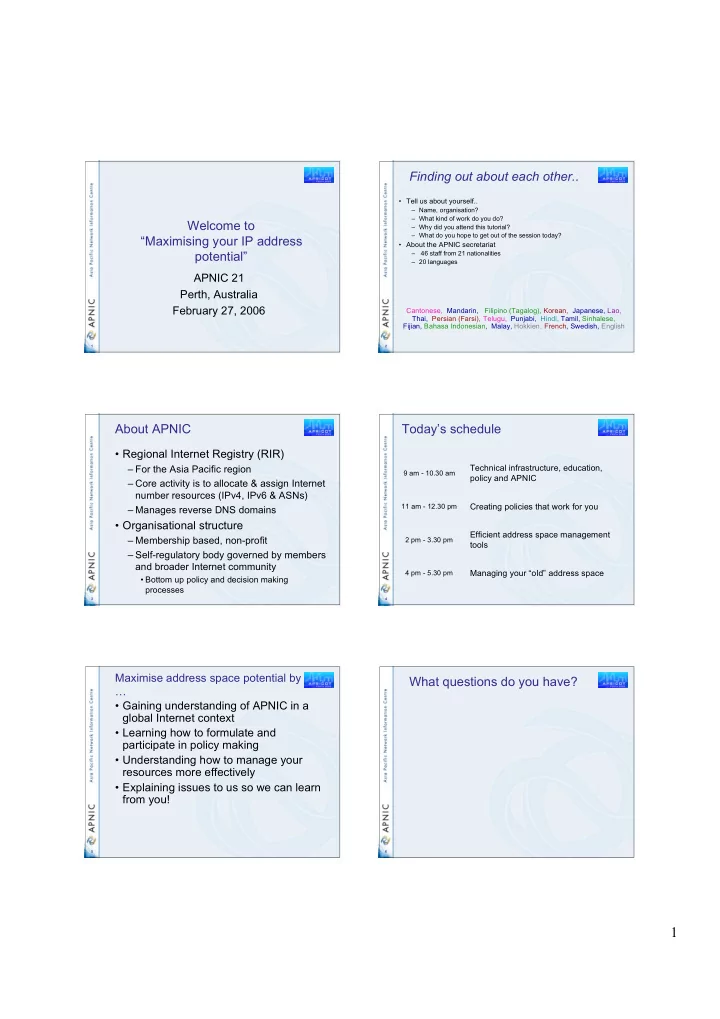
Welcome to “Maximising your IP address potential”

APNIC 21 Perth, Australia February 27, 2006

2

Finding out about each other..

  • Tell us about yourself..

– Name, organisation? – What kind of work do you do? – Why did you attend this tutorial? – What do you hope to get out of the session today?

  • About the APNIC secretariat

– 46 staff from 21 nationalities – 20 languages Cantonese, Mandarin, Filipino (Tagalog), Korean, Japanese, Lao, Thai, Persian (Farsi), Telugu, Punjabi, Hindi, Tamil, Sinhalese, Fijian, Bahasa Indonesian, Malay, Hokkien, French, Swedish, English

3

About APNIC

  • Regional Internet Registry (RIR)

– For the Asia Pacific region – Core activity is to allocate & assign Internet number resources (IPv4, IPv6 & ASNs) – Manages reverse DNS domains

  • Organisational structure

– Membership based, non-profit – Self-regulatory body governed by members and broader Internet community

  • Bottom up policy and decision making

processes

4

Today’s schedule

Technical infrastructure, education, policy and APNIC Creating policies that work for you Efficient address space management tools Managing your “old” address space

9 am - 10.30 am 11 am - 12.30 pm 2 pm - 3.30 pm 4 pm - 5.30 pm

5

  • Gaining understanding of APNIC in a

global Internet context

  • Learning how to formulate and

participate in policy making

  • Understanding how to manage your

resources more effectively

  • Explaining issues to us so we can learn

from you! Maximise address space potential by …

6

What questions do you have?

slide-2
SLIDE 2

2

7

Today’s schedule

Technical infrastructure, education, policy and APNIC Creating policies that work for you Efficient address space management tools Managing your “old” address space

9 am - 10.30 am 11 am - 12.30 pm 2 pm - 3.30 pm 4 pm - 5.30 pm

8

Internet development

Technical internet infrastructure, education, policy and APNIC

9

Presenters

  • Nurani Nimpuno

– Outreach Co-ordinator

  • Anne Lord

– Communications Director

  • Geoff Huston

– Internet Research Scientist

10

Maximise address space potential by …

  • Gaining an understanding of the role and

responsibilities of APNIC and where it fits with “Internet development” agencies

  • Having an appreciation that APNIC supports internet

development with specific technical and human resource focused activities

  • Learning how you can benefit from these activities

and contribute in the wider context

  • Gaining a perspective on changes in the ISP industry

with a view to understanding the future

11

Defining Internet development

  • What do we mean by ‘Internet development’ in this

context?

– Initiatives aimed at developing technical infrastructure – Education and learning programmes – Policy support and evolution

  • UN Declaration of principles (WSIS 2003)

– “Governments, as well as private sector, civil society and the United Nations and other international organizations have an important role and responsibility in the development of the Information Society and, as appropriate, in decision-making processes.”

  • As an international organisation, APNIC has an

important role to play

12

Overview

  • Technical Internet infrastructure
  • Education and support
  • Policy
  • The future of the Internet
slide-3
SLIDE 3

3

13

Internet Development

Technical Internet Infrastructure

14

Technical infrastructure development

Technical infrastructure development

  • perations

technical admin protocols & standards physical network Access and last mile technologies Wireless Physical equipment Creating an operational environment that fosters a secure and reliable network platform Specifying standards and protocols which define the technology IANA, RIRs, cc & TLD operators, Root server advisory committee

15

Technical infrastructure

  • global organisations
  • Operations

– Security - FIRST

  • Brings together CERTS from gov’t, commercial, & educational
  • rg’s across globe
  • Cooperation & coordination, info sharing, rapid responses
  • http://www.first.org
  • Protocols & Standards

– IETF purpose is to support a set of open standards that allow interoperability

  • Open processes, technical competence
  • Volunteer code, “rough consensus & running code”
  • Protocol ownership
  • http://www.ietf.org

RFC 3935

16

ccTLD & gTLD delegation Protocol number assignment IP address delegation (to RIRs)

Technical infrastructure

  • global organisations

Internet Resource allocation DNS Name management

IANA RIRs Technical administration Number resources DNS operations

ccTLDs gTLDs RootOps Registrars NRO ARIN APNIC Afri- NIC LAC- NIC RIPE NCC

17

Technical Internet infrastructure

  • regional groups

APTLD APNG APAN APIA AP*

Collaboration of TLD

  • perators in region

Fostering the advancement

  • f network infrastructure

Asia Pacific Advanced Network Asia Pacific Internet Association (Supports APRICOT) Collaborative effort between AP orgs http://www.aptld.org http://www.apng.org http://www.apan.net http://www.apia.org http://www.apstar.org

18

Technical Internet infrastructure

  • APNIC activities
  • Collaboration

– ICANN root server system advisory committee – CAIDA workshops and research

  • Participate in workshops
  • Provide statistics & measurement points
  • DNS infrastructure

– Improving resiliency

  • Secondary DNS services for ranges delegated by APNIC and

some ccTLD’s – Improving quality

  • “Cleaning up the reverse DNS” requested by community
  • Operational report at DNS SIG at APNIC21
  • http://www.apnic.net/services/rev-del/lame-del/lame-del-response.html
slide-4
SLIDE 4

4

19

Rootservers supported by APNIC

More information at http://www.apnic.net/services/rootserver/

20

Technical Internet infrastructure

  • APNIC activities
  • Certification Authority (CA)

– Issuing X.509 certs to access “MyAPNIC”

  • Secure resource management
  • (Also online voting, training & billing records etc)
  • Optimised for faster response

– Routing certificates trial

  • Issuing X.509 certs with IP & AS extensions
  • Implementing rfc3779
  • “Debogon” project (currently in trial)

– Problem with new APNIC allocations & assignments being blocked by “bogon” filters – Test prefixes from new IANA blocks for one month prior to making allocations from it and produce report RFC 3779

21

APNIC activities - IETF support

  • Staff as WG chairs

– CRISP (cross registry information service protocol)

  • Co-chair: George Michaelson
  • Common framework with registries, structured data (XML)
  • Long term “whois” replacement
  • http://www.ietf.org/html.charters/crisp-charter.html

– GROW (Global routing operations)

  • Chair: Geoff Huston
  • Examines operational problems of IPv4 and IPv6
  • http://www.ietf.org/html.charters/grow-charter.html

– Shim6 (Site multihoming by IPv6 Intermediation)

  • Co-chair: Geoff Huston
  • Specifications for IPv6-based site multihoming
  • http://www.ietf.org/html.charters/shim6-charter.html

22

APNIC activities - IETF support

  • PKIX

– X.509 Extensions for IP Addresses and AS numbers – APNIC deployment of resource certificates (rfc3779)

  • http://www.ietf.org/html.charters/pkix-charter.html
  • DNSop (DNS operations)

– Guidelines for DNS operations

  • http://www.ietf.org/html.charters/dnsop-charter.html
  • V6ops (IPv6 operations)

– Guidelines for the operation of shared v4/v6 Internet – Operation guidelines on how to deploy IPv6 into existing IPv4-only networks

  • http://www.ietf.org/html.charters/v6ops-charter.html
  • IDR (Inter-Domain Routing)

– Standardize and promote BGP-4 to support IPv4 & IPv6 – Improving scalability of BGP

  • http://www.ietf.org/html.charters/idr-charter.html

23

APNIC activities - funding

  • Pan-Asia grants

– Funding partner to ICT R&D grants programme

  • Practical technical research solutions to problems in developing

world

  • http://www.idrc.ca/panasia/
  • Staff support on project committee

– Projects

  • Vclass: SIP-based mobile classroom
  • IPv6 Tunnel Broker: a key for using next generation Internet in

developing countries

  • Other regional funding support

– Infrastructure: APstar, APng, APIA, AP* – Operations: SANOG, PACNOG, NZNOG..

24

Internet infrastructure

  • what about you?
  • Use available sources of information

– RFCs – Drafts & BCPs – APNIC research & technical articles (Geoff)

  • Follow agreed Best Current Practices

– Spam fighting – Security – DNS – Routing aggregation etc

  • Stay abreast of developments
slide-5
SLIDE 5

5

25

Internet Development

Education and Support

26

Education & support - global

  • ISOC

– Facilitates training programmes

  • CCTLD workshops
  • Participation in regional workshops

– On-line workshop resource centre (with NSRC)

  • http://ws.edu.isoc.org/
  • NSRC

– Provides technical and engineering assistance to international networking initiatives building access to the public Internet

  • Active in Africa, South America, Asia
  • ITU

– Mostly telecom workshops, training in IPv6

27

Education & support - regional

JANOG NZNOG SGNOG CNNOG

PacNOG SANOG

APOPS

Ph-ISP AUSNOG

NOGs

(Network Operator Groups

  • Fashioned after NANOG)
  • Technology transfer

& education

  • Workshops,

training, conferences

Also…

  • ISOC

chapters

  • IPv6 forums
  • And much more..

NICE

28

Education & support - APNIC

  • Collaboration with global & regional
  • rganisations

– Supporting NOGs & educational forums

  • APRICOT, NOGs, PITA, ISOC-AU, RIR meetings
  • IPv6 forums, NIR Open Policy meetings..

– Collaboration with training partners

  • AIT, Cisco routing workshops, APTLD
  • ISOC and NSRC workshops

– MoU’s: mutual support & collaboration

  • ISP Associations of South Asia
  • Root server operators (F, K, I)
  • ISOC-AU and others..

29

Education & support - APNIC training

  • Training needs established

– Through member surveys (1999, 2001, 2004) – Feedback from HM’s, training, outreach, billing – “EOI” forms to request training

  • http://www.apnic.net/training/more-info/eoi/eoi-spon-form.html
  • Training schedule & locations
  • http://www.apnic.net/training/schedule/
  • Sponsorship

– Ensures cost-recovery – Training courses subsidised for APNIC members

30

Education & support - APNIC training

Originally… Today Development over time…

Pre-1999 No training courses 1999 1st one-day “resource management training” Additional modules, customised tutorials 2002 Technical courses, tutorials developed 2004 Modular core course Technical workshops & tutorials 2006

  • Evolutionary approach
slide-6
SLIDE 6

6

31

Training in 2005

Karachii Apr Delhi Jan Guangzhou Sep + Nov Makati Mar Bangkok Jun* Kuala Lumpur Aug * + Nov * Jakarta Jul Vientiene + Hanoi Jun + Sep + Sydney May Hamilton Feb (*) with DNS workshop (+) with Routing Essentials workshop

34 sessions 24 locations

Port Moresby Mar Dhaka Feb * Hong Kong Oct + Singapore Dec * Taipei Nov Kyoto Feb UlaanBaatar Sep Thimphu Jul +*

32

APNIC training courses

  • Core courses

– Internet Resource Management training

  • IRM I, IRM II
  • IRM Essentials
  • Tutorials

– Security – IRR – Spam

  • Technical workshops

– DNS – Advanced DNS – Routing essentials

  • Courses under

development

– IPv6 services workshop

  • Material, information and schedules on website

http://www.apnic.net/training

33

APNIC training and eLearning

  • Taking it further…

– Hired an eLearning officer

  • Sall’ee Ryman

– Bringing APNIC training to your desktop

  • On demand training, self paced learning
  • eLearners

– Adult learners

  • Clear instruction and outline of objectives

– English as a second language (ESL)

  • Visual clues, more time, reading vs listening
  • Pilot available 2nd quarter 2006

– 3 modules ready 3rd quarter

34

APNIC eLearning

  • eLearning objectives

– Provide a number of pathways for learning

  • Fast paced or slower

– Deliver outcomes that have immediate application in the real world

  • Request forms easier to complete

– Invite content experts to contribute

  • Hostmasters, external experts

– Generate a sense of “belonging”

  • Immediate support from group for problems

35

APNIC support services

  • Getting answers to your queries

– Problems with your request? Database update failed? Not sure of the policies?

  • VOIP service trial

– Save on international call rates to helpdesk!

  • helpdesk@voip.apnic.net

Member Services Helpdesk

  • One point of contact for all member enquiries!

Helpdesk hours 9 :0 0 am - 7 :0 0 pm (AU EST, UTC + 1 0 hrs)

ph: + 6 1 7 3 8 5 8 3 1 8 8 fax: 6 1 7 3 8 5 8 3 1 9 9

helpdesk@apnic.net

36

Helpdesk “chat” service

How do I update the database?

slide-7
SLIDE 7

7

37

icons.apnic.net

  • Online Community of Networking Specialists

– Articles, presentations, discussions, news

38

Education & support

  • what about you?
  • Get involved with your regional / local

NOG!

– Share your knowledge and experience – Learn from others

  • Participate on ICONs

– Share material, discuss in the forums, exchange ideas and knowledge

  • Knowledgeable peers benefit you and

the rest of the Internet community!

39

Internet Development

Policy

40

  • World Summit on the Information Society
  • Intergovernmental summit hosted by UN

– Phase I: Geneva 2003, Phase II: Tunis 2005

  • WSIS scope covers all aspects of ICTs

– Content, crime, digital divide, ecommerce, capacity building, financing, linguistic diversity – IGov: names & numbers, inter-connection, security…

  • WSIS I outcomes: “Declaration” and “Plan of

Action”

– Guidance to UN and Governments http://www.wsis.org

IGov & WSIS - global discussions

41

http://www.intgovforum.org

Internet Governance

  • WSIS II outcomes - ‘Tunis Agenda’

– “Recognises existing arrangements for Internet Governance have worked effectively..”, “..enhanced co-operation model..” – “..guarantee national interest and rights of countries..” – Recommended forming Internet Governance Forum

  • What does the IGF mean for the RIRs?

– More work ahead! – Governments to limit involvement

  • What will the IGF do?

– Remit is as advisory body – 1st meeting October 24-26th, Athens, Greece

42

IGov & WSIS - regional concerns

  • UNDP-APDIP regional survey

– 1200+ respondents from 30+ economies – Reports from its regional dialogue (ORDIG) for CN, IN, ID, PK and TH

  • Concerns about cybercrime, spam
  • Internet infrastructure and access, local language and content
  • Current allocation system for IP resources (China)
  • AP concerns voiced during WSIS

– Outcomes of the system of Internet governance not fair – Dissatisfaction over US gov oversight of ICANN – Concerns about access to resources

slide-8
SLIDE 8

8

43

RIRs, APNIC & WSIS

  • RIRs position

– Promote need for continued stability – Dispel misconceptions and misunderstanding – Promote a position of “do no harm”, – Be mindful of cross-impacts when proposing changes to infrastructure administrative functions

  • APNIC participation in WSIS

– Internet “pavilion” as part of Summit ‘ICT for all’ exhibition

  • Collaboration between NRO, ISOC, IETF, ICANN and CENTR
  • Promoting bottom-up structure
  • Engaging in discussions with stakeholders

44

Policy in the APNIC region

  • Policy goals

– Lessons learnt from past

  • Who creates policy?

– You as part of the Internet community – Policy development open to all

  • Open processes, public discussion, consensus decisions, full

archives and documentation – Policy changes driven by changes in industry Conservation Aggregation Registration

45

How to participate?

Mailing List Meeting Remote Participation

Participation

Contact APNIC

Video- & audio streaming Jabber chat Live transcripts Archives & minutes SIGs & BoFs Netw ork & discuss w / peers Policy announ- cements SIG discussions

Discuss in your commun- ity

46

Internet policy

  • what about you?
  • Have an awareness of current

discussions

– Operational

  • NOGs, IETF, RIR meetings etc

– Policy

  • Internet resource management
  • Participate in APNIC meetings

– Get involved in discussions

  • Create policies that work for you

47

The future of the Internet

Looking forward

48

There are many ways of predicting the future….

slide-9
SLIDE 9

9

49

The tough bit is getting it right!

“One day man will travel faster than a horse can run” Rene Descarte

50

This approach

  • Informal look at some aspects of the

ISP industry today that might help us in looking forward across the next few years

51

Boom and bust.. is nothing new

  • 1637 Tulip mania

– Takes hold in Holland and the price of tulip bulbs escalates to fantastic levels – The subsequent recovery from the crash took decades to overcome and restore Dutch fortunes

  • 1719 Banque Royale

– John Law introduces the French king to the magical mysteries of bank credit and paper money. The word “millionaire” entered our vocabulary – By 1720 French economy collapsed utterly and France was brought to the brink of revolution

52

It’s a post-dot-boom-and-bust world

  • The Internet boom has been pretty mild by

comparison with past booms in gold, oil, rail, shipping, ice and, of course, tulips

– The peak of the Internet boom saw stock indices peak at just 3 times their longer-term value

53

It’s a post-dot-boom-and-bust world

  • But the lessons from the boom cycle are no

different…

Innovation Enthusiasm Mania Elation Intensity Time Disillusion Cynicism Panic Depression

Overreaction Overreaction Reality Reality

2005

54

Today..

  • ISPs no longer operate a rapid expansion-based

business model

– Internet service business models tending to use a common theme of service consolidation

  • Industry attention at the ISP level is now

concentrating on product marketing aspects of the Internet service model

– Dependability and integrity – Utility and flexibility – Value-add service models – Quality and performance

  • Applications and services that meet business case

criteria

slide-10
SLIDE 10

10

55

From optimism to conservatism

  • We’ve learned that optimism alone is

no substitute for knowledge & capability in the industry

  • A conservative period of consolidation rather than

explosive growth

– Investment programs need to show assured & competitively attractive financial returns across the life cycle of the program – Reduced investment risk implies reduced levels of innovation & experimentation in service models – Attempts to combine communications with additional services to create value-added service bundles – Accompanied by greater emphasis on service robustness and reliability

56

Security questions

  • It’s a very hostile world out there among

the packets..

  • We have learnt that we need to

understand more about what stakeholders want from the Internet in terms of security

57

Security questions

  • The list of outstanding issues include

– How can users identify each other? – How can users identify network-based services & validate the integrity of such services before entrusting them with data? – How can the network protect itself from abuse & attack? – How can users protect themselves do likewise? – What are a user’s obligations & responsibilities? – How can abusers be identified? And whose role is it? – What is the role of the ISP?

  • Neutral common carrier? Trusted intermediary? Enforcement

point?

58

Security focus

  • We’ve learned that we cannot operate global

networks based on random trust models

– A highly visible security focus for the next few years

  • Increased end-user awareness of vulnerabilities & weaknesses

& a desire for more secure & trustable services

  • Increased public sector agency awareness of the vulnerabilities
  • f the Internet communications environment & its consequences
  • A response based on increased technology effort in dismantling

aspects of the Internet’s distributed trust model & attempting to replace it with negotiated conditional trust – There is now a considerable industry based on insecurity – But little actual work based on robust security

59

Multiple networks

  • We’ve learned that ‘IP’ is not the panacea
  • f communications protocols

– “Convergence” remains a deluded fantasy

  • Recognise TCP/IP’s strengths & weaknesses

– TCP/IP allows adaptable traffic sessions to operate extremely efficiently over wired networks – TCP/IP is probably not the optimal approach to support

  • Mobile wireless traffic, resource management requirements

– TCP/IP is not strong in supporting

  • Real time traffic under localized congestion events
  • Various forms of traffic engineering applications
  • (Unless you are willing and able to overprovision everywhere!)

60

Multiple networks

  • “Everything over IP”

– Still not a viable carrier strategy – Continued use of multiple networks to provide specialised service environments for various communications application sectors is likely for some time yet

slide-11
SLIDE 11

11

61

Bandwidth abundance lessons

  • DWD Multiplexing has lifted per-strand optical

capacity over a thousand-fold

– From 2.5Gbps to 6.4Tbps (640 wavelengths, each of 10Gbps per lambda) per optical strand

  • Major long haul comms routes worldwide are more

than amply provisioned with IP bandwidth

– The shift from demand-pull to massive supply-overhang has destroyed business stability of the long haul communications supply market

  • We’ve learned that when you eliminate one choke

point in a system you expose others - doh!

  • Network ‘choke’ points are shifting to access domain,

not the long haul elements

– Continued pressure for high speed last mile services

62

Broadband last mile

  • What form of broadband access?

– Wireless probably not a logical contender for ubiquitous last mile, but it has its areas of application - if you are sufficiently desperate! – Hybrid Fibre Coax systems are capital intensive & often rely

  • n a strong pay-TV market to provide some capital leverage

– no longer relevant for many markets! – Fibre is great but also capital intensive – good for CBD and dense MTA deployments but less capital efficient for low density deployments – too expensive! – DSL is a reasonable compromise for lower density deployment environments over existing copper plant

  • BitTorrent and similar P-2-P is pushing demand for higher speed

symmetrical DSL services

63

Technology – IPv4

  • We’re learning that we might be stuck with making

IPv4 work for longer than we thought we could or should

  • IPv4 remains the overwhelmingly dominant protocol

choice for the service industry

  • Its now a NAT world - but NAT has its problems

– Peer-to-peer networks, service fragility, VOIP, complexity and cost

  • Even with NATS we are running through the IPv4

address pool

– IP service networks will need to commence some considered investment in IPv6 sooner rather than later

64

Technology – IPv6

  • “IP with larger addresses”

– Address space requirements are no longer being easily met by IPv4

  • This is an issue for high volume deployments including

– GPRS mobile, pocket IP devices, consumer devices

  • IPv6 appears to offer reasonable technology solutions

– Preserving IP integrity, reducing middleware dependencies & allowing full end-to-end IP functionality for a device-rich world

  • BUT no-one wants to pay for widespread IPv6

deployment yet!

65

IPv6 - From iPOD to iPOT

  • IPv4 cannot sustain a device-dense world
  • If we are seriously looking towards a world of

billions of chattering devices then we need to look at an evolved communications service industry that understands the full implications

  • f the words “commodity” and “utility”

66

Voice over IP

  • We’re learning that voice has more dimensions than just

emulating simple carriage of a voice signal

  • The technology is getting better…

– Load-sensitive codecs that adjust their signal rate to the current delay / loss characteristics – Abundant trunk bandwidth circumvents need for detailed QoS in network core – Solutions available to map between the phone address domain & the Internet address domain (ENUM) – Intertwining hand-held devices into phone + PDA

  • But its more than Skype

– There are many practical technology, regulatory and business issues remain on the VOIP path….

slide-12
SLIDE 12

12

67

Services and Middleware

  • Can you completely separate various service

platforms from the network?

– Middleware technologies continue to spread with the addition

  • f a more generic approach to include aspects of
  • Interception technologies
  • Active security-based response systems
  • Open pluggable edge service technologies

– Directory technologies & mapping of disparate protocol and services domains into the IP world

  • But its not the only push

– The alternative is packaging the entire service delivery model into XML – which also has its own unstoppable momentum

68

Today’s carrier squeeze play

Service Service Application Application Platform Platform Network Network User User Infrastructure Infrastructure Service Service Application Application Platform Platform Network Network User User The Traditional Model The Emerging Model

69

The ISP and the carrier

  • The carrier ISP business is being

pushed into the role of

– Commodity IP transit provider – Consumer market IP access – SME IP access

  • The enterprise ISP market is being

pushed into the role of

– SME service integrator

70

Optimism vs reality

  • Convergence to IP as a multi-media

broadcast medium are not well grounded

  • Triple Play Time is over – BitTorrent

wins

71

Optimism vs reality

  • Value Added Service Networks are

causing value address service network providers to overstress their business model

  • Leave overlays to the edge

72

Optimism vs reality

  • The Internet’s major point of leverage

was ultimately cheaper services, not better quality

  • QoS in the core has lost
  • The Internet is a lousy time switch
  • High quality real time data needs high

quality real time switching

slide-13
SLIDE 13

13

73

Optimism vs reality

  • VoIP is a regulatory mess
  • And its going to get a lot messier yet!
  • Carrier platform convergence with the

mantra of ‘everything in ATM IP” is still a myth

  • Get over it!

74

Optimism vs reality

  • IP is the not the foundation of high value

add networks

  • From value to volume - IP Transit is

heading into a volume-based low-value commodity activity

75

Optimism vs reality

  • Stop looking for another “killer app” –

now ‘everything over http’ appears to have won the users’ play space!

  • Think XML, RSS, Wikis, Blogs,

Torrents, Podcasts,…

76

Some guiding principles for the IP utility industry

  • Stick to the basics - keep the network
  • ffering simple, stable, fast and cheap
  • Avoid feature-stuffing the network –

leave that to the edge

  • Avoid integrated middleware

– Use modular plug-ins rather than basing the network design on middleware – Use modular service architectures

77

What have we learned?

  • The Internet is not infinitely elastic & some things just

cannot fly no matter how much thrust is put under it

  • Vertical service providers are fading away- building

communications infrastructure is one thing, using it to best effect is another - both aspects require care and attention from dedicated players

  • That the Internet may not be the best entertainment

medium today – but it’s a remarkable exchange medium. And the emerging entertainment models appear to be a peer-to-peer edge-to-edge overlay

  • That this is an immature technology-intensive activity with

much that we still have to learn

78

So what can we expect?

  • My personal list of expectations for the next

few years

– No repeat of boom and bust – Networks are a commodity utility business with commodity returns (the shift from value to volume) – this is plumbing – More surprises from Google et al in terms of compelling user service models – The regulatory pendulum is swinging back - renewed levels of regulatory interest to ensure that public objectives are being achieved – More restructuring - industry sector members with longer term objectives phrased more modestly than may have been the case in the past five years

slide-14
SLIDE 14

14

79

Meet the new economy. Same as the old economy.

80

Summary

  • APNIC is part of a global context

– In addition to its core responsibilities, it is involved with many aspects of Internet infrastructure development in the region

  • Increased awareness of industry developments

– Who benefits?

  • You gain competitive edge
  • Industry-wide knowledge improves health of the Internet
  • Meet the new economy

… Same as the old

81

Thank you for listening

Questions?

82

Today’s schedule - next session

Technical infrastructure, education, policy and APNIC Creating policies that work for you Efficient address space management tools Managing your “old” address space

9 am - 10.30 am 11 am - 12.30 pm 2 pm - 3.30 pm 4 pm - 5.30 pm

83

Creating policies that work for you

APNIC 21 Perth, Australia

February 27, 2006

84

Today’s schedule

Internet development: Technical

infrastructure, education, policy & APNIC

Creating policies that work for you Efficient address space management tools Managing your “old” address space

9 am - 10.30 am 11 am - 12.30 pm 2 pm - 3.30 pm 4 pm - 5.30 pm

slide-15
SLIDE 15

15

85

Today’s schedule

Internet development: Technical

infrastructure, education, policy & APNIC

Creating policies that work for you Efficient address space management tools Managing your “old” address space

9 am - 10.30 am 11 am - 12.30 pm 2 pm - 3.30 pm 4 pm - 5.30 pm

86

Presenters

  • Save Vocea

– Policy Development Manager

  • Amante Alvaran

– Training Officer

87

  • Understanding why a knowledge of

Internet resource policy is important to your business

  • Learning how to participate to ensure

your needs are met

  • Understanding how easy it is to

participate in policy creation Maximise address space potential by …

88

What do we mean by “policy”?

  • A set of agreed principles which define

Internet Resource management

  • Scope

– Anything related to management of Internet resources

  • eg. reverse-DNS, Whois Database, IPv4 & IPv6

addresses, AS numbers

  • Out of scope

– Mandating certain technical behaviour or ‘policing’ ISP business practices

89

Early years: 1981 – 1992

“The assignment of numbers is also handled by Jon. If you are developing a protocol or application that will require the use of a link, socket, port, protocol, or network number please contact Jon to receive a number assignment.” (RFC 790)

1981:

90

Addresses and Routing: ’83 – ’91

83 84 85 86 87 88 89 90 91

slide-16
SLIDE 16

16

91

Addresses and Routing: ’83 – ’91

92

Why do we need policies?

  • Manage and stabilise addressing and routing growth
  • Answering industry needs

– ISP industry needs access to resources on an equal basis – Uniqueness, fairness and consistency Conservation

  • Efficient use of

resources

  • Based on

demonstrated need

Aggregation

  • Limit routing table

growth

  • Support provider-

based routing

Registration

  • Ensure

uniqueness

  • Facilitate trouble

shooting

93

Enter the RIRs: 1992

“It has become clear that … these problems are likely to become critical within the next one to three years.” (RFC1366) “…it is [now] desirable to consider delegating the registration function to an

  • rganization in each of those geographic areas.” (RFC 1338)

1992:

94

Today: 2002 – 2006

2004:

Number Resource Organisation

95

Address distribution to 2006 - /8

96

Routing table to 2006

More data in http://bgp.potaroo.net/

slide-17
SLIDE 17

17

97

IPv4 – IANA distribution

Unused 65 25% RIPENCC 19 7% LACNIC 4 2% Historical 90 36% Reserved 36 14% APNIC 16 6% ARIN 26 10%

98

Why have an interest in policy?

  • Business reasons

– Policy affect your business operating environment and are constantly changing – Ensure your ‘needs’ are met

  • Responsibility as APNIC member

– Be aware of the current policies for managing address space allocated to you

99

Discussion

  • Who has submitted a policy proposal?
  • If not, why not?

– Time poor, not interested, didn’t know you could, not your responsibility to do so?

  • Recognise that there are problems

– APNIC is trying to make things easy with an evolutionary approach

  • eg. RSS mailing lists, and new for this meeting

podcasts & audio only stream

  • eLearning for training

100

Demonstration

  • Process of submitting proposal form

– http://www.apnic.net/cgi-bin/policy_proposal.pl

  • Recognise you are at this meeting but

may not attend future meetings

– Ways to stay “informed with minimal effort” – Catering to on-demand need

  • RSS mailing list announcements
  • Archives of webcasts, podcasts of sessions

101

Policy proposal web-form

102

Ways to participate

Mailing List Meeting Remote Participation

Participation

Contact APNIC

Video- & audio streaming Jabber chat Live transcripts Archives & minutes SIGs & BoFs Netw ork & discuss w / peers Policy announ- cements SIG discussions

Discuss in your commun- ity

slide-18
SLIDE 18

18

103

The policy development process

P r

  • p
  • s

a l

( 4 w b e f

  • r

e m e e t i n g )

M L d i s c u s s i

  • n

M e e t i n g d i s c u s s i

  • n

C

  • n

s e n s u s R e p

  • r

t t

  • A

M M I m p l e m e n t a t i

  • n

( 3 m

  • n

t h s )

C

  • n

s e n s u s C

  • n

s e n s u s E C e n d

  • r

s e m e n t C

  • m

m e n t p e r i

  • d

( 8 w e e k s )

Need Discuss Consensus Implement

104

Elements of the process

Member Meeting Working Groups Birds of a Feather Special Interest Groups Open Policy Meeting & Mailing Lists SIGs: Formal groups that discuss

broad areas of policy relevant to the APNIC internet community BOFs: Informal meetings to exchange ideas eg. CA BOF, SPAM, ICONs Need to hold at least one to form new SIG WGs: semi formal, volunteer group tasked by a SIG to work on a particular project until completed

  • eg. ‘Broadband’

MM: forum specific to APNIC business eg. fee structure, election of executive council & endorsement of policy decisions

105

Facilitating the process

  • Policy development facilitation

– APNIC secretariat is first contact – SIG chairs check suitability – Discussion in appropriate mailing list – Discussion in upcoming SIG and AMM

  • Decision by consensus
  • Want a policy change?

– Discuss with peers – Submit a proposal using the form

  • Don’t need to be a member to participate
  • Secretariat happy to assist if needed

106

Case studies

107

Overview

  • IPv4 minimum allocation size
  • Privacy of address assignments
  • Prevent routing of ‘dark’ address space
  • Portable IPv6 address space assignment

108

Case 1 – IPv4 allocation size

18 19 20 21 22 23 Before 1997 1997 1998 1999 2000 2001 2002 2003 2004 Minimum allocation size

Consistent with the RIPE-NCC allocation policy? Better balance between aggregation and conservation? Too difficult for smaller ISPs to

  • btain portable

allocation?

APNIC 9 APNIC 17 APNIC AMM 1997 / / / / / /

slide-19
SLIDE 19

19

109

Case 2

  • prop-007-v001: Privacy of customer

assignment records

– Discussed in APNIC 16

  • Objective

– Protect ISP customer assignment information – Defines private & public information

  • Motivation

– Privacy and legal responsibility – Database registration accuracy

  • Adopted

– Provision of hidden attributes within APNIC database for use with inetnum, inet6num and autnum

110

Case 3

  • prop-023-v001: A proposal to prevent the routing of

‘dark’ address space (‘unallocated’)

– Discussed in APNIC 18

  • Objective:

– APNIC to revoke allocated IP address space to offenders routing un-allocated address space used for illegal or unsavory practices, eg. Spam

  • Motivation

– Curb spammers

  • Did not get support

111

Case 4

  • 2006-4: IPv6 direct portable

assignments for end sites

– New proposal in ARIN for upcoming ARIN XVII (April 2006)

  • Objective

– Orgs multihoming in IPv4 to qualify for portable assignment in IPv6

  • Motivation

– Orgs need to multihome in IPv6 – No real solution yet

112

Current policy proposals

http://www.apnic.net/docs/policy/proposals/

113

What’s next?

  • This week

– Attend APNIC 21 – Discussions are held in SIG sessions and AMM – Attend various tutorials – Meet and discuss with APNIC staff and hostmaster

  • Subscribe to ML if you haven’t done so

– Follow the discussions – Contribute to the community, post your thoughts

114

Summary

  • Policies evolve and change continually

to reflect changing environment

  • Policies are important as they define the

way that you use, manage and obtain resources and can impact your business

  • We recognise that you have competing

priorities

– We’re trying to make it easier for you

  • If you have a problem, it’s easier to

become involved and be heard

slide-20
SLIDE 20

20

115

Thank you for listening

Questions?

116

Today’s schedule - next session

Technical infrastructure, education, policy and APNIC Creating policies that work for you Efficient address space management tools Managing your “old” address space

9 am - 10.30 am 11 am - 12.30 pm 2 pm - 3.30 pm 4 pm - 5.30 pm

117

Efficient address space management tools APNIC 21

27 February 2006 Perth, Australia

118

Today’s schedule

Internet development: Technical

infrastructure, education, policy & APNIC

Creating policies that work for you Efficient address space management tools Managing your “old” address space

9 am - 10.30 am 11 am - 12.30 pm 2 pm - 3.30 pm 4 pm - 5.30 pm

119

Today’s schedule

Internet development: Technical

infrastructure, education, policy & APNIC

Creating policies that work for you Efficient address space management tools Managing your “old” address space

9 am - 10.30 am 11 am - 12.30 pm 2 pm - 3.30 pm 4 pm - 5.30 pm

120

Presenters

  • Sanjaya

– Technical Services Manager

  • Sall’ee Ryman

– Training Officer

slide-21
SLIDE 21

21

121

Maximise address space potential by …

  • Introducing you to the internet resource

management system

  • Understanding how to use the Whois

database

  • Understanding the functions of

MyAPNIC

122

Overview

  • IP address space management

architecture

– Public data – Private data

  • Tools available

– Whois/auto-dbm – MyAPNIC

  • Whois case study demo
  • MyAPNIC case study demo

123

Your turn

  • Who has used the Whois database?
  • Who uses the GUI on the webpage?
  • Who uses MyAPNIC?
  • Are there any issues you want

addressed?

124

Sub-allocations

Non-APNIC range

Address space management

Customer Assignments Infrastructure

NIR allocations & assignments LIR / ISP allocations & assignments

125

Allocation and assignment

  • Assignment

– A block of address space used to address an operational network – May be used by

  • LIR customers
  • LIR infrastructure

– Private by default

  • Allocation

– A block of address space not yet used to address any networks – Held by an IR (or downstream ISP) – Public

126

APNIC

User

Database tools Private Public

Database User Interface

slide-22
SLIDE 22

22

127

Some database objects

  • contact details
  • NIC-handle
  • unique identifier

status •

mntner • address block • contacts•

128

Some database objects

  • protection scheme

status • mntner • address block • contacts•

129

Some database objects

130

Database User Interface

User

Primary keys Look up keys

Update and search facility Public

131

Case study demo using the Whois tool

132

Whois demonstration

slide-23
SLIDE 23

23

133

MyAPNIC

A day-to-day tool to manage your APNIC account and resources

APNIC

134

What is MyAPNIC

  • A secure member

service web interface, allowing each member to access account and resource information, and to invoke specific APNIC services

135

MyAPNIC advantage

  • Designed for day-to-day management
  • f resources
  • Account self-management
  • Easy to use
  • Reliable (compared to mail-based

update)

  • Very secure

136

MyAPNIC security

  • SSL/TLS protection

– Encrypted transmission data

  • Server certificate authentication
  • Client certificate authentication

– APNIC operates as a CA

  • Role-based authorisation

– Functions available to corporate contacts

  • nly:
  • Update address
  • Update contact persons

137

How it works

Firewall Finance system Membership & resource system Whois master

https://my.apnic.net

Client Server

Member ID Person Authority

MyAPNIC server Member’s staff APNIC internal system APNIC public servers

138

MyAPNIC menus

  • Resource information

– IPv4, IPv6, ASN

  • Administration

– Membership detail – Contact persons – Billing history

  • Training

– Training history

  • Technical

– Looking glass

  • Tools
slide-24
SLIDE 24

24

139

Case study demo using the MyAPNIC tool

140

Getting access to MyAPNIC

  • Apply online for a digital certificate
  • 1. https://www.apnic.net/ca
  • 2. Fax/email your photo ID
  • 3. Download the completed certificate

(approx 2 business days after APNIC receives the photo ID)

  • Go to https://my.apnic.net

141

Common issues

  • Issues in getting a certificate

– Forgetting to send the photo ID – Downloading the certificate to the wrong computer

  • Accessing MyAPNIC

– Using a computer without a digital certificate – Expired certificate

  • It’s easy to renew! Just send a new request via

https://www.apnic.net/ca (renewals do not require photo ID)

142

Summary

Maximising address space potential by…

  • Knowing how to update and search the

public database

  • Knowing how to access the information

in the public database using Whois

  • Knowing how to access my private

information using MyAPNIC

143

Thank you for listening

Questions?

144

Today’s schedule - next session

Internet development: Technical

infrastructure, education, policy & APNIC

Creating policies that work for you Efficient address space management tools Managing your “old” address space

9 am - 10.30 am 11 am - 12.30 pm 2 pm - 3.30 pm 4 pm - 5.30 pm

slide-25
SLIDE 25

25

145

Managing your “Old” address space

APNIC 21 Perth, Australia February 27, 2006

146

Today’s schedule

Internet development: Technical

infrastructure, education, policy & APNIC

Creating policies that work for you Efficient address space management tools Managing your “old” address space

9 am - 10.30 am 11 am - 12.30 pm 2 pm - 3.30 pm 4 pm - 5.30 pm

147

Today’s schedule

Internet development: Technical

infrastructure, education, policy & APNIC

Creating policies that work for you Efficient address space management tools Managing your “old” address space

9 am - 10.30 am 11 am - 12.30 pm 2 pm - 3.30 pm 4 pm - 5.30 pm

148

Presenters

  • Elly Tawhai

– Internet Resource Analyst

149

Maximise address space potential by …

  • Defining what historical addresses are
  • Where they come from
  • Understanding recent changes and their

impact on historical address space

150

Overview

  • Definition of historical (old) space
  • Background
  • Issues
  • Secure data maintenance
  • Motivation behind policy
  • Policy developments
  • Case studies
slide-26
SLIDE 26

26

151

Definition of historical (old) space

  • Pre-RIR allocations/assignments
  • Resources distributed without formal agreement

– Former AUNIC blocks

  • 203.0.0.0/10

– Resource distributed by InterNIC – Part of address from

  • 202/8 and 203/8

– Former NZNIC

  • 202.27/16, 202.37/16, 202.36/16, 202.49/16,

202.50/16

152

Background - Pre-APNIC

  • IPv4 addresses allocated by InterNIC

(US)

– APNIC took over this role in 1998

  • No formal agreement between registry

and organisation

  • No policies
  • No proper registration
  • No fees

– (cost born by University of California)

153

Issues & problems (1)

  • Registrations inaccurate, outdated,

unprotected

  • DB transfer, example: AUNIC to APNIC

– Difficult to establish custodianship – Unauthorised usage of address space

  • Hijacking by spammers and hackers
  • “Stealing” unprotected records
  • Address fragmentation

– Allocations made on classful boundaries

  • Not possible to aggregate announcements

154

Issues & problems (2)

  • “Old addresses” outside the RIR policy

framework

– Low utilisation – Lack of registration and reverse delegations

  • Cost and fairness

– Expectation on APNIC of maintenance and service

  • In-addr.arpa
  • Whois

– Cost carried by APNIC members

155

Policy developments - overview

Improve quality of DNS Inaccurate DNS data Removal of lame delegations Improve security and data accuracy in whois Mail-from un-secure auth method Deprecation of mail- from auth Recover unused address space Unused address space Potential use for spamming and hacking Recovery of unused historical space Resource transferred to correct custodian “Old” space brought into policy framework Old contact information Unused address space Transfer of historical resources Prevent unauthorised use Secure maintenance Establishing custodianship Expectation of maintence & service Hijacking of address space Protecting historical records Reduce routing table size Many discontiguous prefixes announced Historical prefix exchange policy Motivation Issues Policy

156

Policy developments

  • data maintenance
  • Secure data maintenance

– MyAPNIC and Certificates

  • Highly secure maintenance tool

– Customer privacy

  • Removal of incorrect customer data

– Better Whois database security

  • Depreciation of mail-from
  • Removal of maint-null
slide-27
SLIDE 27

27

157

Policy developments

  • routing table
  • Historical prefix exchange policy

– Reduce routing table size – Swap 3 or more discontiguous prefixes for single prefix, no charge

  • http://www.apnic.net/docs/policy/historical-resource-

policies.html#7

– Form for returning addresses

  • http://ftp.apnic.net/apnic/docs/address-return-request

158

Policy developments - whois

  • Protecting historical resource records in

the APNIC Whois Database

– Protect historical resource objects in APNIC Whois Database

  • Prevent unauthorised use of resources
  • mnt-by: APNIC-HM
  • http://www.apnic.net/docs/policy/historical-

resource-policies.html#4

– Existing custodians wish to update records establish formal agreement with APNIC and pay service fee

  • US$100 per account

159

Policy developments - DNS

  • Removing lame delegations

– Repair or remove persistently lame DNS delegations – DNS delegations are lame if:

  • Some or all of the registered DNS nameservers

are unreachable or badly configured

  • http://www.apnic.net/services/rev-del/lame-

del/index.html

160

Policy developments

  • Internet resources
  • Transfer of historical Internet resources

– Bring historical resource registrations into the current policy framework

  • http://www.apnic.net/docs/policy/historical-resource-

policies.html#6

  • Allows transfers from ‘historical’ to ‘current’ status
  • Allow transfers of historical resources to APNIC members
  • the recipient of the transfer must be an APNIC members
  • no technical review or approval
  • custodianship must be verified
  • resources will then be considered "current"

– Address space subject to current policy framework

161

Policy developments

  • Internet resources
  • Recovery of unused historical address

space

– Recover unused historical IPv4 addresses in the AP region

  • http://www.apnic.net/docs/policy/historical-

recovery-guide.html

  • Unused and un-contactable
  • Potential target for hijacking
  • Maybe used for hacking, spamming, etc.

– Administrative steps proposed

  • Notification and updating registry information

162

Case studies

slide-28
SLIDE 28

28

163

Case 1 - HAPPY-AU

  • Historical prefix exchange

– An APNIC member has acquired many smaller companies with historical IPv4 address space and wish to exchange for contiguous block

164

Historical prefix exchange

203.17.194.0/24 203.17.249.0/24 203.19.149.0/24 203.19.156.0/24 203.22.222.0/24 203.23.112.0/24 203.23.187.0/24 203.25.187.0/24 203.27.117.0/24 203.29.2.0/24 203.29.26.0/24 203.29.27.0/24 203.29.28.0/24 203.30.220.0/24 203.30.235.0/24 203.32.62.0/24 203.55.196.0/24 203.56.176.0/24 203.56.231.0/24 203.56.62.0/23 203.24.50.0/23 203.21.74.0/23

19 x /24 3 x /23 1 x /22

  • ne contiguous /19

203.13.168.0/22

19 x /24 3 x /23 1 x /22

  • ne contiguous /19

165

Case 2 - SUNSHINE-NON-AU

  • Protecting historical records

– A company has historical address space registered with invalid contact and out of date information. They would like to update registration details in whois db.

166

203.4.163.0 /24

  • ld mnt-lower

Request for update SUNSHINE-NON-AU

203.4.163.0 /24

MA INT-A U-SMORGONSTEEL

JP666-AP Creating an account new mnt-lower Update the resource

  • ld admin-c, tech-c

new mnt-lower new Admin-c & tech-c

Protecting historical records

167

Request for update SUNSHINE-NON-AU

MA INT-A U-SMORGONSTEEL

JP666-AP Transferring under the account new mnt-by Update the resource 163.4.203.in-addr.arpa Lame nameservers 163.4.203.in-addr.arpa new nameservers admin-c tech-c zone-c OLD admin-c tech-c zone-c NEW

Protecting historical records

168

Case 3 - FUNNY-AU

  • Transfer of historical internet resources

– Company A acquired by company B. Company B wish to update records to their

  • rganisation.
slide-29
SLIDE 29

29

169

Historical transfer

Company A Company B Transferring resource

192.203.154.0 /24

Accepting custodianship of resource new admin-c, tech-c and maintainer for resource

170

Case 4

  • Recovery of unused address space

– A /22 has not been globally routed since 1 January 1998 based on data from Oregon

  • University. Therefore the following process

takes place to contact with registered admin-c and tech-c.

171

Historical address range xxx.yyy.zzz.www Phone: email: fax: Reclaim for one year No contact received Return to free pool for future distribution

Email to: Contact Phone to: Contact Fax to: Contact

Failed! Failed! Failed!

Recovery of unused address space

172

Other cases not covered?

  • What is your experience?

– Do you have issues or questions not covered in this session?

173

Summary

Maximising address space potential by…

  • By understanding what is historical (old)

address space

  • Policies involved, motivation and effects

they have

174

Thank you for listening

Questions?

slide-30
SLIDE 30

30

175

What we’ve talked about today

Technical infrastructure, education, policy and APNIC Creating policies that work for you Efficient address space management tools Managing your “old” address space

9 am - 10.30 am 11 am - 12.30 pm 2 pm - 3.30 pm 4 pm - 5.30 pm

176

  • Gaining understanding of APNIC in a

global Internet context

  • Learning how to formulate and

participate in policy making

  • Understanding how to manage your

resources more effectively

  • Explaining issues to us so we can learn

from you! Did we meet the objectives?

177

Questions / discussion

  • Questions from this morning & lunch answered?

– Additional questions?

  • Talk to us here

– We’ll be here all week

  • Specific issues / cases?

– Make an appointment with the HMC

  • Discuss your particular situation with the APNIC hostmasters
  • Policy issues?

– Come to the Policy-SIG on Thursday

  • Speak your mind! :-)

– Put forward a proposal

178

Thank you for listening