1 8/27/2020 Age Growth in State Prisons 4 In the 2016 book Aging - - PDF document

1
SMART_READER_LITE
LIVE PREVIEW

1 8/27/2020 Age Growth in State Prisons 4 In the 2016 book Aging - - PDF document

8/27/2020 When & how the prison environment creates or supports disabilities for the aging population 1 Colleen Gallagher Connecticut Department of Correction ADA Coordinator Whos in the Room? 2 What facilities do you represent?


slide-1
SLIDE 1

8/27/2020 1

When & how the prison environment creates or supports disabilities for the aging population

Colleen Gallagher Connecticut Department of Correction ADA Coordinator 1

Who’s in the Room?

 What facilities do you represent?  What roles do you serve?

2

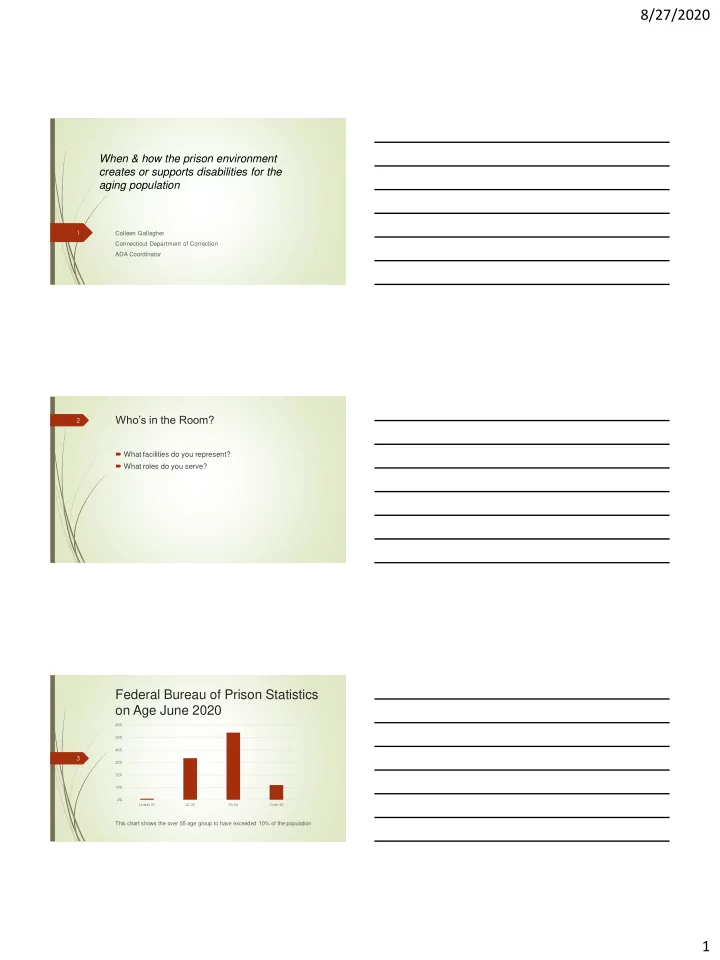
Federal Bureau of Prison Statistics

  • n Age June 2020

This chart shows the over 55 age group to have exceeded 10% of the population

0% 10% 20% 30% 40% 50% 60% Under 21 22-35 35-55 Over 55

3

slide-2
SLIDE 2

8/27/2020 2

Age Growth in State Prisons

 In the 2016 book Aging Of The State Prison Population, 1993-2013 Carson & Sabol state the following "The number of prisoners age 55 or older sentenced to more than 1 year in state prison increased 400% between 1993 and 2013, from 3% of the prison population in 1993 to10% 2013.”  What are the statistics in your state? Have they doubled, tripled or quadrupled?  Do you consider age a disability in prison?  Do you have a geriatric unit of some kind?  Are activities of daily living different in prison? 4

Activities of Daily Living – Major Life Activities

Free world

 Sleeping  Eating / kitchen  Walking  Hygiene  Speaking/ communication  Standing  Learning / working  Transportation  Laundry

Prison

 Sleeping / climbing on a bunk, lights on  Trays, utensils, milk cartons, distance to get to chow  Walking in a straight line at a pace or with leg irons or cuffing behind back  Sink and shower access, raising arms, bending  Limited access to speak directly to people / eye contact time to communicate limited  Lines, count, waiting, outside rec, transportation  Access to school / programs / choices  Hearing alarms /PA system / program calls

5

Sharing Common Concerns

 Whether it is aging specific or an age-related disability what are you seeing?  Does the environment make this more of a challenge? How so?  How have you or your agency made strides to effect change?  What is a functional impairment?

6

slide-3
SLIDE 3

8/27/2020 3

Need Areas Related to Age

Cognitive deficits Chronic disease Mobility Strength Mental Health needs Vision Fall Risk Hearing Adaptive equipment Bottom Bunks / Lower Tiers 7

Looking Through Your Environmental Lens

Creates

 Not recognizing age as a disability in prison  Housing with younger or predatory

  • ffenders

 Location based on availability  Working 6 or 7 days a week full days  Work release programs / HWH  Limited access to recreational programs designed for elderly  High security / lock down of elderly RHU / Rec access

Supports

 Identifying age as a primary reason for adapting an environment or policy  Consideration of housing and cellmate assignment  Location based on access to program most used  Working within capacity / limited schedule  Palliative care / advance care planning

  • pportunities

 Provides special physical and social programming access for elderly / infirm

8

How Does Your System Support or Create Disabilities?

 Is the onus on inmate to ask for help?  Does your policy make a statement about age?  Do you have automatic aging considerations in housing assignments?  Do you house dementia patients in a separate unit? TBI?  Is aging a medical or mental health or security issue? Explain.  Medical  Mental Health  Security 9

slide-4
SLIDE 4

8/27/2020 4

Are the Incarcerated Elderly More At Risk

  • r All Incarcerated Folks?

 Limited education  Living environment pre incarceration  Head injuries  Fights  Depression  Chronic disease  Race/ ethnicity  Substance abuse  Suicide mortality 10

Best Practices? Only Practices?

 Connecticut: 60 West Nursing Home is offered in conjunction with a Warden’s discretionary release under the authority of the Commissioner. Folks are monitored by the parole and community services division and must remain nursing home eligible per medical standards to stay on this release.  California: The Gold Coats are teams of inmates trained to live among and assist those with dementia with showering, shaving, applying deodorant, even changing adult diapers across the CA prison system.  Nevada: True Grit and structured senior living programs; social and interactive groups  Area Agencies on Aging: federally available through the Older Americans Act  Includes aging and disability resource centers  All 50 states except Iowa have a compassionate release mechanism 11

Balance: Encouraging Truth, Discouraging Fiction

 Wants vs needs  Medical or legal action  The Facility Manager may impose sanctions, at his/her discretion,… if it is determined that the inmate’s accommodation request is frivolous or malicious

  • r not brought in good faith. Possible sanctions may include the assessment
  • f a co-payment from the inmate’s account for any evaluation and/or

examination of the inmate by a medical professional in assessing the accommodation request.  The Unit ADA Coordinator shall make arrangements with health services supervisors for evaluation by qualified experts (e.g. audiologist,

  • phthalmologist, etc.) if necessary, to verify any functional impairment and

determine need. As a result of the review and assessment, reasonable accommodations shall be developed if required by the ADA. 12

slide-5
SLIDE 5

8/27/2020 5

Accommodation Request Formats: Jumping through Hoops with a Cane

 Do you need to verify with anyone?  How many hands does it pass?  Does it have a time limit?  Who is the final authority?  What if you do not know you need an accommodation?  Do you have to re write one at each transfer?

13

Give 2 examples each of a change in any policy that can positively effect the aging population.

14

Questions?

Colleen Gallagher Connecticut Department of Correction ADA Coordinator Colleen.Gallagher@ct.gov 15