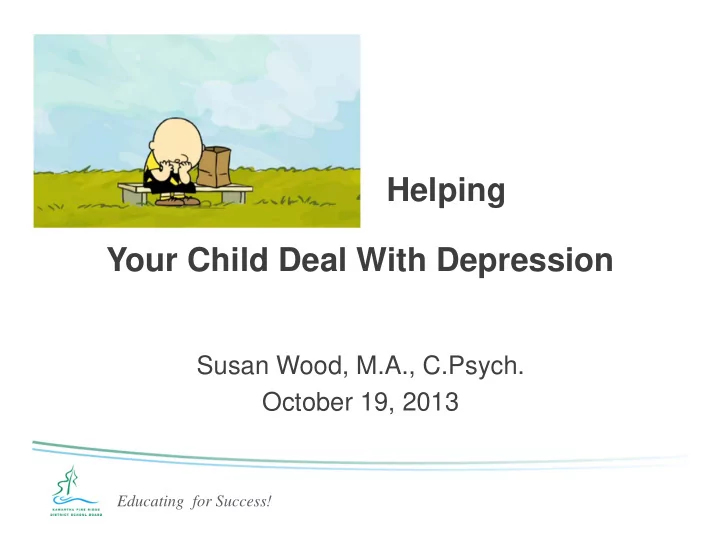
Helping Your Child Deal With Depression Susan Wood, M.A., C.Psych. - - PowerPoint PPT Presentation

helping your child deal with depression
SMART_READER_LITE
LIVE PREVIEW

Helping Your Child Deal With Depression Susan Wood, M.A., C.Psych. - - PowerPoint PPT Presentation

Helping Your Child Deal With Depression Susan Wood, M.A., C.Psych. October 19, 2013 Educating for Success! Goals of presentation Symptoms/diagnosis of depression Risk factors and causes of depression Treatment and ways


slide-1
SLIDE 1

Educating for Success!

Helping Your Child Deal With Depression

Susan Wood, M.A., C.Psych. October 19, 2013

slide-2
SLIDE 2

Educating for Success!

Goals of presentation

  • Symptoms/diagnosis of depression
  • Risk factors and causes of depression
  • Treatment and ways parents can help their child

who is displaying some depressive symptoms and for those whose child has a diagnosis

slide-3
SLIDE 3

Educating for Success!

Statistics

  • Depression does occur in children. It is

estimated that 1 in every 33 children may have depression (from kids.org)

  • In 2009 there were 25 deaths by suicide for

children ages 10 to 14 (Statistics Canada). Rates for other years (43 in 2005, 31 in 2006, 33 in 2007, 25 in 2008)

slide-4
SLIDE 4

Educating for Success!

Symptoms and signs of depression in children

  • Children can be sad without having depression.

When the sadness becomes persistent or disruptive behaviour occurs that interferes with normal social activities, interests, schoolwork,

  • r family life, these may be indicators a child is
  • depressed. Depression in children can look

different than in adults. Symptoms of depression vary in each child. The primary symptoms of depression revolve around feelings of sadness

slide-5
SLIDE 5

Educating for Success!

Diagnosis

  • Kids with depression describe themselves as

feeling hopeless about everything or feeling that nothing is worth the effort. They honestly believe that they are “no good,” that their world is a difficult place, and that they’re helpless to do anything about it. For an accurate diagnosis

  • f depression to be made, a detailed clinical

evaluation must be done by a medical or mental health professional (such as a psychologist or psychiatrist)

slide-6
SLIDE 6

Educating for Success!

Major Depressive Disorder Five or more of these symptoms must be present most days for longer than 2 weeks:

  • Feeling sad, hopeless, irritable most of the day
  • An inability to enjoy things that used to bring

them pleasure

  • A marked weight gain or loss (or failure to gain

weight as expected), and too little or too much interest in eating

  • A significant change in sleep habits
slide-7
SLIDE 7

Educating for Success!

Major Depressive Disorder – con’t

  • Fatigue or loss of energy
  • Feelings of worthlessness or excessive or

inappropriate guilt

  • An inability to concentrate
  • Frequent thoughts of death or suicide
  • Psychomotor agitation or retardation
slide-8
SLIDE 8

Educating for Success!

Persistent Depressive Disorder Two more of these symptoms almost all of the time for at least 1 year (2 years for adults). In children & adolescents, mood can be irritable

  • Poor appetite or overeating
  • Significant sleep changes
  • Low energy or fatigue
  • Low self-esteem
  • Poor concentration or difficulty making

decisions

  • Feelings of hopelessness
slide-9
SLIDE 9

Educating for Success!

slide-10
SLIDE 10

Educating for Success!

Risk Factors & Causes of Depression

  • As with adults, depression in children can be

caused by any combination of factors that relate to physical health, life events, family history, genetic vulnerability, and lowered levels of neurotransmitters (chemicals that carry signals through the nervous system)

  • Can arise from and co-occur with other

disorders

slide-11
SLIDE 11

Educating for Success!

Treatment

  • Therapy/counselling
  • For young children usually a family

component

  • Lifestyle changes
  • Medication
slide-12
SLIDE 12

Educating for Success!

slide-13
SLIDE 13

Educating for Success!

How parents can help

  • If you think your child might be depressed, do

not panic

  • Depression is treatable
  • Start by checking with family doctor to see if a

physical cause

  • Important to recognize your own feelings about

your child’s depression

  • Talk to your child (e.g., are you unhappy? sad?

having a hard time? are you having any fun?)

slide-14
SLIDE 14

Educating for Success!

  • Talk to your child’s school to find out if any

teachers have also noticed changes in behaviour and mood

  • Schools do have professional counsellors on

staff

  • Spend time with your child, be caring, LISTEN

well and be understanding. Parents often want to distract their child from negative emotions

  • Validate your child’s negative feelings. Don’t

trivialize or minimize

slide-15
SLIDE 15

Educating for Success!

  • Avoid being judgemental to help your child
  • pen up to you
  • Accentuate the positives – be specific
  • Have fun time with your child – take time on a

regular basis to help your child enjoy pleasurable activities and recreational interests

  • Spend alone time with your child – baking,

watching a movie, shopping

  • Maintain regular or routine physical activity that

is appropriate. Physical activity can help relieve or manage depression

slide-16
SLIDE 16

Educating for Success!

  • Maintain a regular and nutritional diet. Avoid

meal skipping. A proper diet is a critical source

  • f energy and the child’s ability to cope and

recover

  • Maintain a regular sleep cycle. Avoid sleeping
  • r napping during the day if it is difficult to sleep

during regular times. Irregular sleep patterns prolong or worsen symptoms of depression

slide-17
SLIDE 17

Educating for Success!

  • Sad or depressed children tend to globalize

their problems and engage in negative self-talk. Important to help them interpret their environment and interactions with others in a positive and realistic way. This may be addressed through therapy along with other issues that may need to be addressed

slide-18
SLIDE 18

Educating for Success!

Some Cognitive Distortions

  • All or nothing thinking
  • Mind reading
  • Disqualifying the positive
  • Overgeneralization
  • ‘Shoulds’
  • Personalization
  • Magnification
slide-19
SLIDE 19

Educating for Success!

Intervene by :

  • Identifying underlying beliefs/assumptions
  • Develop alternative positive explanations

(balanced thinking)

slide-20
SLIDE 20

Educating for Success!

Balanced Thinking

  • I’m so stupid. I never do things right.”
  • “Wait a minute. I’m feeling frustrated and
  • vergeneralizing again.”
  • “I do many things right, actually. I can try

again and see if things improve

slide-21
SLIDE 21

Educating for Success!

slide-22
SLIDE 22

Educating for Success!

  • Maintain routines
  • Praise effort
  • Encourage social interaction and activity
  • Have your child be a helper
  • Know what’s typical, ‘baseline’ behaviour
  • Know the signs: listen and observe
slide-23
SLIDE 23

Educating for Success!

  • Assist with problem-solving and planning
  • Celebrate efforts toward recovery
  • Model and talk about good coping
  • Keep in touch with child’s school
  • Although child suicide is rare it does occur. Get

help immediately if child is expressing suicidal thoughts

slide-24
SLIDE 24

Educating for Success!

  • At times, parents may need to remind

themselves that it is not laziness causing their child’s inability to get out of bed, complete chores or do homework. He or she simply doesn’t have the desire or energy

  • Don’t take it personally when your efforts

appear to be rejected

  • Address caregiver support needs
slide-25
SLIDE 25

Educating for Success!

slide-26
SLIDE 26

Educating for Success!

Resources

  • Canadian Mental Health Association:

www.cmha.ca

  • KidsHealth.org
  • Kidshelpphone.ca
  • Healthymindscanada.ca
  • Hinks-Dellcrest Centre: www.hincksdellcrest.org
  • Mood Disorders Association of

Ontario:www.mooddisorders.ca

  • National Institutes of Mental Health

(USA):www.nimh.nih.gov