1 Speaking confidentially Speaking directly and lack of Speaking - - PDF document

1
SMART_READER_LITE
LIVE PREVIEW

1 Speaking confidentially Speaking directly and lack of Speaking - - PDF document

Children Children s direct involvement s direct involvement in family law matters in family law matters Children Children s and Parents s and Parents Views on Views on Talking to Judges Talking to Judges Different


slide-1
SLIDE 1

1

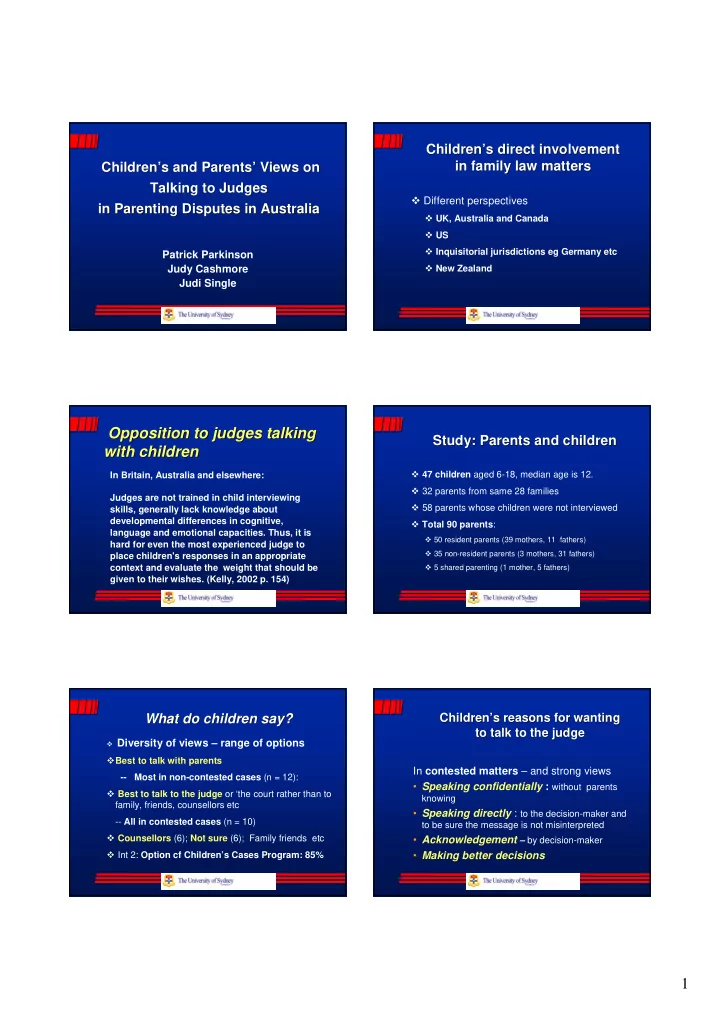
Children Children’ ’s and Parents s and Parents’ ’ Views on Views on Talking to Judges Talking to Judges in Parenting Disputes in Australia in Parenting Disputes in Australia

Patrick Parkinson Judy Cashmore Judi Single

Children Children’ ’s direct involvement s direct involvement in family law matters in family law matters

Different perspectives

UK, Australia and Canada US Inquisitorial jurisdictions eg Germany etc New Zealand

Opposition to judges talking Opposition to judges talking with children with children

In Britain, Australia and elsewhere: Judges are not trained in child interviewing skills, generally lack knowledge about developmental differences in cognitive, language and emotional capacities. Thus, it is hard for even the most experienced judge to place children's responses in an appropriate context and evaluate the weight that should be given to their wishes. (Kelly, 2002 p. 154)

Study: Parents and children Study: Parents and children

47 children aged 6-18, median age is 12. 32 parents from same 28 families 58 parents whose children were not interviewed Total 90 parents:

50 resident parents (39 mothers, 11 fathers) 35 non-resident parents (3 mothers, 31 fathers) 5 shared parenting (1 mother, 5 fathers)

What do children say? What do children say?

Diversity of views – range of options

Best to talk with parents

  • Most in non-contested cases (n = 12):

Best to talk to the judge or ‘the court rather than to family, friends, counsellors etc

  • - All in contested cases (n = 10)

Counsellors (6); Not sure (6); Family friends etc Int 2: Option cf Children’s Cases Program: 85%

Children Children’ ’s reasons for wanting s reasons for wanting to talk to the judge to talk to the judge

In contested matters – and strong views

  • Speaking confidentially : without parents

knowing

  • Speaking directly : to the decision-maker and

to be sure the message is not misinterpreted

  • Acknowledgement – by decision-maker
  • Making better decisions
slide-2
SLIDE 2

2

Speaking confidentially Speaking confidentially

  • !"Helen, 14)

Speaking directly and lack of Speaking directly and lack of faith in the intermediary faith in the intermediary

:

  • #
  • !

"$% &'(

Children Children’ ’s reasons for s reasons for not not wanting wanting to talk to the judge to talk to the judge

Mostly in uncontested matters –

  • Too formal, intimidating
  • Not necessary – prefer speaking with someone

they know

  • Prefer to keep it within family - where

decision is made

What did parents say? What did parents say?

Parents of children wanting to talk with judge supported their views 47% preferred children to talk with a counsellor

  • r other independent person

Both resident parent and non-resident parents No differences – whether contested or not

Resident parents cf non-resident parents 57% cf 30% in favour - judge (alone or with

counsellor)

Parents Parents’ ’ reasons for supporting reasons for supporting judges talking to children judges talking to children

Resident more than non-resident parents

  • Child’s need and right to be heard -- and to feel

heard

  • Acknowledgment and respect
  • Getting the ‘real picture’
  • “Children are not stupid”
  • Hearing at first-hand
  • Efficiency -- saving time and money

Parents Parents’ ’ reasons for opposing judges reasons for opposing judges talking with children talking with children

Resident and non-resident parents

  • Too intimidating
  • Not appropriate person – prefer counsellor, with

more time

  • Risk of children being manipulated
  • Expression of their own frustrations with the

system?

slide-3
SLIDE 3

3

) *+ % , ** %

  • %

! "-(

Underlying models of children: Underlying models of children: Child as Child as ‘ ‘sage sage’ ’

) %./0 !1! 1!1 % % !1 !1!1

  • ! "$( - 2332

Child as Child as manipulable manipulable

) #

  • !%
  • %

"(

Child as manipulators ? Child as manipulators ?

) 4 %% %% %%! "

  • )

!!%%

  • % it would be

OK "(

Implications Implications

Value in allowing participation

  • - therapeutic, not evidence gathering

Importance of children feeling heard

Esp when children have asked to do so (Hale 2006)

Explaining decision to children Gauging reactions for other options, esp against child’s wishes Presumptions about children’s views “Healthy degree of uncertainty”