1 Background on Appropriations Process Background on Appropriations - - PDF document

1
SMART_READER_LITE
LIVE PREVIEW

1 Background on Appropriations Process Background on Appropriations - - PDF document

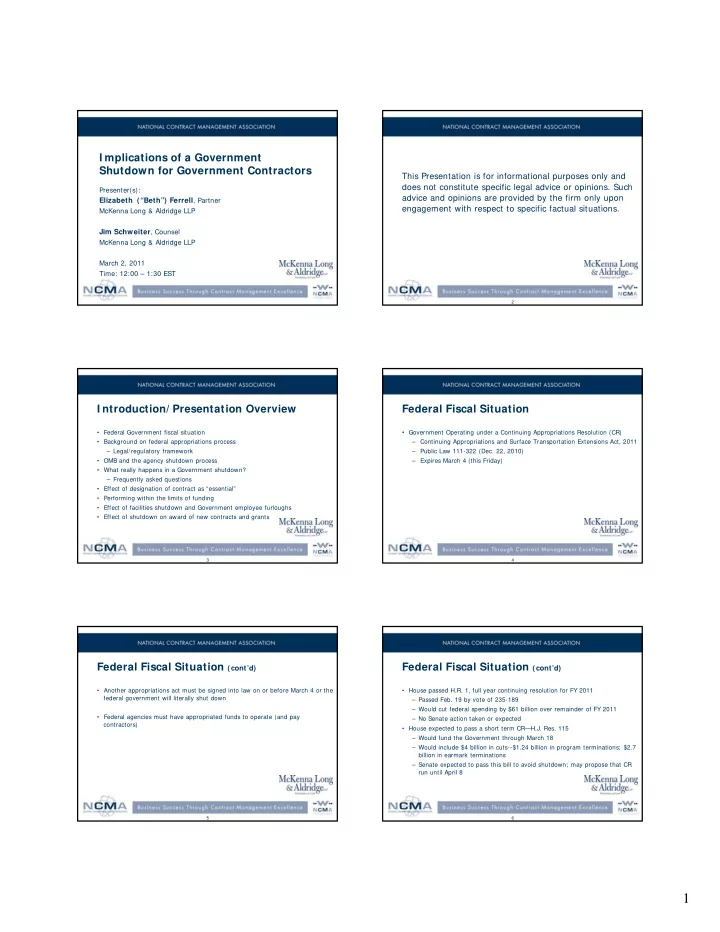
I mplications of a Government Shutdown for Government Contractors This Presentation is for informational purposes only and does not constitute specific legal advice or opinions. Such Presenter(s): advice and opinions are provided by the firm


slide-1
SLIDE 1

1

I mplications of a Government Shutdown for Government Contractors

Presenter(s): Elizabeth (“Beth”) Ferrell, Partner ld d McKenna Long & Aldridge LLP Jim Schweiter, Counsel McKenna Long & Aldridge LLP March 2, 2011 Time: 12:00 – 1:30 EST

This Presentation is for informational purposes only and does not constitute specific legal advice or opinions. Such advice and opinions are provided by the firm only upon engagement with respect to specific factual situations engagement with respect to specific factual situations.

2

I ntroduction/ Presentation Overview

  • Federal Government fiscal situation
  • Background on federal appropriations process

– Legal/regulatory framework

  • OMB and the agency shutdown process
  • What really happens in a Government shutdown?

– Frequently asked questions

  • Effect of designation of contract as “essential”
  • Performing within the limits of funding
  • Effect of facilities shutdown and Government employee furloughs
  • Effect of shutdown on award of new contracts and grants
3

Federal Fiscal Situation

  • Government Operating under a Continuing Appropriations Resolution (CR)

– Continuing Appropriations and Surface Transportation Extensions Act, 2011 – Public Law 111-322 (Dec. 22, 2010) – Expires March 4 (this Friday)

4

Federal Fiscal Situation (cont’d)

  • Another appropriations act must be signed into law on or before March 4 or the

federal government will literally shut down

  • Federal agencies must have appropriated funds to operate (and pay

contractors) contractors)

5

Federal Fiscal Situation (cont’d)

  • House passed H.R. 1, full year continuing resolution for FY 2011

– Passed Feb. 19 by vote of 235-189 – Would cut federal spending by $61 billion over remainder of FY 2011 – No Senate action taken or expected

  • House expected to pass a short term CR—H.J. Res. 115

– Would fund the Government through March 18 – Would include $4 billion in cuts--$1.24 billion in program terminations; $2.7 billion in earmark terminations – Senate expected to pass this bill to avoid shutdown; may propose that CR run until April 8

6
slide-2
SLIDE 2

2

Background on Appropriations Process

  • Federal fiscal year begins October 1
  • For agencies funded through annual appropriations, Congress and the

President must enact interim or full year appropriations acts by this date for government activities to continue operating

  • If appropriations are not enacted into law, a “funding gap” occurs, and the

federal government begins to shut down affected activities

7

Background on Appropriations Process

(cont’d)

Legal Framework US Constitution—Art. I, Sec. 9, Cl. 7: “No Money shall be drawn from the Treasury, but in Consequence of Appropriations made by Law…”

  • This “power of the purse” provision is the basis of Congress’ power to

appropriate funds and to prescribe conditions governing the use of those funds. Literally, no money may be paid out of the Treasury unless it has been appropriated by an act of Congress.

8

Background on Appropriations Process

(cont’d)

Legal Framework Anti-Deficiency Act—31 USC 1341-1342, 1349-1351, 1511-1519

  • Principal means by which Congress has sought to limit the expenditure of

i d f d b h i appropriated funds by the Executive

  • No officer or employee may make a payment of any sum nor authorize such a

payment nor obligate the Government to make a payment in excess of the amount available in an appropriation.

9

Background on Appropriations Process

(cont’d)

Legal Framework Anti-Deficiency Act—

  • An officer or employee may not involve the government in a contract or

bli i f h f b f i i i d l

  • bligation for the payment of money before an appropriation is made unless

authorized by law;

  • No augmentation of appropriations—an agency cannot, absent statutory

authorization, operate beyond the level that can be paid for by its appropriations

10

Background on Appropriations Process

(cont’d)

Legal Framework Anti-Deficiency Act—

  • No acceptance of voluntary services (or goods)—intended to preserve the

i i f h i i integrity of the appropriations process – Exception for emergencies involving safety of human life or protection of property

  • Penalties for violating the ADA—

– Adverse personnel actions—31 USC 1349 – Criminal penalties—31 USC 1350

11

Background on Appropriations Process

(cont’d)

Legal Framework Regulations—

  • OMB Circular A-11—Preparation, Submission and Execution of the Budget

– Section 124—Agency operations in the absence of appropriations

  • Federal Acquisition Regulation—Subpart 32.7—Contract Funding

– Related contract clauses in Part 52 (e.g., 52.232-18; 52.232.20; 52.232-22)

12
slide-3
SLIDE 3

3

Background on Appropriations Process

(cont’d)

Legal Framework

  • DOJ Memoranda—

– Civiletti memoranda—1980; 1981—

  • “Federal agencies may incur no obligations that cannot lawfully be funded from prior

appropriations unless such obligations are otherwise authorized by law.”

  • “authorized by law” exception to ADA—simple authorization or direction to perform

standard acts in agencies’ enabling legislation is insufficient to support obligation of funds in absence of appropriations

  • agencies are by implication authorized “to incur those minimal obligations necessary to

closing [the] agency” – Dellinger memorandum—1995—ADA exception for emergencies involving safety of human life or protection of property to be narrowly construed and “does not include

  • ngoing, regular functions of government…”
  • GAO Red Book—Principles of Federal Appropriations Law
13

Background on Appropriations Process

(cont’d)

Types and Availability of Appropriations

  • Mandatory entitlement programs (e.g., Medicare, Social Security, federal retirement) are

funded through permanent, indefinite appropriations and are not subject to the annual appropriations process—funding for these programs is not affected by a Government shutdown

  • Discretionary spending is controlled by annual appropriations—Funds appropriated are

available for obligation for varying lengths of time—one year, multi-year, no year; only

  • ne year appropriations affected by shutdown
  • An agency appropriation must be obligated during the period of its availability or the

authority to obligate will expire.

  • Once appropriated funds are obligated to the contract, and that contract (or portion

thereof) is funded, its continuation (and the contractor’s obligation to perform) is not affected by the failure of Congress to appropriate further funds.

14

Background on Appropriations Process

(cont’d)

Types and Availability of Appropriations

  • Contracts funded on their face but for which subsequent funding is required will

be affected by the failure of Congress to pass appropriations acts and a government shutdown government shutdown— – Options – Increments of funding in contracts where performance is severable (e.g., task or delivery orders)

15

Background on Appropriations Process

(cont’d)

Types and Availability of Appropriations

  • If funds have not been obligated at the time of the Government shutdown, they

may not be obligated to a contract during the shutdown unless— – Contract is funded by appropriations not limited to one year – authorized by necessary implication from specific duties (e.g., presidential duties)—1981 Civiletti opinion – “authorized by law”—e.g., Feed and Forage Act (41 USC 11) – contract exempt from shutdown because related to “safety of human life or protection of property” – Contract is necessary to terminate agency operations in an orderly way

16

OMB and the Agency Shutdown Process

OMB Guidance to Federal Agencies OMB Circular A-11, Sec. 124.1—

  • In the absence of appropriations:

– Federal officers may not incur any obligations that cannot lawfully be funded f i i i l h bli i h i h i d from prior appropriations unless such obligations are otherwise authorized by law; – Federal officers may incur obligations as necessary for orderly termination of an agency’s functions, but funds may not be disbursed.

17

OMB and the Agency Shutdown Process

(cont’d)

OMB Circular A-11—Executive Branch Shutdown I mplementation

  • Agencies are required to develop and maintain shutdown plans, which are

approved and monitored by OMB

  • Agency heads “decide what activities are essential to operate their agencies

during an appropriations hiatus ” during an appropriations hiatus.

  • Agency actions must contribute to an orderly shutdown of the agency and give

primary consideration to protecting life and safeguarding government property and records.

18
slide-4
SLIDE 4

4

OMB and the Agency Shutdown Process

(cont’d)

OMB Circular A-11—Executive Branch Shutdown I mplementation Shutdown plans must include— – estimate of time needed to complete the shutdown (to nearest half-day) – number of employees expected to be on board before plan implementation – Total number of additional employees who will be retained in order to protect life and property and who are not exempt from furlough – number of employees to be “retained” under the plan, specifically

  • Those engaged in “military, law enforcement, or direct provision of health care

activities”

  • Employees whose “compensation is financed by a resource other than annual

appropriations”

19

OMB and the Agency Shutdown Process

(cont’d)

Effects on Federal Officials and Employees Shutdown Furlough—

  • Applies to federal employees—placed in a temporary non-duty, non-pay status
  • Exceptions—

– Members of Congress, the President, political appointees, legislative branch employees employees – Employees “excepted” by law:

  • performing emergency work involving safety of human life or protection of

property

  • involved in orderly suspension of agency operations
  • performing other exempt functions (see 1981 OMB memo; e.g., air traffic control;

care of prisoners; power production & distribution; emergency & disaster assistance, etc.)

20

OMB and the Agency Shutdown Process

(cont’d)

Effect of Furloughed Employees on Contractors

  • May be denied access to Government facilities, personnel or information
  • Contracting officer may not be available to issue stop work order or to provide

Contracting officer may not be available to issue stop work order or to provide

  • ther contract guidance
  • No one may be available to receive delivery of goods or services
  • Bid or proposal submissions may not be received or acknowledged
  • Necessary inspections or approval of performance milestones required to

continue performance may not occur

21

Frequently Asked Questions

  • What Really Happens With a Government Shutdown?
  • What Impact Does Absence of Appropriations Have on Contract Funding?
  • How Does DOD Designation Of Contract As “Essential” Fit Into The Equation?
  • What Does Performing Within Limits Of Funding Mean?
22

Frequently Asked Questions (cont’d)

  • How Can A Shutdown of Government Facilities Affect My Contract?
  • How Will Furlough of Government Employees Affect My Contract?
  • How Will Contract Performance Be Impacted?
  • How Will the Shutdown Affect the Award of New Contracts and Grants?
  • How Will the Shutdown Affect Contract Payments?
23

What Really Happens With A Government Shutdown?

  • The entire Government does not completely shut down
  • Agencies will implement their agency-specific shutdown plans
  • Generally agency activities are limited to what is needed to maintain the
  • Generally, agency activities are limited to what is needed to maintain the

minimum level of essential activities necessary to protect life and property

24
slide-5
SLIDE 5

5

What Really Happens With A Government Shutdown? (cont’d)

  • What activities are considered essential is not defined, and may change as

circumstances change.

  • For example, in 1995, agencies were not as dependent on IT systems for

communications as now IT functions are likely to be deemed essential communications as now. IT functions are likely to be deemed essential.

  • For example, the recent unrest in Egypt and Libya may mean that more State

Department personnel will be deemed to be engaged in critical activities.

25

What Really Happens With A Government Shutdown? (cont’d)

  • Activities in following areas are more likely to be deemed essential:

– Homeland security (e.g., anti-terrorism, border control) – Foreign relations – Law enforcement and criminal investigations – Public health and Medical care – Emergency and disaster assistance – Information and communications systems – Protection of federal buildings and assets – Air traffic control – Power generation and distribution – Defense activities

26

What Really Happens With A Government Shutdown? (cont’d)

  • October 1990 Three Day Shut Down
  • Over three day Columbus holiday weekend
  • Agencies that completely shutdown:

– EPA – Labor Department – OPM – HUD

27

What Really Happens With A Government Shutdown? (cont’d)

  • Agencies that partially shutdown in October 1990:

– HHS – Department of Energy epa e

  • e gy

– DOI – State Department – Library of Congress – Government Printing Office

28

What Really Happens With A Government Shutdown? (cont’d)

  • Agencies that had NO shutdown in October 1990:

– DOD – Department of Commerce – GSA – Department of Transportation – Department of Education – Treasury Department – Department of Veterans Affairs – Office of Technology Assessment – Department of Justice – GAO

29

What Really Happens With A Government Shutdown? (cont’d)

  • Three week shutdown December 16, 1995 to January 6, 1996
  • GAO reviewed agency shutdown plans shortly before shutdown
  • Purpose was to determine the number of federal employees that may be
  • Purpose was to determine the number of federal employees that may be

subject to a funding lapse furlough

  • Some agencies (such as DOD) were not included
30
slide-6
SLIDE 6

6

What Really Happens With A Government Shutdown? (cont’d)

  • Agencies/Department with lowest percentage of “excepted” employees not

subject to furlough (1995): – American Battle Monuments Commission 7.0 % S % – NASA 7.4 % – Commission on Civil Rights 9.5 % – Arms Control and Disarmament Agency 13.5 % – Office of US Trade Representative 16.7 % – Office of Science and Technology 17.5 % – Department of Interior 28.2 %

31

What Really Happens With A Government Shutdown? (cont’d)

  • Agencies/Departments with highest percentage of “excepted” employees not

subject to furlough (1995): – Forest Service (USDA) 100 % f ff i 8 6 % – Department of Veterans Affairs 84.6 % – Department of Justice 75.4 % – State Department 69.6 %

32

What Really Happens With A Government Shutdown? (cont’d)

  • Percentage of “excepted” employees not subject to furlough for other

Agencies/Departments (1995): f C 33 % – Department of Commerce 33.5 % – Small Business Administration 41.1 % – HHS 42.5 %

33

What I mpact Does Absence of Appropriations Have on Contract Funding?

  • A lapse of appropriations generally means that there are no additional funds

made available for contracts.

  • Can there be new contract awards?

G ll – Generally, no.

  • Can more funding be obligated to existing contracts?

– Generally, no.

34

What I mpact Does Absence of Appropriations Have on Contract Funding?

(cont’d)

  • Does a lapse in funding mean contractors have to stop all contract work?

– Contractors can continue performing within limits of obligated funding – Not limited to “essential” contracts or contracts for mission-critical activities.

35

How Does DOD Designation Of Contract As “Essential” Fit I nto The Equation?

  • Not directly relevant, but may help predict what services will continue to be

provided by DOD contractors at Government facilities

  • Department of Defense Regulation

N R l ti I d O t b 2010 (DFAR P t 237 76) – New Regulation Issued on October 2010 (DFARs Part 237.76)

  • Requires contractors providing “essential” services to be prepared to continue

during periods of crisis.

  • Crisis events such as hurricanes, tornados, blizzards.
  • Contract designates which services are “essential” in contract.

– “Essential” contractor services are those that support mission – essential functions.

36
slide-7
SLIDE 7

7

How Does DOD Designation Of Contract As “Essential” Fit I nto The Equation? (cont’d)

  • Functional commander or civilian equivalent makes determination.
  • Usually only part of contract work is designated as “essential.”
  • If applicable, there will be:

– Written plan in contract to ensure continuation of services. Written plan in contract to ensure continuation of services. – DFARs clause 252.237-7024 in the contract.

  • DOD designation of “essential” for DFARs might not be same as agency

designation in shutdown plan.

– But provides guidance on what services likely to be deemed essential.

37

How Does DOD Designation Of Contract As “Essential” Fit I nto The Equation? (cont’d)

  • Performance of contracts at Government facilities might be limited to essential

services contracts.

  • Contractors performing non-essential services at Government facilities might

h t t k have to stop work.

  • Designation of contract services as “essential” under DFARs shows agency’s

views of what services are critical and likely to be continued even when Government facilities partially shutdown.

38

What Does Performing Within Limits of Funding Mean?

  • Contractors can continue performing within the limits of obligated funding.
  • How do I determine the funding obligated to a contract?

– The amount of obligated funding will be:

  • Shown on the face of the contract
  • Shown on modifications to the contract (usually unilateral) obligating

additional funds

39

What Does Performing Within Limits of Funding Mean? (cont’d)

  • Cost – Reimbursable contracts.

– Contract contains estimate of total costs. Estimate established for purpose

  • f obligation of funds.

C i b bl b f ll f d d ( ll f h f di i – Cost-Reimbursable contracts may be fully funded (all of the funding is

  • bligated) or incrementally funded (funding is made in allotments over the

life of the contract).

40

What Does Performing Within Limits of Funding Mean? (cont’d)

  • Fully funded cost-reimbursable contracts:

– Contractor may not exceed estimate of costs without Contracting Officer approval and upward revision of estimate. – Contract will contain limitation of cost clause – Contract will contain limitation of cost clause.

  • Government is not obligated to reimburse contractor for costs in excess of fully

funded amount (amount of estimated costs)

  • Contractor is not obligated to continue performance/incur costs in excess of fully

funded amount

– No additional funds may be obligated to contract during period of shutdown. – Contractor will have to stop work if funds are exhausted during period of Government shutdown

41

What Does Performing Within Limits of Funding Mean? (cont’d)

  • Incrementally funded cost-reimbursable contracts:

– Funding is obligated to the contract in allotments – Contract specifies the amount of funds presently obligated – Contract is amended as more funds are obligated to the contract – Contract will contain a limitation of funds clause.

  • Government is not obligated to reimburse contractor for costs in excess
  • f amount of funds presently available
  • Contractor is not obligated to continue performance/incur costs in excess
  • f funded amount
42
slide-8
SLIDE 8

8

What Does Performing Within Limits of Funding Mean? (cont’d)

  • Incrementally funded cost-reimbursable contracts (cont’d):

– Since funding is made in increments, it may be exhausted during shutdown. – No additional funds may be obligated to contract during period of shutdown. – Contractor will have to stop work if funds are exhausted during period of Government shutdown

43

What Does Performing Within Limits of Funding Mean? (cont’d)

  • Fixed Price Contracts:

– Usually fully funded. – Contractor performance continues. – Can’t modify contract to add funds during period of Government shutdown. – Can’t exercise options during period of Government shutdown.

44

What Does Performing Within Limits of Funding Mean? (cont’d)

  • Time & Materials/Labor Hour Contracts

– Contractor paid for labor on fixed hourly rates. – Contract has ceiling price. – Contract may be funded in increments. – No funds may be added during period of Government shutdown. – No new orders for services can be made during period of Government shutdown.

45

What Does Performing Within Limits of Funding Mean? (cont’d)

  • IDIQ

– Government places task orders (services) or delivery orders (supplies) – Contract may be funding incrementally. – No new orders can be placed during shutdown. – No funds may be added to contract during period of Government shutdown.

  • GSA schedule contracts

– No new orders during shutdown.

46

How Can A Shutdown of Government Facilities Affect My Contract?

  • Where you are performing a contract at a Government facility, you may be

affected by a complete or partial shutdown of the facility.

  • Where a facility closure will prevent your performance, you should receive

notice from the Contracting Officer notice from the Contracting Officer. – Probably a Stop Work order

47

How Will Furlough of Government Employees Affect My Contract?

  • Non-essential Government personnel will be unavailable to administer contracts.
  • Government personnel may be on furlough and unable to:

– Approve submittals. – Inspect work. – Accept work. – Provide technical direction.

48
slide-9
SLIDE 9

9

How Will Furlough of Government Employees Affect My Contract? (cont’d)

– Provide clarification – Conduct design reviews – Issue contract modifications – Approve invoices for payment – Approve subcontracts – Audit costs – Etc…

49

How Will Contract Performance Be I mpacted?

  • Shutdown of Government facilities and furlough of Government employees may

impact performance. – Performance may be delayed and disrupted. C f f i – Costs of performance may increase. – Time needed for performance may increase. – Congressional Research Service reported that the 1995-96 shutdown adversely affected 20% of federal contractors in the Washington DC area

50

How Will the Shutdown Affect the Award

  • f New Contracts and Grants?
  • Non-essential Government personnel will be unavailable to:

– Issue solicitations. – Evaluate proposals. a ua e p oposa s – Award contracts. – Award grants.

51

How Will the Shutdown Affect the Award

  • f New Contracts and Grants? (cont’d)
  • What if a proposal or bid is due during a shutdown?
  • What if a contract award is expected to be announced during a shutdown?

a a co ac a a d s e pec ed o be a

  • u ced du

g a s u do

  • What if the time for filing a bid protest occurs during a shutdown?
52

How Will Shutdown Affect Contract Payments?

  • Invoices will not be paid.
  • Prompt Payment Act.

– Requires payment on date specified in contract, or – 30 days after proper invoice.

  • If payment is late, Government must pay interest penalty.
  • Contractors should prepare for disruption of cash flow
53

What Should I Do Next?

  • Take stock of your contracts.

– What work are you performing – Where is the work being performed – What types of contracts are at issue – What is the status of contract funding

  • Determine how you and your subcontractors might be impacted.
  • Plan for a shutdown.
54
slide-10
SLIDE 10

10

Contact I nformation

I f you have questions on steps you should take given your particular contracts, including steps to create the greatest likelihood that you will be compensated for the adverse impacts

  • f a shutdown, contact us:

Elizabeth (“Beth”) Ferrell Jim Schweiter (202) 496-7544 (202) 496-7511 eferrell@mckennalong.com jschweiter@mckennalong.com

55