1 CDS vs. Bond Ownership CDS Risk Bondholder Risks Currency Risk - - PDF document

1
SMART_READER_LITE
LIVE PREVIEW

1 CDS vs. Bond Ownership CDS Risk Bondholder Risks Currency Risk - - PDF document

BEIJING BRUSSELS CHICAGO DALLAS FRANKFURT GENEVA HONG KONG LONDON LOS ANGELES NEW YORK PALO ALTO SAN FRANCISCO SHANGHAI SINGAPORE SYDNEY TOKYO WASHINGTON, D.C. Credit Default Swaps Insurance or Not? Casualty Actuarial Society


slide-1
SLIDE 1

1

BEIJING BRUSSELS CHICAGO DALLAS FRANKFURT GENEVA HONG KONG LONDON LOS ANGELES NEW YORK PALO ALTO SAN FRANCISCO SHANGHAI SINGAPORE SYDNEY TOKYO WASHINGTON, D.C.

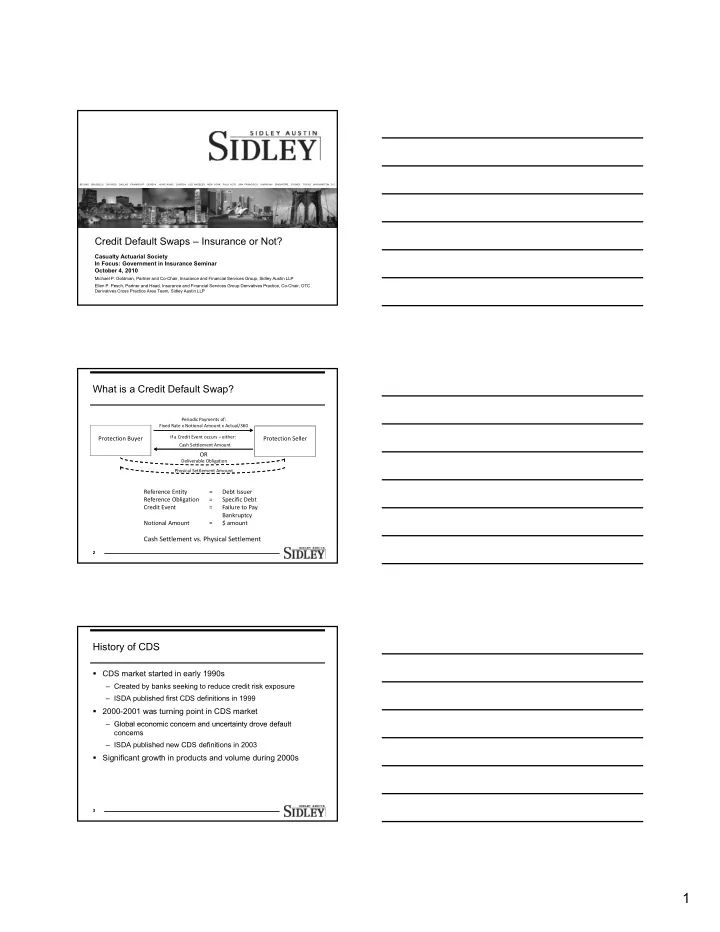
Credit Default Swaps – Insurance or Not?

Casualty Actuarial Society In Focus: Government in Insurance Seminar October 4, 2010

Michael P. Goldman, Partner and Co-Chair, Insurance and Financial Services Group, Sidley Austin LLP Ellen P. Pesch, Partner and Head, Insurance and Financial Services Group Derivatives Practice, Co-Chair, OTC Derivatives Cross Practice Area Team, Sidley Austin LLP

What is a Credit Default Swap?

Protection Buyer Protection Seller

Periodic Payments of: Fixed Rate x Notional Amount x Actual/360 Cash Settlement Amount Deliverable Obligation

OR

If a Credit Event occurs – either:

Reference Entity = Debt Issuer Reference Obligation = Specific Debt Credit Event = Failure to Pay Bankruptcy Notional Amount = $ amount

Cash Settlement vs. Physical Settlement

Physical Settlement Amount

2

History of CDS

  • CDS market started in early 1990s

– Created by banks seeking to reduce credit risk exposure – ISDA published first CDS definitions in 1999

  • 2000-2001 was turning point in CDS market

Global economic concern and uncertainty drove default – Global economic concern and uncertainty drove default concerns – ISDA published new CDS definitions in 2003

  • Significant growth in products and volume during 2000s
3
slide-2
SLIDE 2

2

CDS vs. Bond Ownership

Bondholder Risks

Currency Risk Interest Rate Risk Liquidity Risk Market Risk Credit Risk

CDS Risk

Volatility of exchange rate risk Risk of interest rate volatility Liquidity of the bond in terms of its maturity (tenor) Risk of market price fluctuations Risk that Issuer will default or become insolvent

4

The Distinction Between CDS and Insurance

  • Because CDS provides protection with respect to credit

default risk, the instrument has drawn attention from insurance regulators

  • If CDS falls under the state law definition of “insurance”,

dealer-counterparties (who sell protection) could be viewed as “ d ti i b i ” bj t t t t “conducting an insurance business”, subject to state regulation as insurers

– Categorization as “financial guaranty” insurance

  • Analysis begins with the applicable state law definition of

“insurance”

5

Elements of Insurance

  • While “insurance” is defined under the insurance laws of each

state, there are common definitional components that are present in all states (and English law)

  • 3 key elements of insurance:

– (1) the applicable agreement must confer upon the insured or beneficiary a pecuniary benefit; – (2) the pecuniary benefit is payable upon the occurrence of a fortuitous event; and – (3) the insured or beneficiary has a material interest that may be adversely affected by such fortuitous event.

  • Often presented as the “insurable interest” or “indemnity”

requirement

6
slide-3
SLIDE 3

3

CDS Characteristics

  • CDS have the first two elements of the classic state law

definition of insurance:

– Conferring a pecuniary benefit – Payable upon occurrence of a fortuitous event

  • CDS lacks the element of a requirement of insurable interest

C S ac s e e e e

  • a equ e

e

  • su ab e

e es

  • r indemnity

– Protection buyer not required to own or have exposure to reference entity or reference obligation – Payment obligation is triggered upon a credit event, regardless

  • f any loss

– Amount payable under CDS (e.g. cash settlement amount or physical settlement amount) is determined without regard to any loss

7

Interpretations of Applicable Insurance Law

  • UK Law – Robin Potts opinion

– Requisitioned by ISDA, in response to the creation of CDS

  • U.S. Law – Limited interpretative precedent under U.S. state law regarding CDS
  • U.S. Law – New York Insurance Department OGC Opinions providing guidance

regarding other financial instruments:

– May 31, 1995 Opinion from Rochelle Katz regarding Guaranty of Mutual Fund Performance Febr ar 29 1996 Opinion from Rochelle Kat regarding M t al F nd Offering ith – February 29, 1996 Opinion from Rochelle Katz regarding Mutual Fund Offering with “Redemption Right” – June 25, 1998 Opinion from Paul F. Altruda regarding Catastrophe Options – June 26, 1998 Opinion from Michael J. Moriarty regarding Index Swap Transaction – February 15, 2000 Informal Opinion regarding Weather Financial Instruments

8

Recent Regulatory Attention to CDS

  • New York – Circular Letter No. 19 (2008) “best practices” for

financial guaranty insurers (September, 2008), September 12, 2008 and First Supplement to Circular Letter No. 19 (2008), November 20, 2008

– Initially suggested that ‘covered’ credit default swaps may be ‘insurance’ within NY Insurance Code insurance within NY Insurance Code – First Supplement delayed ‘indefinitely’ interpretation by Department

  • State of Missouri Insurance Department – Insurance Bulletin

08-12: Covered Credit Default Swaps (November 19, 2008)

– Subjects ‘covered’ credit default swaps to regulation under Missouri insurance law

9
slide-4
SLIDE 4

4

Recent Regulatory Attention to CDS (cont’d)

  • National Conference of Insurance Legislators (NCOIL) Model Credit

Default Insurance Legislation (adopted, November, 2009)

– Legislative intent to ban ‘naked’ credit default swaps – Requires ‘covered’ credit default swap providers to be licensed as a “Credit Default Insurer” – Closely tracks New York Article 69 for Financial Guaranty Insurers – Closely tracks New York Article 69 for Financial Guaranty Insurers

  • Limits types of reference obligations that can be the subject of CDS

protection provided by Credit Default Insurers

  • Requires minimum capital to be maintained
  • Limits substantive terms of Credit Default Insurance:

– Credit Default Insurers cannot post collateral; – Insurance is not transferable; and – Obligations are not subject to acceleration upon a default or insolvency of the Credit Default Insurer.

10

Dodd-Frank Wall Street Reform and Consumer Protection Act (Dodd-Frank Act)

  • Regulates all “Swaps” and “Security Based Swaps”

– Broadly defines “Swaps” and “Security Based Swaps” to include virtually all traditional over-the-counter derivative products, includind credit default swaps (CDS), as well as many other financial arrangements

  • CDS falls within the “Security Based Swap“ definition if it involves between

1 and 9 reference obligations that are “securities” and falls within the “Swap” d fi iti if it i l 10 f bli ti th t “ iti ” definition if it involves 10 or more reference obligations that are “securities,”

  • r any reference obligation that is not a “security” (e.g. loans)
  • CFTC has jurisdiction to regulate “Swaps”
  • SEC has jurisdiction to regulation “Security Based Swaps”
  • Dodd-Frank Act expressly provides that “Swaps” and “Security Based

Swaps” may not be regulated by states as insurance

11

Insurance Companies are Logical Users of CDS to:

  • Buyers of credit protection to hedge credit risk of existing

investments and exposures

  • Sellers of credit protection to replicate credit risk by

“synthetically” investing in credits

  • Use of derivatives – including CDS – by insurers are subject

g y j to regulatory limitations

– State investment law limitations

  • Quantitative limits

– Instruments – Strategies – Counterparty exposure

  • Qualitative limitations

– Derivatives Use Plans (DUPs)

12
slide-5
SLIDE 5

5

BEIJING BRUSSELS CHICAGO DALLAS FRANKFURT GENEVA HONG KONG LONDON LOS ANGELES NEW YORK PALO ALTO SAN FRANCISCO SHANGHAI SINGAPORE SYDNEY TOKYO WASHINGTON, D.C.

Implications of CDS Counterparty Bankruptcy Termination Value/Payments

  • 1992 ISDA Master Agreement:

– Market Quotation or Loss – First Method or Second Method

  • 2002 ISDA Master Agreement:

Close Out Amount – Close Out Amount – Second Method

14

U.S. Bankruptcy Code

  • Preferential treatment of derivatives contracts

– Not subject to automatic stay – Ability to terminate and close out contract – Ability to foreclose on collateral – Pledging of collateral and marking-to market not subject to Pledging of collateral and marking to market not subject to voidable preference

15
slide-6
SLIDE 6

6

State Insurance Laws

  • Insurance Companies (domestic) are NOT Bankruptcy Code eligible

debtors – Insolvency governed by state insurance company insolvency laws – Ten states have adopted a version of the specialized Bankruptcy Code– like provisions of the NAIC Insurer Receivership Model Act (IRMA)

  • Model Act States:

– Slight variations from state-to-state

  • Ability to terminate and close out contract
  • Ability to foreclose on collateral
  • Non-Model Act States:

– Implications and remedies vary from state-to-state

16

Section 711: Qualified Financial Contracts of the Insurer Receivership Model Act

Notwithstanding any other provision of this Act, including any other provision of this Act permitting the modification of contracts, or other law of a state, no person shall be stayed or prohibited from exercising: (1) A contractual right to cause the termination, liquidation, acceleration or close out of

  • bligations under or in connection with any netting agreement or qualified financial contract

with an insurer because of: (a) The insolvency, financial condition or default of the insurer at any time, provided that the right is enforceable under applicable law other than this Act; or (b) The commencement of a formal delinquency proceeding under this Act; (2) Any right under a pledge, security, collateral, reimbursement or guarantee agreement or arrangement or any other similar security arrangement or arrangement or other credit enhancement relating to one or more netting agreements or qualified financial contracts; (3) Subject to any provision of Subsection 609B [(providing certain restrictions to set-off)], any right to set off or net out any termination value, payment amount, or other transfer

  • bligation arising under or in connection with one or more qualified financial contracts

where the counterparty or its guarantor is organized under the laws of the United States or a state or a foreign jurisdiction approved by the Securities Valuation Office (SVO) of the NAIC as eligible for netting

17

Contact Information

Sidley is one of only a few internationally recognized law firms to have a substantial, multidisciplinary practice devoted to the insurance and financial services industry. We have approximately 85 lawyers devoted exclusively to providing both transactional and dispute resolution services to the industry, throughout the world. Our Insurance and Financial Services Group has an intimate knowledge of and appreciation for the industry and its unique issues and challenges. Regular clients include many of the largest insurance and reinsurance companies, brokers, banks, investment banking firms and regulatory agencies for which we provide regulatory, corporate, securities, mergers and acquisitions, securitization, derivatives, tax, reinsurance dispute, class action defense and other transactional and litigation services.

For more information, please contact:

18

Michael P. Goldman 312.853.4665 mgoldman@sidley.com Ellen P. Pesch 312.853.7296 epesch@sidley.com