SLIDE 4 4
Blue whiting focus group meeting 12 april 2011 – Bilbao, Spain
Q10: Different stock components?
tation see last slides
separate components, but the stock should be assessed and managed as one, because that is complicated enough. See example NS herring. (1x)
1 2 3 4 5 6 7 Yes No / unclear No comment
Blue whiting focus group meeting 12 april 2011 – Bilbao, Spain
Q11: Can industry contribute with data?
- Scientists should be encouraged to sail on
commercial vessels to witness directly the abundance of fish on the grounds.
- Involvement of the fleet in surveys
- Feed and Roe contents and also length of Tows
It would help determine when the fishery should be closed during spawning
- Distribution of both juveniles and (spawning)
adults, catchability, temperature and weather
Blue whiting focus group meeting 12 april 2011 – Bilbao, Spain
Q12: any other comments?
- Managers made a huge mistake when too easily
deciding on a 92% cut for 2011, without having a firm basis for that decision
- The issue of stock components should be sorted out
before designing a new management plan
- A re-allocation of quota should be considered (3x)
- “It is very important to look into possible ecologic
interactions between the different pelagic stocks. […] predation from mackerel on blue whiting eggs and larvae could be a contributing factor to the observed collapse in blue whiting recruitment.”
Blue whiting focus group meeting 12 april 2011 – Bilbao, Spain
The end
“Fishermen instinctively find where the fish are and their knowledge should be utilized. If I were investing in a new vessel I would not put a scientist on the bridge to rely on paying back the loan, but rather a keen eyed fishermen.”
Blue whiting focus group meeting 12 april 2011 – Bilbao, Spain
Annex 1: Questions
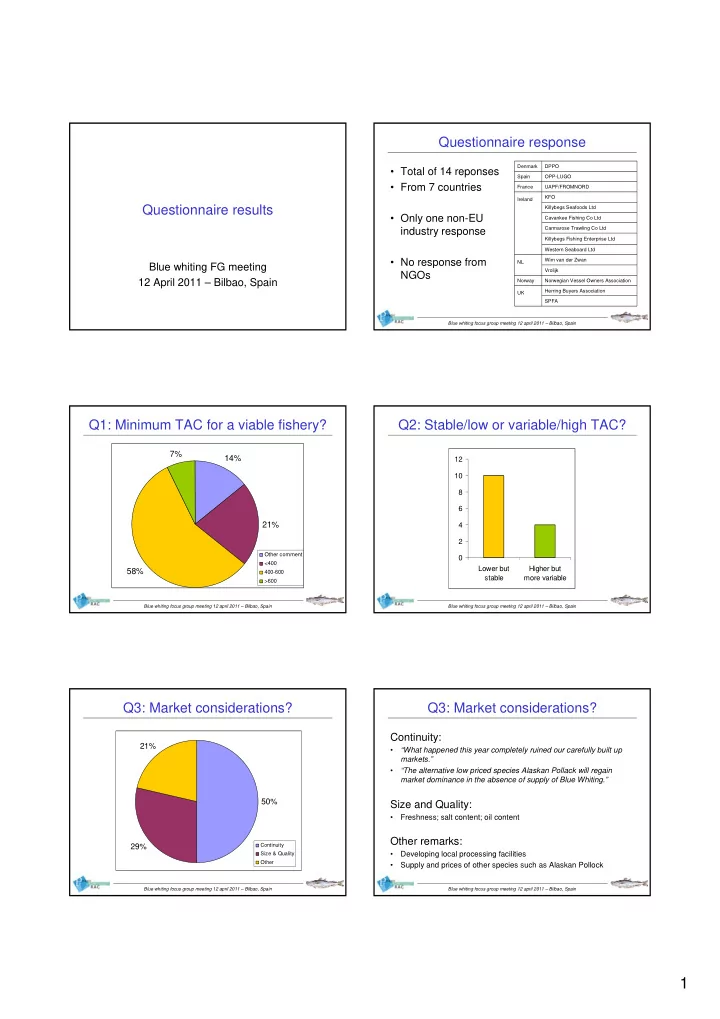
1. What in your view is the minimum annual TAC for a viable blue whiting fishery? 2. Would you prefer a lower but stable TAC or a more variable but higher one, on average? 3. What are the key market considerations? 4. Should the blue whiting fishery be confined to a human consumption fishery? 5. Is there any size/weight/condition of fish which is more valuable for your market? 6. What additional measures if any do you consider should be put in place to manage the blue whiting stock? (eg closed areas, closed seasons, protection juveniles etc) 7. What changes have you experienced in the distribution and catchability of blue whiting over last five years? 8. Has the location and distribution of juvenile blue whiting changed over the last five years? 9. Do you consider that the scientific advice is reliable over past five years? 10. Do you consider that there are different blue whiting stocks or stock components? If so what is your basis for this view? 11. Do you consider that the industry can contribute additional data? If so what type of data? 12. Is there anything else that you would like to suggest should be taken into account? Please feel free to make suggestions of any kind, about the contents of possible future management considerations or about the process of the focus group. Blue whiting focus group meeting 12 april 2011 – Bilbao, Spain
Stock components
- Yes. If we go back to the first study (‘80s) made by ICES on this specie, it were
clearly showed two separate stocks: the north and the south, placing the boundary between the Porcupine Bank. Finally for years It excludes the southern part due to lack of data in that area. That might be one of the reasons that warranted the union of both stocks, together with the percentage of stock biomass representing the entire
- south. The findings of the ICES Working Group on Methods of Population
Identification, justified an independent management of the southern blue whiting
- population. Once confirmed, it is necessary to re-claim data and studies (and there is
some) in the South, because the type of fishery that takes place in this area and the type of existing population, are clearly different from the North area
- Based on the experience of captains of surimi pelagic trawler operating every year for
twenty years from january to april from Porcupine to Faero waters, we consider that there is at least two main components.- A southern component whose individuals are found - during the spawning season - in Porcupine, Hebrides and part of Rockall. The main spawning place is Porcupine bank. This fish stands in 8°-10° water . After spawning, post-spawners go northwards, moving slower and slower in end of March up to Wyville Thomson ridge and then spread to the East (where grounds are only 100-200 meters deep) and go back southward- A northern component (whose age structure is different, shape and colour are different, water temperature is different, fish moving fast in end of March and april) is found North of Wyville Thomson ridge, in Shetland and Faero areas. This fish stands in 4°-5° water. Its spawning time seems to be in April.