1 Drnevich on FE Exam and PE Licensure 10/3/2017 What do Employers - - PDF document

1
SMART_READER_LITE
LIVE PREVIEW

1 Drnevich on FE Exam and PE Licensure 10/3/2017 What do Employers - - PDF document

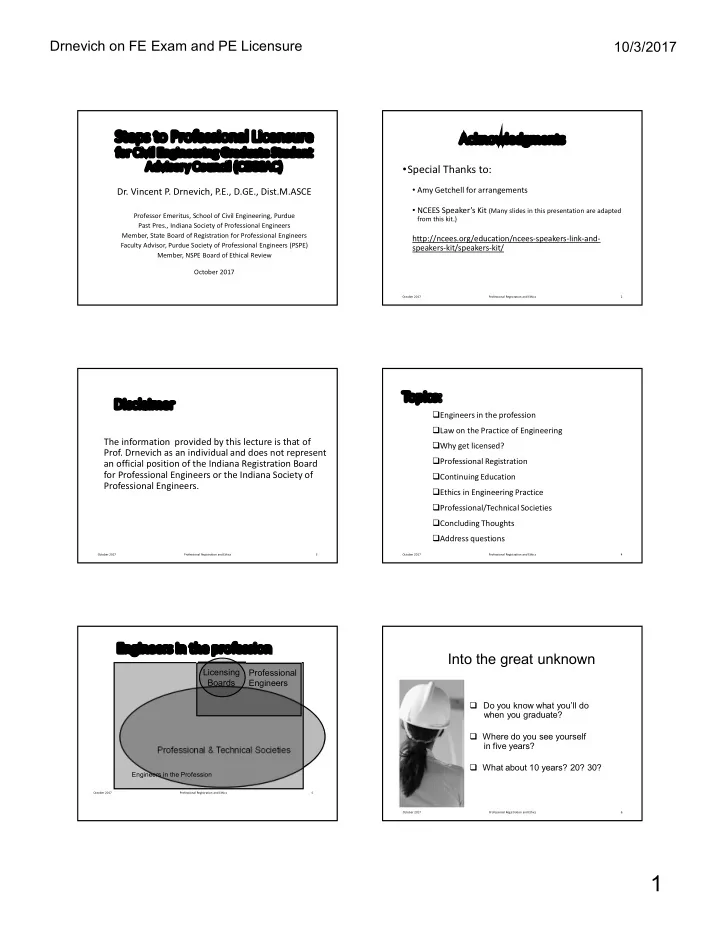
Drnevich on FE Exam and PE Licensure 10/3/2017 Steps to Professional Licensure Acknowledgments for Civil Engineering Graduate Student Advisory Council (CEGSAC) Special Thanks to: Amy Getchell for arrangements Dr. Vincent P. Drnevich,


slide-1
SLIDE 1

Drnevich on FE Exam and PE Licensure 10/3/2017

1

Steps to Professional Licensure

for Civil Engineering Graduate Student Advisory Council (CEGSAC)

  • Dr. Vincent P. Drnevich, P.E., D.GE., Dist.M.ASCE

Professor Emeritus, School of Civil Engineering, Purdue Past Pres., Indiana Society of Professional Engineers Member, State Board of Registration for Professional Engineers Faculty Advisor, Purdue Society of Professional Engineers (PSPE) Member, NSPE Board of Ethical Review October 2017

Acknowledgments

  • Special Thanks to:
  • Amy Getchell for arrangements
  • NCEES Speaker’s Kit (Many slides in this presentation are adapted

from this kit.)

http://ncees.org/education/ncees-speakers-link-and- speakers-kit/speakers-kit/

October 2017 Professional Registration and Ethics 2

Disclaimer

The information provided by this lecture is that of

  • Prof. Drnevich as an individual and does not represent

an official position of the Indiana Registration Board for Professional Engineers or the Indiana Society of Professional Engineers.

October 2017 Professional Registration and Ethics 3

Topics:

Engineers in the profession Law on the Practice of Engineering Why get licensed? Professional Registration Continuing Education Ethics in Engineering Practice Professional/Technical Societies Concluding Thoughts Address questions

October 2017 Professional Registration and Ethics 4

Professional & Technical Societies

Engineers in the Profession

Engineers in the profession

October 2017 Professional Registration and Ethics 5

Professional Engineers Licensing Boards

Into the great unknown

 Do you know what you’ll do when you graduate?  Where do you see yourself in five years?  What about 10 years? 20? 30?

October 2017 Professional Registration and Ethics 6

slide-2
SLIDE 2

Drnevich on FE Exam and PE Licensure 10/3/2017

2

What do Employers look for? It’s about showing what you can do

  • Degrees, work references, technical

skills

  • What if there were a universal standard

that is recognized throughout the profession?

October 2017 Professional Registration and Ethics 8 October 2017 Professional Registration and Ethics 9

State law and engineering practice

  • Only a P.E. can practice

engineering.

  • What does that include?

– Owning a firm – Consulting – Signing/sealing a design – Bidding for public money – Advertising your services – Calling yourself a professional engineer

October 2017 Professional Registration and Ethics 10

The P.E. license

  • A professional engineer

– Has the education, experience, and technical knowledge to lead – Has an obligation to safeguard the public

  • It works both ways:

– You stand out in a crowd as a P.E. – The public is safeguarded from incompetent or unethical practice.

October 2017 Professional Registration and Ethics 11

The licensing process

  • Who oversees licensure?
  • Requirements can differ by state

(but not too much).

  • Comity licensure: obtaining a P.E.

license in additional states

October 2017 Professional Registration and Ethics 12

slide-3
SLIDE 3

Drnevich on FE Exam and PE Licensure 10/3/2017

3

Professional Registration

  • Required by law for the professional practice of engineering
  • Each state and territory has a “registration law”
  • Implemented by a Boards of Registration

http://ncees.org/licensing-boards/ http://www.in.gov/pla/engineer.htm

  • National Council of Examiners for Engineering and

Surveying (NCEES) generate and grade the FE and PE exams used by boards of registration http://www.ncees.org

October 2017 Professional Registration and Ethics 13

Industrial Exemption

October 2017 Professional Registration and Ethics 14

IC 25-31-1-20 in Indiana (similar in other states)

Exempt persons

(a) An employee or a subordinate of a licensed engineer ….. (b) This chapter does not require registration for the purpose of practicing engineering by an individual or a business: (1) on property owned or leased by that individual or business unless the engineering practice involves the public health or safety, or the health or safety of the employees of that individual or business;

(2) for the performance of engineering which relates solely to the design or fabrication of manufactured products; or

The benefits of a P.E.

  • It opens career doors.
  • In a stack of resumes, yours stands out.
  • You serve the public–not just your employer.
  • You typically earn more than peers without a P.E.

October 2017 Professional Registration and Ethics 15

Why Get Licensed?

  • Mark of a professional
  • Required for practice engineering involving health,

welfare, and safety of the public

  • Ethics requirements
  • Career development and growth
  • Continuing Education
  • Prestige and respect
  • Flexibility
  • Salary

October 2017 Professional Registration and Ethics 16

Steps to Professional Licensure

  • 1. Graduation from program in engineering

acceptable to the Board (ABET EAC accredited)

  • 2. Passing the Fundamentals of Engineering (FE)

Exam

  • 3. Four years of engineering practice experience
  • One year granted for MS degree in engineering
  • Two years granted for PhD degree in engineering
  • 4. Passing the Principles and Practice (PE) Exam

October 2017 Professional Registration and Ethics 17

  • Get an engineering degree from an

EAC/ABET* accredited program

  • Mostly Bachelor’s degrees
  • Some accredited Master’s degrees exist

*The Engineering Accreditation Commission (EAC) of ABET accredits engineering programs

Education Required for Professional Licensure

slide-4
SLIDE 4

Drnevich on FE Exam and PE Licensure 10/3/2017

4

  • Most states rely on a NCEES Credentials

Evaluation https://ncees.org/records/ncees- credentials-evaluations/

  • Uses NCEES Engineering Education Standard

https://ncees.org/engineering/ncees-engineering- education-standard/

  • Ensures that your education is comparable to an

accredited degree in the United States

  • Other Engineering Credential Organizations are

sometimes accepted

  • Transcripts from school where you graduated will

be required.

  • Applicant may have to complete additional

courses

What if You Don’t Have an EAC/ABET Accredited Degree?

  • Indiana requires:
  • NCEES Evaluation for all foreign degree

applicants

  • May consider applicants from non EAC/ABET

programs in the US See 864 IAC 1.1-2-2 http://www.in.gov/legislative/iac/iac_title?iact=864

  • Supplemental Information on coursework

https://forms.in.gov/Download.aspx?id=5896

  • Additional years of experience is required.

What if You Don’t Have an EAC/ABET Accredited Degree?

  • Fundamentals: what you learned

in college

  • Computer-based exams
  • Offered year-round at approved

Pearson VUE test centers

FE exam

October 2017 Professional Registration and Ethics 21

FE exam format and content

  • 7 freestanding discipline-specific exams

–110 multiple-choice questions

  • Exam specifications (what’s on the exam)

–Available at www.ncees.org/exams

  • FE Reference Handbook
  • Practice exams

October 2017 Professional Registration and Ethics 22

Computer-Based FE Exams

  • Seven separate exams:
  • Chemical
  • Civil
  • Electrical and Computer
  • Environmental
  • Industrial
  • Mechanical
  • Other Disciplines

October 2017 Professional Registration and Ethics 23

Downloading FE Reference Handbook

http://ncees.org/exams/study-materials/download-fe-supplied- reference-handbook/

October 2017 Professional Registration and Ethics 24

Submit your email address in the email field. A pass code will immediately be emailed to you. Copy and paste that code into the password field below, and you will be provided with a download link.

slide-5
SLIDE 5

Drnevich on FE Exam and PE Licensure 10/3/2017

5

FE Civil exam: Exam specifications

  • Mathematics 7–11
  • Probability and Statistics 4–6
  • Computational Tools 4–6
  • Ethics and Professional

Practice 4–6

  • Engineering Economics 4–6
  • Statics 7–11
  • Dynamics 4–6
  • Mechanics of Materials 7–11
  • Materials 4–6
  • Fluid Mechanics 4–6
  • Hydraulics and Hydrologic Systems 8–12
  • Structural Analysis 6–9
  • Structural Design 6–9
  • Geotechnical Engineering 9–14
  • Transportation Engineering

8–12

  • Environmental Engineering 6–9
  • Construction 4–6
  • Surveying 4–6

Morning (No. of Questions) Afternoon (No. of Questions)

October 2017 Professional Registration and Ethics 25

OTHER DISCIPLINES CBT Exam Specifications – Morning

October 2017 Professional Registration and Ethics 26

Knowledge Number of Questions

  • 1. Mathematics and

Advanced Engineering Mathematics 12–18

  • 2. Probability and Statistics

6–9

  • 3. Chemistry

7–11

  • 4. Instrumentation and Data Acquisition

4–6

  • 5. Ethics and Professional Practice

3–5

  • 6. Safety, Health, and Environment

4–6

  • 7. Engineering Economics

7–11

OTHER DISCIPLINES CBT Exam Specifications - Afternoon

October 2017 Professional Registration and Ethics 27

Knowledge Number of Questions

  • 8. Statics

8–12

  • 9. Dynamics

7–11

  • 10. Strength of Materials

8–12

  • 11. Materials Science

6–9

  • 12. Fluid Mechanics and Dynamics of Liquids

8–12

  • 13. Fluid Mechanics and Dynamics of Gases

4–6

  • 14. Electricity, Power, and Magnetism

7–11

  • 15. Heat, Mass, and Energy Transfer

9–14

FE exam administration

  • Approved Pearson VUE test centers
  • Many located around the country
  • Can take test at any site convenient for you
  • Four, 3-month-long testing windows:
  • Jan., Feb., & Mar.
  • Apr., May, & Jun.
  • Jul., Aug., & Sep.
  • Oct., Nov., & Dec.

October 2017 Professional Registration and Ethics 28

FE exam administration, Cont’d.

  • Apply to NCEES to register for FE and FS exams

(http://ncees.org/engineering/fe/)

  • Provide information
  • Pay $225 fee (To be reduced to $175 in January 2018)
  • Schedule Exam with Pearson-Vue
  • Choose location (Purdue is among 7 in Indiana; many in

every state to choose from)

  • Choose from dates available.
  • Must take exam within one year of registering
  • Penalty for rescheduling - $50

October 2017 Professional Registration and Ethics 29

Pearson Vue Site

  • Explore the computer-based exam experience

https://www.youtube.com/watch?v=5YbpV48rNK4

October 2017 Professional Registration and Ethics 30

slide-6
SLIDE 6

Drnevich on FE Exam and PE Licensure 10/3/2017

6

Exam Session

  • 6-hour exam appointment, which includes

–Nondisclosure agreement (2 minutes)

–Tutorial (8 minutes) –Exam (5 hours and 20 minutes) –Scheduled break (25 minutes) –Brief survey

October 2017 Professional Registration and Ethics 31

FE Exam Pass Rates

October 2017 Professional Registration and Ethics 32 Spring 2017 Professional Registration and Ethics 33

Slide from President Daniels Report to Board of Trustees, Oct. 9, 2015

From: Pres. Mitch Daniels Open Letter

(January 2017)

Spring 2017 Professional Registration and Ethics 34

Purdue FE Exam Pass Rates

Spring 2017 Professional Registration and Ethics 35

Engineer-in-Training* (EIT)

  • Once the required education is completed and the

FE exam is passed, must apply to State Board for certification as an EIT.

  • Requires submitting transcripts
  • Must be certified as EIT before taking PE exam.
  • All state boards accept passed FE exam
  • Board information available at:

http://ncees.org/licensing-boards/

October 2017 Professional Registration and Ethics 36

* aka Engineering Intern (EI)

slide-7
SLIDE 7

Drnevich on FE Exam and PE Licensure 10/3/2017

7

Important Points

  • Optimum Time for taking FE is senior year or within a

year after graduation; Don’t put it off!

  • Never any regrets for taking and passing it
  • Encourage engineering classmates to take it
  • Positive item for your resume.
  • Once passing the FE exam, no expiration date

October 2017 Professional Registration and Ethics 37

Four years (or more) of engineering practice experience

  • Typically starts at B.S. degree graduation
  • Undergrad Co-Op or Internship may or may

not be counted

  • One year granted for MS degree in

engineering

  • Two years granted for PhD degree in

engineering

  • Will need licensed engineers as references

Engineering Practice Experience Principles and Practice (PE) Exams

(Typically taken after 4 years of engineering practice experience)

  • PE Agricultural & Biological
  • PE Architectural
  • PE Chemical
  • PE Civil
  • PE Control Systems
  • PE Electrical and Computer
  • PE Environmental
  • PE Fire Protection
  • PE Industrial
  • PE Mechanical
  • PE Metallurgical and

Materials

  • PE Mining and Mineral

Processing

  • PE Naval Architecture and

Marine Engineering

  • PE Nuclear
  • PE Petroleum
  • PE Structural I
  • PE Structural II
  • PS Surveying

October 2017 Professional Registration and Ethics 39

Comity Registration

  • Registration in a given state for person registered in

another state

  • Special application and fees
  • Applicant must meet the educational, experience, and

examination requirements for registration in other state.

  • Rules for registration vary
  • Among states
  • With time that original registration occurred
  • Determination made by the Board

https://secure.in.gov/pla/2741.htm

Drnevich September 2017 40

Expedite Comity with NCEES Record

NCEES Records is a service designed for engineers seeking comity licensure. One-time fee of $175, no annual fee. There is a $75 transmittal fee. Steps for completing the Record application process:

  • 1. Applicant creates an account
  • 2. Applicant completion of all sections of the online application
  • Seven sections — Education, Examinations, Licensure, References,

Questions for the Applicant, Experience Record, and Payment Information.

  • 3. NCEES verifies application information
  • 4. NCEES reviews and verifies all transcripts and responses from references

and employers.

  • 5. NCEES notifies applicant and provides a Record Number

Drnevich September 2017 41

http://ncees.org/records/

Time line for Engineers

October 2017 Professional Registration and Ethics 42

birth Start school University education Professional registration after passing PE Exam. Engineering Intern Retirement Pass FE Exam and Graduate Note: For surveyors, the corresponding exams are the FS and PS exams.

slide-8
SLIDE 8

Drnevich on FE Exam and PE Licensure 10/3/2017

8

Continuing Education

  • 41 of the states now have Continuing Education

requirements for maintaining licenses.

  • Typically require 24 to 30 hours per biennium for

renewal of license

  • Approved activities vary, but always include courses and

short courses related to the practice of engineering

  • Rules for Indiana were established in 2010 and updated

in 2014

October 2017 Professional Registration and Ethics 43

Continuing Education Question

  • How does a professional acquire new knowledge

and keep up with developments in the field?

  • Answer: By continuing your education through
  • Self study
  • Additional coursework
  • Graduate study
  • Engaging in research
  • Continuing education courses
  • Conferences
  • Professional and technical societies

October 2017 Professional Registration and Ethics 44

Engineering Ethics

  • Engineering Ethics typically covers:
  • Code of ethics (professional and technical societies)
  • Agreements and contracts
  • Ethical versus legal
  • Professional liability
  • Public protection issues (e.g., licensing boards)

October 2017 Professional Registration and Ethics 45

Ethical behavior

Contract among affected parties

  • Unwritten understanding…
  • Agreed behavior among individuals
  • Taught by our upbringing
  • “Gentlemen’s Agreement”
  • Written Contract – defined focus
  • Professional Code of Ethics
  • Established and administered by a profession
  • The Law
  • Federal, state, and local Statutes and Rules
  • Administered and enforced by officials: fines and penalties

October 2017 Professional Registration and Ethics 46

Codes of Ethics

  • Established by membership of professional

societies

  • Standard Format (especially among engineering
  • rganizations)
  • Preamble
  • Fundamental Canons
  • Rules of Practice
  • Professional Obligations

October 2017 Professional Registration and Ethics 47

NSPE on Ethics www.nspe.org/ethics/

October 2017 Professional Registration and Ethics 48 Reprinted by Permission of the National Society of Professional Engineers (NSPE) www.nspe.org.

slide-9
SLIDE 9

Drnevich on FE Exam and PE Licensure 10/3/2017

9

NCEES Model Code of Ethics

In Reference Handbook

Three Major Sections:

1) Licensee’s Obligation to Society 2) Licensee’s Obligations to Employers and Clients 3) Licensee’s Obligations to Other Licensees

October 2017 Professional Registration and Ethics 49

http://ncees.org/exams/study-materials/download-fe-supplied-reference-handbook/

240.15 Rules of Professional Conduct

October 2017 Professional Registration and Ethics 50

  • A. Licensee’s Obligation to Society
  • 1. Licensees, in the performance of their services for clients, employers, and

customers, shall be cognizant that their first and foremost responsibility is to the public welfare.

  • 2. Licensees shall approve and seal only those design documents and surveys that

conform to accepted engineering and surveying standards and safeguard the life, health, property, and welfare of the public.

  • 3. Licensees shall notify their employer or client and such other authority as may be

appropriate when their professional judgment is overruled under circumstances where the life, health, property, or welfare of the public is endangered. Five more items

240.15 Rules of Professional Conduct

October 2017 Professional Registration and Ethics 51

  • B. Licensee’s Obligation to Employer and Clients
  • 1. Licensees shall undertake assignments only when qualified by education or

experience in the specific technical fields of engineering or surveying involved.

  • 2. Licensees shall not affix their signatures or seals to any plans or documents dealing

with subject matter in which they lack competence, nor to any such plan or document not prepared under their responsible charge.

  • 3. Licensees may accept assignments for coordination of an entire project, provided

that each design segment is signed and sealed by the licensee responsible for preparation of that design segment. Four more items

240.15 Rules of Professional Conduct

October 2017 Professional Registration and Ethics 52

  • C. Licensee’s Obligation to Other Licensees
  • 1. Licensees shall not falsify or permit misrepresentation of their, or their associates’,

academic or professional qualifications. They shall not misrepresent or exaggerate their degree of responsibility in prior assignments nor the complexity of said

  • assignments. Presentations incident to the solicitation of employment or business

shall not misrepresent pertinent facts concerning employers, employees, associates, joint ventures, or past accomplishments.

  • 2. Licensees shall not offer, give, solicit, or receive, either directly or indirectly, any

commission, or gift, or other valuable consideration in order to secure work, and shall not make any political contribution with the intent to influence the award of a contract by public authority.

  • 3. Licensees shall not attempt to injure, maliciously or falsely, directly or indirectly, the

professional reputation, prospects, practice, or employment of other licensees, nor indiscriminately criticize other licensees’ work.

State Laws on Engineering Practice

  • Generated by the Legislatures
  • Consistent with Codes of Ethics
  • Enforced by:
  • State Engineering Registration Boards
  • State Attorney General’s Office
  • Penalties for non-compliance
  • Fines
  • Possible loss of license

October 2017 Professional Registration and Ethics 53

Professional and Technical Societies

  • Source of new knowledge and technologies – Continuing

Education

  • Sense of identity to the professional
  • Represents the profession to government and society
  • Codes of Ethics
  • Develop leadership skills
  • Networking
  • Other

October 2017 Professional Registration and Ethics 54

slide-10
SLIDE 10

Drnevich on FE Exam and PE Licensure 10/3/2017

10

Recommended Prof./Tech. Orgs.

  • Professional Org.
  • NSPE/ISPE with local chapters and student chapters (PSPE at

Purdue)

  • SWE, NSBE, etc.
  • Technical Orgs.
  • Basic Founder Societies, e.g. ASABE, ASCE, ASME, ANS, IEEE, IIE, etc.
  • Specialty Societies, e.g. ASTM , ITE

October 2017 Professional Registration and Ethics 55

National Society of Professional Engineers (NSPE)

October 2017 Professional Registration and Ethics 56

Student Membership You qualify for a FREE NSPE national student membership if you are an engineering student enrolled full-time NSPE Student Membership get the following:

  • Free Resources for Students Looking for a job
  • Deep discounts on a wide variety of publications including FE/PE

Exam preparation materials https://www.nspe.org/membership/type-membership/student- membership www.nspe.org

Order of the Engineer

http://www.order-of-the-engineer.org/

The Order of the Engineer was initiated in the United States to foster a spirit of pride and responsibility in the engineering profession, to bridge the gap between training and experience, and to present to the public a visible symbol identifying the engineer. Member identified by the wearing of a stainless steel ring on the small finger of the working hand. Ceremony at Purdue in April and December before graduations If O/E does not exist on your campus, consider establishing it

Reprinted with permission of the Order of the EngineerProfessional Registration and Ethics

57 October 2017

Concluding Thoughts

  • Reasons to become licensed:
  • Required by the law to practice engineering
  • Money
  • Status/Respect
  • Career Flexibility
  • Licensure is a 4-step process
  • Education from ABET accredited program
  • Pass FE Exam (exam is changing to CBT in 2014)
  • Four years of experience after graduation
  • Pass the PE Exam
  • Professional and Technical Societies play an important

role in the professional lives of engineers.

October 2017 Professional Registration and Ethics 58

Things you need to do:

  • Obtain a broad engineering education
  • Keep in mind the topics covered in the FE Exam
  • Plan to take the FE Exam
  • Apply for it at the beginning of the last semester before graduating
  • Choose a job that provides qualifying work experience for

the PE Exam

  • Keep your resume’ updated
  • Prepare for and take the PE Exam at your earliest possible

date

October 2017 Professional Registration and Ethics 59

Things to consider:

  • Participate in professional and technical organizations
  • Continue to learn
  • Careers in engineering are exciting and rewarding
  • Many career paths are open to you with an engineering

degree

October 2017 Professional Registration and Ethics 60

slide-11
SLIDE 11

Drnevich on FE Exam and PE Licensure 10/3/2017

11

Questions and Discussions

  • 1. When should you start preparing for the FE? Senior year.
  • 2. How to prepare for FE exam? Attend Chi Epsilon sessions,

become familiar with the FE Reference guide, and take sample tests.

  • 3. How many questions are on the FE? 110 Multiple choice
  • 4. How important is FE license after one passes the FE exam?

Passing the FE exam plus having the qualifying education allows for getting a EIT certificate, which is needed for sitting for the PE exam.

  • 5. Is my EIT certification valid in any state? It is valid in all

states and U.S. Territories and does not expire.

October 2017 Professional Registration and Ethics 61

Questions and Discussions

  • 6. What are the differences in FE to PE wait time from

state to state? Several states (California, Texas, and several others have no waiting period. Most states require 4 years.

  • 7. When compiling professional experience to go

towards my eventual licensure, is there a certain format/form to use? Most states have a form for this, however, consider creating a NCEES Record http://ncees.org/records/ which is accepted by every

  • state. Special low fee is available for people who are

not already licensed.

October 2017 Professional Registration and Ethics 62

Questions and Discussions

  • 8. While the requirements for getting a license differ by

state, once a license is received is it nationally recognized? Licensure in a given state only allows for practice in that

  • state. Must become licensed in other states by “comity”.
  • 9. Can we use experience of other countries to get it counted

for professional license? It depends on the state and experience details. State Board makes final determination. 10.Do I need to have an SE and a PE to practice structural engineering or just certain states require this? Illinois only requires a SE license. California and Hawaii require both. Seven other states allow PE’s to structural engineering, but with restrictions.

October 2017 Professional Registration and Ethics 63

Questions and Discussions

  • 11. I got a BS degree with the specialization of CEM. Am I

eligible for PE license? Yes, as long as your CEM degree is ABET EAC accredited.

  • 12. Could you kindly confirm the relevance of exams like

CMIT and FE? CMIT stands for Construction Manager in

  • Training. Very helpful for career in construction.
  • 13. What steps should you take during grad school to set

yourself up for the PE in a few years? (Passed the FE... now what?) Use opportunities to attend technical talks, conferences, and field trips

  • 14. If a PhD, leaning towards academia, when is the right

time to take FE and PE? Take FE as soon as possible. Take PE two to four years after completing Ph.D.

October 2017 Professional Registration and Ethics 64

Thanks for listening!

Vince Drnevich

E-mail: drnevich@purdue.edu