1 Complex Topology The talk includes Large Acquisition Holes - - PDF document

1
SMART_READER_LITE
LIVE PREVIEW

1 Complex Topology The talk includes Large Acquisition Holes - - PDF document

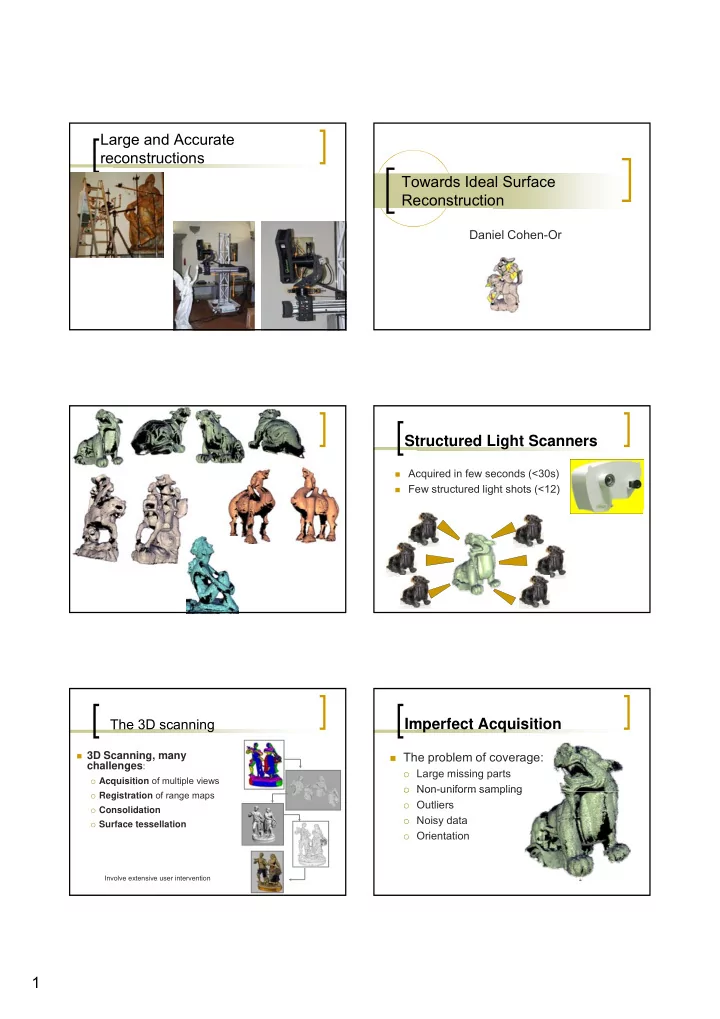
Large and Accurate reconstructions Towards Ideal Surface Reconstruction Daniel Cohen-Or Structured Light Scanners Acquired in few seconds (<30s) Few structured light shots (<12) The 3D scanning Imperfect Acquisition 3D


slide-1
SLIDE 1

1 Towards Ideal Surface Reconstruction

Daniel Cohen-Or

Large and Accurate reconstructions Structured Light Scanners

Acquired in few seconds (<30s) Few structured light shots (<12)

Imperfect Acquisition

The problem of coverage:

Large missing parts Non-uniform sampling Non uniform sampling Outliers Noisy data Orientation

The 3D scanning

3D Scanning, many

challenges:

Acquisition of multiple views

f

Registration of range maps Consolidation Surface tessellation

Involve extensive user intervention

slide-2
SLIDE 2

2 The talk includes

Completion of Large missing parts Consolidation of point clouds Consolidation of point clouds Registration of noisy data

Complex Topology

Large Acquisition Holes

play p y

Topology-aware Reconstruction

play

Competing Fronts for Coarse Competing Fronts for Coarse– –to to– –Fine Fine Surface Reconstruction Surface Reconstruction (Sharf et al. Eurographics (Sharf et al. Eurographics 2006 2006) ) Deformable Model Reconstruction

Watertight guarantee Topology control

play

Deformable model

Implicit coarse guidance

field or attraction field

Explicit deformable

model (a mesh)

slide-3
SLIDE 3

3

front: set of connected vertices

not ε-close to zero level-set

Mesh Fronts

play

Competing Fronts Overview

Incremental steps Multiple fronts Front control Front control Coarse-to-fine

play

Initialization

Guidance field:

RBF distance-field

Deformable model D:

sphere mesh placed in interior

Attraction Field

Vertex Attraction (Ea)

Outward normal direction Unsigned field speed Unsigned field speed

Uphill evolution

play

Starting position invariance

Flexible evolution Multiple fronts

play

Coarse-to-Fine

Initial coarse reconstruction Incremental fine detail recovery

Competing fronts

Incremental fine detail recovery

Adaptation control

Tension factor Triangle density play

slide-4
SLIDE 4

4

  • Coarse-to-fine Competition :
  • hole - complete
  • narrow tunnel - intrude

Topology ambiguity

  • narrow tunnel intrude
  • Topology ambiguity solution:
  • First: hole – complete
  • Next: narrow tunnel - intrude

Coarse-to-fine Competition

  • Next: narrow tunnel intrude

Coarse-to-fine Competition

3D scenario

play play

Coarse-to-fine Competition

Power-crust Competing-fronts

Evolution Parameters

Attraction (Ea)

  • Outward normal direction
  • Unsigned distance field speed

Ea

Tension (w·Et i)

  • Smoothness factor

Laplace system: Local remeshing and subdivision

2

arg min ( )

i i

i i t a v v front

w E E

⎧ ⎫ ⎪ ⎪ ⋅ + ⎨ ⎬ ⎪ ⎪ ⎩ ⎭

Et

Final Projection

ε-close vertices: normal project far-vertices: interpolate

play

slide-5
SLIDE 5

5 Topology Aware

High genus cases:

Collision detection Merge fronts Merge fronts play Tunnel

ε-close Stop Criteria

satisfied points: points ε-close

to model

“wake up” procedure for

  • wake up procedure for

unsatisfied points:

Fronts revived and subdivided Tension released

Limitations Results

play play

Topology-aware

So far:

Watertight guarantee Watertight guarantee Heuristics (Coarse–to–fine) Topology aware – but…

User Interaction!

An ill posed problem: infinite

surfaces pass through or near the data points

Reconstructed object is not

necessarily the expected one!

UI for correct interpretation!

slide-6
SLIDE 6

6 Interactive Topology-aware

Automatic detection of ill conditioned cases Ask the user for inside/outside constraints Resolve locally and achieve expected

y p shape.

Interactive Topology-aware Surface Reconstruction (Sharf et al.)

Implicit Formulation

Goal: construct surface:

  • smooth
  • close to the input points
  • separates the in/out scribbles

Implicit representation u(p) s.t.:

  • Z = u-1({0})
  • u(p) ≈ 0 for p ∈ Ps
  • u(p) > 0 for p ∈ Pin
  • u(p) < 0 for p ∈ Pout

FEM Fields

Underlying structure:

Dynamically adaptive

  • ctree

Dual hierarchical mesh

graph

Penalty functions:

( )

smoothness T M M

u u Ku Ψ =

FEM Fields cont’d

  • Ψpoint constraints+ Ψsmoothness optimization problem:
  • We solve using a fast sparse Cholesky factorization

(CHOLMOD) Update factorization when user adds/removes constraints

  • Update factorization when user adds/removes constraints.

Method Overview

Automatically generated,

loose constraints

Compute a smooth coarse

approximation

Analyze the implicit function

and identify weak regions

Allow the user to draw

scribbles to specify local sign.

slide-7
SLIDE 7

7 Topological Critical Points

Where should interaction occur?

Topological Critical Points

Topological non-stability detection: u(p)- ε

and u(p)+ε have different topologies

Weak Regions

Discrete critical points

(Morse):

Partition link graph into Partition link graph into

positive and negative groups

Detect critical points by

number of connected groups

User Interface

Provide 2D tablets at weak regions near zero

level-set

2D tablets are located at critical points,

perpendicularly to critical lines perpendicularly to critical lines

The user draws scribbles to correct or reinforce the

topology

Video

slide-8
SLIDE 8

8 Surface Reconstruction using Local Shape Priors (SGP07) Surface Reconstruction using Local Shape Priors Surface Reconstruction using Local Shape Priors Surface Reconstruction using Local Shape Priors

Sharp Features, Faithful Reconstruction (Lipman et al. SGP07)

Parametrization-free projection (Lipman et al.)

Original data Initial guess (projected set) MLS projection LOP projection 07 Lop

slide-9
SLIDE 9

9

4-Points Congruent Sets for Robust Pairwise Surface Registration (Aiger et al.)

points 4

Skeleton extraction from incomplete point cloud

50

Andrea Tagliasacchi, Hao Zhang, Daniel Cohen-Or

SIGGRAPH 2009

Direct reconstruction through RBF

51

Skeleton aided reconstruction

52

Thank you