1 Problems with this? Classic issues Only works if all the events - - PDF document

1
SMART_READER_LITE
LIVE PREVIEW

1 Problems with this? Classic issues Only works if all the events - - PDF document

Our topic To get high performance, distributed systems Concurrency Support need to achieve a high level of concurrency As a practical matter: interleaving tasks, so that while one waits for something, another can run Multi-core


slide-1
SLIDE 1

1 Concurrency Support

Ken Birman

Our topic…

To get high performance, distributed systems

need to achieve a high level of concurrency

As a practical matter: interleaving tasks, so that

while one waits for something, another can run

Multi-core processors are about to make this

a central focus of the OS community after a period of relative inattention

So: how can an OS help the developer build

concurrent applications that perform well?

Why threads?

Emerged as an early issue with UNIX! Consider challenge of building a program for

a single-processor machine that

Accepts input from multiple I/O sockets Needs to handle timeouts May launch internal threads May receive interrupts or signals May want to do some blocking I/O

Using cthreads (no kernel thread support)

Why is this a problem?

In UNIX blocking I/O blocks the whole

address space! So… any I/O leaves cthreads blocked!

Options?

Select system call only understands I/O

channels and timeout, not signals or other kinds of events

UNIX asynchronous I/O is hard to use

Classic solution?

Go ahead and build a multithreaded

application, but threads never do blocking I/O

Connect each “external event source” to a

hand-crafted “monitoring routine”

Often will use signals to detect that I/O is

available

Then package the event as an event object and

put this on a queue. Tickle the scheduler if it was asleep

Scheduler dequeues events, processes them one

by one… forks lightweight threads as needed

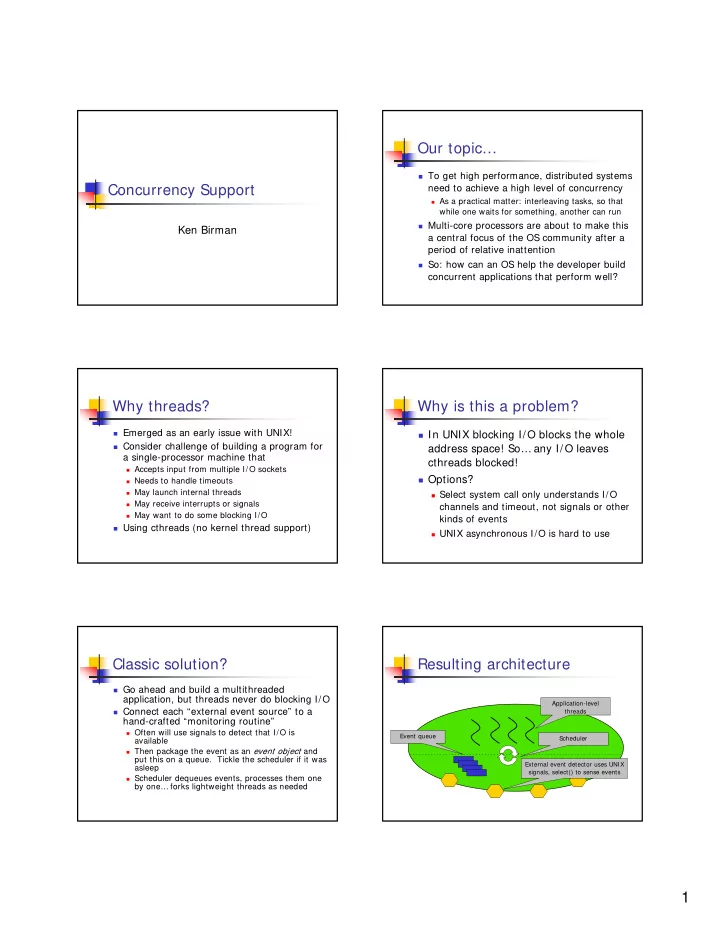
Resulting architecture

Application-level threads Scheduler External event detector uses UNIX signals, select() to sense events Event queue

slide-2
SLIDE 2

2 Problems with this?

Only works if all the events show up as

signals

Depends on UNIX not “losing” signals Often must process a signal and also do a

select call to receive an event

Scheduler needs a way to block when no

work to do (probably select()) and must be sure that signal handlers can wake it up

Classic issues

Threads that get forked off, then block for

some reason

Address space soon bloats, causing application to

crash

Program is incredibly hard to debug, some

problems seen only now and then

Outright mistakes because C/C+ + don’t

support “monitor style” synchronization

(Easier in Java, C# )

Bottom line?

Concurrency bugs are incredibly common and

very hard to track down and fix

We want our cake but not the calories

Programmers find concurrency unnatural

Try to package it better? Identify software engineering paradigms that can

ease the task of gaining high performance

Hauser et. al. case study

Their focus is on how the world’s best

hackers actually use threads

They learned the hard way Maybe we can learn from them

Paradigms of thread usage

Defer work General pumps Slack processes Sleepers One-shots Deadlock avoidance Rejuvenation Serializers Encapsulated fork Exploiting parallelism

Defer work

A very common scenario for them Client sees snappy response…

something client requested is fired off to happen in the background

Examples: forking off a document print

  • peration, or code that updates window

Issue? What if thread hangs for some

  • reason. Client may see confusing behavior
  • n a subsequent request!
slide-3
SLIDE 3

3 Pumps

Components of producer-consumer

pipelines that take input in, operate on it, then output it “downstream”

Value is that they can absorb transient

rate mismatches

Slack process: a pump used to explicitly

add delay, employed when trying to group small operations into batches

Sleepers, one-shots

These are threads that wait for some

event, then trigger, then wait again

Examples:

Call this procedure every 20ms, or after

some timeout

Can think of device interrupt handler as a

kind of sleeper thread

Deadlock avoiders

Thread created to perform some action

that might have blocked, launched by a caller who holds a lock and doesn’t want to wait

A fairly dangerous paradigm…

Thread may be created with X true, but by

the time it executes, X may be false!

Surprising scheduling delays a big risk here

Task rejuvenation

A nasty style of thread

Application had multiple major

subactivities, such as input handler,

  • renderer. Something awful happened.

So create a new instance and pray

Seems to invite “heisenbugs”

Aside: Bohr-bugs and Heisenbugs

Bruce Lindsey, refers to models of the atom A Bohr nuclear was a nice solid little thing.

Same with a Bohr-bug. You can hit it reproducibly and hence can fix it

A Heisenbug is hard to pin down: if you

localize an instance, the bug shifts elsewhere. Results from non-deterministic executions,

  • ld corruption in data structures, etc….

Some thread paradigms invite trouble!

Others

Serializers: a queue, and a thread that

removes work from it and processes that work item by item

Used heavily in SEDA

Concurrency exploiters: for multiple

CPUs

Encapsulated forks: threads packaged

with other paradigms

slide-4
SLIDE 4

4 Threads considered marvelous

Threads are wonderful when some

action may block for a while

Like a slow I/O operation, RPC, etc

Your code remains clean and “linear” Moreover, aggregated performance is

  • ften far higher than without threading

Threads considered harmful

They are fundamentally non-

deterministic, hence invite Heisenbugs

Reentrant code is really hard to write Surprising scheduling can be a huge

headache

When something “major” changes the

state of a system, cleaning up threads running based on the old state is a pain

SEDA paradigm

Tries to replace most threads with:

Small pools of threads Event queues

Idea is to build a pipelined architecture

that doesn’t fork threads dynamically

Classic threading paradigm and a performance issue Event-oriented paradigm Staged, Event Driven Approach (SEDA)

A SEDA stage

slide-5
SLIDE 5

5 SEDA performance Criticisms of SEDA

It can still bloat, by having event

queues get very large

Demands a delicate match of

processing power (basically, stages to the right need to be faster than stages to the left)

Some claim that Haboob didn’t work as

asserted in this paper…

Background

SEDA was developed by Matt Welsh

Now at Harvard Matt ran afoul of some of the über-hackers

  • f the systems world

Huge fight ensued. Matt ultimately shifted

to work on sensor networks (safer crowd)

Comments that follow came from one

  • f these angry über-hackers

“Why SEDA sucks” (from an anonymous über-hacker)

First, if you read between the lines, the

paper’s own numbers show how much SEDA sucks.

For example, it shows comparable throughput

to Flash where flash has half the number of file descriptors, which means he's at least twice as slow as flash.

(Since usually performance of these systems

scales relatively linearly with file descriptors.)

“Why SEDA sucks” (from an anonymous über-hacker)

The paper shows graphs like CDFs of

response time for clients serviced, when SEDA was dumping most requests (and hence they weren't showing up in the graph), while the other servers were serving way more clients.

So yeah, SEDA's latency is lower than other

servers if SEDA serves fewer clients and thus has lower throughput. And SEDA's throughput is comparable to other servers if you cut the other servers' concurrency.

“Why SEDA sucks” (from an anonymous über-hacker)

But on top of that the comparison is still dishonest,

because the other servers are production servers with logging and everything.

SEDA lacks a bunch of necessary facilities that would

presumably decrease its performance if implemented. The authors annoyed some members of the systems community by giving talks saying, "You might ask if the use of Java would put SEDA at a performance

  • disadvantage. It doesn't because fortunately I'm a

very, very good programmer."

Not a good move.

slide-6
SLIDE 6

6

“Why SEDA sucks” (from an anonymous über-hacker)

  • “Almost as embarrassing as the performance and the complete

failure to solve the stated problem (namely cnn.com's overload

  • n September 11, 2001, which he never demonstrated SEDA

could fix) is the fact that the authors completely ignored the related work from Mogul and Ramakrishnan on eliminating receive livelock.”

  • That work appeared in Journal form in 1997, and earlier in

conference form).

  • They made a strong case for dropping events as early as possible,

eliminating most queues, and processing events all the way through whenever you can.

  • Viewed in this light, SEDA should not have been published (years

later) without even attempting to rebut their argument.

Threads: What next?

Language community is exploring threads

with integrated transactional rollback…

Idea: thread is created for parallelism It tracks data that was changed (undo list) At commit point, check for possible concurrent

execution by some other thread accessing same

  • data. If so, roll back, retry

Concerns? Many. Recalls Argus system

(MIT) which used threads, transactions on abstract data types…. Life gets messy!

Bottom line?

Threads? Events? Transactions? (With top-level actions,

  • rphan termination, nested commit???)

A mixture?