1 Fetcher WebDB/Fetcher Updates Fetcher is very stupid. Not a - - PDF document

1
SMART_READER_LITE
LIVE PREVIEW

1 Fetcher WebDB/Fetcher Updates Fetcher is very stupid. Not a - - PDF document

Meta-details Built to encourage public search work Open-source, w/pluggable modules All About Nutch Cheap to run, both machines & admins Goal: Search more pages, with better quality, than any other engine Michael J. Cafarella


slide-1
SLIDE 1

1 All About Nutch

Michael J. Cafarella CSE 454 April 14, 2005

Meta-details

Built to encourage public search work

Open-source, w/pluggable modules Cheap to run, both machines & admins

Goal: Search more pages, with better

quality, than any other engine

Pretty good ranking Currently can do ~ 200M pages

Outline

Nutch design

Link database, fetcher, indexer, etc…

Supporting parts

Distributed filesystem, job control

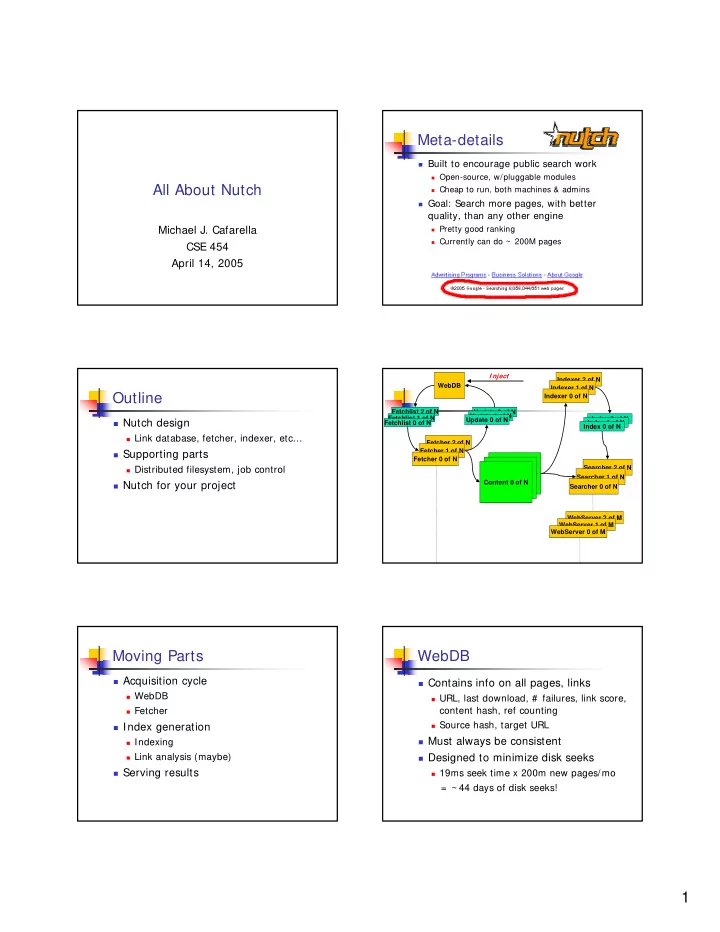
Nutch for your project WebDB Fetcher 2 of N Fetcher 1 of N Fetcher 0 of N Fetchlist 2 of N Fetchlist 1 of N Fetchlist 0 of N Update 2 of N Update 1 of N Update 0 of N Content 0 of N Content 0 of N Content 0 of N Indexer 2 of N Indexer 1 of N Indexer 0 of N Searcher 2 of N Searcher 1 of N Searcher 0 of N WebServer 2 of M WebServer 1 of M WebServer 0 of M Index 2 of N Index 1 of N Index 0 of N I nject

Moving Parts

Acquisition cycle

WebDB Fetcher

Index generation

Indexing Link analysis (maybe)

Serving results

WebDB

Contains info on all pages, links

URL, last download, # failures, link score,

content hash, ref counting

Source hash, target URL

Must always be consistent Designed to minimize disk seeks

19ms seek time x 200m new pages/mo

= ~ 44 days of disk seeks!

slide-2
SLIDE 2

2 Fetcher

Fetcher is very stupid. Not a “crawler” Divide “to-fetch list” into k pieces, one

for each fetcher machine

URLs for one domain go to same list,

  • therwise random

“Politeness” w/o inter-fetcher protocols Can observe robots.txt similarly Better DNS, robots caching Easy parallelism

Two outputs: pages, WebDB edits

  • 2. Sort edits (externally, if necessary)

WebDB/Fetcher Updates

ContentHash: None LastUpdated: Never URL: http://www.flickr/com/index.html ContentHash: None LastUpdated: Never URL: http://www.cnn.com/index.html ContentHash: MD5_toewkekqmekkalekaa LastUpdated: 4/07/05 URL: http://www.yahoo/index.html ContentHash: MD5_sdflkjweroiwelksd LastUpdated: 3/22/05 URL: http://www.cs.washington.edu/index.html ContentHash: MD5_balboglerropewolefbag URL: http://www.cnn.com/index.html Edit: DOWNLOAD_CONTENT ContentHash: MD5_toewkekqmekkalekaa URL: http://www.yahoo/index.html Edit: DOWNLOAD_CONTENT ContentHash: None URL: http://www.flickr.com/index.html Edit: NEW_LINK

WebDB Fetcher edits

  • 1. Write down fetcher edits
  • 3. Read streams in parallel, emitting new database
  • 4. Repeat for other tables

ContentHash: MD5_balboglerropewolefbag LastUpdated: Today! URL: http://www.cnn.com/index.html ContentHash: MD5_toewkekqmekkalekaa LastUpdated: Today! URL: http://www.yahoo.com/index.html

Indexing

Iterate through all k page sets in parallel,

constructing inverted index

Creates a “searchable document” of:

URL text Content text Incoming anchor text

Other content types might have a different

document fields

Eg, email has sender/receiver Any searchable field end-user will want

Uses Lucene text indexer

Link analysis

A page’s relevance depends on both

intrinsic and extrinsic factors

Intrinsic: page title, URL, text Extrinsic: anchor text, link graph

PageRank is most famous of many Others include:

HITS Simple incoming link count

Link analysis is sexy, but importance

generally overstated

Link analysis (2)

Nutch performs analysis in WebDB

Emit a score for each known page At index time, incorporate score into

inverted index

Extremely time-consuming

In our case, disk-consuming, too (because

we want to use low-memory machines)

0.5 * log(# incoming links)

“britney”

Query Processing

Docs 0-1M Docs 1-2M Docs 2-3M Docs 3-4M Docs 4-5M “ b r i t n e y ” “britney” “ b r i t n e y ” “ b r i t n e y ” “britney”

Ds 1, 29 Ds 1.2M, 1.7M Ds 2.3M, 2.9M D s 3 . 1 M , 3 . 2 M Ds 4.4M, 4.5M 1.2M, 4.4M, 29, …
slide-3
SLIDE 3

3 Administering Nutch

Admin costs are critical

It’s a hassle when you have 25 machines Google has maybe > 100k

Files

WebDB content, working files Fetchlists, fetched pages Link analysis outputs, working files Inverted indices

Jobs

Emit fetchlists, fetch, update WebDB Run link analysis Build inverted indices

Administering Nutch (2)

Admin sounds boring, but it’s not!

Really I swear

Large-file maintenance

Google File System (Ghemawat, Gobioff,

Leung)

Nutch Distributed File System

Job Control

Map/Reduce (Dean and Ghemawat)

Nutch Distributed File System

Similar, but not identical, to GFS Requirements are fairly strange

Extremely large files Most files read once, from start to end Low admin costs per GB

Equally strange design

Write-once, with delete Single file can exist across many machines Wholly automatic failure recovery

NDFS (2)

Data divided into blocks Blocks can be copied, replicated Datanodes hold and serve blocks Namenode holds metainfo

Filename block list Block datanode-location

Datanodes report in to namenode every

few seconds,

NDFS File Read

Namenode Datanode 0 Datanode 1 Datanode 2 Datanode 3 Datanode 4 Datanode 5

  • 1. Client asks datanode for filename info
  • 2. Namenode responds with blocklist, and

location(s) for each block

  • 3. Client fetches each block, in sequence, from

a datanode

“crawl.txt” (block-33 / datanodes 1, 4) (block-95 / datanodes 0, 2) (block-65 / datanodes 1, 4, 5)

NDFS Replication

Namenode Datanode 0 (33, 95) Datanode 1 (46, 95) Datanode 2 (33, 104) Datanode 3 (21, 33, 46) Datanode 4 (90) Datanode 5 (21, 90, 104)

  • 1. Always keep at least k copies of each blk
  • 2. Imagine datanode 4 dies; blk 90 lost
  • 3. Namenode loses heartbeat, decrements blk

90’s reference count. Asks datanode 5 to replicate blk 90 to datanode 0

  • 4. Choosing replication target is tricky

(Blk 90 to dn 0)

slide-4
SLIDE 4

4 Map/Reduce

Map/Reduce is programming model

from Lisp (and other places)

Easy to distribute across nodes Nice retry/failure semantics

map(key, val) is run on each item in set

emits key/val pairs

reduce(key, vals) is run for each unique

key emitted by map()

emits final output

Many problems can be phrased this way

Map/Reduce (2)

Task: count words in docs

Input consists of (url, contents) pairs map(key= url, val= contents):

For each word w in contents, emit (w, “1”)

reduce(key= word, values= uniq_counts):

Sum all “1”s in values list Emit result “(word, sum)”

Map/Reduce (3)

Task: grep

Input consists of (url+ offset, single line) map(key= url+ offset, val= line):

If contents matches regexp, emit (line, “1”)

reduce(key= line, values= uniq_counts):

Don’t do anything; just emit line

We can also do graph inversion, link

analysis, WebDB updates, etc

Map/Reduce (4)

  • How is this distributed?

1.

Partition input key/value pairs into chunks, run map() tasks in parallel

2.

After all map()s are complete, consolidate all emitted values for each unique emitted key

3.

Now partition space of output map keys, and run reduce() in parallel

  • If map() or reduce() fails, reexecute!

Map/Reduce Job Processing

JobTracker TaskTracker 0 TaskTracker 1 TaskTracker 2 TaskTracker 3 TaskTracker 4 TaskTracker 5

  • 1. Client submits “grep” job, indicating code

and input files

  • 2. JobTracker breaks input file into k chunks,

(in this case 6). Assigns work to ttrackers.

  • 3. After map(), tasktrackers exchange map-
  • utput to build reduce() keyspace
  • 4. JobTracker breaks reduce() keyspace into

m chunks (in this case 6). Assigns work.

  • 5. reduce() output may go to NDFS

“grep”

Searching webcams

Index size will be small Need all the hints you can get

Page text, anchor text URL sources like Yahoo or DMOZ entries Webcam-only content types Avoid processing images at query time

Take a look at Nutch pluggable content

types (current examples include PDF, MS Word, etc.). Might work.

slide-5
SLIDE 5

5 Searching webcams (2)

Annotate Lucene document with new

fields

“Image qualities” might contain “indoors”

  • r “daylight” or “flesh tones”

Parse text for city names to fill “location”

field

Multiple downloads to compute “lattitude”

field

Others?

Will require new search procedure, too

Conclusion

http://www.nutch.org/

Partial documentation Source code Developer discussion board

“Lucene in Action” by Hatcher,

Gospodnetic (you can borrow mine)

Questions?