1 Interested in Memory Mgmt Only Some basic concepts Registers, - - PDF document

1
SMART_READER_LITE
LIVE PREVIEW

1 Interested in Memory Mgmt Only Some basic concepts Registers, - - PDF document

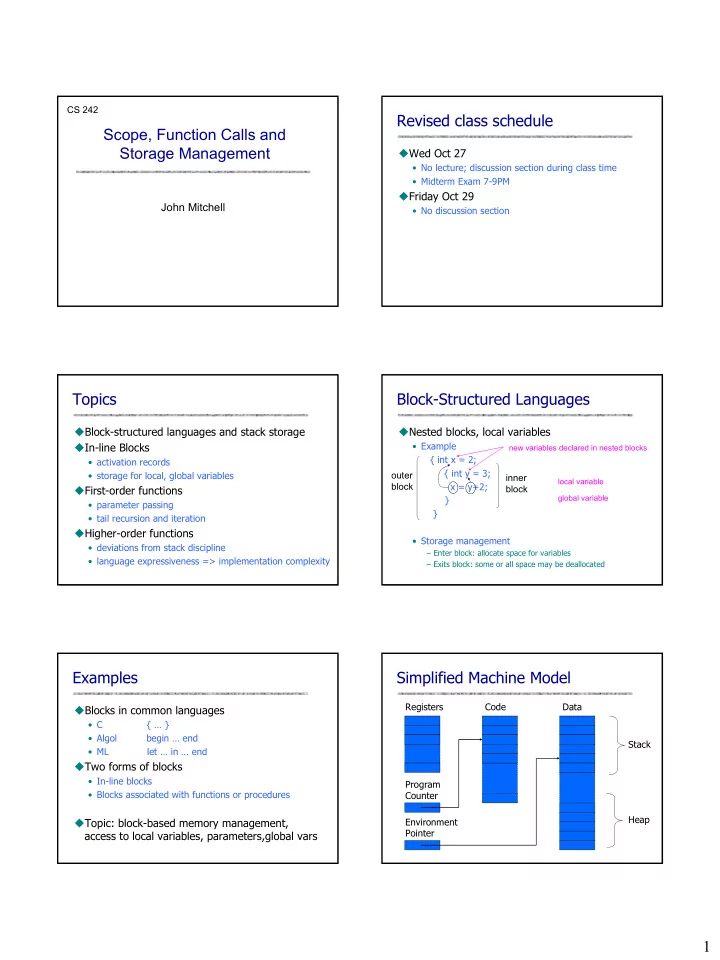
CS 242 Revised class schedule Scope, Function Calls and Storage Management Wed Oct 27 No lecture; discussion section during class time Midterm Exam 7-9PM Friday Oct 29 John Mitchell No discussion section Topics


slide-1
SLIDE 1

1 Scope, Function Calls and Storage Management

John Mitchell

CS 242

Revised class schedule

Wed Oct 27

  • No lecture; discussion section during class time
  • Midterm Exam 7-9PM

Friday Oct 29

  • No discussion section

Topics

Block-structured languages and stack storage In-line Blocks

  • activation records
  • storage for local, global variables

First-order functions

  • parameter passing
  • tail recursion and iteration

Higher-order functions

  • deviations from stack discipline
  • language expressiveness => implementation complexity

Block-Structured Languages

Nested blocks, local variables

  • Example

{ int x = 2; { int y = 3; x = y+2; } }

  • Storage management

– Enter block: allocate space for variables – Exits block: some or all space may be deallocated new variables declared in nested blocks

inner block

  • uter

block

local variable global variable

Examples

Blocks in common languages

  • C { … }
  • Algol

begin … end

  • ML let … in … end

Two forms of blocks

  • In-line blocks
  • Blocks associated with functions or procedures

Topic: block-based memory management, access to local variables, parameters,global vars

Simplified Machine Model

Registers Environment Pointer Program Counter Data Code Heap Stack

slide-2
SLIDE 2

2 Interested in Memory Mgmt Only

Registers, Code segment, Program counter

  • Ignore registers
  • Details of instruction set will not matter

Data Segment

  • Stack contains data related to block entry/exit
  • Heap contains data of varying lifetime
  • Environment pointer points to current stack position

– Block entry: add new activation record to stack – Block exit: remove most recent activation record

Some basic concepts

Scope

  • Region of program text where declaration is visible

Lifetime

  • Period of time when location is allocated to program
  • Inner declaration of x hides outer one.
  • Called “hole in scope”
  • Lifetime of outer x includes time when

inner block is executed

  • Lifetime ≠ scope
  • Lines indicate “contour model” of scope.

{ int x = … ; { int y = … ; { int x = … ; …. }; }; };

In-line Blocks

Activation record

  • Data structure stored on run-time stack
  • Contains space for local variables

Example

May need space for variables and intermediate results like (x+y), (x-y) { int x=0; int y=x+1; { int z=(x+y)*(x-y); }; }; Push record with space for x, y Set values of x, y Push record for inner block Set value of z Pop record for inner block Pop record for outer block

Activation record for in-line block

Control link

  • pointer to previous record
  • n stack

Push record on stack:

  • Set new control link to

point to old env ptr

  • Set env ptr to new record

Pop record off stack

  • Follow control link of

current record to reset environment pointer

Control link Local variables Intermediate results Control link Local variables Intermediate results

Environment Pointer

Can be optimized away, but assume not for purpose of discussion.

Example

{ int x=0; int y=x+1; { int z=(x+y)*(x-y); }; }; Push record with space for x, y Set values of x, y Push record for inner block Set value of z Pop record for inner block Pop record for outer block Control link x y 1 x+y x-y

Environment Pointer

1

  • 1

Control link z

  • 1

Scoping rules

Global and local variables

{ int x=0; int y=x+1; { int z=(x+y)*(x-y); }; };

  • x, y are local to outer block
  • z is local to inner bock
  • x, y are global to inner block

Static scope

  • global refers to declaration in closest enclosing block

Dynamic scope

  • global refers to most recent activation record

These are same until we consider function calls.

slide-3
SLIDE 3

3 Functions and procedures

Syntax of procedures (Algol) and functions (C)

procedure P (<pars>) <type> function f(<pars>) begin { <local vars> <local vars> <proc body> <function body> end; };

Activation record must include space for

  • parameters
  • return address
  • return value

(an intermediate result)

  • location to put return

value on function exit

Activation record for function

Return address

  • Location of code to

execute on function return

Return-result address

  • Address in activation

record of calling block to receive return address

Parameters

  • Locations to contain data

from calling block

Control link Local variables Intermediate results

Environment Pointer

Parameters Return address Return-result addr

Example

Function

fact(n) = if n<= 1 then 1 else n * fact(n-1)

Return result address

  • location to put fact(n)

Parameter

  • set to value of n by calling

sequence

Intermediate result

  • locations to contain value
  • f fact(n-1)

Control link Local variables Intermediate results

Environment Pointer

Parameters Return address Return result addr Control link fact(n-1) n Return-result addr 3 fact(3)

Function call

Return address omitted; would be ptr into code segment Control link fact(n-1) n Return-result addr 2 fact(2)

fact(n) = if n<= 1 then 1 else n * fact(n-1)

Control link fact(n-1) n Return-result addr k fact(k) Environment Pointer Control link fact(n-1) n Return-result addr 1 fact(1)

Function return next slide →

Function return

Control link fact(n-1) n Return result addr 3 fact(3) Control link fact(n-1) n Return result addr 1 2 fact(2) Control link fact(n-1) n Return result addr 1 fact(1)

fact(n) = if n<= 1 then 1 else n * fact(n-1)

Control link fact(n-1) n Return result addr 2 3 fact(3) Control link fact(n-1) n Return result addr 1 2 fact(2)

Topics for first-order functions

Parameter passing

  • use ML reference cells to describe pass-by-value,

pass-by-reference

Access to global variables

  • global variables are contained in an activation record

higher “up” the stack

Tail recursion

  • an optimization for certain recursive functions

See this yourself: write factorial and run under debugger

slide-4
SLIDE 4

4 ML imperative features

General terminology: L-values and R-values

  • Assignment y := x+3

– Identifier on left refers to location, called its L-value – Identifier on right refers to contents, called R-value

ML reference cells and assignment

  • Different types for location and contents

x : int non-assignable integer value y : int ref location whose contents must be integer !y the contents of cell y ref x expression creating new cell initialized to x

  • ML form of assignment

y := x+3 place value of x+3 in location (cell) y y := !y + 3 add 3 to contents of y and store in location y

ML examples

Create cell and change contents

val x = ref “Bob”; x := “Bill”;

Create cell and increment

val y = ref 0; y := !y + 1;

While loop

val i = ref 0; while !i < 10 do i := !i +1; !i; Bob Bill x 1 y

Parameter passing

Pass-by-reference

  • Caller places L-value (address)
  • f actual parameter in activation record
  • Function can assign to variable that is passed

Pass-by-value

  • Caller places R-value (contents)
  • f actual parameter in activation record
  • Function cannot change value of caller’s variable
  • Reduces aliasing (alias: two names refer to same loc)

Example

function f (x) = { x := x+1; return x }; var y : int = 0; print f(y)+y; fun f (x : int ref) = ( x := !x+1; !x ); y = ref 0 : int ref; f(y) + !y; fun f (z : int) = let x = ref z in x := !x+1; !x end; y = ref 0 : int ref; f(!y) + !y;

pseudo-code Standard ML

pass-by-ref pass-by-value

Access to global variables

Two possible scoping conventions

  • Static scope: refer to closest enclosing block
  • Dynamic scope: most recent activation record on stack

Example

int x=1; function g(z) = x+z; function f(y) = { int x = y+1; return g(y*x) }; f(3); x 1 x 4 y 3 z 12

  • uter block

f(3) g(12) Which x is used for expression x+z ?

Activation record for static scope

Control link

  • Link to activation record of

previous (calling) block

Access link

  • Link to activation record of

closest enclosing block in program text

Difference

  • Control link depends on

dynamic behavior of prog

  • Access link depends on

static form of program text

Control link Local variables Intermediate results

Environment Pointer

Parameters Return address Return result addr Access link

slide-5
SLIDE 5

5 Complex nesting structure

int x=1; function g(z) = x+z; function f(y) = { int x = y+1; return g(y*x) }; f(3); function m(…) { int x=1; … function n( … ){ function g(z) = x+z; … { … function f(y) { int x = y+1; return g(y*x) }; … f(3); … } … n( … ) …} … m(…)

Simplify to Simplified code has same block nesting, if we follow convention that each declaration begins a new block.

Static scope with access links

int x=1; function g(z) = x+z; function f(y) = { int x = y+1; return g(y*x) }; f(3); x 1 x 4 y 3 z 12

  • uter block

f(3) g(12) control link access link g … f … control link access link control link access link access link control link Use access link to find global variable: – Access link is always set to frame

  • f closest enclosing lexical block

– For function body, this is block that contains function declaration

Tail recursion (first-order case)

Function g makes a tail call to function f if

  • Return value of function f is return value of g

Example

fun g(x) = if x>0 then f(x) else f(x)*2

Optimization

  • Can pop activation record on a tail call
  • Especially useful for recursive tail call

– next activation record has exactly same form

tail call not a tail call

Example Calculate least power of 2 greater than y

fun f(x,y) = if x>y then x else f(2*x, y); f(1,3) + 7;

control return val x 1 y 3 control return val x 1 y 3 control return val x 2 y 3 control return val x 4 y 3 f(1,3)

Optimization

  • Set return

value address to that of caller

Question

  • Can we do the

same with control link?

Optimization

  • avoid return to

caller

Tail recursion elimination

fun f(x,y) = if x>y then x else f(2*x, y); f(1,3);

control return val x 1 y 3 f(4,3)

Optimization

  • pop followed by push =

reuse activation record in place

Conclusion

  • Tail recursive function equiv to

iterative loop

control return val x 2 y 3 f(1,3) control return val x 4 y 3 f(2,3)

Tail recursion and iteration

fun f(x,y) = if x>y then x else f(2*x, y); f(1,y);

control return val x 1 y 3 f(4,3) control return val x 2 y 3 f(1,3) control return val x 4 y 3 f(2,3)

fun g(y) = { x := 1; while not(x>y) do x := 2*x; return x; };

initial value loop body test

slide-6
SLIDE 6

6 Higher-Order Functions

Language features

  • Functions passed as arguments
  • Functions that return functions from nested blocks
  • Need to maintain environment of function

Simpler case

  • Function passed as argument
  • Need pointer to activation record “higher up” in stack

More complicated second case

  • Function returned as result of function call
  • Need to keep activation record of returning function

Pass function as argument

val x = 4; fun f(y) = x*y; fun g(h) = let val x=7 in h(3) + x; g(f); There are two declarations of x Which one is used for each occurrence of x? { int x = 4; { int f(int y) {return x*y;} { int g(int→int h) { int x=7; return h(3) + x; } g(f); } } }

Static Scope for Function Argument

val x = 4; fun f(y) = x*y; fun g(h) = let val x=7 in h(3) + x; g(f);

x 4 h y 3 f g Code for f Code for g g(f) h(3) x * y x 7 follow access link local var

How is access link for h(3) set?

Static Scope for Function Argument

{ int x = 4; { int f(int y) {return x*y;} { int g(int→int h) { int x=7; return h(3) + x; } g(f); } } }

x 4 h y 3 f g Code for f Code for g g(f) h(3) x * y x 7 follow access link local var

How is access link for h(3) set?

Closures

Function value is pair closure = 〈env, code 〉 When a function represented by a closure is called,

  • Allocate activation record for call (as always)
  • Set the access link in the activation record using the

environment pointer from the closure

Function Argument and Closures

val x = 4; fun f(y) = x*y; fun g(h) = let val x=7 in h(3) + x; g(f); x 4 access link set from closure Code for f f access

Run-time stack with access links

Code for g h(3) y 3 access g(f) h access x 7 g access

slide-7
SLIDE 7

7

{ int x = 4; { int f(int y){return x*y;} { int g(int→int h) { int x=7; return h(3)+x; } g(f); }}}

Function Argument and Closures

x 4 access link set from closure Code for f f access

Run-time stack with access links

Code for g h(3) y 3 access g(f) h access x 7 g access

Summary: Function Arguments

Use closure to maintain a pointer to the static environment of a function body When called, set access link from closure All access links point “up” in stack

  • May jump past activ records to find global vars
  • Still deallocate activ records using stack (lifo) order

Return Function as Result

Language feature

  • Functions that return “new” functions
  • Need to maintain environment of function

Example

fun compose(f,g) = (fn x => g(f x));

Function “created” dynamically

  • expression with free variables

values are determined at run time

  • function value is closure = 〈env, code〉
  • code not compiled dynamically (in most languages)

Example: Return fctn with private state

fun mk_counter (init : int) = let val count = ref init fun counter(inc:int) = (count := !count + inc; !count) in counter end; val c = mk_counter(1); c(2) + c(2);

  • Function to “make counter”

returns a closure

  • How is correct value of

count determined in c(2) ?

Example: Return fctn with private state

{int→int mk_counter (int init) { int count = init; int counter(int inc) { return count += inc;} return counter} int→int c = mk_counter(1); print c(2) + c(2); } Function to “make counter” returns a closure How is correct value of count determined in call c(2) ?

Function Results and Closures

fun mk_counter (init : int) = let val count = ref init fun counter(inc:int) = (count := !count + inc; !count) in counter end end; val c = mk_counter(1); c(2) + c(2);

c access Code for counter Code for mk_counter c(2) access inc 2 1 mk_counter(1) count init 1 access counter mk_c Call changes cell value from 1 to 3 3

slide-8
SLIDE 8

8 Function Results and Closures

c access Code for counter Code for mk_counter c(2) access inc 2 1 mk_counter(1) count init 1 access counter mk_c Call changes cell value from 1 to 3 3 {int→int mk_counter (int init) { int count = init; int counter(int inc) { return count+=inc;} } int→int c = mk_counter(1); print c(2) + c(2); }

Summary: Return Function Results

Use closure to maintain static environment May need to keep activation records after return

  • Stack (lifo) order fails!

Possible “stack” implementation

  • Forget about explicit deallocation
  • Put activation records on heap
  • Invoke garbage collector as needed
  • Not as totally crazy as is sounds

May only need to search reachable data

Summary of scope issues

Block-structured lang uses stack of activ records

  • Activation records contain parameters, local vars, …
  • Also pointers to enclosing scope

Several different parameter passing mechanisms Tail calls may be optimized Function parameters/results require closures

  • Closure environment pointer used on function call
  • Stack deallocation may fail if function returned from call
  • Closures not needed if functions not in nested blocks