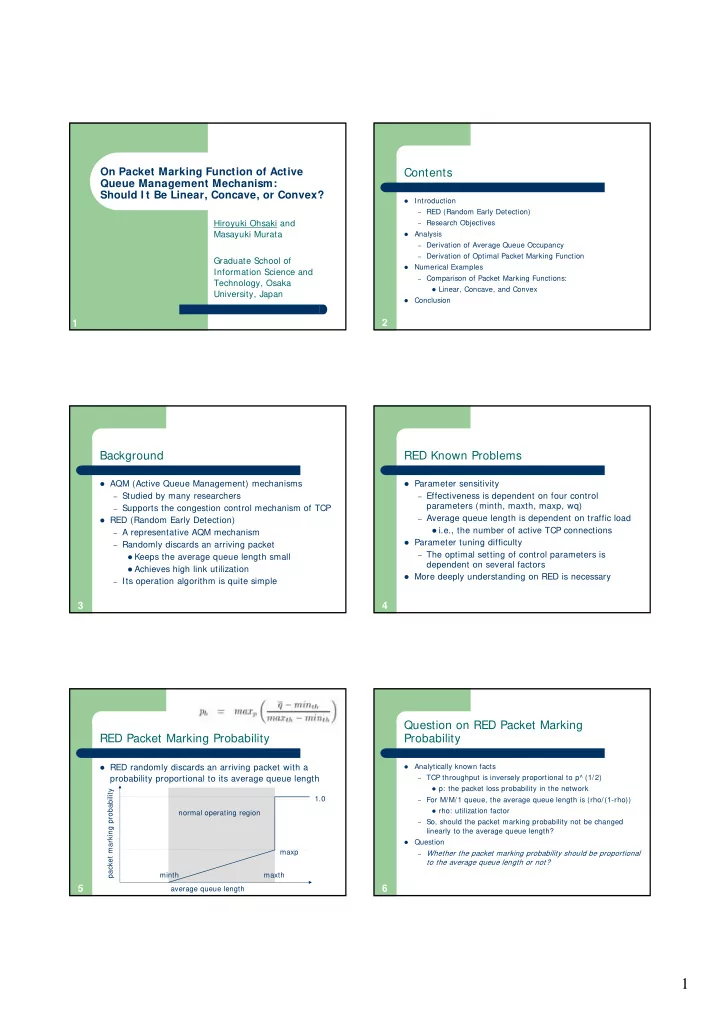
1 Objectives Analysis Overview Investigate effect of packet - - PDF document

1
SMART_READER_LITE
LIVE PREVIEW

1 Objectives Analysis Overview Investigate effect of packet - - PDF document

On Packet Marking Function of Active Contents Queue Management Mechanism: Should I t Be Linear, Concave, or Convex? Introduction RED (Random Early Detection) Hiroyuki Ohsaki and Research Objectives Masayuki Murata Analysis


slide-1
SLIDE 1

1

1

On Packet Marking Function of Active Queue Management Mechanism: Should I t Be Linear, Concave, or Convex?

Hiroyuki Ohsaki and Masayuki Murata Graduate School of Information Science and Technology, Osaka University, Japan

2

Contents

  • Introduction

– RED (Random Early Detection) – Research Objectives

  • Analysis

– Derivation of Average Queue Occupancy – Derivation of Optimal Packet Marking Function

  • Numerical Examples

– Comparison of Packet Marking Functions: Linear, Concave, and Convex

  • Conclusion

3

Background

AQM (Active Queue Management) mechanisms – Studied by many researchers – Supports the congestion control mechanism of TCP RED (Random Early Detection) – A representative AQM mechanism – Randomly discards an arriving packet Keeps the average queue length small Achieves high link utilization – Its operation algorithm is quite simple

4

RED Known Problems

Parameter sensitivity – Effectiveness is dependent on four control

parameters (minth, maxth, maxp, wq)

– Average queue length is dependent on traffic load i.e., the number of active TCP connections Parameter tuning difficulty – The optimal setting of control parameters is

dependent on several factors

More deeply understanding on RED is necessary

5

RED Packet Marking Probability

RED randomly discards an arriving packet with a

probability proportional to its average queue length

average queue length packet marking probability maxth minth maxp 1.0 normal operating region

6

Question on RED Packet Marking Probability

  • Analytically known facts

– TCP throughput is inversely proportional to p^ (1/2) p: the packet loss probability in the network – For M/M/1 queue, the average queue length is (rho/(1-rho)) rho: utilization factor – So, should the packet marking probability not be changed

linearly to the average queue length?

  • Question

– Whether the packet marking probability should be proportional

to the average queue length or not?

slide-2
SLIDE 2

2

7

Objectives

  • Investigate effect of packet marking function on its performance

– Steady state performance – Transient state performance

  • Show how packet marking function should be determined

– Utilize analytic results of TCP and RED steady state analyses

  • Consider three classes of packet marking functions

– Linear, concave, and convex – Show which packet marking functions is the best... for good transient state performance and robustness

8

Analysis Overview

  • 1. Replace the packet marking function of RED with a

generic function f(x)

  • 2. Combine two analytic models

– Stochastic model of TCP window size – Deterministic model of RED queue length

  • 3. Analyze toward what value the average queue

length converges...

– for a given average queue length

9

  • 1. Replace Packet Marking Function and

Define Queue Occupancy

The packet marking function is replaced by Introduce “queue occupancy”

10

  • 2. Combining Two Analytic Models

Expected value of TCP window size: w(p) – b: the number of packets required for returning an

ACK packet

– p: the packet loss probability in the network

11

  • 2. Combining Two Analytic Models (Cont’d)

Queue length of RED in steady state: q – N: the number of TCP connections – w: TCP window size – B: maximum transmission capacity of RED router – tau: two-way propagation delay of TCP connection

12

  • 3. Analyze Average Queue Length

Convergence Point

Average queue length convergence point: q(x) Queue occupancy in steady state: x^ *

slide-3
SLIDE 3

3

13

Effect of Packet Marking Function

14

Optimal Packet Marking Function

  • x^ * becomes a linear function if f(x) is given by
  • To optimize the steady state and transient state performances...

– f(x) must be dynamically changed according to N N: the number of active TCP connections

  • However, the above function is impractical since...

– RED has no capability to know the number of TCP connections

  • Question

– For practical purposes, what type of packet marking function is

the best for steady state and transient state performances?

15

Three Packet Marking Function Classes: Linear, Concave, Convex

Linear Concave Convex

16

RED Packet Marking Probability

RED randomly discards an arriving packet with a

probability proportional to its average queue length

average queue length packet marking probability maxth minth maxp 1.0 normal operating region convex linear concave

17

RED Queue Occupancy (Linear Case)

  • medium steady state

queue occupancy

  • unstable transient

state performance

  • medium steady state

queue occupancy

  • unstable transient

state performance

18

RED Queue Occupancy (Concave Case)

  • large steady state

queue occupancy

  • stable transient

state performance

  • large steady state

queue occupancy

  • stable transient

state performance

slide-4
SLIDE 4

4

19

RED Queue Occupancy (Convex Case)

  • small steady state

queue occupancy

  • unstable transient

state performance

  • small steady state

queue occupancy

  • unstable transient

state performance

20

Conclusion

  • Analyze effect of packet marking function on RED's performance

– Steady state performance – Transient state performance

  • Show how the packet marking function should be determined

– Utilize analytic results of TCP and RED steady state analyses – Derive the optimal packet marking function

  • Consider three classes of packet marking functions

– Linear, concave, and convex – Show RED with concave packet marking function is the best... in terms of good transient state performance and

robustness