
SLIDE 1
A Semantic Analysis of Mood Selection in Complement Clauses in Persian Narges Nematollahi nnematol@indiana.edu North American Conference on Iranian Linguistics (NACIL1) April 29, 2017 1
- 1. Introduction
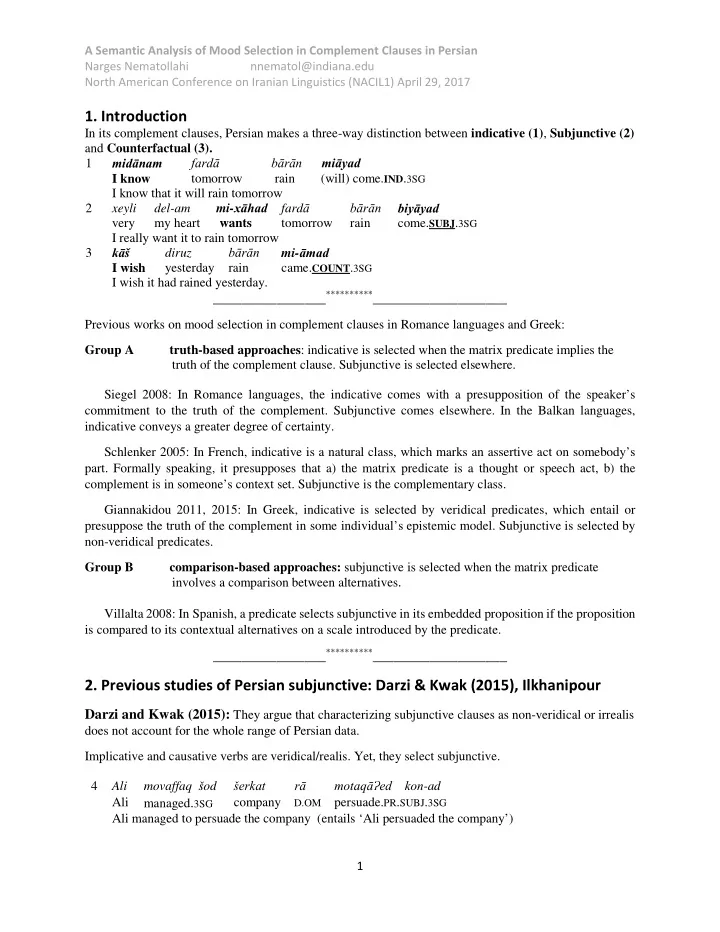
In its complement clauses, Persian makes a three-way distinction between indicative (1), Subjunctive (2) and Counterfactual (3). 1 midānam fardā bārān miāyad I know tomorrow rain (will) come.IND.3SG I know that it will rain tomorrow 2 xeyli del-am mi-xāhad fardā bārān biyāyad very my heart wants tomorrow rain come.SUBJ.3SG I really want it to rain tomorrow 3 kāš diruz bārān mi-āmad I wish yesterday rain came.COUNT.3SG I wish it had rained yesterday.
________________**********___________________
Previous works on mood selection in complement clauses in Romance languages and Greek: Group A truth-based approaches: indicative is selected when the matrix predicate implies the truth of the complement clause. Subjunctive is selected elsewhere. Siegel 2008: In Romance languages, the indicative comes with a presupposition of the speaker’s commitment to the truth of the complement. Subjunctive comes elsewhere. In the Balkan languages, indicative conveys a greater degree of certainty. Schlenker 2005: In French, indicative is a natural class, which marks an assertive act on somebody’s
- part. Formally speaking, it presupposes that a) the matrix predicate is a thought or speech act, b) the
complement is in someone’s context set. Subjunctive is the complementary class. Giannakidou 2011, 2015: In Greek, indicative is selected by veridical predicates, which entail or presuppose the truth of the complement in some individual’s epistemic model. Subjunctive is selected by non-veridical predicates. Group B comparison-based approaches: subjunctive is selected when the matrix predicate involves a comparison between alternatives. Villalta 2008: In Spanish, a predicate selects subjunctive in its embedded proposition if the proposition is compared to its contextual alternatives on a scale introduced by the predicate.
________________**********___________________
- 2. Previous studies of Persian subjunctive: Darzi & Kwak (2015), Ilkhanipour