1 Experience in Batterers Intervention Programs (BIP) CCR - - PDF document

1 experience in batterers intervention programs bip
SMART_READER_LITE
LIVE PREVIEW

1 Experience in Batterers Intervention Programs (BIP) CCR - - PDF document

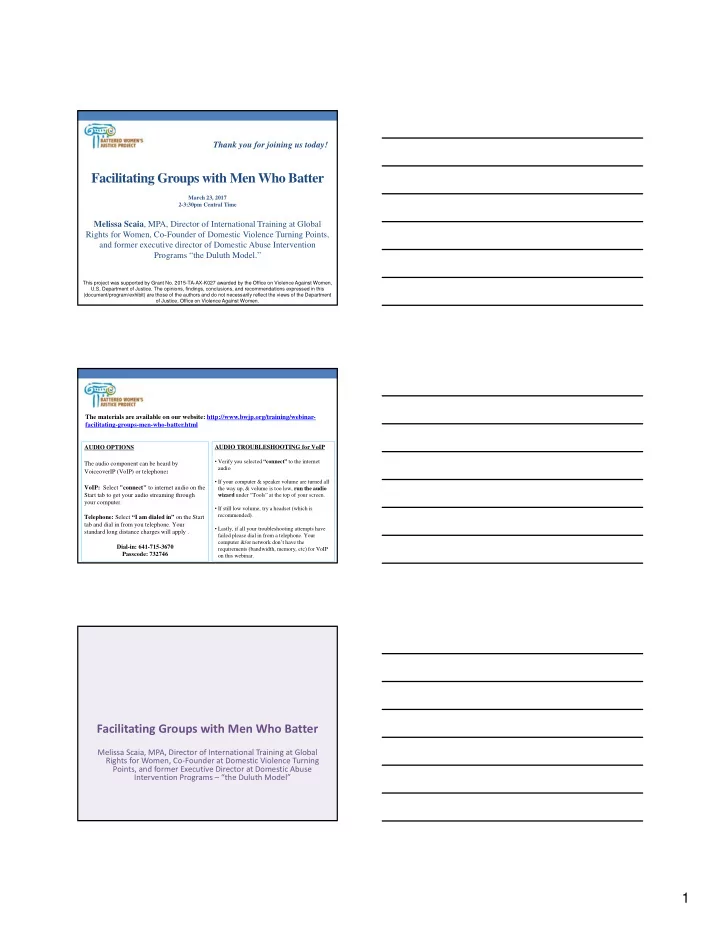
Thank you for joining us today! Facilitating Groups with Men Who Batter March 23, 2017 2-3:30pm Central Time Melissa Scaia , MPA, Director of International Training at Global Rights for Women, Co-Founder of Domestic Violence Turning Points, and


slide-1
SLIDE 1

1 Facilitating Groups with Men Who Batter

March 23, 2017 2-3:30pm Central Time

Melissa Scaia, MPA, Director of International Training at Global Rights for Women, Co-Founder of Domestic Violence Turning Points, and former executive director of Domestic Abuse Intervention Programs “the Duluth Model.”

This project was supported by Grant No. 2015-TA-AX-K027 awarded by the Office on Violence Against Women, U.S. Department of Justice. The opinions, findings, conclusions, and recommendations expressed in this (document/program/exhibit) are those of the authors and do not necessarily reflect the views of the Department

  • f Justice, Office on Violence Against Women.

Thank you for joining us today!

AUDIO OPTIONS The audio component can be heard by VoiceoverIP (VoIP) or telephone: VoIP: Select "connect" to internet audio on the Start tab to get your audio streaming through your computer. Telephone: Select “I am dialed in” on the Start tab and dial in from you telephone. Your standard long distance charges will apply . Dial-in: 641-715-3670 Passcode: 732746 AUDIO TROUBLESHOOTING for VoIP

  • Verify you selected “connect” to the internet

audio

  • If your computer & speaker volume are turned all

the way up, & volume is too low, run the audio wizard under “Tools” at the top of your screen.

  • If still low volume, try a headset (which is

recommended).

  • Lastly, if all your troubleshooting attempts have

failed please dial in from a telephone. Your computer &/or network don’t have the requirements (bandwidth, memory, etc) for VoIP

  • n this webinar.

The materials are available on our website: http://www.bwjp.org/training/webinar- facilitating-groups-men-who-batter.html

Facilitating Groups with Men Who Batter

Melissa Scaia, MPA, Director of International Training at Global Rights for Women, Co‐Founder at Domestic Violence Turning Points, and former Executive Director at Domestic Abuse Intervention Programs – “the Duluth Model”

slide-2
SLIDE 2

2

Experience in Batterers Intervention Programs (BIP)

  • CCR Coordinator in Itasca and northern St. Louis

County

  • CCR Co‐Coordinator in southern St. Louis County
  • Co‐facilitated men’s BIP groups off and on for 17

years

  • Co‐facilitated groups for women who use violence

for over 10 years

  • Co‐Author on “Addressing Fatherhood with Men

Who Batter”

  • Co‐Author on “Turning Points: A Non‐Violence

Curriculum for Women”

BIP Guiding Principles and Purpose

  • To increase the safety of women and children
  • To develop a process that deconstructs men’s

historical and socially constructed entitlement to be violent to women in the culture and community in which they live

  • Create an ongoing, formal relationship with

advocates

BIP Guiding Principles and Purpose

  • Dialogue in facilitation is central to creating an

educational process of change for men who batter

  • Be responsive to the advocacy and safety

needs of the women whose partners are in the program

  • Co‐facilitation by a man AND woman
  • Integrated part of a community CCR
slide-3
SLIDE 3

3

Who are the facilitators?

  • Who are the best facilitators?
  • Who should not facilitate?
  • Are letters after the name necessary?
  • What disconnects the facilitators from the

men in the room?

  • Liberators or Oppressors? It is NEVER neutral.

Paulo Freire

  • Brazilian Educator
  • Worked with peasants in literacy programs
  • Found language an important part of people learning

to read the word and world (revolutione and liberatone).

  • 1964 exiled by government
  • 1967 published first book – accepted a teaching

position at Harvard

  • 1980‐86 returned to Brazil and supervised the

Worker’s Party Adult Literacy Project

  • 1997 died of heart failure at the age of 75

Paulo Freire

Paulo’s teaching helps us:

  • Understand mythical structures of thinking (nature
  • vs. culture)
  • Understand that to change our world view

(entitlements), we need to know our myths (beliefs), be conscious of them, look at the consequences and know we have other choices

  • Make the shift away from the banking system and

toward a problem posing one

slide-4
SLIDE 4

4

Paulo Freire

The process of Dialogue:

  • Involves Problem Posing questions
  • Exposes Interrelationships and connections

between our personal and cultural beliefs

  • Exposes the dehumanizing Consequences of our

world view on ourselves and others

  • Creates alternative views of reality – other ways of

understanding our world

Four Pillars of Paulo Freire’s Work

  • 1. Be concrete – start with the lives of people
  • 2. Dialogue is the medium of learning
  • 3. Education is never neutral – conversations

with oppressed people either function to domesticate or liberate

  • 4. Liberated consciousness is borne out of love,

not hatred

The Role of the Educator

  • Be authentic
  • Promote dialogue without collusion
  • Work with lived experience rather than theory
  • Challenge without judgment
  • Make connections and expose contradictions
  • Encourage critical thinking
  • Expose contradictions in men’s thinking
  • Simultaneously see the beauty the men bring to

the world and the threat they pose

slide-5
SLIDE 5

5

Accountability

  • Facilitating a class / group in a way that allows for men to

critically examine the beliefs that inform the men’s violence, how they’ve been socially constructed to batter and nonviolent alternatives

  • Developing and organizing a BIP that facilitates personal

accountability as opposed to “oppressive” and “non‐ changing” accountability – MAKING men deconstruct the violent episode that got them there – COERCING men to talk about their use of violence – All in an effort for us to be able to say “He took accountability for his violence.”

“Shred” all of your handouts

  • They impose thinking on people

– Education is never neutral – conversations with

  • ppressed people either function to domesticate
  • r liberate

– Most handouts seek to “impose”

  • What is the culture they come from? The

dominant culture?

  • Especially the ones with the word “healthy” in

them

Words Matter

Respect and Emotional Abuse

slide-6
SLIDE 6

6

Respect

What does it mean to respect your partner? What does respect look like during a disagreement? What beliefs make respect for your partner possible?

Emotional Abuse

What is emotional abuse? What does emotional abuse look like during a disagreement? What beliefs make emotional abuse against your partner possible?

Modeling Role‐Playing

  • Don’t judge
  • Don’t tell the other person what to do
  • Don’t be abusive
slide-7
SLIDE 7

7 Core Components of Facilitating Groups with Men Who Batter

  • Male and female facilitators in class
  • Co‐facilitation
  • Dialogue without judgment
  • Exposing contradictions
  • Facilitate men ‘reading their world’
  • Spend 75% of class time exploring themes that

are non‐violent and non‐abusive

  • Provide culturally specific programs for men

Collusion

Anytime we facilitate a class or a program in a way that keeps participants in group from critically examining the beliefs that inform their action, we collude.

Collusion

  • Facilitators who co‐present as opposed to co‐ facilitate
  • Facilitators as the cause of the resistance with the men
  • Not addressing sexist and offensive clothing, jokes, and

judgments about women

  • Thinking of violence as a conflict and relationship problem
  • Thinking of every type of domestic violence as battering
  • Not committing ourselves to addressing our own entitlement

we have and doing our own personal work

slide-8
SLIDE 8

8

Skill Practice as Type of Collusion

  • A strong trend in groups is to incorporate skill

practice

  • Focuses on improving behavior by teaching the

“right way”

  • Skill practice is ACTION focused and does not

address the thinking (BELIEFS) that leads to it

Group Facilitation Issues

  • Prep time
  • Co‐facilitation
  • Your questions….

Resources

Global Rights for Women www.globalrightsforwomen.org Domestic Abuse Intervention Programs www.theduluthmodel.org Domestic Violence Turning Points/Advocates for Family Peace www.dvturningpoints.com www.stopdomesticabuse.org Battered Women’s Justice Project www.bwjp.org Casa de Esperanza www.casadeesperanza.org Mending the Sacred Hoop Technical Assistance Project www.msh‐ta.org Praxis International www.praxisinternational.org

slide-9
SLIDE 9

9

Contact Information

  • mscaia@grwomen.org
  • melissascaia@icloud.com
  • 218‐969‐3498
  • www.dvturningpoints.com