1. Call to order 2. Introductions 3. Approval of minutes from - - PowerPoint PPT Presentation

1 call to order 2 introductions 3 approval of minutes
SMART_READER_LITE
LIVE PREVIEW

1. Call to order 2. Introductions 3. Approval of minutes from - - PowerPoint PPT Presentation

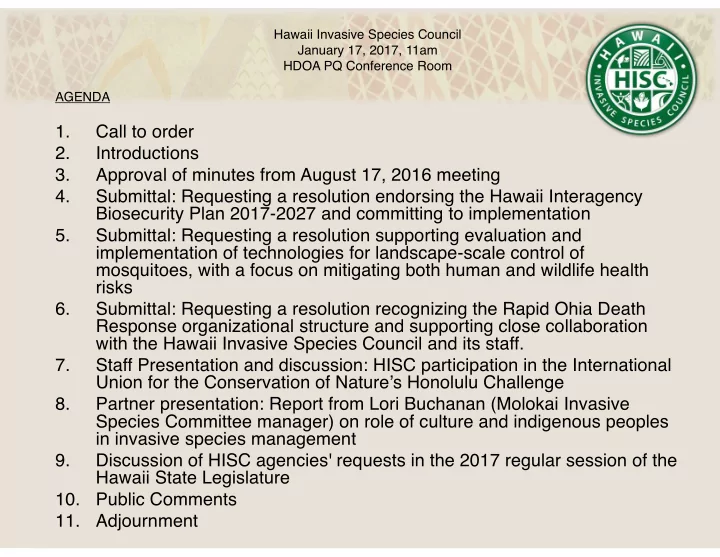
Hawaii Invasive Species Council January 17, 2017, 11am HDOA PQ Conference Room AGENDA 1. Call to order 2. Introductions 3. Approval of minutes from August 17, 2016 meeting 4. Submittal: Requesting a resolution endorsing the Hawaii


slide-1
SLIDE 1

Hawaii Invasive Species Council January 17, 2017, 11am HDOA PQ Conference Room AGENDA

1. Call to order 2. Introductions 3. Approval of minutes from August 17, 2016 meeting 4. Submittal: Requesting a resolution endorsing the Hawaii Interagency Biosecurity Plan 2017-2027 and committing to implementation 5. Submittal: Requesting a resolution supporting evaluation and implementation of technologies for landscape-scale control of mosquitoes, with a focus on mitigating both human and wildlife health risks 6. Submittal: Requesting a resolution recognizing the Rapid Ohia Death Response organizational structure and supporting close collaboration with the Hawaii Invasive Species Council and its staff. 7. Staff Presentation and discussion: HISC participation in the International Union for the Conservation of Nature’s Honolulu Challenge 8. Partner presentation: Report from Lori Buchanan (Molokai Invasive Species Committee manager) on role of culture and indigenous peoples in invasive species management 9. Discussion of HISC agencies' requests in the 2017 regular session of the Hawaii State Legislature 10. Public Comments 11. Adjournment

slide-2
SLIDE 2
  • Year-long, collaborative process
  • Interagency analysis of comprehensive

biosecurity system, including

  • Pre-border
  • Border
  • Post-border
  • Outreach
  • Outcomes are primarily focused on

actions led by HDOA, DLNR, UH, DOH, and the counties, with support from

  • ther state, federal, and county

agencies

slide-3
SLIDE 3

HIBP Outcomes

  • 147 action items prioritized,

assigned to agencies, and placed on timeline

  • 69% are no-cost “process” or

“policy” actions

  • $378M to implement all

actions over 10 years

  • $283M for Priority 1 actions

alone

slide-4
SLIDE 4

Priorities and Costs

slide-5
SLIDE 5

Submittal: Requesting a resolution endorsing the Hawaii Interagency Biosecurity Plan and committing to implementation

Recommends that the HISC adopt a resolution that: 1. Endorses the Hawaii Interagency Biosecurity Plan as the State's guiding strategy for biosecurity and invasive species efforts over the next decade (2017-2027), 2. Commits generally to facilitating timely implementation of the HIBP action items, and 3. Commits specifically to initiate implementation of the highest priority action items for which HISC agencies are designated as the lead and for which the implementation timeline begins in the first biennium of the plan (2017-2018).

slide-6
SLIDE 6

HISC Agency Priority 1 Actions, 2017-19

DOH Implementation Tasks Relevant HIBP Tasks Timeline Add remaining positions to restore the Vector Control Branch BorTifs1.5 2019–2027 Shared Implementation Tasks Relevant HIBP Tasks Timeline Develop best management practices that agencies, industry, and private individuals can follow or require for actions on their lands. PosPro1.6 2018–2027 UH Implementation Tasks Relevant HIBP Tasks Timeline Hire four agricultural extension agents to facilitate areawide control of pests on farms, nurseries, and ranches. PosTifs1.12 2018–2027 Hire two aquaculture extension agents, one extension specialist, and one researcher to conduct research, develop screening, quarantine and management protocols PosTifs1.13 2018–2027 Hire four agricultural diagnosticians to provide for rapid screening, diagnostic testing, and identification of insects and diseases PosTifs1.14 2018–2027 Utilize CTAHR Office of Communications Services to develop new statewide comprehensive education and outreach materials targeted at specific audiences, PwsTifs1.6 2018–2027

Total cost: $2,060,000 Total cost: $979,100 Total cost: $0

slide-7
SLIDE 7

HISC Agency Priority 1 Actions, 2017-19

DLNR Implementation Actions Relevant HIBP Tasks Timeline Amend HAR 13-76 to make it consistent with USCG ballast water regulations, including minimum ballast water discharge standards PrePol1.6 2017–2021 Hire/contract two biologists to conduct aquatic risk assessments for hull fouling, ballast water, aquaculture, and aquarium issues. PrePro1.7, PreTifs2.5, BorTifs3.4 2017–2027 Propose legislation to authorize DLNR to inspect vessels and regulate hull-fouling threats, with penalty provisions for noncompliance. Create a database to house data from inspections and inform risk assessments. Hire/contract four biologists, one technician, and one data management specialist to support this work. BorPol1.6, BorPro2.3, BorTifs3.1, BorTifs3.2, BorTifs3.3, PwsTifs1.5 2018–2019 Write protocols for statewide field response to unexpected AIS arrivals, such as materials transported by a tsunami PosPro4.1 2017–2018 Provide training and logistical support to local community organizations to effectively control and eradicate established aquatic pests. PosPro4.7 2018–2027 Increasing base funding of competitive grants for Watershed Partnerships from the current $2 million per year to $6 million per year. PosPro3.3 2018–2027 Hire four forest health specialists and one forestry pathologist to conduct monitoring, detection, and control for high-risk pests and pathogens in forest PosTifs1.8 2018–2027 Hire 9 invasive species technicians per biennium (45 total by 2027) to detect, monitor, remove, and control invasive species in DOFAW’s protected areas. PosTifs1.10 2018–2027

Total cost: $11,054,304 (incl $8M for WPPG)

slide-8
SLIDE 8

HISC Agency Priority 1 Actions, 2017-19

HDOA Implementation Actions Relevant HIBP Tasks Timeline Amend HRS §150A-5 to enable HDOA to screen and inspect nonagricultural commodities PrePol1.1 2017–2019 Policy amendments to implement a comprehensive emanifest system, implemented by 2020 PrePol1.2, PrePro1.1 2017–2019 Implement a biosecurity database system to record emanifest actions, input from risk assessments and survey

  • data. Hire four data management specialists to support this system.

PrePro1.4, PreTifs2.3 2017–2025 Conduct risk analyses of terrestrial plants, pests, diseases, commodities, and pathways to prioritize screening and

  • inspections. Hire three entomologists, two plant pathologists, and two botanists to support this work.

PrePro1.2, PreTifs2.2 2018–2027 Propose legislation to enable HDOA oversight of third-party transitional facilities for freight inspection and

  • quarantine. Write minimum specifications and operational protocols that would constitute HDOA’s certification

program for operating transitional facilities in Hawaii. Enter into public-private partnerships to operate these facilities. BorPol1.1, BorPol1.2, BorPro1.2, BorPro1.3 2017–2019 Implement inspections by state detector dogs BorPro1.1 2017–2027 Develop a comprehensive approach to minimize the interisland movement of plant pathogen and pests (e.g., amend and update HAR Chapter 4-72 for stricter regulation of interisland movement of pests and pathogens, enter into compliance agreements, or develop an interisland nursery certification program). PosPol1.3 2018–2020 Build new office complex to house the PPC Branch, including new biocontrol facilities and chemical/mechanical pest control facilities. PosTifs2.1 2018–2027 Restructure the HISC as the Hawaii Invasive Species Authority (HISA). Fund the HISA's operations and an annual grant program for interagency projects PosPol2.1, PosTifs1.1 2017–2019 Propose legislation to create a biosecurity emergency response fund to support multiagency emergency responses and allocate money on an annual basis to this fund. BorPol1.3, BorTifs1.4 2018–2019 Hire/contract policy analysts to write necessary rules and regulations listed in this plan. Hire a natural resource economist to analyze the costs of inaction on high-profile biosecurity threats. PreTifs2.1, PwsTifs1.2 2018–2027 Enter MOAs with DOD to allow for the inspection and clearance of military vessels and related cargo PrePro3.2 2018–2027 Add 15 Animal Industry positions to implement an expanded livestock disease detection monitoring program. BorTifs1.2 2018–2027 Align the notifiable disease list with internationally and nationally recognized lists of existing threats to domestic livestock (terrestrial and aquatic). PrePol3.3 2017–2020 Create working group to develop effective solutions that address carcass disposal, including carcasses of marine animals. PosPro3.2 2018–2027

Total cost: $64,100,000 (incl $35M for PPC facilities, $21M for HISA)
slide-9
SLIDE 9

Submittal: Requesting a resolution endorsing the Hawaii Interagency Biosecurity Plan and committing to implementation

Recommends that the HISC adopt a resolution that: 1. Endorses the Hawaii Interagency Biosecurity Plan as the State's guiding strategy for biosecurity and invasive species efforts over the next decade (2017-2027), 2. Commits generally to facilitating timely implementation of the HIBP action items, and 3. Commits specifically to initiate implementation of the highest priority action items for which HISC agencies are designated as the lead and for which the implementation timeline begins in the first biennium of the plan (2017-2018).

slide-10
SLIDE 10

Submittal: Requesting a resolution supporting evaluation and implementation of technologies for landscape-scale control of mosquitoes, with a focus on mitigating both human and wildlife health risks

  • Hawaii has no native mosquitoes
  • Six species impact humans and wildlife, primarily from

two genera: Aedes and Culex. Associated diseases include:

– Dengue fever, vectored by Aedes mosquitoes – Zika, vectored by Aedes mosquitoes – Chikungunya, vectored by Aedes mosquitoes – Yellow fever, vectored by Aedes mosquitoes – West Nile Virus, primarily vectored by C. quiquefasciatus – Avian malaria, primarily vectored by C. quinquefasciatus

slide-11
SLIDE 11

New technologies for landscape-scale control:

  • Sterile Insect Technique
  • Incompatible Insect Technique
  • Self-limiting Genetic Technique
  • Gene Drive

Submittal: Requesting a resolution supporting evaluation and implementation of technologies for landscape-scale control of mosquitoes, with a focus on mitigating both human and wildlife health risks

slide-12
SLIDE 12

Recommendation that the HISC adopt a resolution that: 1. Recognizes landscape-scale control of mosquitoes to be an important, cross-sector invasive species goal 2. Supports evaluation of technologies for landscape-scale control of mosquitoes in Hawaii, including sterile insect technique, incompatible insect technique, and genetic tools 3. Encourages researchers to take a cross-sector approach to evaluating technologies and wherever possible pursue research that benefits both human health and the health of native wildlife 4. Supports implementing evaluated technologies that are scientifically demonstrated as safe, effective control methods for mosquitoes

Submittal: Requesting a resolution supporting evaluation and implementation of technologies for landscape-scale control of mosquitoes, with a focus on mitigating both human and wildlife health risks

slide-13
SLIDE 13

Submittal: Requesting a resolution recognizing the Rapid Ohia Death Response organizational structure and supporting close collaboration with the Hawaii Invasive Species Council and its staff. Recommendations

  • That the HISC adopt a resolution recognizing the Rapid

Ohia Death Response Team as the lead entity for the Rapid Ohia Death response and supporting close collaboration between the HISC and the ROD response at all levels. The HISC also requests that the Response Team identify agency representatives for the agencies discussed in the submittal.

slide-14
SLIDE 14
slide-15
SLIDE 15
slide-16
SLIDE 16

Honolulu Challenge Supporters

slide-17
SLIDE 17

Commitments to Date

slide-18
SLIDE 18

Partner Presentation

  • Report from Lori Buchanan (Molokai

Invasive Species Committee manager) on role of culture and indigenous peoples in invasive species management

slide-19
SLIDE 19

Discussion of HISC agencies' requests in the 2017 regular session of the Hawaii State Legislature

slide-20
SLIDE 20

Hawaii Invasive Species Council January 17, 2017, 11am HDOA PQ Conference Room AGENDA

1. Call to order 2. Introductions 3. Approval of minutes from August 17, 2016 meeting 4. Submittal: Requesting a resolution endorsing the Hawaii Interagency Biosecurity Plan 2017-2027 and committing to implementation 5. Submittal: Requesting a resolution supporting evaluation and implementation of technologies for landscape-scale control of mosquitoes, with a focus on mitigating both human and wildlife health risks 6. Submittal: Requesting a resolution recognizing the Rapid Ohia Death Response organizational structure and supporting close collaboration with the Hawaii Invasive Species Council and its staff. 7. Staff Presentation and discussion: HISC participation in the International Union for the Conservation of Nature’s Honolulu Challenge 8. Partner presentation: Report from Lori Buchanan (Molokai Invasive Species Committee manager) on role of culture and indigenous peoples in invasive species management 9. Discussion of HISC agencies' requests in the 2017 regular session of the Hawaii State Legislature 10. Public Comments 11. Adjournment